
How to Efficiently Synthesize Notch Filter Structures
MAR 17, 20269 MIN READ
Generate Your Research Report Instantly with AI Agent
Patsnap Eureka helps you evaluate technical feasibility & market potential.
Notch Filter Synthesis Background and Objectives
Notch filters represent a specialized class of frequency-selective circuits designed to attenuate signals within a narrow frequency band while allowing signals at other frequencies to pass through with minimal attenuation. These filters are characterized by their ability to create deep nulls at specific frequencies, making them essential components in various electronic systems where interference suppression or signal conditioning is required.
The evolution of notch filter technology spans several decades, beginning with passive LC implementations in the early 20th century and progressing through active filter designs using operational amplifiers in the 1960s and 1970s. The advent of digital signal processing in the 1980s introduced software-based notch filtering capabilities, while recent developments have focused on integrated circuit implementations and adaptive filtering techniques. This technological progression has been driven by the increasing demand for precise frequency control and the miniaturization requirements of modern electronic devices.
Contemporary applications of notch filters extend across multiple domains, including power line interference elimination in biomedical instrumentation, harmonic suppression in audio systems, and spurious signal rejection in communication equipment. The growing complexity of electromagnetic environments and the proliferation of wireless devices have intensified the need for more sophisticated notch filtering solutions that can provide higher selectivity, broader tuning ranges, and improved stability.
Current synthesis challenges center on achieving optimal trade-offs between key performance parameters such as notch depth, bandwidth, quality factor, and implementation complexity. Traditional design approaches often require iterative optimization processes that can be time-consuming and may not guarantee global optimality. The increasing demand for multi-band notch filters and tunable implementations further complicates the synthesis process, necessitating more advanced design methodologies.
The primary objective of efficient notch filter synthesis is to develop systematic design procedures that can rapidly generate optimal filter configurations based on specified performance requirements. This includes establishing clear relationships between circuit parameters and filter characteristics, enabling designers to predict and control the resulting frequency response with high accuracy. Additionally, the synthesis process should accommodate various implementation technologies, from discrete component realizations to integrated circuit designs, while maintaining design flexibility and performance predictability.
The evolution of notch filter technology spans several decades, beginning with passive LC implementations in the early 20th century and progressing through active filter designs using operational amplifiers in the 1960s and 1970s. The advent of digital signal processing in the 1980s introduced software-based notch filtering capabilities, while recent developments have focused on integrated circuit implementations and adaptive filtering techniques. This technological progression has been driven by the increasing demand for precise frequency control and the miniaturization requirements of modern electronic devices.
Contemporary applications of notch filters extend across multiple domains, including power line interference elimination in biomedical instrumentation, harmonic suppression in audio systems, and spurious signal rejection in communication equipment. The growing complexity of electromagnetic environments and the proliferation of wireless devices have intensified the need for more sophisticated notch filtering solutions that can provide higher selectivity, broader tuning ranges, and improved stability.
Current synthesis challenges center on achieving optimal trade-offs between key performance parameters such as notch depth, bandwidth, quality factor, and implementation complexity. Traditional design approaches often require iterative optimization processes that can be time-consuming and may not guarantee global optimality. The increasing demand for multi-band notch filters and tunable implementations further complicates the synthesis process, necessitating more advanced design methodologies.
The primary objective of efficient notch filter synthesis is to develop systematic design procedures that can rapidly generate optimal filter configurations based on specified performance requirements. This includes establishing clear relationships between circuit parameters and filter characteristics, enabling designers to predict and control the resulting frequency response with high accuracy. Additionally, the synthesis process should accommodate various implementation technologies, from discrete component realizations to integrated circuit designs, while maintaining design flexibility and performance predictability.
Market Demand for Advanced Notch Filter Solutions
The telecommunications industry represents the largest market segment driving demand for advanced notch filter solutions. Modern wireless communication systems require precise frequency selectivity to eliminate unwanted signals while preserving desired frequency bands. The proliferation of 5G networks has intensified this demand, as these systems operate across multiple frequency bands simultaneously and require superior interference rejection capabilities. Base stations, mobile devices, and network infrastructure equipment all rely heavily on high-performance notch filters to maintain signal integrity.
Radar and defense applications constitute another critical market segment with stringent requirements for notch filter performance. Military radar systems demand filters capable of rejecting specific interference frequencies while maintaining exceptional phase linearity and amplitude response. Electronic warfare systems require rapidly tunable notch filters that can adapt to changing threat environments. The increasing sophistication of radar systems and the need for enhanced signal processing capabilities continue to drive innovation in this sector.
The consumer electronics market has emerged as a significant growth driver for notch filter technology. Audio equipment manufacturers seek advanced notch filters to eliminate power line interference and improve sound quality. High-end audio systems, professional recording equipment, and broadcast facilities require filters with minimal distortion and precise frequency control. The growing demand for premium audio experiences has created opportunities for innovative filter designs.
Medical device applications present unique challenges that drive specialized notch filter development. Electrocardiogram equipment, magnetic resonance imaging systems, and other diagnostic instruments require filters capable of removing power line interference without affecting critical biomedical signals. The increasing prevalence of electronic medical devices and the push toward more accurate diagnostic equipment continue to expand this market segment.
Industrial automation and measurement systems represent an emerging market for advanced notch filters. Manufacturing equipment operating in electromagnetically noisy environments requires robust filtering solutions to maintain measurement accuracy. Process control systems, sensor networks, and precision instrumentation all benefit from improved notch filter designs that can adapt to varying interference conditions.
The satellite communication sector demands notch filters with exceptional stability and reliability for space-based applications. These systems must operate in extreme environmental conditions while maintaining precise frequency response characteristics. The growing commercial satellite industry and increasing demand for global connectivity services continue to drive requirements for advanced filtering solutions.
Market trends indicate a shift toward software-defined and digitally controlled notch filters that offer greater flexibility and adaptability. This evolution reflects the industry's need for reconfigurable systems capable of addressing multiple interference scenarios without hardware modifications.
Radar and defense applications constitute another critical market segment with stringent requirements for notch filter performance. Military radar systems demand filters capable of rejecting specific interference frequencies while maintaining exceptional phase linearity and amplitude response. Electronic warfare systems require rapidly tunable notch filters that can adapt to changing threat environments. The increasing sophistication of radar systems and the need for enhanced signal processing capabilities continue to drive innovation in this sector.
The consumer electronics market has emerged as a significant growth driver for notch filter technology. Audio equipment manufacturers seek advanced notch filters to eliminate power line interference and improve sound quality. High-end audio systems, professional recording equipment, and broadcast facilities require filters with minimal distortion and precise frequency control. The growing demand for premium audio experiences has created opportunities for innovative filter designs.
Medical device applications present unique challenges that drive specialized notch filter development. Electrocardiogram equipment, magnetic resonance imaging systems, and other diagnostic instruments require filters capable of removing power line interference without affecting critical biomedical signals. The increasing prevalence of electronic medical devices and the push toward more accurate diagnostic equipment continue to expand this market segment.
Industrial automation and measurement systems represent an emerging market for advanced notch filters. Manufacturing equipment operating in electromagnetically noisy environments requires robust filtering solutions to maintain measurement accuracy. Process control systems, sensor networks, and precision instrumentation all benefit from improved notch filter designs that can adapt to varying interference conditions.
The satellite communication sector demands notch filters with exceptional stability and reliability for space-based applications. These systems must operate in extreme environmental conditions while maintaining precise frequency response characteristics. The growing commercial satellite industry and increasing demand for global connectivity services continue to drive requirements for advanced filtering solutions.
Market trends indicate a shift toward software-defined and digitally controlled notch filters that offer greater flexibility and adaptability. This evolution reflects the industry's need for reconfigurable systems capable of addressing multiple interference scenarios without hardware modifications.
Current Synthesis Challenges and Technical Barriers
The synthesis of notch filter structures faces significant computational complexity challenges that stem from the inherent nonlinear optimization problems involved in filter design. Traditional synthesis methods often require iterative algorithms that converge slowly, particularly when dealing with multiple notch frequencies or stringent specifications. The computational burden increases exponentially with the filter order and the number of design constraints, making real-time synthesis applications practically unfeasible.
Bandwidth control represents another critical technical barrier in notch filter synthesis. Achieving precise notch depth while maintaining narrow bandwidth requires careful balance of pole-zero placement, which becomes increasingly difficult as specifications tighten. The sensitivity of notch characteristics to component variations further complicates the synthesis process, as designers must account for manufacturing tolerances and environmental factors that can significantly degrade filter performance.
Multi-notch filter synthesis introduces additional complexity layers, as the interaction between multiple notch frequencies can create unwanted ripples and distortions in the passband regions. The coupling effects between adjacent notches often require sophisticated optimization techniques that may not guarantee global optimal solutions. Current synthesis algorithms frequently struggle with local minima problems, resulting in suboptimal designs that fail to meet all specified requirements simultaneously.
Frequency response accuracy presents ongoing challenges, particularly in applications requiring deep notches with minimal impact on adjacent frequency bands. The trade-off between notch depth and filter stability becomes more pronounced in high-Q designs, where small parameter variations can lead to oscillations or complete filter failure. Existing synthesis methods often lack robust mechanisms to ensure stability margins while achieving desired frequency response characteristics.
Implementation constraints further complicate the synthesis process, as theoretical designs must be translated into realizable circuit topologies using standard component values. The discretization of component values introduces additional approximation errors that can significantly deviate from ideal frequency responses. Current synthesis tools often inadequately address the gap between theoretical optimization and practical implementation, leading to iterative design cycles and increased development time.
Bandwidth control represents another critical technical barrier in notch filter synthesis. Achieving precise notch depth while maintaining narrow bandwidth requires careful balance of pole-zero placement, which becomes increasingly difficult as specifications tighten. The sensitivity of notch characteristics to component variations further complicates the synthesis process, as designers must account for manufacturing tolerances and environmental factors that can significantly degrade filter performance.
Multi-notch filter synthesis introduces additional complexity layers, as the interaction between multiple notch frequencies can create unwanted ripples and distortions in the passband regions. The coupling effects between adjacent notches often require sophisticated optimization techniques that may not guarantee global optimal solutions. Current synthesis algorithms frequently struggle with local minima problems, resulting in suboptimal designs that fail to meet all specified requirements simultaneously.
Frequency response accuracy presents ongoing challenges, particularly in applications requiring deep notches with minimal impact on adjacent frequency bands. The trade-off between notch depth and filter stability becomes more pronounced in high-Q designs, where small parameter variations can lead to oscillations or complete filter failure. Existing synthesis methods often lack robust mechanisms to ensure stability margins while achieving desired frequency response characteristics.
Implementation constraints further complicate the synthesis process, as theoretical designs must be translated into realizable circuit topologies using standard component values. The discretization of component values introduces additional approximation errors that can significantly deviate from ideal frequency responses. Current synthesis tools often inadequately address the gap between theoretical optimization and practical implementation, leading to iterative design cycles and increased development time.
Existing Notch Filter Synthesis Approaches
01 Digital notch filter implementation and optimization
Digital notch filters can be implemented using various digital signal processing techniques to achieve high efficiency in synthesis. These implementations focus on optimizing computational complexity while maintaining filter performance. Advanced algorithms and architectures are employed to reduce processing requirements and improve real-time performance. The synthesis methods include direct form structures, cascade configurations, and parallel implementations that balance resource utilization with filtering accuracy.- Digital notch filter implementation and optimization: Digital notch filters can be implemented using various digital signal processing techniques to achieve high efficiency in synthesis. These implementations focus on optimizing computational complexity while maintaining filter performance. Advanced algorithms and architectures are employed to reduce processing requirements and improve real-time performance. The synthesis methods include direct form structures, cascade configurations, and parallel implementations that balance resource utilization with filtering accuracy.
- Adaptive notch filter structures: Adaptive notch filter structures automatically adjust their parameters to track varying frequency components in input signals. These structures employ feedback mechanisms and adaptive algorithms to dynamically modify filter coefficients, enabling efficient suppression of time-varying interference. The synthesis efficiency is enhanced through iterative optimization techniques that minimize computational overhead while maintaining tracking accuracy. Such structures are particularly useful in applications where interference frequencies change over time.
- Multi-stage cascaded notch filter architectures: Multi-stage cascaded architectures combine multiple notch filter sections to achieve enhanced selectivity and improved stopband attenuation. This approach allows for efficient synthesis by distributing the filtering task across several simpler stages, each optimized for specific frequency ranges. The cascaded structure provides flexibility in design and enables independent tuning of individual stages. This configuration reduces overall design complexity while achieving superior performance compared to single-stage implementations.
- Low-power notch filter synthesis techniques: Low-power synthesis techniques focus on minimizing energy consumption in notch filter implementations while maintaining acceptable performance levels. These methods employ power-efficient circuit topologies, reduced-complexity algorithms, and optimized component selection. Techniques include coefficient quantization, reduced-order modeling, and selective activation of filter sections. The synthesis process prioritizes energy efficiency through careful trade-offs between power consumption, processing speed, and filter quality.
- Programmable and reconfigurable notch filter designs: Programmable notch filter designs offer flexibility through software-controlled parameter adjustment and reconfigurable hardware architectures. These structures enable dynamic modification of center frequency, bandwidth, and attenuation characteristics without physical circuit changes. The synthesis efficiency is achieved through modular design approaches and parameterized filter models that facilitate rapid reconfiguration. Such designs are valuable in multi-standard applications and systems requiring adaptive filtering capabilities across different operating conditions.
02 Adaptive notch filter structures
Adaptive notch filter structures automatically adjust their parameters to track varying frequency components in input signals. These structures employ feedback mechanisms and adaptive algorithms to dynamically modify filter coefficients, enabling efficient suppression of time-varying interference. The synthesis efficiency is enhanced through iterative optimization techniques that minimize computational overhead while maintaining rapid convergence. Such structures are particularly useful in applications where the interference frequency changes over time.Expand Specific Solutions03 Multi-stage cascaded notch filter architectures
Multi-stage cascaded architectures combine multiple notch filter sections to achieve superior frequency selectivity and rejection characteristics. This approach allows for independent tuning of each stage, providing flexibility in filter design and improved overall performance. The synthesis efficiency is optimized by distributing the filtering task across multiple simpler stages rather than using a single complex filter. This modular approach also facilitates easier implementation and reduces sensitivity to component variations.Expand Specific Solutions04 Low-power notch filter circuit designs
Low-power circuit designs for notch filters focus on minimizing energy consumption while maintaining filtering performance. These designs employ techniques such as switched-capacitor circuits, current-mode processing, and optimized transistor sizing to reduce power dissipation. The synthesis efficiency is improved through careful selection of circuit topologies that inherently consume less power. Advanced fabrication processes and design methodologies are utilized to achieve high performance with minimal energy requirements.Expand Specific Solutions05 Integrated notch filter synthesis methodologies
Integrated synthesis methodologies combine multiple design aspects including frequency response optimization, stability analysis, and hardware implementation considerations. These comprehensive approaches utilize computer-aided design tools and automated synthesis algorithms to generate efficient notch filter structures. The methodologies incorporate trade-off analysis between various performance metrics such as selectivity, group delay, and implementation complexity. Advanced mathematical techniques and optimization algorithms are employed to achieve optimal filter designs that meet specific application requirements.Expand Specific Solutions
Leading Companies in Filter Synthesis Technology
The notch filter synthesis technology market represents a mature yet evolving sector within the broader RF and electronic filtering industry. The competitive landscape spans multiple development stages, from established semiconductor giants like Intel Corp. and NXP Semiconductors driving advanced integration solutions, to specialized RF component manufacturers such as KMW Inc. and SPINNER GmbH focusing on dedicated filtering applications. Market size reflects significant growth potential, particularly in telecommunications and aerospace sectors, evidenced by Boeing's involvement and various research institutions like South China University of Technology and Indian Institute of Science advancing fundamental research. Technology maturity varies considerably across applications - while basic notch filtering is well-established, emerging areas like integrated circuit implementations by companies such as Magnachip Semiconductor and specialized biomedical applications through Cardiac Pacemakers Inc. represent frontier developments. The presence of both multinational corporations and specialized component manufacturers indicates a healthy competitive ecosystem with opportunities for both volume production and niche applications.
KMW, Inc.
Technical Solution: KMW specializes in cavity-based notch filter synthesis for high-power RF applications, particularly in cellular base station systems. Their approach utilizes precision-machined metallic cavities with adjustable coupling mechanisms and temperature-compensated resonators. The company's synthesis methodology focuses on achieving ultra-high Q-factors exceeding 10,000 while maintaining excellent power handling capabilities. Their notch filter structures incorporate advanced materials and sophisticated mechanical tuning systems that enable precise frequency adjustment and long-term stability. KMW's designs emphasize robust construction and field-serviceability for demanding telecommunications infrastructure applications.
Strengths: Exceptional power handling capacity and ultra-high Q-factor performance with excellent long-term stability. Weaknesses: Large physical size and weight limitations, plus higher costs for precision mechanical components.
NXP Semiconductors (Thailand) Co., Ltd.
Technical Solution: NXP develops integrated circuit solutions for notch filter synthesis using advanced CMOS and BiCMOS technologies. Their approach combines on-chip inductors, precision capacitors, and active transconductance elements to create tunable notch filter structures. The company's synthesis methodology emphasizes low-power operation and high integration density, incorporating automatic calibration circuits and process variation compensation. Their designs feature digitally-controlled frequency tuning and bandwidth adjustment capabilities, enabling adaptive performance optimization. NXP's notch filter solutions support wide frequency ranges from audio to RF bands with excellent linearity and noise performance characteristics.
Strengths: High integration level with low power consumption and excellent cost-effectiveness for volume production. Weaknesses: Limited Q-factor compared to discrete solutions and susceptibility to process variations affecting performance consistency.
Key Patents in Efficient Notch Filter Design
Notch filter structure with open stubs in semiconductor substrate and design structure
PatentInactiveUS9263782B2
Innovation
- The design incorporates open-ended via stubs partially extending into the semiconductor substrate, forming a transmission line and a ground plane with a defected ground structure, allowing for a smaller chip area while maintaining equivalent electrical performance.


Electronically tunable, absorptive, low-loss notch filter
PatentInactiveUS8013690B2
Innovation
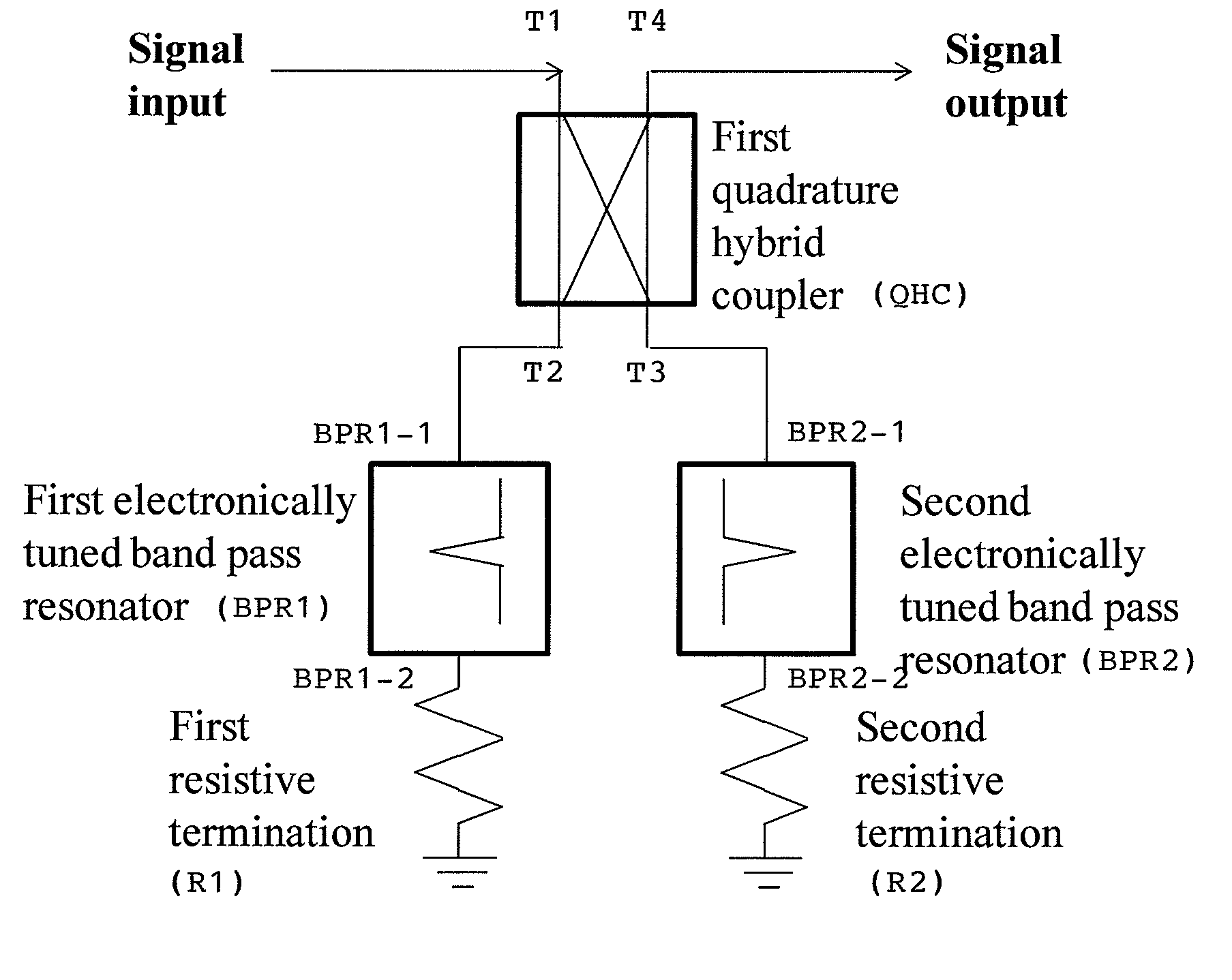
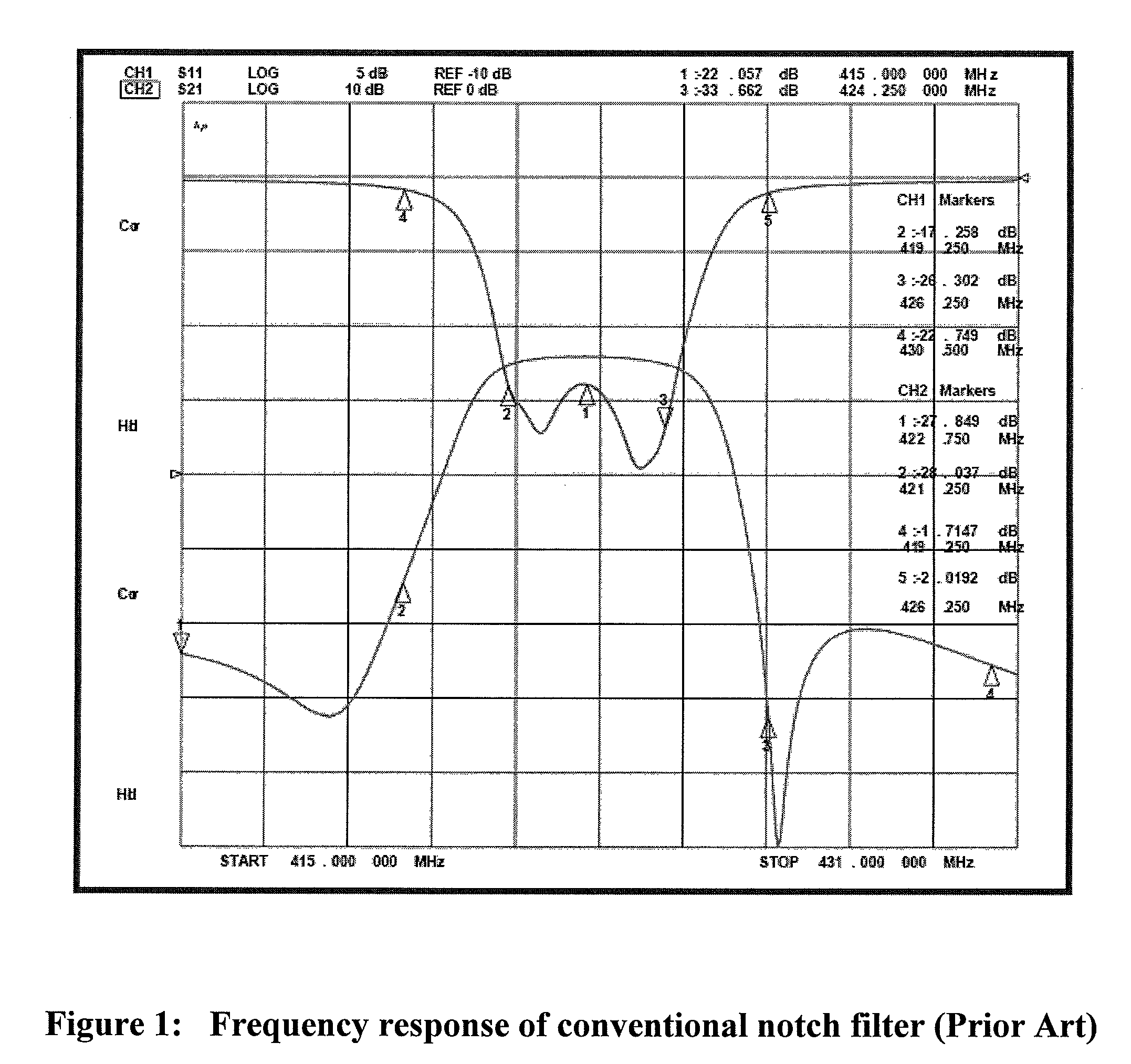
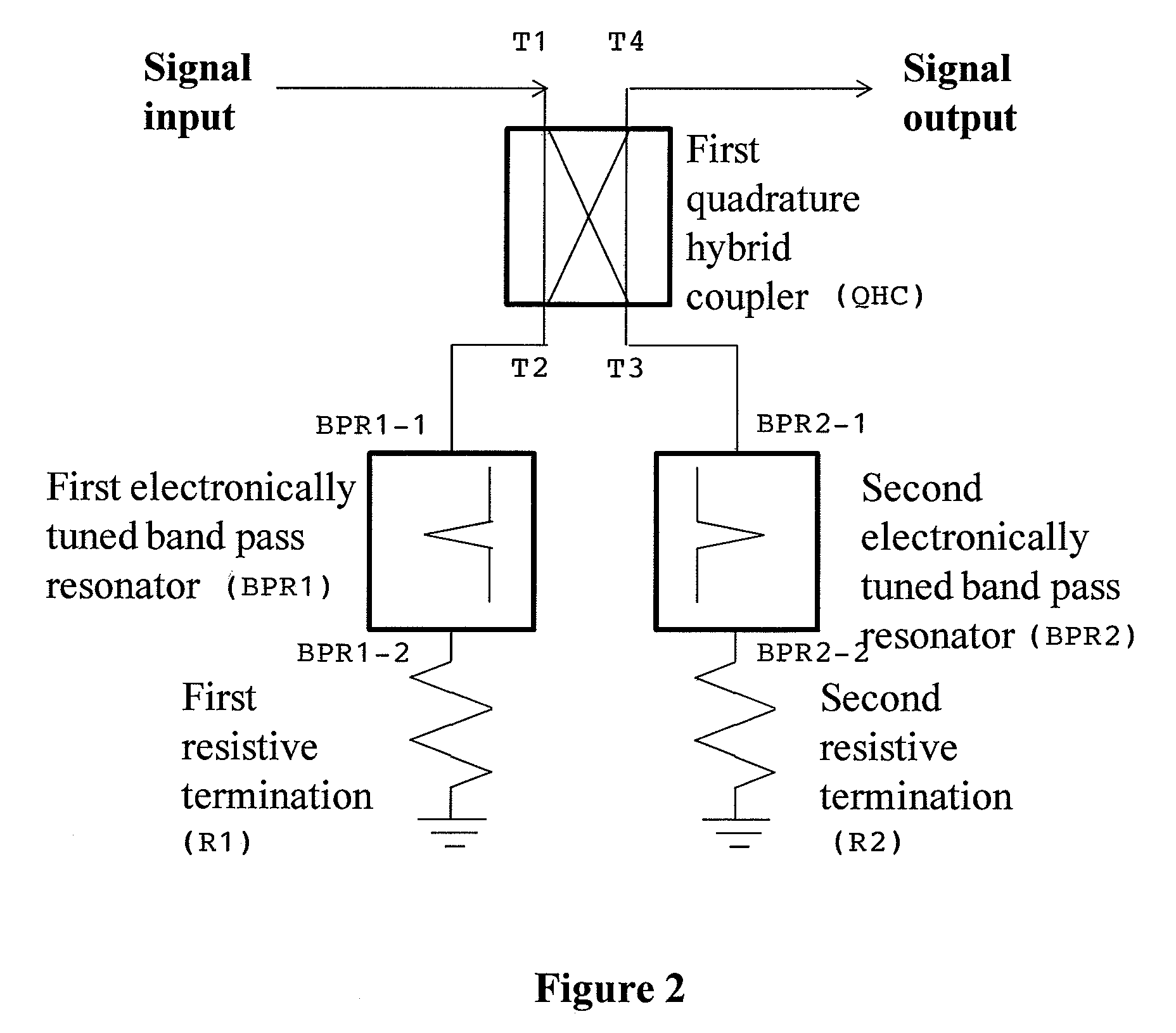
- An electronically tunable, absorptive notch filter design utilizing a quadrature hybrid coupler with series-only electronically tunable band pass resonators and resistive terminations, which absorbs signals at the notch frequency and reflects out-of-notch frequencies with minimal loss, enabling high power handling and fast tuning speeds.

CAD Tools for Filter Structure Optimization
Computer-aided design tools have revolutionized the synthesis and optimization of notch filter structures, enabling engineers to achieve precise frequency response characteristics while minimizing design time and computational overhead. Modern CAD environments integrate sophisticated algorithms that automate the complex mathematical processes involved in filter synthesis, transforming theoretical specifications into realizable circuit topologies.
Advanced simulation platforms such as ADS, CST Microwave Studio, and ANSYS HFSS incorporate specialized filter design modules that utilize optimization algorithms including genetic algorithms, particle swarm optimization, and gradient-based methods. These tools enable designers to define target specifications such as notch depth, bandwidth, and rejection characteristics, then automatically generate optimal component values and physical dimensions.
The integration of electromagnetic simulation capabilities within CAD tools allows for accurate prediction of parasitic effects and coupling mechanisms that significantly impact notch filter performance. Full-wave electromagnetic solvers can model complex geometries including substrate effects, conductor losses, and manufacturing tolerances, providing realistic performance predictions before physical prototyping.
Machine learning algorithms are increasingly being incorporated into filter design CAD tools, enabling predictive modeling and automated design space exploration. Neural networks trained on extensive databases of filter responses can rapidly generate initial design parameters, significantly reducing convergence time for optimization routines.
Parametric optimization engines within modern CAD platforms support multi-objective optimization, allowing simultaneous optimization of multiple performance metrics such as insertion loss, return loss, and spurious response suppression. These tools employ sophisticated constraint handling techniques to ensure designs remain within manufacturing and physical realizability bounds.
Cloud-based CAD platforms are emerging as powerful solutions for computationally intensive filter optimization tasks, leveraging distributed computing resources to perform extensive parameter sweeps and Monte Carlo analyses. These platforms enable collaborative design workflows and provide access to high-performance computing resources without significant local infrastructure investment.
Advanced simulation platforms such as ADS, CST Microwave Studio, and ANSYS HFSS incorporate specialized filter design modules that utilize optimization algorithms including genetic algorithms, particle swarm optimization, and gradient-based methods. These tools enable designers to define target specifications such as notch depth, bandwidth, and rejection characteristics, then automatically generate optimal component values and physical dimensions.
The integration of electromagnetic simulation capabilities within CAD tools allows for accurate prediction of parasitic effects and coupling mechanisms that significantly impact notch filter performance. Full-wave electromagnetic solvers can model complex geometries including substrate effects, conductor losses, and manufacturing tolerances, providing realistic performance predictions before physical prototyping.
Machine learning algorithms are increasingly being incorporated into filter design CAD tools, enabling predictive modeling and automated design space exploration. Neural networks trained on extensive databases of filter responses can rapidly generate initial design parameters, significantly reducing convergence time for optimization routines.
Parametric optimization engines within modern CAD platforms support multi-objective optimization, allowing simultaneous optimization of multiple performance metrics such as insertion loss, return loss, and spurious response suppression. These tools employ sophisticated constraint handling techniques to ensure designs remain within manufacturing and physical realizability bounds.
Cloud-based CAD platforms are emerging as powerful solutions for computationally intensive filter optimization tasks, leveraging distributed computing resources to perform extensive parameter sweeps and Monte Carlo analyses. These platforms enable collaborative design workflows and provide access to high-performance computing resources without significant local infrastructure investment.
Performance Metrics and Validation Standards
The establishment of comprehensive performance metrics for notch filter structures requires a multi-dimensional evaluation framework that encompasses both frequency domain and time domain characteristics. Primary frequency domain metrics include notch depth, typically measured in decibels and representing the attenuation level at the target frequency. The notch bandwidth, defined as the frequency range where attenuation exceeds a specified threshold, directly correlates with filter selectivity. Quality factor (Q-factor) serves as a critical parameter, calculated as the ratio of center frequency to bandwidth, indicating the sharpness of the notch response.
Insertion loss measurements across the passband regions provide essential insights into filter efficiency, while return loss characteristics reveal impedance matching performance. Phase response linearity becomes particularly crucial in applications requiring signal integrity preservation. Temperature stability coefficients and aging characteristics must be quantified to ensure long-term reliability in practical deployments.
Validation standards for notch filter synthesis encompass both simulation-based verification and experimental validation protocols. Network analyzer measurements following IEEE standards provide accurate S-parameter characterization across specified frequency ranges. Automated test equipment protocols ensure repeatability and statistical significance of measurements through multiple sample evaluations.
Manufacturing tolerance analysis requires Monte Carlo simulations to assess yield rates and performance variations. Environmental testing standards, including temperature cycling, humidity exposure, and mechanical stress evaluations, validate robustness under operational conditions. Electromagnetic compatibility assessments ensure minimal interference with adjacent systems.
Comparative benchmarking against established filter technologies provides context for performance evaluation. Statistical process control methodologies enable continuous monitoring of synthesis accuracy and reproducibility. Calibration procedures for measurement equipment maintain traceability to national standards, ensuring measurement reliability and inter-laboratory consistency in validation results.
Insertion loss measurements across the passband regions provide essential insights into filter efficiency, while return loss characteristics reveal impedance matching performance. Phase response linearity becomes particularly crucial in applications requiring signal integrity preservation. Temperature stability coefficients and aging characteristics must be quantified to ensure long-term reliability in practical deployments.
Validation standards for notch filter synthesis encompass both simulation-based verification and experimental validation protocols. Network analyzer measurements following IEEE standards provide accurate S-parameter characterization across specified frequency ranges. Automated test equipment protocols ensure repeatability and statistical significance of measurements through multiple sample evaluations.
Manufacturing tolerance analysis requires Monte Carlo simulations to assess yield rates and performance variations. Environmental testing standards, including temperature cycling, humidity exposure, and mechanical stress evaluations, validate robustness under operational conditions. Electromagnetic compatibility assessments ensure minimal interference with adjacent systems.
Comparative benchmarking against established filter technologies provides context for performance evaluation. Statistical process control methodologies enable continuous monitoring of synthesis accuracy and reproducibility. Calibration procedures for measurement equipment maintain traceability to national standards, ensuring measurement reliability and inter-laboratory consistency in validation results.
Unlock deeper insights with Patsnap Eureka Quick Research — get a full tech report to explore trends and direct your research. Try now!
Generate Your Research Report Instantly with AI Agent
Supercharge your innovation with Patsnap Eureka AI Agent Platform!