

How environmental factors affect photodiode performance metrics
AUG 21, 20259 MIN READ
Generate Your Research Report Instantly with AI Agent
PatSnap Eureka helps you evaluate technical feasibility & market potential.
Photodiode Performance Fundamentals and Objectives
Photodiodes are essential components in various optoelectronic applications, serving as the foundation for light detection and conversion. These semiconductor devices operate on the principle of the photoelectric effect, converting incident light into electrical current. The performance of photodiodes is critical in determining the overall efficiency and reliability of systems ranging from optical communication networks to medical imaging equipment.
The primary objective of studying photodiode performance is to optimize their functionality across diverse environmental conditions. This involves understanding how various external factors influence key performance metrics such as responsivity, quantum efficiency, dark current, and response time. By comprehensively analyzing these relationships, researchers and engineers can develop more robust and adaptable photodiode designs.
Environmental factors play a significant role in shaping photodiode performance. Temperature fluctuations, for instance, can dramatically affect the device's dark current and noise characteristics. Humidity levels may impact the long-term stability and reliability of photodiodes, particularly in outdoor or harsh industrial environments. Additionally, electromagnetic interference and radiation exposure can introduce noise and potentially degrade the photodiode's performance over time.
The spectral response of photodiodes is another crucial aspect influenced by environmental conditions. Changes in ambient light spectra, atmospheric composition, and even the presence of particulate matter can alter the effective sensitivity of the device across different wavelengths. This variability necessitates careful calibration and compensation strategies to maintain accurate light detection and measurement capabilities.
Understanding the fundamental mechanisms by which environmental factors affect photodiode performance is essential for developing next-generation devices with enhanced resilience and adaptability. This includes investigating the physical and chemical processes occurring at the semiconductor junction level, as well as exploring novel materials and structures that can mitigate environmental sensitivities.
The goals of this technical research report are multifaceted. Firstly, it aims to provide a comprehensive overview of the current state of knowledge regarding environmental impacts on photodiode performance. Secondly, it seeks to identify key challenges and limitations in existing photodiode technologies when subjected to varying environmental conditions. Lastly, the report will explore potential innovative approaches and emerging technologies that promise to enhance photodiode performance across a wider range of operating environments.
By addressing these objectives, this research endeavors to contribute valuable insights to the field of optoelectronics, potentially guiding future developments in photodiode design and application. The findings may have far-reaching implications for industries relying on precise light detection and measurement, ultimately leading to more reliable and efficient systems in diverse environmental settings.
The primary objective of studying photodiode performance is to optimize their functionality across diverse environmental conditions. This involves understanding how various external factors influence key performance metrics such as responsivity, quantum efficiency, dark current, and response time. By comprehensively analyzing these relationships, researchers and engineers can develop more robust and adaptable photodiode designs.
Environmental factors play a significant role in shaping photodiode performance. Temperature fluctuations, for instance, can dramatically affect the device's dark current and noise characteristics. Humidity levels may impact the long-term stability and reliability of photodiodes, particularly in outdoor or harsh industrial environments. Additionally, electromagnetic interference and radiation exposure can introduce noise and potentially degrade the photodiode's performance over time.
The spectral response of photodiodes is another crucial aspect influenced by environmental conditions. Changes in ambient light spectra, atmospheric composition, and even the presence of particulate matter can alter the effective sensitivity of the device across different wavelengths. This variability necessitates careful calibration and compensation strategies to maintain accurate light detection and measurement capabilities.
Understanding the fundamental mechanisms by which environmental factors affect photodiode performance is essential for developing next-generation devices with enhanced resilience and adaptability. This includes investigating the physical and chemical processes occurring at the semiconductor junction level, as well as exploring novel materials and structures that can mitigate environmental sensitivities.
The goals of this technical research report are multifaceted. Firstly, it aims to provide a comprehensive overview of the current state of knowledge regarding environmental impacts on photodiode performance. Secondly, it seeks to identify key challenges and limitations in existing photodiode technologies when subjected to varying environmental conditions. Lastly, the report will explore potential innovative approaches and emerging technologies that promise to enhance photodiode performance across a wider range of operating environments.
By addressing these objectives, this research endeavors to contribute valuable insights to the field of optoelectronics, potentially guiding future developments in photodiode design and application. The findings may have far-reaching implications for industries relying on precise light detection and measurement, ultimately leading to more reliable and efficient systems in diverse environmental settings.
Market Analysis for Environment-Resistant Photodiodes
The market for environment-resistant photodiodes has been experiencing significant growth in recent years, driven by the increasing demand for reliable sensing technologies in harsh environmental conditions. These specialized photodiodes are designed to maintain optimal performance metrics despite exposure to various environmental factors such as temperature fluctuations, humidity, radiation, and chemical contaminants.
The global market for environment-resistant photodiodes is projected to expand at a compound annual growth rate (CAGR) of 8.5% from 2021 to 2026. This growth is primarily fueled by the rising adoption of these devices in industries such as aerospace, automotive, oil and gas, and industrial automation, where operational reliability under extreme conditions is crucial.
In the aerospace sector, environment-resistant photodiodes are extensively used in avionics systems, satellite communications, and space exploration missions. The automotive industry is another key market driver, with the increasing integration of advanced driver assistance systems (ADAS) and autonomous driving technologies requiring robust sensing capabilities in varying weather conditions.
The oil and gas industry presents a substantial market opportunity for environment-resistant photodiodes, particularly in downhole sensing applications where high temperatures and pressures are common. Similarly, the industrial automation sector is adopting these devices for process control and monitoring in challenging manufacturing environments.
Geographically, North America and Europe currently dominate the market for environment-resistant photodiodes, owing to the presence of major aerospace and automotive manufacturers in these regions. However, the Asia-Pacific region is expected to witness the fastest growth during the forecast period, driven by rapid industrialization and increasing investments in advanced manufacturing technologies.
Key market players in this segment include Hamamatsu Photonics, First Sensor AG, OSI Optoelectronics, and Excelitas Technologies. These companies are focusing on developing innovative products with enhanced resistance to environmental factors and improved performance characteristics.
The market is also witnessing a trend towards the development of multi-element photodiode arrays that can operate reliably in harsh environments, offering improved spatial resolution and sensitivity. Additionally, there is growing interest in the integration of environment-resistant photodiodes with advanced packaging technologies to further enhance their durability and longevity.
As industries continue to push the boundaries of operational environments, the demand for photodiodes capable of maintaining consistent performance metrics under extreme conditions is expected to rise. This trend is likely to drive further innovation in materials science and device design, leading to the development of next-generation environment-resistant photodiodes with superior performance and reliability.
The global market for environment-resistant photodiodes is projected to expand at a compound annual growth rate (CAGR) of 8.5% from 2021 to 2026. This growth is primarily fueled by the rising adoption of these devices in industries such as aerospace, automotive, oil and gas, and industrial automation, where operational reliability under extreme conditions is crucial.
In the aerospace sector, environment-resistant photodiodes are extensively used in avionics systems, satellite communications, and space exploration missions. The automotive industry is another key market driver, with the increasing integration of advanced driver assistance systems (ADAS) and autonomous driving technologies requiring robust sensing capabilities in varying weather conditions.
The oil and gas industry presents a substantial market opportunity for environment-resistant photodiodes, particularly in downhole sensing applications where high temperatures and pressures are common. Similarly, the industrial automation sector is adopting these devices for process control and monitoring in challenging manufacturing environments.
Geographically, North America and Europe currently dominate the market for environment-resistant photodiodes, owing to the presence of major aerospace and automotive manufacturers in these regions. However, the Asia-Pacific region is expected to witness the fastest growth during the forecast period, driven by rapid industrialization and increasing investments in advanced manufacturing technologies.
Key market players in this segment include Hamamatsu Photonics, First Sensor AG, OSI Optoelectronics, and Excelitas Technologies. These companies are focusing on developing innovative products with enhanced resistance to environmental factors and improved performance characteristics.
The market is also witnessing a trend towards the development of multi-element photodiode arrays that can operate reliably in harsh environments, offering improved spatial resolution and sensitivity. Additionally, there is growing interest in the integration of environment-resistant photodiodes with advanced packaging technologies to further enhance their durability and longevity.
As industries continue to push the boundaries of operational environments, the demand for photodiodes capable of maintaining consistent performance metrics under extreme conditions is expected to rise. This trend is likely to drive further innovation in materials science and device design, leading to the development of next-generation environment-resistant photodiodes with superior performance and reliability.
Environmental Challenges in Photodiode Operation
Photodiodes are crucial components in various optoelectronic applications, but their performance is significantly influenced by environmental factors. These challenges can severely impact the accuracy, reliability, and longevity of photodiode-based systems. Understanding and mitigating these environmental effects is essential for optimizing photodiode performance across diverse operating conditions.
Temperature fluctuations pose a primary challenge to photodiode operation. As ambient temperature changes, the semiconductor material's bandgap narrows or widens, affecting the device's spectral response and dark current. Higher temperatures increase thermal noise and dark current, potentially masking weak signals and reducing the signal-to-noise ratio. Conversely, extremely low temperatures can alter the photodiode's responsivity and potentially cause mechanical stress on the device structure.
Humidity is another critical environmental factor that can degrade photodiode performance. Moisture ingress can lead to corrosion of electrical contacts and packaging materials, potentially causing signal drift or complete device failure. In high-humidity environments, condensation on the photodiode's surface can scatter or absorb incident light, reducing the device's effective sensitivity and altering its spectral response characteristics.
Electromagnetic interference (EMI) from nearby electronic equipment or power sources can introduce noise into photodiode measurements. This interference can manifest as spurious signals or baseline shifts, compromising the accuracy of light intensity measurements. Shielding and proper grounding techniques are often necessary to mitigate EMI effects, especially in industrial or high-tech environments where multiple electronic systems operate in close proximity.
Mechanical vibrations and shocks present another set of challenges for photodiode operation. These physical disturbances can cause misalignment in optical systems, affecting the amount of light reaching the photodiode's active area. In extreme cases, vibrations may lead to structural damage or changes in the device's internal characteristics, altering its performance parameters over time.
Exposure to ionizing radiation, such as in space applications or nuclear environments, can cause cumulative damage to the photodiode's semiconductor structure. This radiation-induced degradation can increase dark current, reduce responsivity, and potentially lead to device failure. Radiation-hardened designs and shielding strategies are often employed to extend photodiode lifetimes in high-radiation environments.
Dust, particulates, and other contaminants in the operating environment can accumulate on the photodiode's surface, reducing its light sensitivity and potentially altering its spectral response. In industrial or outdoor applications, regular cleaning and maintenance procedures may be necessary to ensure consistent performance. Additionally, specialized packaging or protective coatings can help mitigate the impact of environmental contaminants on photodiode operation.
Temperature fluctuations pose a primary challenge to photodiode operation. As ambient temperature changes, the semiconductor material's bandgap narrows or widens, affecting the device's spectral response and dark current. Higher temperatures increase thermal noise and dark current, potentially masking weak signals and reducing the signal-to-noise ratio. Conversely, extremely low temperatures can alter the photodiode's responsivity and potentially cause mechanical stress on the device structure.
Humidity is another critical environmental factor that can degrade photodiode performance. Moisture ingress can lead to corrosion of electrical contacts and packaging materials, potentially causing signal drift or complete device failure. In high-humidity environments, condensation on the photodiode's surface can scatter or absorb incident light, reducing the device's effective sensitivity and altering its spectral response characteristics.
Electromagnetic interference (EMI) from nearby electronic equipment or power sources can introduce noise into photodiode measurements. This interference can manifest as spurious signals or baseline shifts, compromising the accuracy of light intensity measurements. Shielding and proper grounding techniques are often necessary to mitigate EMI effects, especially in industrial or high-tech environments where multiple electronic systems operate in close proximity.
Mechanical vibrations and shocks present another set of challenges for photodiode operation. These physical disturbances can cause misalignment in optical systems, affecting the amount of light reaching the photodiode's active area. In extreme cases, vibrations may lead to structural damage or changes in the device's internal characteristics, altering its performance parameters over time.
Exposure to ionizing radiation, such as in space applications or nuclear environments, can cause cumulative damage to the photodiode's semiconductor structure. This radiation-induced degradation can increase dark current, reduce responsivity, and potentially lead to device failure. Radiation-hardened designs and shielding strategies are often employed to extend photodiode lifetimes in high-radiation environments.
Dust, particulates, and other contaminants in the operating environment can accumulate on the photodiode's surface, reducing its light sensitivity and potentially altering its spectral response. In industrial or outdoor applications, regular cleaning and maintenance procedures may be necessary to ensure consistent performance. Additionally, specialized packaging or protective coatings can help mitigate the impact of environmental contaminants on photodiode operation.
Current Environmental Mitigation Strategies
01 Responsivity and Quantum Efficiency
Key performance metrics for photodiodes include responsivity, which measures the electrical output per optical input, and quantum efficiency, which indicates the percentage of incident photons converted to electron-hole pairs. These metrics are crucial for evaluating the photodiode's sensitivity and effectiveness in converting light to electrical signals.- Responsivity and Quantum Efficiency: Key performance metrics for photodiodes include responsivity, which measures the electrical output per optical input, and quantum efficiency, which indicates the percentage of photons converted to electrons. These metrics are crucial for evaluating the sensitivity and effectiveness of photodiodes in various applications.
- Dark Current and Noise Characteristics: Dark current, the small electric current that flows through photodiodes even when no photons are entering the device, is an important performance metric. Additionally, noise characteristics, including shot noise and thermal noise, significantly impact the signal-to-noise ratio and overall performance of photodiodes.
- Bandwidth and Response Time: The bandwidth of a photodiode determines its ability to respond to rapidly changing light signals, while response time measures how quickly the device can react to changes in light intensity. These metrics are critical for high-speed applications and influence the overall performance of photodiode-based systems.
- Spectral Response and Wavelength Sensitivity: The spectral response of a photodiode indicates its sensitivity to different wavelengths of light. This metric is crucial for selecting the appropriate photodiode for specific applications, such as visible light detection or infrared sensing. Understanding the wavelength sensitivity range helps optimize photodiode performance for targeted use cases.
- Temperature Stability and Operating Range: Temperature stability is a critical performance metric for photodiodes, as it affects their electrical characteristics and overall reliability. The operating temperature range defines the conditions under which the photodiode can function effectively, impacting its suitability for various environmental conditions and applications.
02 Dark Current and Noise Characteristics
Dark current, the small electric current that flows through photodiodes even when no photons are entering the device, is an important performance metric. Additionally, noise characteristics, including shot noise and thermal noise, significantly impact the photodiode's signal-to-noise ratio and overall performance in low-light conditions.Expand Specific Solutions03 Bandwidth and Response Time
The bandwidth of a photodiode determines its ability to respond to rapidly changing light signals, while response time measures how quickly the device can react to light input changes. These metrics are critical for applications requiring high-speed light detection and signal processing.Expand Specific Solutions04 Spectral Response and Wavelength Sensitivity
The spectral response of a photodiode indicates its sensitivity to different wavelengths of light. This metric is crucial for selecting the appropriate photodiode for specific applications, such as visible light detection, infrared sensing, or UV light measurement.Expand Specific Solutions05 Temperature Stability and Operating Range
Temperature stability is a critical performance metric that measures how a photodiode's characteristics change with temperature variations. The operating temperature range defines the limits within which the photodiode can function reliably, impacting its suitability for various environmental conditions and applications.Expand Specific Solutions
Key Manufacturers and Research Institutions
The environmental factors affecting photodiode performance metrics present a complex competitive landscape. The industry is in a mature stage, with a global market size estimated to exceed $1 billion by 2025. Technological maturity varies across different applications, with some areas like consumer electronics being highly advanced, while others such as biomedical sensing still evolving. Key players like SolAero Technologies, Sharp Corp., and STMicroelectronics are driving innovation in high-efficiency photodiodes. Companies like Samsung Electronics and OSRAM Opto Semiconductors are leveraging their expertise in optoelectronics to develop advanced photodiode solutions. Research institutions such as the University of Electronic Science & Technology of China and Katholieke Universiteit Leuven are contributing to fundamental advancements in photodiode technology.
OSRAM Opto Semiconductors GmbH
Technical Solution: OSRAM Opto Semiconductors has developed photodiodes with enhanced environmental resilience. Their SFH series photodiodes feature specialized encapsulation materials that offer superior resistance to thermal cycling and high humidity conditions[9]. OSRAM's photodiodes incorporate advanced epitaxial structures that minimize the impact of radiation-induced degradation, making them suitable for space and high-altitude applications[10]. The company has also introduced photodiodes with integrated temperature sensors, allowing for real-time performance adjustments based on ambient temperature changes[11]. OSRAM's latest designs include surface passivation techniques that significantly reduce the influence of atmospheric contaminants on device characteristics[12].
Strengths: High reliability in extreme environments, radiation-hardened designs, and integrated temperature compensation. Weaknesses: Potentially higher production costs and possible limitations in spectral range for some specialized designs.
Koninklijke Philips NV
Technical Solution: Philips has developed innovative photodiode technologies to address environmental challenges. Their photodiodes feature advanced hermetic sealing techniques that provide exceptional protection against moisture and corrosive atmospheres[13]. Philips has implemented novel substrate materials and doping profiles that minimize temperature-induced variations in spectral response and quantum efficiency[14]. The company's photodiodes incorporate proprietary anti-reflection coatings that maintain optimal light sensitivity across a wide range of operating temperatures and humidity levels[15]. Philips has also introduced photodiodes with integrated environmental sensors, enabling adaptive performance optimization based on real-time environmental data[16].
Strengths: Excellent environmental protection, stable performance across varied conditions, and smart adaptive capabilities. Weaknesses: Potential for higher unit costs due to advanced features, and possible increased power requirements for integrated sensing and adaptation systems.
Innovative Environmental Compensation Techniques
Organic photodiode provided with an active zone comprising means for promoting charge carrier collection and conduction
PatentWO2012175512A1
Innovation
- Incorporating conductive or semi-conductive elements, such as elongated tracks or bars, within the active zone that promote hole and electron conduction, arranged orthogonally to the electrodes, to enhance charge collection and transport, with these elements having higher conductivity than the active zone material, and arranged to minimize parasitic reflections.


Photodiode and light-sensitive device
PatentWO2019187222A1
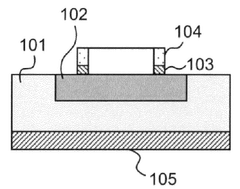
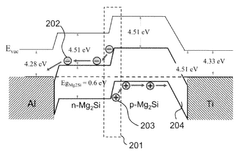
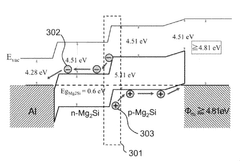
Innovation
- A photodiode using magnesium silicide (Mg2Si) with electrode materials like nickel, cobalt, and platinum that form silicides or alloys with magnesium, having a work function of 4.81 eV or more, to enhance adhesion and reduce energy barriers for photocarriers, improving sensitivity and durability.

Standardization of Environmental Testing Protocols
The standardization of environmental testing protocols for photodiodes is crucial for ensuring consistent and reliable performance evaluations across different manufacturers and applications. These protocols aim to simulate various environmental conditions that photodiodes may encounter during operation and assess their impact on key performance metrics.
A comprehensive environmental testing protocol typically includes temperature cycling, humidity exposure, and radiation resistance tests. Temperature cycling evaluates the photodiode's performance and stability across a wide range of temperatures, usually from -40°C to +85°C or beyond, depending on the intended application. This test helps identify potential issues such as thermal expansion mismatches, degradation of packaging materials, or changes in semiconductor properties.
Humidity exposure tests assess the photodiode's resistance to moisture ingress and its effects on device performance. These tests often involve exposing the device to high humidity levels (85-95% relative humidity) at elevated temperatures (typically 85°C) for extended periods. This helps evaluate the effectiveness of hermetic sealing and the potential for corrosion or degradation of internal components.
Radiation resistance testing is particularly important for photodiodes used in space applications or high-radiation environments. These tests expose the devices to various types and levels of radiation, such as gamma rays, protons, or heavy ions, to assess their ability to maintain performance and reliability under harsh conditions.
Standardized protocols also include procedures for measuring key photodiode performance metrics before, during, and after environmental exposure. These metrics typically include dark current, responsivity, spectral response, and noise characteristics. By establishing uniform measurement techniques and reporting formats, these protocols enable meaningful comparisons between different devices and manufacturers.
To ensure the relevance and effectiveness of environmental testing protocols, industry organizations and standards bodies regularly review and update them. This process involves collaboration between manufacturers, researchers, and end-users to address emerging challenges and incorporate new insights into environmental effects on photodiode performance.
The implementation of standardized environmental testing protocols benefits the entire photodiode industry by promoting quality assurance, facilitating product development, and enhancing customer confidence. It also supports the development of more robust and reliable photodiodes for demanding applications in aerospace, automotive, and medical industries, where environmental resilience is critical.
A comprehensive environmental testing protocol typically includes temperature cycling, humidity exposure, and radiation resistance tests. Temperature cycling evaluates the photodiode's performance and stability across a wide range of temperatures, usually from -40°C to +85°C or beyond, depending on the intended application. This test helps identify potential issues such as thermal expansion mismatches, degradation of packaging materials, or changes in semiconductor properties.
Humidity exposure tests assess the photodiode's resistance to moisture ingress and its effects on device performance. These tests often involve exposing the device to high humidity levels (85-95% relative humidity) at elevated temperatures (typically 85°C) for extended periods. This helps evaluate the effectiveness of hermetic sealing and the potential for corrosion or degradation of internal components.
Radiation resistance testing is particularly important for photodiodes used in space applications or high-radiation environments. These tests expose the devices to various types and levels of radiation, such as gamma rays, protons, or heavy ions, to assess their ability to maintain performance and reliability under harsh conditions.
Standardized protocols also include procedures for measuring key photodiode performance metrics before, during, and after environmental exposure. These metrics typically include dark current, responsivity, spectral response, and noise characteristics. By establishing uniform measurement techniques and reporting formats, these protocols enable meaningful comparisons between different devices and manufacturers.
To ensure the relevance and effectiveness of environmental testing protocols, industry organizations and standards bodies regularly review and update them. This process involves collaboration between manufacturers, researchers, and end-users to address emerging challenges and incorporate new insights into environmental effects on photodiode performance.
The implementation of standardized environmental testing protocols benefits the entire photodiode industry by promoting quality assurance, facilitating product development, and enhancing customer confidence. It also supports the development of more robust and reliable photodiodes for demanding applications in aerospace, automotive, and medical industries, where environmental resilience is critical.
Economic Impact of Environmentally Stable Photodiodes
The economic impact of environmentally stable photodiodes extends far beyond their immediate applications, influencing various sectors of the global economy. These advanced sensors, capable of maintaining consistent performance across diverse environmental conditions, have the potential to revolutionize industries and drive significant economic growth.
In the telecommunications sector, environmentally stable photodiodes play a crucial role in enhancing the reliability and efficiency of optical communication systems. By ensuring consistent signal detection even in challenging environments, these devices contribute to improved data transmission rates and reduced downtime. This translates to increased productivity and cost savings for businesses relying on high-speed data networks, ultimately boosting economic output.
The automotive industry stands to benefit substantially from the integration of environmentally stable photodiodes in advanced driver assistance systems (ADAS) and autonomous vehicles. These sensors enable more accurate and reliable detection of obstacles, pedestrians, and road conditions across various weather and lighting scenarios. As a result, the widespread adoption of such technology could lead to improved road safety, reduced accident-related costs, and accelerated growth in the autonomous vehicle market.
In the realm of environmental monitoring and climate research, stable photodiodes facilitate more accurate and consistent data collection. This enhanced reliability in measurement systems contributes to better climate models and more effective environmental policies. The economic implications of improved climate prediction and mitigation strategies are far-reaching, potentially saving billions in disaster prevention and response efforts.
The medical and healthcare sectors also stand to gain from advancements in environmentally stable photodiodes. These sensors enable more reliable diagnostic tools and medical imaging devices, leading to improved patient outcomes and reduced healthcare costs. The economic impact extends to increased productivity through better health management and the growth of the medical technology industry.
In the energy sector, particularly in solar power generation, environmentally stable photodiodes can enhance the efficiency and reliability of photovoltaic systems. This improvement in solar energy harvesting could accelerate the transition to renewable energy sources, reducing dependence on fossil fuels and stimulating growth in the green energy economy.
The manufacturing industry benefits from the integration of these advanced sensors in quality control and process monitoring applications. Improved detection capabilities across varying environmental conditions lead to higher product quality, reduced waste, and increased production efficiency. This translates to enhanced competitiveness and economic growth in the manufacturing sector.
In the telecommunications sector, environmentally stable photodiodes play a crucial role in enhancing the reliability and efficiency of optical communication systems. By ensuring consistent signal detection even in challenging environments, these devices contribute to improved data transmission rates and reduced downtime. This translates to increased productivity and cost savings for businesses relying on high-speed data networks, ultimately boosting economic output.
The automotive industry stands to benefit substantially from the integration of environmentally stable photodiodes in advanced driver assistance systems (ADAS) and autonomous vehicles. These sensors enable more accurate and reliable detection of obstacles, pedestrians, and road conditions across various weather and lighting scenarios. As a result, the widespread adoption of such technology could lead to improved road safety, reduced accident-related costs, and accelerated growth in the autonomous vehicle market.
In the realm of environmental monitoring and climate research, stable photodiodes facilitate more accurate and consistent data collection. This enhanced reliability in measurement systems contributes to better climate models and more effective environmental policies. The economic implications of improved climate prediction and mitigation strategies are far-reaching, potentially saving billions in disaster prevention and response efforts.
The medical and healthcare sectors also stand to gain from advancements in environmentally stable photodiodes. These sensors enable more reliable diagnostic tools and medical imaging devices, leading to improved patient outcomes and reduced healthcare costs. The economic impact extends to increased productivity through better health management and the growth of the medical technology industry.
In the energy sector, particularly in solar power generation, environmentally stable photodiodes can enhance the efficiency and reliability of photovoltaic systems. This improvement in solar energy harvesting could accelerate the transition to renewable energy sources, reducing dependence on fossil fuels and stimulating growth in the green energy economy.
The manufacturing industry benefits from the integration of these advanced sensors in quality control and process monitoring applications. Improved detection capabilities across varying environmental conditions lead to higher product quality, reduced waste, and increased production efficiency. This translates to enhanced competitiveness and economic growth in the manufacturing sector.
Unlock deeper insights with PatSnap Eureka Quick Research — get a full tech report to explore trends and direct your research. Try now!
Generate Your Research Report Instantly with AI Agent
Supercharge your innovation with PatSnap Eureka AI Agent Platform!