

How to Implement Blockchain for Fixed Satellite Security
MAR 18, 20269 MIN READ
Generate Your Research Report Instantly with AI Agent
Patsnap Eureka helps you evaluate technical feasibility & market potential.
Blockchain Satellite Security Background and Objectives
The integration of blockchain technology into fixed satellite security systems represents a critical evolution in space-based infrastructure protection. As satellite networks become increasingly vital for global communications, navigation, and Earth observation services, they face mounting cybersecurity threats ranging from signal jamming and spoofing to unauthorized access and data manipulation. Traditional centralized security approaches have proven inadequate against sophisticated adversaries who exploit single points of failure and centralized control mechanisms.
Fixed satellite systems, including geostationary and medium Earth orbit constellations, handle massive volumes of sensitive data and critical communications that require robust authentication, integrity verification, and secure command execution. The distributed nature of satellite operations, involving ground stations, satellite-to-satellite links, and user terminals across multiple jurisdictions, creates complex security challenges that demand innovative solutions beyond conventional cryptographic methods.
Blockchain technology emerges as a promising solution due to its inherent characteristics of decentralization, immutability, and consensus-driven validation. The distributed ledger approach can address key vulnerabilities in satellite security by eliminating single points of failure, providing transparent audit trails, and enabling secure multi-party operations without requiring trusted intermediaries.
The primary objective of implementing blockchain for fixed satellite security is to establish a tamper-resistant framework that ensures data integrity, authentication, and secure command authorization across the entire satellite ecosystem. This includes protecting telemetry data, securing uplink and downlink communications, and maintaining reliable access control for satellite operations.
Secondary objectives encompass enhancing inter-satellite communication security through blockchain-based identity management, implementing smart contracts for automated security protocols, and creating decentralized key management systems that can operate reliably in the challenging space environment. The technology aims to provide real-time threat detection and response capabilities while maintaining operational efficiency.
The ultimate goal is to develop a comprehensive blockchain-based security architecture that can adapt to evolving threats, support scalable satellite networks, and ensure continuous service availability even under coordinated cyber attacks. This approach seeks to transform satellite security from reactive defense mechanisms to proactive, self-healing systems that leverage the collective intelligence of distributed networks.
Market Demand for Secure Satellite Communication Systems
The global satellite communication market has experienced unprecedented growth driven by increasing demand for secure, reliable connectivity across diverse sectors. Government agencies, military organizations, and defense contractors represent the primary drivers of demand for enhanced satellite security solutions, as they require communications infrastructure that can withstand sophisticated cyber threats and maintain operational integrity in contested environments.
Commercial enterprises operating in critical infrastructure sectors, including energy, transportation, and telecommunications, have emerged as significant market segments requiring secure satellite communications. These organizations face mounting pressure to protect their operational technology networks from cyber attacks that could disrupt essential services. The proliferation of Internet of Things devices and remote monitoring systems has further amplified the need for secure satellite links that can maintain data integrity across vast geographical distances.
Financial services and banking institutions increasingly rely on satellite communications for backup connectivity and disaster recovery operations. The regulatory requirements for data protection and transaction security in these sectors have created substantial demand for communication systems that can provide cryptographic protection and tamper-evident data transmission capabilities.
The maritime and aviation industries represent rapidly expanding market segments for secure satellite communications. Commercial shipping companies require protected communication channels to safeguard cargo manifests, navigation data, and operational communications from potential interference or interception. Similarly, commercial aviation operators need secure satellite links for flight operations, passenger services, and maintenance communications.
Emerging market drivers include the growing deployment of satellite-based Internet of Things networks and the expansion of remote sensing applications. Agricultural technology companies, environmental monitoring organizations, and smart city initiatives require secure data transmission capabilities to protect sensitive operational data and maintain system reliability.
The increasing frequency and sophistication of cyber attacks targeting satellite infrastructure have heightened awareness of security vulnerabilities across all market segments. Recent incidents involving satellite communication disruptions have demonstrated the critical need for robust security measures that can protect against both traditional cyber threats and emerging attack vectors specific to space-based systems.
Market demand is further amplified by regulatory compliance requirements across various industries. Organizations must implement security measures that meet stringent standards for data protection, operational continuity, and incident response capabilities, driving adoption of advanced security technologies for satellite communications.
Current Satellite Security Challenges and Blockchain Status
Fixed satellite systems face unprecedented security challenges as they become increasingly integrated into critical infrastructure and commercial operations. Traditional satellite security frameworks rely heavily on ground-based control systems and conventional encryption methods, which present significant vulnerabilities. The primary security concerns include unauthorized access to satellite control systems, data interception during transmission, signal jamming and spoofing attacks, and the lack of real-time authentication mechanisms for satellite communications.
Current satellite security architectures suffer from centralized control structures that create single points of failure. Ground stations managing satellite operations are vulnerable to cyber attacks, potentially compromising entire satellite networks. The communication protocols between satellites and ground stations often lack robust end-to-end encryption, making them susceptible to eavesdropping and man-in-the-middle attacks. Additionally, the static nature of traditional security credentials makes it difficult to implement dynamic authentication and authorization processes.
Blockchain technology has emerged as a promising solution for addressing these security challenges through its inherent characteristics of decentralization, immutability, and cryptographic security. The distributed ledger technology offers the potential to eliminate single points of failure by creating a decentralized network of nodes that can validate and record satellite operations. Smart contracts can automate security protocols and ensure that only authorized entities can access satellite systems or modify operational parameters.
The current state of blockchain implementation in satellite security remains largely experimental, with several pilot projects and research initiatives exploring various applications. Major aerospace companies and research institutions are investigating blockchain-based identity management systems for satellites, secure communication protocols using distributed consensus mechanisms, and tamper-proof logging of satellite operations and data transmissions.
However, significant technical challenges persist in adapting blockchain technology for satellite environments. The limited computational resources available on satellites pose constraints for running complex blockchain algorithms. Network latency and intermittent connectivity issues in space-based communications create additional complications for maintaining synchronized distributed ledgers. Energy consumption requirements of traditional blockchain consensus mechanisms may not be suitable for power-constrained satellite systems.
Recent developments in lightweight blockchain protocols and consensus algorithms specifically designed for resource-constrained environments show promise for satellite applications. These innovations focus on reducing computational overhead while maintaining security guarantees, making blockchain implementation more feasible for fixed satellite systems.
Existing Blockchain Solutions for Satellite Networks
01 Cryptographic methods for blockchain data protection
Implementation of advanced cryptographic techniques to secure blockchain transactions and data storage. These methods include encryption algorithms, digital signatures, and hash functions to ensure data integrity and confidentiality. The cryptographic approaches provide protection against unauthorized access and tampering of blockchain records.- Cryptographic methods for blockchain data protection: Implementation of advanced cryptographic techniques to secure blockchain transactions and data storage. These methods include encryption algorithms, digital signatures, and hash functions to ensure data integrity and confidentiality. The cryptographic approaches provide protection against unauthorized access and tampering of blockchain records.
- Consensus mechanism security enhancements: Improved consensus protocols and validation mechanisms to prevent attacks and ensure network integrity. These enhancements focus on strengthening the agreement process among network nodes, preventing double-spending, and protecting against malicious actors. The solutions include Byzantine fault tolerance improvements and novel validation algorithms.
- Smart contract security and vulnerability detection: Methods and systems for identifying and preventing vulnerabilities in smart contracts deployed on blockchain platforms. These approaches include automated testing, formal verification, and runtime monitoring to detect potential security flaws before and during execution. The techniques help prevent exploitation of contract logic and protect digital assets.
- Access control and authentication systems: Implementation of robust access control mechanisms and multi-factor authentication for blockchain networks. These systems manage user permissions, verify identities, and control access to sensitive blockchain operations. The solutions ensure that only authorized participants can perform specific actions within the blockchain ecosystem.
- Distributed ledger monitoring and threat detection: Real-time monitoring systems and anomaly detection mechanisms for identifying security threats in blockchain networks. These solutions analyze transaction patterns, network behavior, and node activities to detect suspicious activities, potential attacks, and system vulnerabilities. The monitoring frameworks enable proactive security responses and incident prevention.
02 Consensus mechanism security enhancements
Improved consensus protocols and validation mechanisms to prevent attacks and ensure network integrity. These enhancements focus on strengthening the agreement process among network nodes, preventing double-spending, and protecting against malicious actors. The methods include Byzantine fault tolerance improvements and proof-of-stake security measures.Expand Specific Solutions03 Smart contract vulnerability detection and prevention
Systems and methods for identifying and mitigating security vulnerabilities in smart contracts deployed on blockchain platforms. These solutions include automated testing frameworks, formal verification techniques, and runtime monitoring to detect potential exploits before they can be executed. The approaches help prevent common vulnerabilities such as reentrancy attacks and integer overflows.Expand Specific Solutions04 Access control and authentication mechanisms
Advanced authentication and authorization systems for controlling access to blockchain networks and resources. These mechanisms implement multi-factor authentication, role-based access control, and identity verification protocols to ensure only authorized participants can interact with the blockchain. The solutions provide granular permission management and user identity protection.Expand Specific Solutions05 Distributed ledger monitoring and threat detection
Real-time monitoring systems for detecting anomalous activities and potential security threats in blockchain networks. These solutions employ machine learning algorithms, pattern recognition, and behavioral analysis to identify suspicious transactions and network attacks. The monitoring frameworks provide early warning capabilities and automated response mechanisms to mitigate security incidents.Expand Specific Solutions
Key Players in Satellite and Blockchain Security Industry
The blockchain implementation for fixed satellite security represents an emerging market at the intersection of space technology and cybersecurity, currently in its early development stage. The market shows significant growth potential driven by increasing satellite deployments and rising security concerns. Technology maturity varies considerably across players, with established aerospace giants like Lockheed Martin Corp., Siemens AG, and The Aerospace Corp. leading in satellite systems integration, while telecommunications leaders such as China Mobile Communications Group, ZTE Corp., and China Telecom Corp. bring blockchain expertise. Academic institutions including Tsinghua University, Beijing Institute of Technology, and Xidian University contribute foundational research. Specialized companies like Axelspace Corp. and Vector Launch focus on microsatellite technologies, while emerging players such as Shanghai Satellite Internet Research Institute represent new market entrants developing integrated solutions for this nascent but rapidly evolving sector.
Siemens AG
Technical Solution: Siemens has developed industrial-grade blockchain solutions for satellite security applications, leveraging their expertise in critical infrastructure protection. Their approach implements a multi-layered blockchain architecture with hardware security modules (HSMs) integrated into satellite systems for secure key storage and cryptographic operations. The solution features Byzantine fault-tolerant consensus algorithms specifically adapted for satellite network topologies with varying communication delays and potential node failures. Siemens' platform includes automated compliance monitoring through smart contracts and provides end-to-end encryption for satellite data transmission with blockchain-based certificate management. The system also incorporates digital twin technology combined with blockchain for secure satellite system modeling and predictive maintenance.
Strengths: Robust industrial security expertise and proven critical infrastructure protection capabilities. Weaknesses: Higher complexity in implementation and potential over-engineering for simpler satellite security requirements.
ZTE Corp.
Technical Solution: ZTE has developed blockchain-enabled satellite security solutions focusing on 5G-satellite integration scenarios. Their technology stack includes a hybrid blockchain architecture that combines public and private chains to handle different security requirements for satellite communications. The system implements advanced consensus mechanisms optimized for space-based networks with intermittent connectivity, utilizing proof-of-stake variants that consume minimal power. ZTE's solution incorporates AI-driven anomaly detection integrated with blockchain immutable logging to identify and respond to security threats in real-time. The platform also features cross-chain interoperability protocols enabling secure communication between different satellite networks and terrestrial infrastructure.
Strengths: Strong telecommunications background and expertise in 5G-satellite convergence technologies. Weaknesses: Limited proven deployment experience in pure satellite environments compared to terrestrial networks.
Core Blockchain Technologies for Fixed Satellite Security
Satellite management method based on blockchain and physical unclonable function
PatentActiveCN111200500A
Innovation
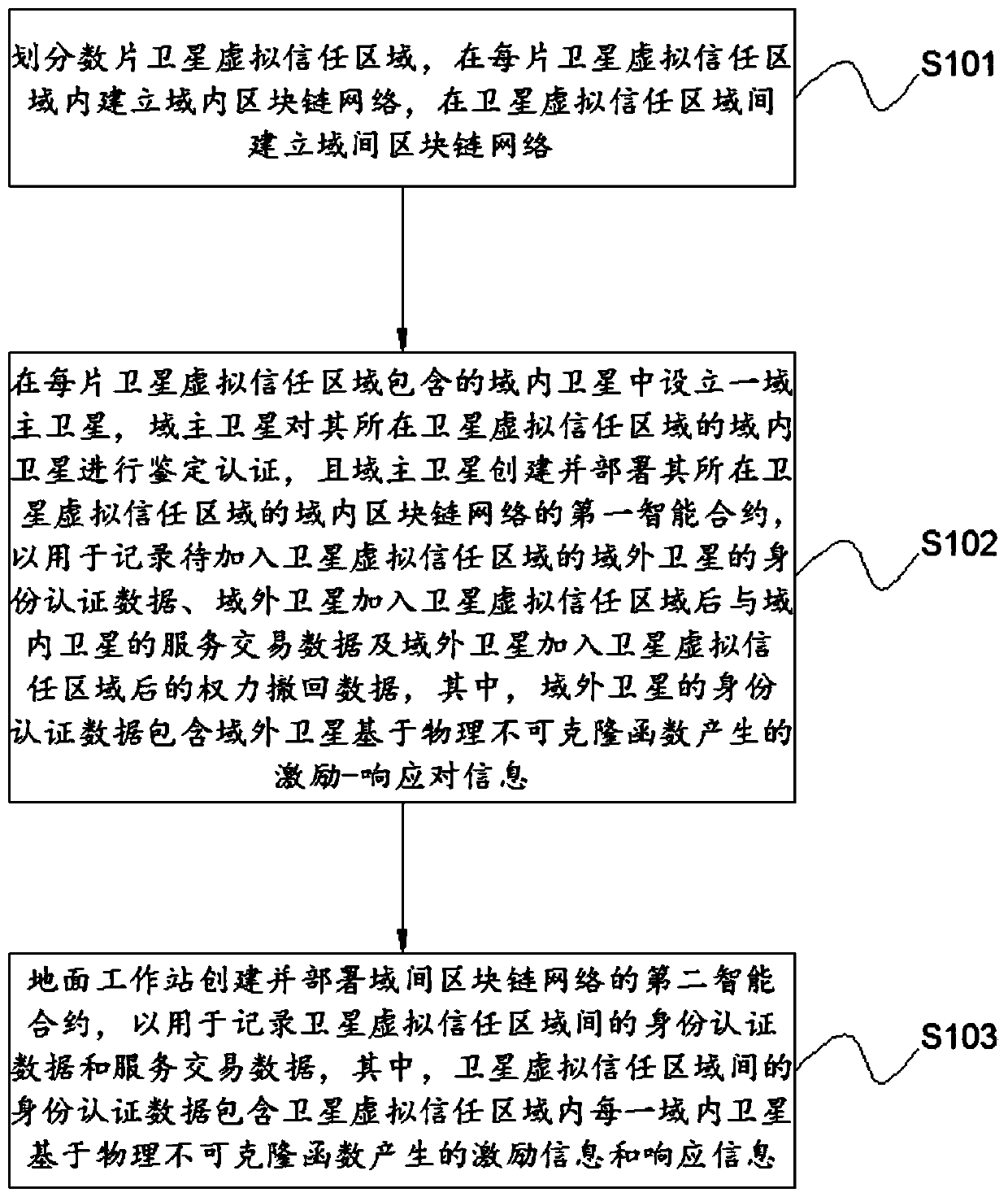
- Adopt a satellite management method based on blockchain and physical unclonable functions to divide several satellite virtual trust areas, establish intra-domain and inter-domain blockchain networks, conduct identity authentication and service transaction data recording through domain master satellites and ground workstations, and use Smart contracts manage identity authentication and authority authorization between satellites.



Distributed Blockchain Data Management In A Satellite Environment
PatentActiveUS20200296114A1
Innovation
- A distributed satellite platform that enables data storage and processing across multiple satellites, allowing for shared storage pools, virtual nodes, and blockchain management, where ledger entries are verified and stored across a network of satellites, optimizing resource use and reducing redundancy through pooled storage and efficient data distribution.


Space Law and Blockchain Regulatory Framework
The implementation of blockchain technology for fixed satellite security operates within a complex regulatory landscape that spans multiple jurisdictions and legal frameworks. Current space law primarily relies on international treaties established decades before blockchain technology emerged, creating significant gaps in regulatory coverage. The Outer Space Treaty of 1967, while foundational, lacks specific provisions for distributed ledger technologies and cybersecurity protocols in space-based systems.
National space agencies and regulatory bodies are beginning to address blockchain integration through evolving policy frameworks. The Federal Communications Commission in the United States has initiated preliminary discussions on blockchain applications for satellite communications, while the European Space Agency has established working groups to examine distributed ledger technology compliance with existing space regulations. However, these efforts remain fragmented and lack comprehensive coordination across international boundaries.
Cross-border data governance presents particular challenges for blockchain-enabled satellite security systems. Fixed satellites operating in geostationary orbits may transmit data across multiple national jurisdictions, raising questions about data sovereignty and regulatory compliance. Current international telecommunications regulations do not adequately address the decentralized nature of blockchain networks, creating uncertainty for satellite operators seeking to implement these security solutions.
Emerging regulatory frameworks are beginning to incorporate blockchain-specific provisions for space applications. Several countries have proposed amendments to their national space legislation to accommodate distributed ledger technologies, focusing on data integrity requirements and cybersecurity standards. These developments suggest a gradual shift toward more comprehensive regulatory coverage, though significant harmonization challenges remain.
The liability and insurance implications of blockchain implementation in satellite systems require careful consideration within existing legal frameworks. Current space law establishes operator liability for space objects, but the distributed nature of blockchain networks complicates traditional liability models. Insurance providers are developing new coverage models to address these emerging risks, though regulatory clarity remains limited.
Future regulatory development will likely focus on establishing international standards for blockchain-enabled satellite security systems. Proposed frameworks emphasize interoperability requirements, data protection standards, and cross-border enforcement mechanisms. These evolving regulations will significantly influence the technical implementation approaches for blockchain security solutions in fixed satellite systems.
Quantum Resistance for Future Satellite Security
The emergence of quantum computing presents an unprecedented threat to current cryptographic systems used in satellite communications. Traditional encryption methods, including RSA and elliptic curve cryptography, face potential obsolescence as quantum computers develop the capability to break these algorithms exponentially faster than classical computers. This quantum threat necessitates immediate attention to developing quantum-resistant security measures for fixed satellite systems.
Post-quantum cryptography represents the primary defense mechanism against quantum attacks on satellite infrastructure. Lattice-based cryptographic algorithms, such as CRYSTALS-Kyber for key encapsulation and CRYSTALS-Dilithium for digital signatures, offer promising solutions that remain secure against both classical and quantum computational attacks. These algorithms rely on mathematical problems that are believed to be intractable even for quantum computers, providing a foundation for future-proof satellite security.
Hash-based signature schemes present another viable quantum-resistant approach for satellite communications. The Merkle signature scheme and its variants, including XMSS and SPHINCS+, derive their security from the collision resistance of cryptographic hash functions. These systems offer strong security guarantees and are particularly suitable for scenarios where signature generation frequency is predictable, making them ideal for scheduled satellite communications.
Code-based cryptography, exemplified by the McEliece cryptosystem, provides additional quantum resistance through error-correcting codes. While these systems typically require larger key sizes compared to traditional methods, they offer excellent performance characteristics for satellite applications where computational efficiency is crucial. The Classic McEliece algorithm has demonstrated particular promise for satellite key exchange protocols.
Multivariate cryptography offers another quantum-resistant paradigm based on solving systems of multivariate polynomial equations over finite fields. Rainbow and GeMSS represent leading candidates in this category, providing compact signature sizes that are advantageous for bandwidth-constrained satellite communications.
The integration of quantum key distribution protocols with satellite networks represents an advanced quantum-resistant approach. Satellite-based QKD systems can establish provably secure communication channels by leveraging quantum mechanical principles, though current implementations face challenges related to atmospheric interference and hardware complexity.
Hybrid cryptographic approaches combining multiple quantum-resistant algorithms provide enhanced security through cryptographic diversity. This strategy mitigates the risk of single-algorithm vulnerabilities while maintaining operational flexibility for different satellite mission requirements and security levels.
Unlock deeper insights with Patsnap Eureka Quick Research — get a full tech report to explore trends and direct your research. Try now!
Generate Your Research Report Instantly with AI Agent
Supercharge your innovation with Patsnap Eureka AI Agent Platform!