
Neuromorphic Computing for Industrial Sensor Networks
MAR 11, 202610 MIN READ
Generate Your Research Report Instantly with AI Agent
Patsnap Eureka helps you evaluate technical feasibility & market potential.
Neuromorphic Computing Background and Industrial IoT Goals
Neuromorphic computing represents a paradigm shift in computational architecture, drawing inspiration from the human brain's neural networks to create processors that mimic biological neural structures and functions. This revolutionary approach emerged from decades of neuroscience research and advances in semiconductor technology, fundamentally challenging traditional von Neumann computing architectures. Unlike conventional digital processors that separate memory and processing units, neuromorphic systems integrate these functions within artificial neurons and synapses, enabling parallel processing and adaptive learning capabilities.
The evolution of neuromorphic computing traces back to Carver Mead's pioneering work in the 1980s, where he first proposed using analog circuits to simulate neural behavior. Since then, the field has progressed through multiple generations, from early analog implementations to modern hybrid digital-analog systems. Recent breakthroughs in memristive devices, spike-based processing, and brain-inspired algorithms have accelerated the technology's maturation, making it increasingly viable for practical applications.
Industrial Internet of Things represents the convergence of operational technology and information technology in manufacturing and industrial environments. The proliferation of smart sensors, edge computing devices, and real-time monitoring systems has created unprecedented demands for intelligent data processing at the network edge. Traditional computing approaches struggle with the massive data volumes, real-time processing requirements, and energy constraints inherent in industrial sensor networks.
The integration of neuromorphic computing into industrial sensor networks aims to address several critical objectives. Primary goals include achieving ultra-low power consumption for battery-operated sensors, enabling real-time pattern recognition and anomaly detection, and providing adaptive learning capabilities that can evolve with changing industrial conditions. These systems must deliver robust performance in harsh industrial environments while maintaining cost-effectiveness and scalability.
Neuromorphic processors excel at processing temporal and spatial patterns, making them ideally suited for industrial applications such as predictive maintenance, quality control, and process optimization. The technology's inherent fault tolerance and graceful degradation characteristics align well with industrial reliability requirements. Furthermore, the ability to perform on-device learning reduces dependency on cloud connectivity and enhances data privacy and security.
The convergence of neuromorphic computing and industrial IoT represents a transformative opportunity to create intelligent, autonomous sensor networks capable of self-adaptation and continuous improvement, ultimately revolutionizing industrial automation and efficiency.
The evolution of neuromorphic computing traces back to Carver Mead's pioneering work in the 1980s, where he first proposed using analog circuits to simulate neural behavior. Since then, the field has progressed through multiple generations, from early analog implementations to modern hybrid digital-analog systems. Recent breakthroughs in memristive devices, spike-based processing, and brain-inspired algorithms have accelerated the technology's maturation, making it increasingly viable for practical applications.
Industrial Internet of Things represents the convergence of operational technology and information technology in manufacturing and industrial environments. The proliferation of smart sensors, edge computing devices, and real-time monitoring systems has created unprecedented demands for intelligent data processing at the network edge. Traditional computing approaches struggle with the massive data volumes, real-time processing requirements, and energy constraints inherent in industrial sensor networks.
The integration of neuromorphic computing into industrial sensor networks aims to address several critical objectives. Primary goals include achieving ultra-low power consumption for battery-operated sensors, enabling real-time pattern recognition and anomaly detection, and providing adaptive learning capabilities that can evolve with changing industrial conditions. These systems must deliver robust performance in harsh industrial environments while maintaining cost-effectiveness and scalability.
Neuromorphic processors excel at processing temporal and spatial patterns, making them ideally suited for industrial applications such as predictive maintenance, quality control, and process optimization. The technology's inherent fault tolerance and graceful degradation characteristics align well with industrial reliability requirements. Furthermore, the ability to perform on-device learning reduces dependency on cloud connectivity and enhances data privacy and security.
The convergence of neuromorphic computing and industrial IoT represents a transformative opportunity to create intelligent, autonomous sensor networks capable of self-adaptation and continuous improvement, ultimately revolutionizing industrial automation and efficiency.
Market Demand for Smart Industrial Sensor Networks
The global industrial sensor network market is experiencing unprecedented growth driven by the accelerating adoption of Industry 4.0 initiatives and digital transformation strategies across manufacturing sectors. Traditional industrial environments are rapidly evolving toward smart factories that demand real-time monitoring, predictive maintenance, and autonomous decision-making capabilities. This transformation has created substantial demand for intelligent sensor networks that can process data locally, reduce latency, and operate efficiently in harsh industrial conditions.
Manufacturing industries, including automotive, aerospace, chemical processing, and semiconductor fabrication, are increasingly seeking sensor solutions that can handle complex pattern recognition tasks while maintaining ultra-low power consumption. The demand stems from the need to monitor equipment health, detect anomalies, predict failures, and optimize production processes in real-time. Current centralized processing approaches face significant limitations in terms of bandwidth constraints, latency issues, and energy consumption when dealing with the massive data volumes generated by modern industrial sensor arrays.
The market demand is particularly strong for sensor networks capable of edge intelligence, where data processing occurs at the sensor level rather than requiring transmission to centralized cloud systems. Industrial operators are prioritizing solutions that can reduce network traffic, minimize response times, and maintain operational continuity even during connectivity disruptions. This requirement is especially critical in safety-critical applications such as chemical plant monitoring, power grid management, and automated manufacturing systems.
Energy efficiency represents another crucial market driver, as industrial facilities seek to reduce operational costs while expanding their sensor deployments. Traditional digital processing architectures struggle to meet the power constraints required for battery-operated sensors or energy-harvesting applications in remote industrial locations. The market increasingly demands sensor solutions that can operate for extended periods without maintenance while providing sophisticated data analysis capabilities.
The convergence of artificial intelligence with industrial automation has created specific demand for sensor networks capable of adaptive learning and pattern recognition. Industries require systems that can learn normal operational patterns, detect deviations, and adapt to changing environmental conditions without extensive reprogramming. This demand extends across various applications including vibration analysis, thermal monitoring, acoustic signature detection, and multi-parameter process optimization.
Regulatory compliance and safety standards in industrial environments further drive market demand for reliable, fault-tolerant sensor networks. Industries must meet stringent requirements for continuous monitoring and rapid response to hazardous conditions, creating opportunities for advanced sensor technologies that can provide both high reliability and intelligent processing capabilities.
Manufacturing industries, including automotive, aerospace, chemical processing, and semiconductor fabrication, are increasingly seeking sensor solutions that can handle complex pattern recognition tasks while maintaining ultra-low power consumption. The demand stems from the need to monitor equipment health, detect anomalies, predict failures, and optimize production processes in real-time. Current centralized processing approaches face significant limitations in terms of bandwidth constraints, latency issues, and energy consumption when dealing with the massive data volumes generated by modern industrial sensor arrays.
The market demand is particularly strong for sensor networks capable of edge intelligence, where data processing occurs at the sensor level rather than requiring transmission to centralized cloud systems. Industrial operators are prioritizing solutions that can reduce network traffic, minimize response times, and maintain operational continuity even during connectivity disruptions. This requirement is especially critical in safety-critical applications such as chemical plant monitoring, power grid management, and automated manufacturing systems.
Energy efficiency represents another crucial market driver, as industrial facilities seek to reduce operational costs while expanding their sensor deployments. Traditional digital processing architectures struggle to meet the power constraints required for battery-operated sensors or energy-harvesting applications in remote industrial locations. The market increasingly demands sensor solutions that can operate for extended periods without maintenance while providing sophisticated data analysis capabilities.
The convergence of artificial intelligence with industrial automation has created specific demand for sensor networks capable of adaptive learning and pattern recognition. Industries require systems that can learn normal operational patterns, detect deviations, and adapt to changing environmental conditions without extensive reprogramming. This demand extends across various applications including vibration analysis, thermal monitoring, acoustic signature detection, and multi-parameter process optimization.
Regulatory compliance and safety standards in industrial environments further drive market demand for reliable, fault-tolerant sensor networks. Industries must meet stringent requirements for continuous monitoring and rapid response to hazardous conditions, creating opportunities for advanced sensor technologies that can provide both high reliability and intelligent processing capabilities.
Current State of Neuromorphic Chips in Industrial Applications
Neuromorphic computing has emerged as a transformative technology for industrial sensor networks, with several commercial and research-grade chips now demonstrating practical capabilities in real-world applications. Intel's Loihi series represents one of the most mature neuromorphic platforms, featuring 128 neuromorphic cores with 131,072 artificial neurons and 130 million synapses. The chip operates at extremely low power consumption levels, making it particularly suitable for edge computing in industrial environments where power efficiency is critical.
IBM's TrueNorth chip has established itself as another significant player in the industrial neuromorphic landscape. With 4,096 cores containing over one million programmable neurons and 256 million synapses, TrueNorth excels in pattern recognition tasks essential for industrial sensor data processing. The chip's event-driven architecture enables real-time processing of sensor inputs while maintaining power consumption below 100 milliwatts during active operation.
BrainChip's Akida processor has gained traction in industrial applications through its commercial availability and software development ecosystem. The chip integrates convolutional neural networks with spiking neural networks, enabling efficient processing of both traditional machine learning algorithms and neuromorphic computing paradigms. Industrial deployments have demonstrated its effectiveness in vibration analysis, acoustic monitoring, and predictive maintenance applications.
European initiatives have produced notable neuromorphic solutions, including the SpiNNaker system developed by the University of Manchester. While primarily designed for brain simulation research, SpiNNaker's massively parallel architecture has shown promise in industrial sensor fusion applications, particularly in scenarios requiring real-time processing of multiple sensor streams with complex temporal dependencies.
Current industrial implementations face several technical constraints that limit widespread adoption. Processing capabilities remain restricted compared to traditional computing systems, with most neuromorphic chips optimized for specific types of sensor data rather than general-purpose industrial computing. Memory limitations pose challenges for complex industrial applications requiring extensive historical data analysis or large-scale pattern recognition across multiple sensor modalities.
Integration challenges persist in existing industrial infrastructure, as neuromorphic chips require specialized programming paradigms and development tools that differ significantly from conventional embedded systems. The learning curve for industrial engineers transitioning from traditional signal processing approaches to neuromorphic computing remains steep, limiting rapid deployment across industrial sectors.
Despite these limitations, current neuromorphic chips demonstrate significant advantages in specific industrial use cases. Power efficiency improvements of 10-100x compared to traditional processors make them ideal for remote sensor nodes and battery-powered industrial monitoring systems. Real-time processing capabilities enable immediate response to critical sensor events without relying on cloud connectivity, enhancing system reliability in industrial environments with limited network infrastructure.
IBM's TrueNorth chip has established itself as another significant player in the industrial neuromorphic landscape. With 4,096 cores containing over one million programmable neurons and 256 million synapses, TrueNorth excels in pattern recognition tasks essential for industrial sensor data processing. The chip's event-driven architecture enables real-time processing of sensor inputs while maintaining power consumption below 100 milliwatts during active operation.
BrainChip's Akida processor has gained traction in industrial applications through its commercial availability and software development ecosystem. The chip integrates convolutional neural networks with spiking neural networks, enabling efficient processing of both traditional machine learning algorithms and neuromorphic computing paradigms. Industrial deployments have demonstrated its effectiveness in vibration analysis, acoustic monitoring, and predictive maintenance applications.
European initiatives have produced notable neuromorphic solutions, including the SpiNNaker system developed by the University of Manchester. While primarily designed for brain simulation research, SpiNNaker's massively parallel architecture has shown promise in industrial sensor fusion applications, particularly in scenarios requiring real-time processing of multiple sensor streams with complex temporal dependencies.
Current industrial implementations face several technical constraints that limit widespread adoption. Processing capabilities remain restricted compared to traditional computing systems, with most neuromorphic chips optimized for specific types of sensor data rather than general-purpose industrial computing. Memory limitations pose challenges for complex industrial applications requiring extensive historical data analysis or large-scale pattern recognition across multiple sensor modalities.
Integration challenges persist in existing industrial infrastructure, as neuromorphic chips require specialized programming paradigms and development tools that differ significantly from conventional embedded systems. The learning curve for industrial engineers transitioning from traditional signal processing approaches to neuromorphic computing remains steep, limiting rapid deployment across industrial sectors.
Despite these limitations, current neuromorphic chips demonstrate significant advantages in specific industrial use cases. Power efficiency improvements of 10-100x compared to traditional processors make them ideal for remote sensor nodes and battery-powered industrial monitoring systems. Real-time processing capabilities enable immediate response to critical sensor events without relying on cloud connectivity, enhancing system reliability in industrial environments with limited network infrastructure.
Existing Neuromorphic Solutions for Sensor Data Processing
01 Neuromorphic hardware architectures and circuit designs
Neuromorphic computing systems utilize specialized hardware architectures that mimic biological neural networks. These architectures include neuromorphic processors, synaptic circuits, and neural network chips designed to process information in a brain-inspired manner. The hardware implementations feature analog or digital circuits that emulate neurons and synapses, enabling parallel processing and low-power computation. These designs incorporate memristive devices, crossbar arrays, and specialized interconnection structures to achieve efficient neural computation.- Neuromorphic hardware architectures and circuit designs: Neuromorphic computing systems utilize specialized hardware architectures that mimic biological neural networks. These architectures include novel circuit designs with synaptic elements, neuron circuits, and interconnection structures that enable parallel processing and low-power operation. The hardware implementations focus on creating physical substrates that can efficiently execute neural network computations through analog or digital circuits, memristive devices, and crossbar arrays that replicate synaptic behavior and neuronal dynamics.
- Spiking neural network implementations: Spiking neural networks represent a key approach in neuromorphic computing where information is encoded and processed through discrete spike events similar to biological neurons. These implementations include methods for spike timing, spike-based learning algorithms, and temporal coding schemes. The technology focuses on event-driven processing where computations occur only when spikes are generated, leading to significant energy efficiency improvements compared to traditional artificial neural networks.
- Learning and training algorithms for neuromorphic systems: Specialized learning algorithms are developed for neuromorphic computing platforms, including spike-timing-dependent plasticity, online learning methods, and unsupervised learning approaches. These algorithms enable neuromorphic systems to adapt and learn from data in real-time while maintaining energy efficiency. The training methods are designed to work with the unique characteristics of neuromorphic hardware, including temporal dynamics and event-based processing paradigms.
- Memory and storage solutions for neuromorphic computing: Neuromorphic computing requires specialized memory architectures that can efficiently store synaptic weights and neural states. These solutions include emerging memory technologies such as resistive memory, phase-change memory, and other non-volatile memory devices that can implement synaptic plasticity. The memory systems are designed to support in-memory computing capabilities, enabling computation to occur directly within the memory array to reduce data movement and improve energy efficiency.
- Applications and system integration of neuromorphic computing: Neuromorphic computing systems are being integrated into various application domains including pattern recognition, sensory processing, robotics, and edge computing devices. These implementations focus on system-level integration that combines neuromorphic processors with sensors, conventional computing elements, and communication interfaces. The technology enables real-time processing of complex data streams with minimal power consumption, making it suitable for autonomous systems, IoT devices, and embedded applications requiring intelligent processing capabilities.
02 Spiking neural network implementations
Spiking neural networks represent a key approach in neuromorphic computing where information is encoded and transmitted through discrete spike events, similar to biological neurons. These implementations utilize temporal coding schemes and spike-timing-dependent plasticity for learning and information processing. The systems incorporate event-driven processing mechanisms that activate only when spikes occur, resulting in significant energy efficiency improvements. Various encoding and decoding schemes are employed to convert input data into spike trains and interpret output spike patterns.Expand Specific Solutions03 Learning algorithms and training methods for neuromorphic systems
Specialized learning algorithms are developed to train neuromorphic computing systems, adapting traditional machine learning approaches to work with neuromorphic hardware constraints. These methods include online learning algorithms, unsupervised learning techniques, and bio-inspired plasticity rules that enable the system to adapt and learn from data in real-time. The training approaches account for the unique characteristics of neuromorphic hardware such as analog variability, limited precision, and event-driven operation. Novel optimization techniques are employed to map neural network models onto neuromorphic substrates efficiently.Expand Specific Solutions04 Memory and storage technologies for neuromorphic computing
Advanced memory technologies are integrated into neuromorphic systems to store synaptic weights and neural states efficiently. These include emerging non-volatile memory devices such as resistive RAM, phase-change memory, and other memristive technologies that can emulate synaptic behavior. The memory architectures are designed to support in-memory computing capabilities, where computation occurs within or near the memory elements, reducing data movement and energy consumption. Multi-level storage capabilities enable the representation of synaptic weights with varying precision levels.Expand Specific Solutions05 Applications and system integration of neuromorphic computing
Neuromorphic computing systems are applied to various domains including pattern recognition, sensory processing, robotics, and edge computing applications. Integration approaches combine neuromorphic processors with conventional computing systems to leverage the strengths of both paradigms. System-level designs address interfacing challenges, data conversion between conventional and neuromorphic formats, and hybrid processing workflows. Application-specific optimizations tailor neuromorphic implementations to particular use cases such as vision processing, auditory processing, or autonomous navigation tasks.Expand Specific Solutions
Key Players in Neuromorphic and Industrial IoT Industry
The neuromorphic computing for industrial sensor networks market represents an emerging technology sector in its early development stage, characterized by significant growth potential but limited commercial deployment. The market remains relatively small with most applications still in research and prototype phases, though projections indicate substantial expansion as industrial IoT adoption accelerates. Technology maturity varies considerably across key players, with established semiconductor giants like Intel Corp., Samsung Electronics, and IBM Corp. leading advanced chip development and system integration capabilities. Memory specialists including SK Hynix and Macronix International contribute essential storage components, while specialized neuromorphic companies like Syntiant Corp. and Beijing Lingxi Technology focus on dedicated brain-inspired processors. Academic institutions such as Tsinghua University, KAIST, and Zhejiang University drive fundamental research breakthroughs. Defense contractors including Northrop Grumman and Thales SA explore military applications, while the competitive landscape suggests a fragmented ecosystem where collaboration between hardware manufacturers, research institutions, and system integrators will determine market leadership as the technology transitions from laboratory to industrial deployment.
International Business Machines Corp.
Technical Solution: IBM has developed TrueNorth neuromorphic chip architecture specifically designed for ultra-low power sensor applications in industrial environments. The TrueNorth chip contains 1 million programmable neurons and 256 million synapses, consuming only 70 milliwatts of power during operation. For industrial sensor networks, IBM's neuromorphic solution enables real-time pattern recognition and anomaly detection directly at sensor nodes, eliminating the need for constant data transmission to central processing units. The system can process multiple sensor inputs simultaneously, including temperature, vibration, acoustic, and visual data, making it ideal for predictive maintenance applications in manufacturing environments.
Strengths: Extremely low power consumption and mature chip architecture with proven scalability. Weaknesses: Limited commercial availability and high development costs for custom implementations.
Samsung Electronics Co., Ltd.
Technical Solution: Samsung has developed neuromorphic memory solutions using their advanced semiconductor manufacturing capabilities, focusing on memristor-based synaptic devices for neuromorphic computing applications. Their approach integrates neuromorphic processing capabilities directly into memory arrays, enabling distributed computing within sensor networks. For industrial sensor networks, Samsung's neuromorphic memory technology allows for in-memory computing at sensor nodes, reducing data movement and power consumption. The technology supports real-time learning and adaptation, enabling sensor networks to automatically adjust to changing industrial conditions and improve their accuracy over time without requiring external training or updates.
Strengths: Leverages advanced semiconductor manufacturing expertise and offers scalable memory-based neuromorphic solutions. Weaknesses: Technology still in development phase and requires specialized integration expertise for industrial applications.
Core Patents in Neuromorphic Industrial Applications
Neuromorphic architecture with multiple coupled neurons using internal state neuron information
PatentActiveUS20170372194A1
Innovation
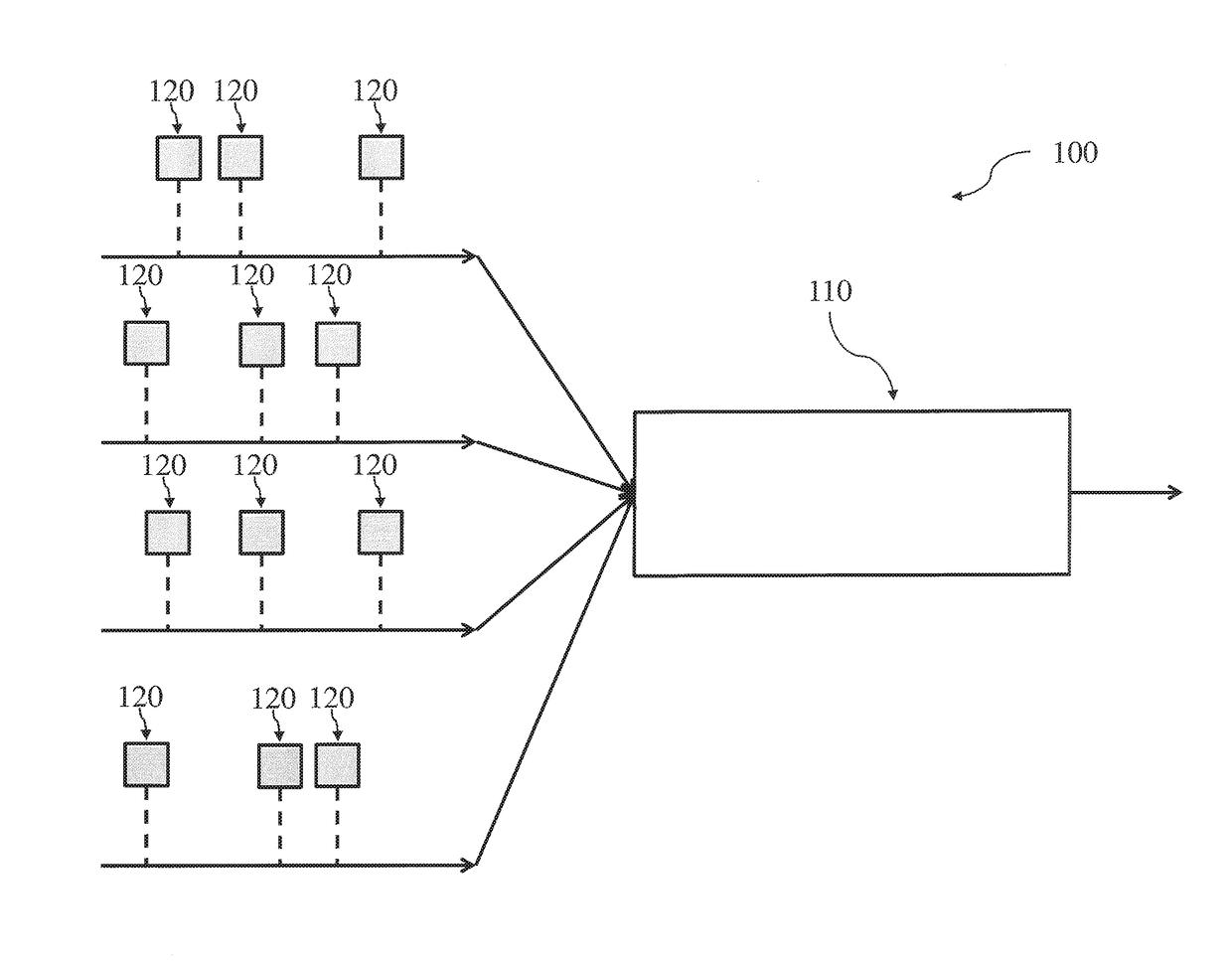
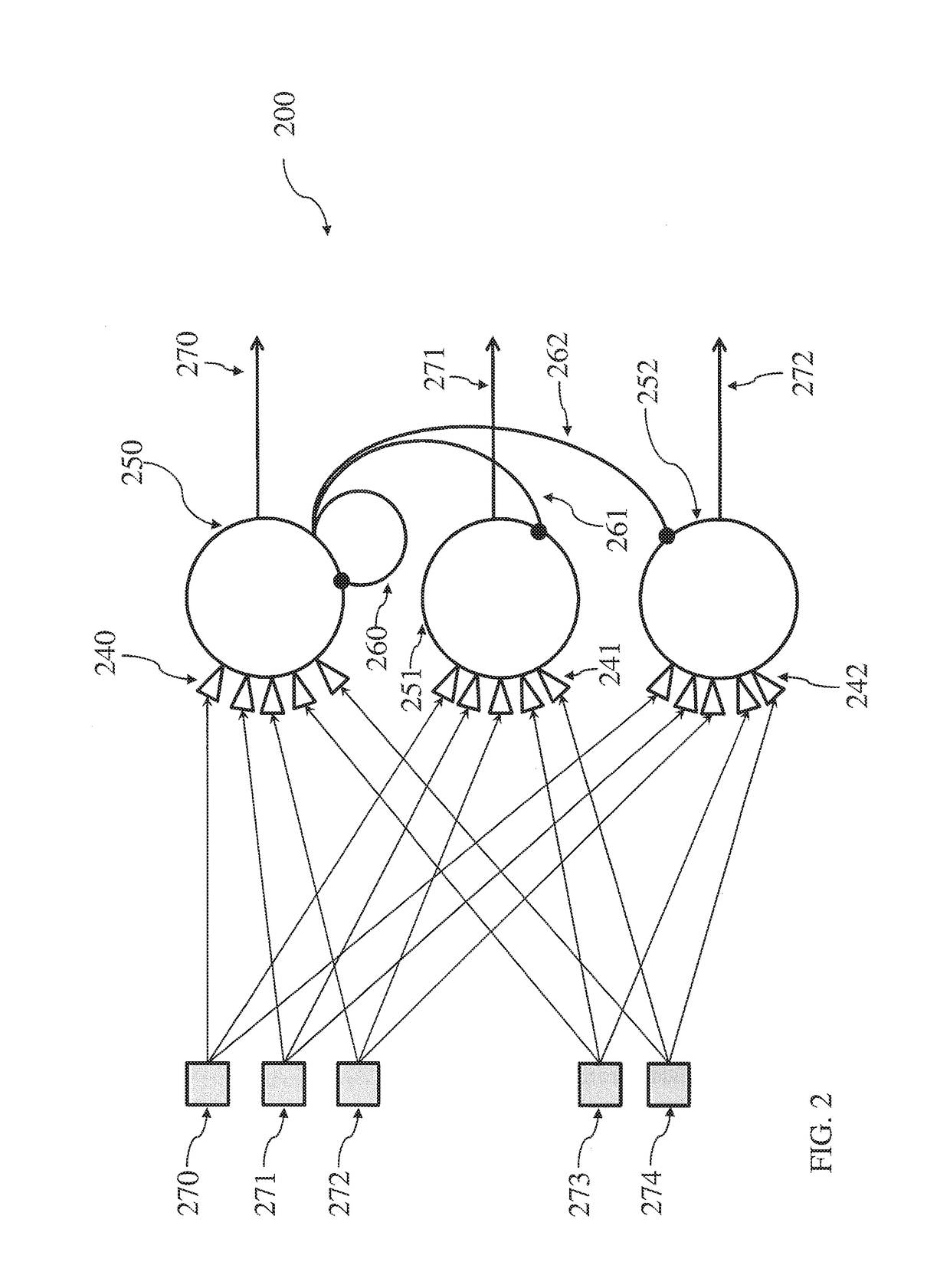
- A neuromorphic architecture featuring interconnected neurons with internal state information links, allowing for the transmission of internal state information across layers to modify the operation of other neurons, enhancing the system's performance and capability in data processing, pattern recognition, and correlation detection.
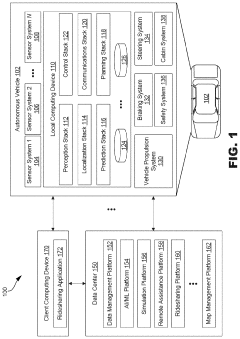
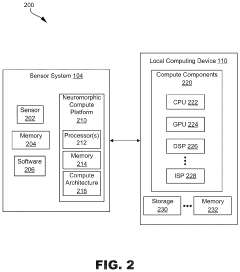
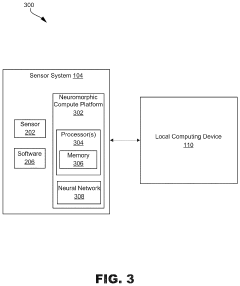
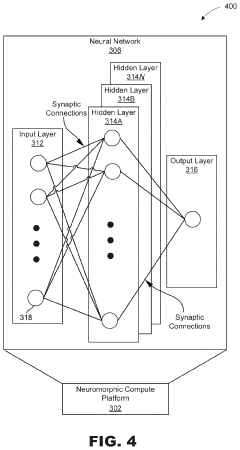
Neuromorphic computing system for edge computing
PatentPendingUS20240220787A1
Innovation
- Implementing neuromorphic computing at edge devices, which collocates compute components like processors and memory with sensors, enabling efficient processing, reduced power consumption, and improved thermal management through collocated architectures that mimic neuro-biological systems.
Industrial Standards for Neuromorphic Computing Systems
The standardization of neuromorphic computing systems for industrial sensor networks represents a critical foundation for widespread adoption and interoperability across diverse manufacturing environments. Currently, the field lacks comprehensive industrial standards, creating significant barriers to commercial deployment and system integration. The absence of unified protocols affects everything from hardware interfaces to data processing methodologies, limiting the scalability of neuromorphic solutions in industrial contexts.
Several international standardization bodies are beginning to address this gap, with the IEEE leading efforts through its emerging standards committees. The IEEE 2957 working group focuses on neuromorphic computing architectures, while ISO/IEC JTC1 SC29 explores standardization frameworks for brain-inspired computing systems. These initiatives aim to establish common benchmarks for performance evaluation, power consumption metrics, and reliability assessments specific to industrial applications.
Hardware standardization efforts concentrate on defining interface protocols between neuromorphic processors and conventional industrial control systems. Key areas include analog-to-digital conversion standards for spike-based data representation, timing synchronization protocols for distributed sensor networks, and fault tolerance specifications for harsh industrial environments. The challenge lies in accommodating the diverse range of neuromorphic architectures while maintaining compatibility with existing industrial infrastructure.
Software and algorithmic standardization presents unique challenges due to the fundamental differences between neuromorphic and traditional computing paradigms. Proposed standards address spike encoding formats, learning algorithm benchmarks, and real-time processing requirements. The development of standardized application programming interfaces enables easier integration of neuromorphic solutions into existing industrial software ecosystems.
Certification and compliance frameworks are emerging to ensure neuromorphic systems meet industrial safety and reliability requirements. These standards encompass electromagnetic compatibility, temperature tolerance, and cybersecurity protocols specific to neuromorphic architectures. The establishment of testing methodologies and validation procedures ensures consistent performance across different manufacturers and deployment scenarios, ultimately accelerating the adoption of neuromorphic computing in industrial sensor networks.
Several international standardization bodies are beginning to address this gap, with the IEEE leading efforts through its emerging standards committees. The IEEE 2957 working group focuses on neuromorphic computing architectures, while ISO/IEC JTC1 SC29 explores standardization frameworks for brain-inspired computing systems. These initiatives aim to establish common benchmarks for performance evaluation, power consumption metrics, and reliability assessments specific to industrial applications.
Hardware standardization efforts concentrate on defining interface protocols between neuromorphic processors and conventional industrial control systems. Key areas include analog-to-digital conversion standards for spike-based data representation, timing synchronization protocols for distributed sensor networks, and fault tolerance specifications for harsh industrial environments. The challenge lies in accommodating the diverse range of neuromorphic architectures while maintaining compatibility with existing industrial infrastructure.
Software and algorithmic standardization presents unique challenges due to the fundamental differences between neuromorphic and traditional computing paradigms. Proposed standards address spike encoding formats, learning algorithm benchmarks, and real-time processing requirements. The development of standardized application programming interfaces enables easier integration of neuromorphic solutions into existing industrial software ecosystems.
Certification and compliance frameworks are emerging to ensure neuromorphic systems meet industrial safety and reliability requirements. These standards encompass electromagnetic compatibility, temperature tolerance, and cybersecurity protocols specific to neuromorphic architectures. The establishment of testing methodologies and validation procedures ensures consistent performance across different manufacturers and deployment scenarios, ultimately accelerating the adoption of neuromorphic computing in industrial sensor networks.
Energy Efficiency Considerations in Industrial Deployments
Energy efficiency represents a critical design consideration for neuromorphic computing systems deployed in industrial sensor networks, where power constraints directly impact operational feasibility and economic viability. Traditional digital processing architectures in industrial environments typically consume substantial power, requiring frequent battery replacements or continuous power supply infrastructure that increases maintenance costs and operational complexity.
Neuromorphic processors demonstrate significant advantages in power consumption through their event-driven processing paradigm, which fundamentally differs from conventional clock-based computation. These systems consume power only when processing actual sensor events, rather than maintaining continuous computational cycles. This characteristic proves particularly beneficial in industrial sensor networks where data generation is often sporadic and event-based, such as vibration monitoring, temperature anomaly detection, or equipment status surveillance.
The ultra-low power characteristics of neuromorphic chips enable extended autonomous operation periods, with some implementations achieving power consumption in the microwatt range during idle states. This capability allows industrial sensor nodes to operate for months or years on single battery charges, dramatically reducing maintenance requirements in harsh or remote industrial environments where frequent servicing is impractical or costly.
Power management strategies for neuromorphic industrial deployments must address dynamic workload variations typical in manufacturing environments. Advanced power scaling techniques allow these systems to adapt their energy consumption based on real-time processing demands, automatically transitioning between different power states as sensor activity fluctuates throughout operational cycles.
Thermal considerations become particularly important in industrial settings where ambient temperatures may exceed standard operating ranges. Neuromorphic processors' inherently low power dissipation reduces thermal stress on sensor nodes, improving reliability and extending operational lifespans in challenging industrial environments. This thermal efficiency also eliminates the need for active cooling systems, further reducing overall power requirements and system complexity.
Energy harvesting integration presents additional opportunities for sustainable neuromorphic sensor deployments. The minimal power requirements of these systems make them compatible with various energy harvesting technologies, including vibration, thermal gradient, and photovoltaic sources commonly available in industrial facilities, potentially enabling completely self-sustaining sensor networks.
Neuromorphic processors demonstrate significant advantages in power consumption through their event-driven processing paradigm, which fundamentally differs from conventional clock-based computation. These systems consume power only when processing actual sensor events, rather than maintaining continuous computational cycles. This characteristic proves particularly beneficial in industrial sensor networks where data generation is often sporadic and event-based, such as vibration monitoring, temperature anomaly detection, or equipment status surveillance.
The ultra-low power characteristics of neuromorphic chips enable extended autonomous operation periods, with some implementations achieving power consumption in the microwatt range during idle states. This capability allows industrial sensor nodes to operate for months or years on single battery charges, dramatically reducing maintenance requirements in harsh or remote industrial environments where frequent servicing is impractical or costly.
Power management strategies for neuromorphic industrial deployments must address dynamic workload variations typical in manufacturing environments. Advanced power scaling techniques allow these systems to adapt their energy consumption based on real-time processing demands, automatically transitioning between different power states as sensor activity fluctuates throughout operational cycles.
Thermal considerations become particularly important in industrial settings where ambient temperatures may exceed standard operating ranges. Neuromorphic processors' inherently low power dissipation reduces thermal stress on sensor nodes, improving reliability and extending operational lifespans in challenging industrial environments. This thermal efficiency also eliminates the need for active cooling systems, further reducing overall power requirements and system complexity.
Energy harvesting integration presents additional opportunities for sustainable neuromorphic sensor deployments. The minimal power requirements of these systems make them compatible with various energy harvesting technologies, including vibration, thermal gradient, and photovoltaic sources commonly available in industrial facilities, potentially enabling completely self-sustaining sensor networks.
Unlock deeper insights with Patsnap Eureka Quick Research — get a full tech report to explore trends and direct your research. Try now!
Generate Your Research Report Instantly with AI Agent
Supercharge your innovation with Patsnap Eureka AI Agent Platform!