
Neuromorphic Computing in Wearable Devices
MAR 11, 20269 MIN READ
Generate Your Research Report Instantly with AI Agent
Patsnap Eureka helps you evaluate technical feasibility & market potential.
Neuromorphic Computing Background and Wearable Integration Goals
Neuromorphic computing represents a paradigm shift in computational architecture, drawing inspiration from the human brain's neural networks to create processors that mimic biological neural structures and functions. This revolutionary approach emerged from decades of neuroscience research and advances in semiconductor technology, fundamentally challenging traditional von Neumann computing architectures. Unlike conventional digital processors that separate memory and processing units, neuromorphic systems integrate these functions within artificial neurons and synapses, enabling parallel processing and adaptive learning capabilities.
The evolution of neuromorphic computing traces back to Carver Mead's pioneering work in the 1980s, which laid the theoretical foundation for brain-inspired silicon circuits. Since then, the field has progressed through several critical phases, from early analog implementations to modern mixed-signal and digital neuromorphic processors. Recent breakthroughs in materials science, particularly in memristive devices and phase-change materials, have accelerated the development of more sophisticated neuromorphic architectures capable of real-time learning and adaptation.
Current technological trends indicate a strong convergence toward ultra-low-power computing solutions, driven by the exponential growth of edge computing applications and Internet of Things devices. Neuromorphic computing addresses these demands by offering event-driven processing capabilities that consume power only when actively processing information, similar to biological neural networks. This characteristic makes neuromorphic processors particularly attractive for battery-constrained applications where energy efficiency is paramount.
The integration of neuromorphic computing into wearable devices represents a natural evolution of this technology, addressing the unique constraints and requirements of personal computing platforms. Wearable devices demand processors that can operate continuously while maintaining minimal power consumption, real-time responsiveness, and compact form factors. Traditional processors struggle to meet these simultaneous requirements, often forcing compromises between performance and battery life.
The primary integration goals for neuromorphic computing in wearables encompass several key objectives. Energy efficiency stands as the foremost priority, aiming to extend device operation from hours to days or weeks on a single charge. Real-time sensor fusion and pattern recognition capabilities enable more sophisticated health monitoring, gesture recognition, and environmental awareness without relying on cloud connectivity. Additionally, on-device learning allows wearables to adapt to individual user patterns and preferences, improving accuracy and personalization over time.
Advanced integration objectives include enabling seamless human-machine interfaces through natural gesture and voice recognition, supporting continuous health monitoring with minimal user intervention, and facilitating predictive analytics for proactive health and wellness management. These goals collectively aim to transform wearable devices from simple data collectors into intelligent, adaptive companions that enhance human capabilities while maintaining privacy and reducing dependence on external computational resources.
The evolution of neuromorphic computing traces back to Carver Mead's pioneering work in the 1980s, which laid the theoretical foundation for brain-inspired silicon circuits. Since then, the field has progressed through several critical phases, from early analog implementations to modern mixed-signal and digital neuromorphic processors. Recent breakthroughs in materials science, particularly in memristive devices and phase-change materials, have accelerated the development of more sophisticated neuromorphic architectures capable of real-time learning and adaptation.
Current technological trends indicate a strong convergence toward ultra-low-power computing solutions, driven by the exponential growth of edge computing applications and Internet of Things devices. Neuromorphic computing addresses these demands by offering event-driven processing capabilities that consume power only when actively processing information, similar to biological neural networks. This characteristic makes neuromorphic processors particularly attractive for battery-constrained applications where energy efficiency is paramount.
The integration of neuromorphic computing into wearable devices represents a natural evolution of this technology, addressing the unique constraints and requirements of personal computing platforms. Wearable devices demand processors that can operate continuously while maintaining minimal power consumption, real-time responsiveness, and compact form factors. Traditional processors struggle to meet these simultaneous requirements, often forcing compromises between performance and battery life.
The primary integration goals for neuromorphic computing in wearables encompass several key objectives. Energy efficiency stands as the foremost priority, aiming to extend device operation from hours to days or weeks on a single charge. Real-time sensor fusion and pattern recognition capabilities enable more sophisticated health monitoring, gesture recognition, and environmental awareness without relying on cloud connectivity. Additionally, on-device learning allows wearables to adapt to individual user patterns and preferences, improving accuracy and personalization over time.
Advanced integration objectives include enabling seamless human-machine interfaces through natural gesture and voice recognition, supporting continuous health monitoring with minimal user intervention, and facilitating predictive analytics for proactive health and wellness management. These goals collectively aim to transform wearable devices from simple data collectors into intelligent, adaptive companions that enhance human capabilities while maintaining privacy and reducing dependence on external computational resources.
Market Demand for Low-Power Wearable Computing Solutions
The global wearable device market has experienced unprecedented growth, driven by increasing consumer awareness of health monitoring and fitness tracking. This expansion has created substantial demand for computing solutions that can operate efficiently within the stringent power constraints of wearable form factors. Traditional computing architectures struggle to meet the dual requirements of sophisticated processing capabilities and extended battery life that modern wearables demand.
Healthcare applications represent the largest segment driving low-power computing demand in wearables. Continuous monitoring devices for vital signs, glucose levels, and cardiac rhythms require processors capable of real-time data analysis while maintaining operational periods measured in days or weeks. The aging global population and rising healthcare costs have accelerated adoption of remote patient monitoring systems, creating sustained market pressure for more efficient computing solutions.
Fitness and wellness applications constitute another significant demand driver, with consumers expecting advanced features such as sleep pattern analysis, stress monitoring, and personalized coaching. These applications require sophisticated algorithms running continuously in the background, placing substantial computational demands on devices that must remain lightweight and long-lasting. The integration of artificial intelligence capabilities for predictive health insights has further intensified the need for power-efficient processing architectures.
Enterprise and industrial applications are emerging as high-growth segments, with smart glasses, augmented reality headsets, and industrial monitoring devices requiring robust computing performance in challenging environments. These applications often demand real-time processing of sensor data, wireless connectivity, and user interface management simultaneously, creating complex power management challenges that traditional architectures cannot adequately address.
The Internet of Things ecosystem expansion has amplified demand for edge computing capabilities in wearable devices. Users increasingly expect seamless integration with smart home systems, autonomous vehicles, and workplace technologies, requiring wearables to process and respond to multiple data streams without compromising battery performance. This connectivity demand has created market opportunities for computing solutions that can efficiently handle distributed processing tasks.
Consumer expectations for always-on functionality have established new performance benchmarks for wearable computing. Modern users demand devices that remain responsive throughout extended usage periods while supporting features like voice recognition, gesture control, and environmental sensing. Meeting these expectations requires fundamental advances in computing efficiency that go beyond incremental improvements in traditional processor designs.
Healthcare applications represent the largest segment driving low-power computing demand in wearables. Continuous monitoring devices for vital signs, glucose levels, and cardiac rhythms require processors capable of real-time data analysis while maintaining operational periods measured in days or weeks. The aging global population and rising healthcare costs have accelerated adoption of remote patient monitoring systems, creating sustained market pressure for more efficient computing solutions.
Fitness and wellness applications constitute another significant demand driver, with consumers expecting advanced features such as sleep pattern analysis, stress monitoring, and personalized coaching. These applications require sophisticated algorithms running continuously in the background, placing substantial computational demands on devices that must remain lightweight and long-lasting. The integration of artificial intelligence capabilities for predictive health insights has further intensified the need for power-efficient processing architectures.
Enterprise and industrial applications are emerging as high-growth segments, with smart glasses, augmented reality headsets, and industrial monitoring devices requiring robust computing performance in challenging environments. These applications often demand real-time processing of sensor data, wireless connectivity, and user interface management simultaneously, creating complex power management challenges that traditional architectures cannot adequately address.
The Internet of Things ecosystem expansion has amplified demand for edge computing capabilities in wearable devices. Users increasingly expect seamless integration with smart home systems, autonomous vehicles, and workplace technologies, requiring wearables to process and respond to multiple data streams without compromising battery performance. This connectivity demand has created market opportunities for computing solutions that can efficiently handle distributed processing tasks.
Consumer expectations for always-on functionality have established new performance benchmarks for wearable computing. Modern users demand devices that remain responsive throughout extended usage periods while supporting features like voice recognition, gesture control, and environmental sensing. Meeting these expectations requires fundamental advances in computing efficiency that go beyond incremental improvements in traditional processor designs.
Current State of Neuromorphic Chips in Wearable Applications
Neuromorphic computing technology in wearable devices has reached a critical juncture where several prototype implementations demonstrate promising capabilities while revealing significant technical constraints. Current neuromorphic chips designed for wearable applications primarily focus on ultra-low power consumption, achieving power efficiency levels that are orders of magnitude better than traditional digital processors for specific computational tasks.
Intel's Loihi and IBM's TrueNorth represent the most advanced neuromorphic architectures that have been adapted for wearable contexts, though neither was originally designed specifically for this application domain. These chips demonstrate the ability to process sensory data with power consumption in the microwatt range, making them theoretically suitable for battery-constrained wearable devices. However, practical implementations remain limited due to manufacturing costs and integration complexities.
The primary technical challenge facing current neuromorphic chips in wearables centers on the trade-off between computational flexibility and power efficiency. Existing solutions excel at pattern recognition tasks such as gesture detection and biometric monitoring but struggle with more complex computational requirements. The spike-based processing paradigm, while energy-efficient, requires specialized programming models that differ significantly from conventional software development approaches.
Manufacturing scalability presents another significant constraint. Current neuromorphic chips utilize specialized fabrication processes that are not yet compatible with standard semiconductor manufacturing pipelines used for consumer electronics. This limitation results in higher production costs and longer development cycles, hindering widespread adoption in cost-sensitive wearable markets.
Integration challenges persist in connecting neuromorphic processors with conventional digital systems within wearable devices. The analog-digital interface requirements, signal conditioning circuits, and data format conversion processes add complexity and power overhead that can negate some of the neuromorphic advantages. Additionally, the lack of standardized development tools and software frameworks creates barriers for device manufacturers seeking to implement these technologies.
Despite these challenges, recent developments show promising progress in addressing key limitations. Emerging hybrid architectures combine neuromorphic processing units with conventional microcontrollers, enabling more practical implementation pathways. Several research initiatives are exploring novel materials and fabrication techniques that could reduce manufacturing costs while maintaining the fundamental advantages of neuromorphic computing for wearable applications.
Intel's Loihi and IBM's TrueNorth represent the most advanced neuromorphic architectures that have been adapted for wearable contexts, though neither was originally designed specifically for this application domain. These chips demonstrate the ability to process sensory data with power consumption in the microwatt range, making them theoretically suitable for battery-constrained wearable devices. However, practical implementations remain limited due to manufacturing costs and integration complexities.
The primary technical challenge facing current neuromorphic chips in wearables centers on the trade-off between computational flexibility and power efficiency. Existing solutions excel at pattern recognition tasks such as gesture detection and biometric monitoring but struggle with more complex computational requirements. The spike-based processing paradigm, while energy-efficient, requires specialized programming models that differ significantly from conventional software development approaches.
Manufacturing scalability presents another significant constraint. Current neuromorphic chips utilize specialized fabrication processes that are not yet compatible with standard semiconductor manufacturing pipelines used for consumer electronics. This limitation results in higher production costs and longer development cycles, hindering widespread adoption in cost-sensitive wearable markets.
Integration challenges persist in connecting neuromorphic processors with conventional digital systems within wearable devices. The analog-digital interface requirements, signal conditioning circuits, and data format conversion processes add complexity and power overhead that can negate some of the neuromorphic advantages. Additionally, the lack of standardized development tools and software frameworks creates barriers for device manufacturers seeking to implement these technologies.
Despite these challenges, recent developments show promising progress in addressing key limitations. Emerging hybrid architectures combine neuromorphic processing units with conventional microcontrollers, enabling more practical implementation pathways. Several research initiatives are exploring novel materials and fabrication techniques that could reduce manufacturing costs while maintaining the fundamental advantages of neuromorphic computing for wearable applications.
Existing Neuromorphic Solutions for Wearable Devices
01 Neuromorphic hardware architectures and circuit designs
Neuromorphic computing systems utilize specialized hardware architectures that mimic biological neural networks. These architectures include novel circuit designs with synaptic elements, neuron circuits, and interconnection structures that enable parallel processing and low-power operation. The hardware implementations focus on creating physical substrates that can efficiently execute neural network computations through analog or digital circuits, memristive devices, and crossbar arrays that replicate synaptic behavior and neuronal dynamics.- Neuromorphic hardware architectures and circuit designs: Neuromorphic computing systems utilize specialized hardware architectures that mimic biological neural networks. These designs include neuromorphic processors, synaptic circuits, and neural network chips that implement brain-inspired computing paradigms. The hardware architectures feature interconnected processing elements that emulate neurons and synapses, enabling parallel processing and low-power computation. These circuits are designed to support spike-based processing and event-driven computation, which are fundamental characteristics of biological neural systems.
- Memristive and resistive memory devices for neuromorphic systems: Neuromorphic computing leverages memristive devices and resistive memory technologies to implement synaptic functionality. These devices can store and process information simultaneously, mimicking the behavior of biological synapses. The resistive switching characteristics of these memory elements enable the implementation of synaptic weights and plasticity mechanisms. These technologies provide non-volatile storage with analog conductance states, allowing for efficient implementation of neural network parameters and learning algorithms in hardware.
- Spiking neural networks and event-driven processing: Spiking neural networks represent a key computational model in neuromorphic computing, where information is encoded and transmitted through discrete spike events. This approach enables asynchronous, event-driven processing that closely resembles biological neural communication. The spike-based computation allows for temporal coding of information and energy-efficient processing, as computations only occur when spikes are present. These systems implement various neuron models and spike-timing-dependent plasticity mechanisms for learning and adaptation.
- Learning algorithms and training methods for neuromorphic systems: Specialized learning algorithms and training methodologies have been developed for neuromorphic computing platforms. These methods include online learning approaches, unsupervised learning techniques, and bio-inspired plasticity rules that can be implemented directly in neuromorphic hardware. The training methods are designed to work with the constraints and capabilities of neuromorphic systems, including spike-based communication and local learning rules. These algorithms enable the systems to adapt and learn from data in real-time with minimal energy consumption.
- Applications and integration of neuromorphic computing systems: Neuromorphic computing technologies are being applied to various domains including pattern recognition, sensory processing, robotics, and edge computing applications. These systems are integrated with sensors and other computing platforms to enable intelligent processing at the edge with low power consumption. The applications leverage the parallel processing capabilities and energy efficiency of neuromorphic systems for real-time data processing tasks. Integration approaches include hybrid systems that combine neuromorphic processors with conventional computing architectures to optimize performance for specific applications.
02 Spiking neural network implementations
Spiking neural networks represent a key approach in neuromorphic computing where information is encoded and processed through discrete spike events similar to biological neurons. These implementations include methods for spike timing, event-driven processing, and temporal coding schemes. The technology focuses on algorithms and hardware that can efficiently handle asynchronous spike-based communication, enabling more biologically realistic computation with improved energy efficiency compared to traditional artificial neural networks.Expand Specific Solutions03 Memory and learning mechanisms for neuromorphic systems
Neuromorphic computing systems incorporate various memory technologies and learning mechanisms that enable adaptive behavior and information storage. These include synaptic plasticity implementations, weight update algorithms, and on-chip learning capabilities. The approaches encompass both supervised and unsupervised learning methods, utilizing mechanisms such as spike-timing-dependent plasticity and other biologically-inspired learning rules that allow the system to adapt and improve performance over time without external retraining.Expand Specific Solutions04 Neuromorphic processors and computing units
Specialized neuromorphic processors and computing units are designed to execute brain-inspired algorithms efficiently. These processors integrate multiple neuromorphic cores, routing networks, and control logic to enable scalable neural computation. The designs focus on achieving high parallelism, low latency, and energy efficiency through dedicated neural processing elements, event-based communication protocols, and hierarchical architectures that can be scaled from single chips to large multi-chip systems for complex cognitive tasks.Expand Specific Solutions05 Applications and integration of neuromorphic computing
Neuromorphic computing technologies are being applied across various domains including pattern recognition, sensory processing, robotics, and edge computing. The integration approaches focus on combining neuromorphic processors with conventional computing systems, sensors, and actuators to create hybrid architectures. These applications leverage the unique advantages of neuromorphic systems such as real-time processing, low power consumption, and adaptive learning capabilities for tasks including image recognition, speech processing, autonomous navigation, and cognitive computing in resource-constrained environments.Expand Specific Solutions
Key Players in Neuromorphic Wearable Technology
The neuromorphic computing in wearable devices sector represents an emerging technology landscape currently in its early development stage, with significant growth potential driven by increasing demand for energy-efficient, intelligent wearable solutions. The market remains nascent but shows promising expansion opportunities as healthcare monitoring, fitness tracking, and augmented reality applications proliferate. Technology maturity varies considerably across key players, with established technology giants like IBM, Samsung Electronics, and Google leading fundamental research and development efforts, while specialized companies such as Cala Health focus on specific medical applications. Academic institutions including KAIST, Peking University, and University of Chicago contribute crucial foundational research, supported by government entities like the US Air Force driving innovation. Memory semiconductor leaders SK Hynix and Macronix provide essential hardware components, while emerging players like Chengdu Synsense Technology and Shenzhen Shizhi Technology represent the growing ecosystem of specialized neuromorphic solution providers targeting wearable device integration.
International Business Machines Corp.
Technical Solution: IBM has developed TrueNorth neuromorphic chip architecture specifically designed for ultra-low power applications in wearable devices. The chip features 1 million programmable neurons and 256 million synapses, consuming only 70 milliwatts of power during operation. Their neuromorphic computing approach mimics brain-like processing for real-time sensor data analysis in wearables, enabling continuous health monitoring, gesture recognition, and adaptive user interface responses. The architecture supports event-driven computation that activates only when needed, making it ideal for battery-constrained wearable applications. IBM's solution integrates seamlessly with existing wearable ecosystems and provides SDK tools for developers to create neuromorphic applications for fitness trackers, smartwatches, and medical monitoring devices.
Strengths: Extremely low power consumption, mature chip architecture, comprehensive development ecosystem. Weaknesses: Limited computational complexity compared to traditional processors, requires specialized programming knowledge.
Samsung Electronics Co., Ltd.
Technical Solution: Samsung has integrated neuromorphic computing capabilities into their Galaxy Watch series and fitness wearables through their custom Exynos processors with dedicated neural processing units. Their approach focuses on on-device AI processing for health monitoring, sleep pattern analysis, and predictive wellness insights without requiring cloud connectivity. The neuromorphic elements enable real-time ECG analysis, stress level detection through heart rate variability, and personalized fitness recommendations. Samsung's solution leverages spiking neural networks for efficient pattern recognition in biometric data, allowing continuous 24/7 monitoring while maintaining multi-day battery life. Their platform supports third-party health applications and integrates with Samsung Health ecosystem for comprehensive wellness tracking.
Strengths: Market-proven integration in consumer devices, strong ecosystem integration, advanced health monitoring capabilities. Weaknesses: Proprietary architecture limits third-party development, primarily focused on health applications rather than general computing.
Core Patents in Neuromorphic Wearable Computing
Skin-like stretchable neuromorphic devices for artificial intelligence applications
PatentWO2023096837A1
Innovation
- Development of a stretchable neuromorphic computing platform using organic-electrochemical-transistor (OECT) structures with redox-active semiconducting layers and electrolyte-type dielectric layers, allowing for neuromorphic artificial neural networks (ANNs) to be integrated into wearable devices that maintain functionality even under 100% strain.


Neuromorphic computing device and method of designing the same
PatentActiveUS11881260B2
Innovation
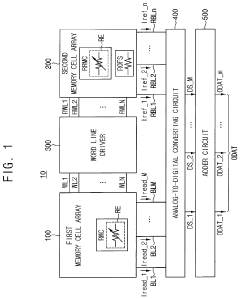
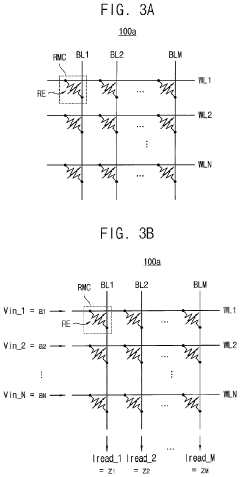
- Incorporating a second memory cell array with offset resistors connected in parallel, using the same resistive material as the first memory cell array, to convert read currents into digital signals, thereby mitigating temperature and time dependency, and ensuring consistent resistance across offset resistors for enhanced sensing performance.
Power Efficiency Standards for Wearable Computing
The integration of neuromorphic computing into wearable devices necessitates the establishment of comprehensive power efficiency standards to ensure optimal performance while maintaining acceptable battery life. Current power efficiency benchmarks for wearable computing systems typically range from 10-100 milliwatts for continuous operation, with neuromorphic processors offering significant advantages through their event-driven architecture that can reduce power consumption by 10-1000x compared to traditional digital processors.
Existing power efficiency standards for wearable devices primarily focus on conventional computing architectures, with IEEE 802.11ah and Bluetooth Low Energy protocols setting baseline power consumption metrics. However, neuromorphic computing introduces unique power characteristics that require specialized measurement methodologies. The asynchronous, spike-based nature of neuromorphic processors means power consumption varies dramatically based on input activity levels, necessitating dynamic power efficiency metrics rather than static benchmarks.
Industry standards organizations are developing new frameworks specifically for neuromorphic wearable devices. The International Electrotechnical Commission has proposed activity-normalized power efficiency metrics measured in operations per joule, accounting for the variable computational load inherent in neuromorphic systems. These standards consider both active processing power and standby power consumption, with target efficiency levels of 1-10 TOPS/W for neuromorphic wearable applications.
Battery life requirements for wearable devices typically demand 24-48 hours of continuous operation, translating to strict power budgets of 20-50 milliwatts average consumption. Neuromorphic processors excel in meeting these requirements through their ability to remain in ultra-low power states during periods of minimal sensory input, consuming as little as 1-10 microwatts in standby mode.
Thermal management standards also play a crucial role in power efficiency regulations for wearable neuromorphic devices. Maximum skin contact temperatures of 40-45°C limit the sustained power dissipation to approximately 100 milliwatts per square centimeter, directly impacting the allowable computational throughput and requiring careful thermal design considerations.
Emerging standards emphasize the importance of adaptive power management techniques that leverage the inherent sparsity of neuromorphic computation. These include dynamic voltage and frequency scaling protocols specifically designed for spike-based processing, enabling power efficiency optimization based on real-time computational demands while maintaining the responsiveness required for wearable applications.
Existing power efficiency standards for wearable devices primarily focus on conventional computing architectures, with IEEE 802.11ah and Bluetooth Low Energy protocols setting baseline power consumption metrics. However, neuromorphic computing introduces unique power characteristics that require specialized measurement methodologies. The asynchronous, spike-based nature of neuromorphic processors means power consumption varies dramatically based on input activity levels, necessitating dynamic power efficiency metrics rather than static benchmarks.
Industry standards organizations are developing new frameworks specifically for neuromorphic wearable devices. The International Electrotechnical Commission has proposed activity-normalized power efficiency metrics measured in operations per joule, accounting for the variable computational load inherent in neuromorphic systems. These standards consider both active processing power and standby power consumption, with target efficiency levels of 1-10 TOPS/W for neuromorphic wearable applications.
Battery life requirements for wearable devices typically demand 24-48 hours of continuous operation, translating to strict power budgets of 20-50 milliwatts average consumption. Neuromorphic processors excel in meeting these requirements through their ability to remain in ultra-low power states during periods of minimal sensory input, consuming as little as 1-10 microwatts in standby mode.
Thermal management standards also play a crucial role in power efficiency regulations for wearable neuromorphic devices. Maximum skin contact temperatures of 40-45°C limit the sustained power dissipation to approximately 100 milliwatts per square centimeter, directly impacting the allowable computational throughput and requiring careful thermal design considerations.
Emerging standards emphasize the importance of adaptive power management techniques that leverage the inherent sparsity of neuromorphic computation. These include dynamic voltage and frequency scaling protocols specifically designed for spike-based processing, enabling power efficiency optimization based on real-time computational demands while maintaining the responsiveness required for wearable applications.
Privacy Implications of Neuromorphic Wearable Data
The integration of neuromorphic computing into wearable devices introduces unprecedented privacy challenges that extend far beyond traditional data protection concerns. Unlike conventional digital systems that process discrete data points, neuromorphic architectures continuously capture and analyze biometric patterns, behavioral signatures, and physiological responses in real-time. This creates a comprehensive digital fingerprint of users that encompasses not only their physical activities but also their emotional states, cognitive patterns, and subconscious responses.
The continuous learning nature of neuromorphic systems amplifies privacy risks through persistent data accumulation. These devices can infer sensitive information about users' health conditions, psychological states, and personal habits without explicit consent or awareness. The spike-based processing inherent in neuromorphic computing enables the detection of subtle physiological variations that may reveal medical conditions, stress levels, or even predict behavioral patterns before users themselves are conscious of them.
Data ownership and control present significant challenges in neuromorphic wearable ecosystems. The distributed processing capabilities of these systems often involve edge computing nodes, cloud-based learning algorithms, and third-party analytics platforms. This multi-layered architecture creates ambiguity regarding data custody, processing transparency, and user control over their biometric information. Users may unknowingly contribute to training datasets that enhance system capabilities while simultaneously compromising their privacy.
The temporal persistence of neuromorphic data poses unique risks for long-term privacy protection. Unlike traditional wearable data that captures snapshots of activity, neuromorphic systems maintain continuous temporal correlations that can reconstruct detailed behavioral patterns over extended periods. This capability enables retrospective analysis that could reveal sensitive information years after initial data collection, creating lasting privacy vulnerabilities.
Regulatory frameworks struggle to address the nuanced privacy implications of neuromorphic wearable data. Existing privacy legislation primarily focuses on structured data protection, while neuromorphic systems generate unstructured, continuous data streams that challenge traditional consent models and data minimization principles. The adaptive learning capabilities of these systems further complicate compliance efforts, as the full scope of data utilization may not be predictable at the time of collection.
The continuous learning nature of neuromorphic systems amplifies privacy risks through persistent data accumulation. These devices can infer sensitive information about users' health conditions, psychological states, and personal habits without explicit consent or awareness. The spike-based processing inherent in neuromorphic computing enables the detection of subtle physiological variations that may reveal medical conditions, stress levels, or even predict behavioral patterns before users themselves are conscious of them.
Data ownership and control present significant challenges in neuromorphic wearable ecosystems. The distributed processing capabilities of these systems often involve edge computing nodes, cloud-based learning algorithms, and third-party analytics platforms. This multi-layered architecture creates ambiguity regarding data custody, processing transparency, and user control over their biometric information. Users may unknowingly contribute to training datasets that enhance system capabilities while simultaneously compromising their privacy.
The temporal persistence of neuromorphic data poses unique risks for long-term privacy protection. Unlike traditional wearable data that captures snapshots of activity, neuromorphic systems maintain continuous temporal correlations that can reconstruct detailed behavioral patterns over extended periods. This capability enables retrospective analysis that could reveal sensitive information years after initial data collection, creating lasting privacy vulnerabilities.
Regulatory frameworks struggle to address the nuanced privacy implications of neuromorphic wearable data. Existing privacy legislation primarily focuses on structured data protection, while neuromorphic systems generate unstructured, continuous data streams that challenge traditional consent models and data minimization principles. The adaptive learning capabilities of these systems further complicate compliance efforts, as the full scope of data utilization may not be predictable at the time of collection.
Unlock deeper insights with Patsnap Eureka Quick Research — get a full tech report to explore trends and direct your research. Try now!
Generate Your Research Report Instantly with AI Agent
Supercharge your innovation with Patsnap Eureka AI Agent Platform!