Policy Frameworks Supporting V2G Implementation
AUG 8, 20259 MIN READ
Generate Your Research Report Instantly with AI Agent
Patsnap Eureka helps you evaluate technical feasibility & market potential.
V2G Policy Background and Objectives
Vehicle-to-Grid (V2G) technology has emerged as a promising solution to address the challenges of integrating renewable energy sources into the power grid and managing the increasing demand for electricity. The concept of V2G involves using electric vehicles (EVs) as mobile energy storage units, capable of both drawing power from the grid and feeding it back when needed. This bidirectional flow of energy has the potential to revolutionize the way we manage our power systems and accelerate the transition to a more sustainable energy future.
The development of V2G technology can be traced back to the early 2000s when researchers began exploring the potential of using EVs as distributed energy resources. Since then, the technology has evolved significantly, driven by advancements in battery technology, power electronics, and smart grid infrastructure. The growing adoption of EVs worldwide has further fueled interest in V2G, as policymakers and industry stakeholders recognize its potential to address grid stability issues and support the integration of intermittent renewable energy sources.
The primary objectives of V2G policy frameworks are multifaceted. Firstly, they aim to create a supportive regulatory environment that encourages the adoption of V2G technology by addressing legal and technical barriers. This includes establishing clear guidelines for grid interconnection, standardizing communication protocols, and ensuring the safety and reliability of V2G systems.
Secondly, V2G policies seek to incentivize participation in V2G programs by both EV owners and utility companies. This may involve developing appropriate pricing mechanisms, such as time-of-use tariffs or capacity payments, to compensate EV owners for providing grid services. Additionally, policies may focus on creating market structures that allow for the aggregation of multiple EVs to provide more substantial and reliable grid services.
Another key objective of V2G policy frameworks is to promote innovation and research in the field. This includes supporting pilot projects, funding research and development initiatives, and fostering collaboration between academia, industry, and government agencies. By encouraging experimentation and knowledge sharing, policymakers aim to accelerate the development and deployment of V2G technologies.
Furthermore, V2G policies often seek to align with broader energy and environmental goals. This includes supporting the integration of renewable energy sources, reducing greenhouse gas emissions, and enhancing overall grid resilience. By leveraging the storage capacity of EVs, V2G can help balance supply and demand, mitigate the impact of peak loads, and provide ancillary services to the grid.
As the technology continues to evolve, V2G policy frameworks must adapt to address emerging challenges and opportunities. This includes considering the impact of V2G on battery degradation, ensuring cybersecurity in V2G systems, and developing fair and transparent mechanisms for valuing grid services provided by EVs. By addressing these issues proactively, policymakers can help create a robust and sustainable ecosystem for V2G implementation.
The development of V2G technology can be traced back to the early 2000s when researchers began exploring the potential of using EVs as distributed energy resources. Since then, the technology has evolved significantly, driven by advancements in battery technology, power electronics, and smart grid infrastructure. The growing adoption of EVs worldwide has further fueled interest in V2G, as policymakers and industry stakeholders recognize its potential to address grid stability issues and support the integration of intermittent renewable energy sources.
The primary objectives of V2G policy frameworks are multifaceted. Firstly, they aim to create a supportive regulatory environment that encourages the adoption of V2G technology by addressing legal and technical barriers. This includes establishing clear guidelines for grid interconnection, standardizing communication protocols, and ensuring the safety and reliability of V2G systems.
Secondly, V2G policies seek to incentivize participation in V2G programs by both EV owners and utility companies. This may involve developing appropriate pricing mechanisms, such as time-of-use tariffs or capacity payments, to compensate EV owners for providing grid services. Additionally, policies may focus on creating market structures that allow for the aggregation of multiple EVs to provide more substantial and reliable grid services.
Another key objective of V2G policy frameworks is to promote innovation and research in the field. This includes supporting pilot projects, funding research and development initiatives, and fostering collaboration between academia, industry, and government agencies. By encouraging experimentation and knowledge sharing, policymakers aim to accelerate the development and deployment of V2G technologies.
Furthermore, V2G policies often seek to align with broader energy and environmental goals. This includes supporting the integration of renewable energy sources, reducing greenhouse gas emissions, and enhancing overall grid resilience. By leveraging the storage capacity of EVs, V2G can help balance supply and demand, mitigate the impact of peak loads, and provide ancillary services to the grid.
As the technology continues to evolve, V2G policy frameworks must adapt to address emerging challenges and opportunities. This includes considering the impact of V2G on battery degradation, ensuring cybersecurity in V2G systems, and developing fair and transparent mechanisms for valuing grid services provided by EVs. By addressing these issues proactively, policymakers can help create a robust and sustainable ecosystem for V2G implementation.
V2G Market Demand Analysis
The market demand for Vehicle-to-Grid (V2G) technology is rapidly evolving, driven by the increasing adoption of electric vehicles (EVs) and the growing need for grid flexibility. As the global EV market expands, with sales reaching 10.5 million units in 2022, the potential for V2G implementation grows proportionally. This technology allows EVs to not only draw power from the grid but also feed it back, creating a bidirectional energy flow that can provide valuable grid services.
The primary market drivers for V2G include the need for grid stabilization, renewable energy integration, and peak load management. Utility companies are increasingly recognizing the value of V2G in addressing these challenges. For instance, some European countries have already begun implementing V2G pilot projects, with the UK's National Grid estimating that V2G could provide up to 38 GW of flexible capacity by 2050.
Consumer demand for V2G is also on the rise, albeit at a slower pace. EV owners are becoming more aware of the potential financial benefits of participating in V2G programs, such as reduced electricity costs and potential revenue from providing grid services. However, concerns about battery degradation and the need for specialized equipment remain barriers to widespread adoption.
The commercial and industrial sectors present significant opportunities for V2G implementation. Fleet operators, in particular, are showing interest in V2G as a means to optimize their energy costs and potentially generate additional revenue. This segment is expected to be a key driver of V2G market growth in the near term.
Geographically, Europe is currently leading in V2G market development, with countries like Denmark, the Netherlands, and the UK at the forefront. North America and parts of Asia, particularly Japan and South Korea, are also showing increasing interest and investment in V2G technology.
The market for V2G-related hardware, including bidirectional chargers and smart meters, is expected to grow substantially. Software solutions for managing V2G systems and facilitating transactions between EV owners and grid operators are also emerging as a significant market segment.
Despite the promising outlook, several challenges need to be addressed to fully realize the market potential of V2G. These include the need for standardization of V2G protocols, development of more sophisticated energy management systems, and creation of regulatory frameworks that incentivize V2G participation. As these barriers are overcome, the V2G market is poised for significant growth, with some analysts projecting a compound annual growth rate of over 40% in the coming years.
The primary market drivers for V2G include the need for grid stabilization, renewable energy integration, and peak load management. Utility companies are increasingly recognizing the value of V2G in addressing these challenges. For instance, some European countries have already begun implementing V2G pilot projects, with the UK's National Grid estimating that V2G could provide up to 38 GW of flexible capacity by 2050.
Consumer demand for V2G is also on the rise, albeit at a slower pace. EV owners are becoming more aware of the potential financial benefits of participating in V2G programs, such as reduced electricity costs and potential revenue from providing grid services. However, concerns about battery degradation and the need for specialized equipment remain barriers to widespread adoption.
The commercial and industrial sectors present significant opportunities for V2G implementation. Fleet operators, in particular, are showing interest in V2G as a means to optimize their energy costs and potentially generate additional revenue. This segment is expected to be a key driver of V2G market growth in the near term.
Geographically, Europe is currently leading in V2G market development, with countries like Denmark, the Netherlands, and the UK at the forefront. North America and parts of Asia, particularly Japan and South Korea, are also showing increasing interest and investment in V2G technology.
The market for V2G-related hardware, including bidirectional chargers and smart meters, is expected to grow substantially. Software solutions for managing V2G systems and facilitating transactions between EV owners and grid operators are also emerging as a significant market segment.
Despite the promising outlook, several challenges need to be addressed to fully realize the market potential of V2G. These include the need for standardization of V2G protocols, development of more sophisticated energy management systems, and creation of regulatory frameworks that incentivize V2G participation. As these barriers are overcome, the V2G market is poised for significant growth, with some analysts projecting a compound annual growth rate of over 40% in the coming years.
V2G Policy Challenges and Barriers
Despite the promising potential of Vehicle-to-Grid (V2G) technology, its widespread implementation faces several significant policy challenges and barriers. One of the primary obstacles is the lack of a comprehensive regulatory framework specifically designed for V2G systems. Many existing energy policies and regulations were developed before the advent of V2G technology, resulting in a misalignment between current regulatory structures and the unique requirements of V2G integration.
The absence of standardized protocols for V2G operations poses another substantial challenge. Without unified standards, interoperability issues arise between different electric vehicle (EV) models, charging stations, and grid systems. This fragmentation hinders the seamless integration of V2G technology across various platforms and geographical regions, impeding its scalability and widespread adoption.
Financial incentives and market mechanisms to support V2G implementation are often inadequate or non-existent. The lack of clear pricing structures for grid services provided by EVs, coupled with insufficient compensation models for EV owners participating in V2G programs, creates economic barriers to adoption. Additionally, the absence of well-defined business models for V2G services further complicates the economic viability of large-scale implementation.
Grid infrastructure limitations present another significant hurdle. Many existing power grids are not equipped to handle the bidirectional flow of electricity required for V2G operations. Upgrading grid infrastructure to accommodate V2G technology requires substantial investments, which may face resistance from utilities and regulators without clear policy directives and funding mechanisms.
Data privacy and cybersecurity concerns also pose challenges to V2G implementation. The exchange of data between EVs, charging stations, and grid operators raises questions about data ownership, protection, and potential vulnerabilities to cyber attacks. Developing robust policies and regulations to address these concerns is crucial for building trust and ensuring the security of V2G systems.
Lastly, the complex interplay between different stakeholders – including EV manufacturers, utilities, grid operators, and consumers – creates coordination challenges. Aligning the interests and responsibilities of these diverse groups requires careful policy design and collaborative efforts. Without clear guidelines and incentives for cooperation, the fragmented landscape of stakeholders can impede the smooth implementation of V2G technology.
Addressing these policy challenges and barriers requires a multifaceted approach, involving collaboration between policymakers, industry stakeholders, and researchers. Developing comprehensive and flexible regulatory frameworks, establishing standardized protocols, creating appropriate financial incentives, and addressing infrastructure and security concerns are essential steps towards overcoming these obstacles and realizing the full potential of V2G technology.
The absence of standardized protocols for V2G operations poses another substantial challenge. Without unified standards, interoperability issues arise between different electric vehicle (EV) models, charging stations, and grid systems. This fragmentation hinders the seamless integration of V2G technology across various platforms and geographical regions, impeding its scalability and widespread adoption.
Financial incentives and market mechanisms to support V2G implementation are often inadequate or non-existent. The lack of clear pricing structures for grid services provided by EVs, coupled with insufficient compensation models for EV owners participating in V2G programs, creates economic barriers to adoption. Additionally, the absence of well-defined business models for V2G services further complicates the economic viability of large-scale implementation.
Grid infrastructure limitations present another significant hurdle. Many existing power grids are not equipped to handle the bidirectional flow of electricity required for V2G operations. Upgrading grid infrastructure to accommodate V2G technology requires substantial investments, which may face resistance from utilities and regulators without clear policy directives and funding mechanisms.
Data privacy and cybersecurity concerns also pose challenges to V2G implementation. The exchange of data between EVs, charging stations, and grid operators raises questions about data ownership, protection, and potential vulnerabilities to cyber attacks. Developing robust policies and regulations to address these concerns is crucial for building trust and ensuring the security of V2G systems.
Lastly, the complex interplay between different stakeholders – including EV manufacturers, utilities, grid operators, and consumers – creates coordination challenges. Aligning the interests and responsibilities of these diverse groups requires careful policy design and collaborative efforts. Without clear guidelines and incentives for cooperation, the fragmented landscape of stakeholders can impede the smooth implementation of V2G technology.
Addressing these policy challenges and barriers requires a multifaceted approach, involving collaboration between policymakers, industry stakeholders, and researchers. Developing comprehensive and flexible regulatory frameworks, establishing standardized protocols, creating appropriate financial incentives, and addressing infrastructure and security concerns are essential steps towards overcoming these obstacles and realizing the full potential of V2G technology.
Current V2G Policy Frameworks
01 V2G system architecture and communication
This category focuses on the overall system architecture and communication protocols for Vehicle-to-Grid (V2G) technology. It includes methods for establishing secure and efficient communication between electric vehicles and the power grid, as well as the integration of V2G systems with existing grid infrastructure. The architecture may involve smart charging stations, energy management systems, and data exchange protocols to enable bidirectional power flow and grid services.- V2G system architecture and communication: This category focuses on the overall system architecture for Vehicle-to-Grid (V2G) technology, including communication protocols between electric vehicles and the power grid. It covers methods for managing bidirectional power flow, data exchange, and control systems that enable efficient integration of electric vehicles with the electrical grid infrastructure.
- Grid stabilization and load balancing: V2G technology can be used to stabilize the power grid and balance loads during peak demand periods. This involves using electric vehicle batteries as distributed energy storage units, allowing them to supply power back to the grid when needed. The system can help manage fluctuations in renewable energy sources and improve overall grid reliability.
- Charging and discharging strategies: This aspect covers intelligent charging and discharging strategies for electric vehicles participating in V2G systems. It includes algorithms for optimizing charging schedules, managing battery health, and maximizing economic benefits for vehicle owners while meeting grid requirements. The strategies consider factors such as electricity prices, grid demand, and user preferences.
- V2G market mechanisms and incentives: This category addresses the economic and market aspects of V2G technology. It includes methods for creating incentive structures, pricing models, and payment systems to encourage electric vehicle owners to participate in V2G programs. The focus is on developing fair and attractive market mechanisms that benefit both grid operators and vehicle owners.
- V2G integration with renewable energy sources: This point explores the synergy between V2G systems and renewable energy sources such as solar and wind power. It covers methods for using electric vehicle batteries to store excess renewable energy and supply it back to the grid during periods of low renewable generation. The integration aims to increase the overall efficiency and sustainability of the power system.
02 Grid stabilization and load balancing
This aspect of V2G technology deals with using electric vehicles as distributed energy resources to stabilize the power grid and balance loads. It includes methods for aggregating multiple vehicles to provide grid services, such as frequency regulation, voltage support, and peak shaving. The technology aims to optimize the use of renewable energy sources and improve overall grid reliability by leveraging the storage capacity of electric vehicle batteries.Expand Specific Solutions03 Energy management and optimization algorithms
This category encompasses advanced algorithms and software solutions for optimizing energy flow between vehicles and the grid. It includes predictive models for energy demand and supply, dynamic pricing strategies, and intelligent charging/discharging schedules. These algorithms aim to maximize the benefits for both vehicle owners and grid operators while considering factors such as battery health, energy prices, and grid conditions.Expand Specific Solutions04 V2G hardware and infrastructure
This point focuses on the physical components and infrastructure required for V2G implementation. It includes innovative designs for bidirectional chargers, smart meters, and grid-interactive inverters. The hardware solutions aim to enable seamless power transfer between vehicles and the grid, ensure safety and reliability, and support various V2G use cases such as home energy management and emergency power supply.Expand Specific Solutions05 V2G business models and market integration
This category addresses the economic and market aspects of V2G technology. It includes innovative business models for monetizing V2G services, such as aggregator platforms, peer-to-peer energy trading, and grid service markets. The focus is on creating value propositions for vehicle owners, utilities, and other stakeholders, as well as developing regulatory frameworks and market mechanisms to support widespread V2G adoption.Expand Specific Solutions
Key Stakeholders in V2G Policy Development
The implementation of Vehicle-to-Grid (V2G) technology is currently in its early stages, with the market showing significant growth potential. The global V2G market size is projected to expand rapidly in the coming years, driven by increasing electric vehicle adoption and the need for grid stability. Technologically, V2G is still evolving, with companies like Samsung, LG Electronics, and Huawei leading in related innovations. However, widespread adoption faces challenges such as standardization and infrastructure development. Automotive giants like Toyota and Honda are also investing in V2G research, while energy companies like State Grid Corp. of China are exploring integration possibilities. The involvement of diverse players indicates a competitive landscape poised for substantial advancements in V2G implementation.
State Grid Corp. of China
Technical Solution: State Grid Corp. of China has developed a comprehensive V2G implementation framework that integrates smart grid technologies with electric vehicle charging infrastructure. Their approach includes advanced bidirectional charging stations, real-time energy management systems, and a cloud-based platform for coordinating V2G operations[1]. The company has implemented pilot projects in several Chinese cities, demonstrating the feasibility of large-scale V2G integration. Their policy framework emphasizes the importance of standardization, incentive mechanisms for EV owners, and grid stability measures to support widespread V2G adoption[3].
Strengths: Extensive power grid infrastructure, strong government support, and large-scale implementation experience. Weaknesses: Limited international presence and potential challenges in adapting the framework to different regulatory environments.
AT&T Intellectual Property I LP
Technical Solution: AT&T has developed a V2G policy framework that leverages their expertise in telecommunications and IoT technologies. Their approach focuses on creating a robust communication infrastructure to support V2G implementations. AT&T's framework includes the development of secure, low-latency communication protocols for real-time data exchange between EVs, charging stations, and grid operators[9]. The company has also developed cloud-based platforms for managing V2G operations at scale. AT&T's policy recommendations emphasize the importance of cybersecurity measures, standardized communication protocols, and the integration of V2G systems with existing smart grid infrastructure[10].
Strengths: Extensive experience in telecommunications and IoT, strong focus on secure and reliable communication for V2G applications. Weaknesses: Limited direct experience in automotive and energy sectors, which may require partnerships for comprehensive V2G solutions.
Critical V2G Policy Innovations
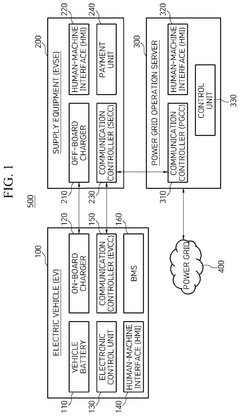
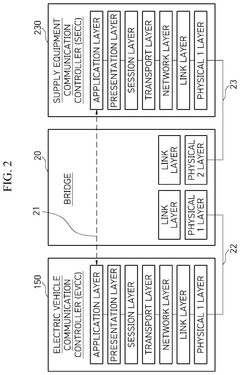
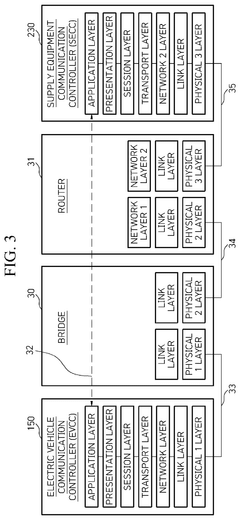
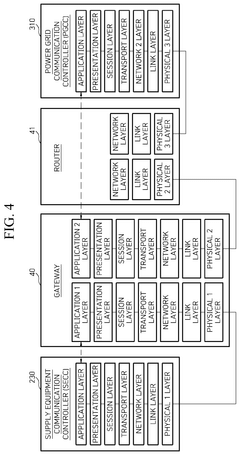
Communication method between electric vehicle, supply equipment and power grid operation server and power transmission device embedded in electric vehicle
PatentActiveUS12103424B2
Innovation
- A communication method and system are established between electric vehicles, supply equipment, and the power grid, enabling the transmission of discharge schedules, cost calculations, and authorization messages to facilitate efficient energy transfer and billing through an electric vehicle communication controller, a supply equipment communication controller, and a power grid communication controller.
Priority based vehicle control strategy
PatentActiveUS9987940B2
Innovation
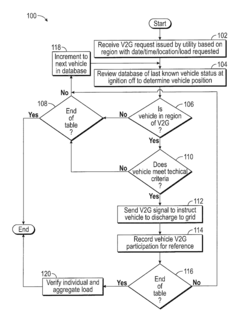
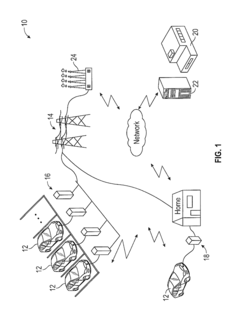
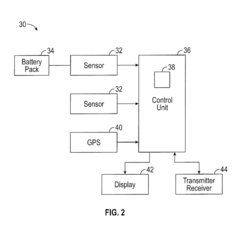
- A method and system that prioritize V2G requests based on vehicle location and historical data to select vehicles that meet specific criteria, such as state of charge, charge cycles, and geographic proximity, to reduce battery degradation, involving a network with a server that determines eligible vehicles and sends signals for participation, thereby limiting V2G participation and extending battery life.
Economic Impacts of V2G Policies
The economic impacts of Vehicle-to-Grid (V2G) policies are multifaceted and far-reaching, affecting various stakeholders in the energy and transportation sectors. These policies have the potential to create new revenue streams for electric vehicle (EV) owners, reduce electricity costs for consumers, and enhance grid stability.
One of the primary economic benefits of V2G policies is the creation of a new market for ancillary services. By allowing EVs to participate in grid balancing and frequency regulation, V2G enables vehicle owners to monetize their battery storage capacity. This can significantly offset the higher upfront costs of EVs, making them more attractive to consumers and potentially accelerating EV adoption rates.
For utilities and grid operators, V2G policies can lead to reduced infrastructure costs. By leveraging the distributed storage capacity of EVs, utilities may be able to defer or avoid costly investments in peaker plants and grid upgrades. This could result in lower electricity rates for all consumers, not just EV owners.
The implementation of V2G policies also has the potential to stimulate job creation in the clean energy sector. As V2G technology becomes more widespread, there will be increased demand for skilled workers in areas such as smart grid technology, EV charging infrastructure, and energy management systems.
However, the economic impacts of V2G policies are not without challenges. The initial costs of implementing V2G infrastructure, including bidirectional chargers and advanced metering systems, can be substantial. These costs may be borne by utilities, EV owners, or shared between stakeholders, depending on the specific policy framework.
Furthermore, V2G policies may have implications for the automotive industry. As EVs become more integrated with the grid, automakers may need to adapt their vehicle designs and warranties to accommodate more frequent charging and discharging cycles. This could lead to increased research and development costs, which may be passed on to consumers.
The economic impacts of V2G policies also extend to the broader energy market. By enabling more efficient use of renewable energy sources, V2G can help reduce reliance on fossil fuels, potentially impacting traditional energy producers. Conversely, it may create new opportunities for renewable energy developers and energy storage providers.
In conclusion, while V2G policies offer significant economic potential, their successful implementation requires careful consideration of costs, benefits, and impacts across multiple sectors. Policymakers must balance the interests of various stakeholders to maximize the economic benefits while mitigating potential drawbacks.
One of the primary economic benefits of V2G policies is the creation of a new market for ancillary services. By allowing EVs to participate in grid balancing and frequency regulation, V2G enables vehicle owners to monetize their battery storage capacity. This can significantly offset the higher upfront costs of EVs, making them more attractive to consumers and potentially accelerating EV adoption rates.
For utilities and grid operators, V2G policies can lead to reduced infrastructure costs. By leveraging the distributed storage capacity of EVs, utilities may be able to defer or avoid costly investments in peaker plants and grid upgrades. This could result in lower electricity rates for all consumers, not just EV owners.
The implementation of V2G policies also has the potential to stimulate job creation in the clean energy sector. As V2G technology becomes more widespread, there will be increased demand for skilled workers in areas such as smart grid technology, EV charging infrastructure, and energy management systems.
However, the economic impacts of V2G policies are not without challenges. The initial costs of implementing V2G infrastructure, including bidirectional chargers and advanced metering systems, can be substantial. These costs may be borne by utilities, EV owners, or shared between stakeholders, depending on the specific policy framework.
Furthermore, V2G policies may have implications for the automotive industry. As EVs become more integrated with the grid, automakers may need to adapt their vehicle designs and warranties to accommodate more frequent charging and discharging cycles. This could lead to increased research and development costs, which may be passed on to consumers.
The economic impacts of V2G policies also extend to the broader energy market. By enabling more efficient use of renewable energy sources, V2G can help reduce reliance on fossil fuels, potentially impacting traditional energy producers. Conversely, it may create new opportunities for renewable energy developers and energy storage providers.
In conclusion, while V2G policies offer significant economic potential, their successful implementation requires careful consideration of costs, benefits, and impacts across multiple sectors. Policymakers must balance the interests of various stakeholders to maximize the economic benefits while mitigating potential drawbacks.
International V2G Policy Comparison
Vehicle-to-Grid (V2G) technology has gained significant attention globally as a potential solution for grid stability and renewable energy integration. However, the implementation of V2G systems varies widely across different countries due to diverse policy frameworks and regulatory environments.
In the United States, V2G policies are primarily driven by state-level initiatives. California leads the way with its ambitious zero-emission vehicle mandate and supportive policies for electric vehicle (EV) integration into the grid. The state's Public Utilities Commission has approved pilot programs for V2G, allowing EV owners to sell electricity back to the grid during peak demand periods. Other states, such as New York and Massachusetts, have also introduced policies to encourage V2G adoption, including incentives for V2G-capable charging infrastructure.
The European Union has taken a more coordinated approach to V2G implementation. The EU's Clean Energy Package, adopted in 2019, includes provisions for aggregators and demand response services, which are crucial for V2G deployment. Countries like Denmark and the Netherlands have been at the forefront of V2G trials and policy development. Denmark, in particular, has implemented favorable regulations for V2G, including reduced electricity taxes for EV owners participating in grid services.
Japan has been a pioneer in V2G technology, with its CHAdeMO charging standard supporting bidirectional charging. The country's V2G policies are closely tied to its broader energy security and disaster resilience strategies. Following the Fukushima disaster, Japan has promoted V2G as part of its efforts to create a more resilient and decentralized energy system.
China, the world's largest EV market, has recently begun to explore V2G technology. While specific V2G policies are still in development, the country's broader push for smart grid technologies and EV adoption provides a favorable environment for future V2G implementation. Pilot projects are underway in cities like Beijing and Shenzhen, with the government closely monitoring their results to inform future policy decisions.
The United Kingdom has taken a proactive approach to V2G, with the government funding numerous pilot projects and research initiatives. The UK's regulatory body, Ofgem, has introduced reforms to support V2G services, including changes to electricity market rules to allow for more flexible grid connections and services.
In the United States, V2G policies are primarily driven by state-level initiatives. California leads the way with its ambitious zero-emission vehicle mandate and supportive policies for electric vehicle (EV) integration into the grid. The state's Public Utilities Commission has approved pilot programs for V2G, allowing EV owners to sell electricity back to the grid during peak demand periods. Other states, such as New York and Massachusetts, have also introduced policies to encourage V2G adoption, including incentives for V2G-capable charging infrastructure.
The European Union has taken a more coordinated approach to V2G implementation. The EU's Clean Energy Package, adopted in 2019, includes provisions for aggregators and demand response services, which are crucial for V2G deployment. Countries like Denmark and the Netherlands have been at the forefront of V2G trials and policy development. Denmark, in particular, has implemented favorable regulations for V2G, including reduced electricity taxes for EV owners participating in grid services.
Japan has been a pioneer in V2G technology, with its CHAdeMO charging standard supporting bidirectional charging. The country's V2G policies are closely tied to its broader energy security and disaster resilience strategies. Following the Fukushima disaster, Japan has promoted V2G as part of its efforts to create a more resilient and decentralized energy system.
China, the world's largest EV market, has recently begun to explore V2G technology. While specific V2G policies are still in development, the country's broader push for smart grid technologies and EV adoption provides a favorable environment for future V2G implementation. Pilot projects are underway in cities like Beijing and Shenzhen, with the government closely monitoring their results to inform future policy decisions.
The United Kingdom has taken a proactive approach to V2G, with the government funding numerous pilot projects and research initiatives. The UK's regulatory body, Ofgem, has introduced reforms to support V2G services, including changes to electricity market rules to allow for more flexible grid connections and services.
Unlock deeper insights with Patsnap Eureka Quick Research — get a full tech report to explore trends and direct your research. Try now!
Generate Your Research Report Instantly with AI Agent
Supercharge your innovation with Patsnap Eureka AI Agent Platform!