

Borosilicate Glass Viscosity under Variable Conditions
JUL 3, 20259 MIN READ
Generate Your Research Report Instantly with AI Agent
PatSnap Eureka helps you evaluate technical feasibility & market potential.
Borosilicate Glass Viscosity Research Objectives
The research on borosilicate glass viscosity under variable conditions aims to comprehensively understand and predict the behavior of this versatile material across a wide range of temperatures and compositions. This study is crucial for optimizing manufacturing processes, enhancing product quality, and expanding the application scope of borosilicate glass in various industries.
The primary objective is to develop a robust model that accurately describes the viscosity of borosilicate glass as a function of temperature, composition, and other relevant parameters. This model will serve as a powerful tool for glass manufacturers, enabling them to fine-tune their production processes and achieve desired material properties with greater precision.
Another key goal is to investigate the effects of minor compositional changes on the viscosity of borosilicate glass. This includes studying the impact of various additives and impurities that may be present in raw materials or introduced during the manufacturing process. Understanding these subtle influences will allow for better control over the final product characteristics and potentially lead to the development of new glass formulations with enhanced properties.
The research also aims to explore the viscosity behavior of borosilicate glass under extreme conditions, such as very high temperatures or rapid cooling rates. This knowledge is particularly valuable for applications in aerospace, nuclear energy, and other high-performance sectors where materials are subjected to extreme environments.
Furthermore, the study seeks to establish a comprehensive database of viscosity measurements for a wide range of borosilicate glass compositions. This database will serve as a valuable resource for researchers and industry professionals, facilitating the development of new products and processes.
An additional objective is to investigate the relationship between viscosity and other important properties of borosilicate glass, such as thermal expansion, chemical durability, and optical characteristics. This holistic approach will provide a more complete understanding of the material's behavior and enable more informed decision-making in glass design and application.
Lastly, the research aims to develop and validate new experimental techniques for measuring glass viscosity with higher accuracy and over a broader range of conditions. This may involve the use of advanced sensors, high-temperature furnaces, or novel rheological methods. Improving measurement capabilities will not only enhance the quality of the collected data but also push the boundaries of what can be studied in glass science.
The primary objective is to develop a robust model that accurately describes the viscosity of borosilicate glass as a function of temperature, composition, and other relevant parameters. This model will serve as a powerful tool for glass manufacturers, enabling them to fine-tune their production processes and achieve desired material properties with greater precision.
Another key goal is to investigate the effects of minor compositional changes on the viscosity of borosilicate glass. This includes studying the impact of various additives and impurities that may be present in raw materials or introduced during the manufacturing process. Understanding these subtle influences will allow for better control over the final product characteristics and potentially lead to the development of new glass formulations with enhanced properties.
The research also aims to explore the viscosity behavior of borosilicate glass under extreme conditions, such as very high temperatures or rapid cooling rates. This knowledge is particularly valuable for applications in aerospace, nuclear energy, and other high-performance sectors where materials are subjected to extreme environments.
Furthermore, the study seeks to establish a comprehensive database of viscosity measurements for a wide range of borosilicate glass compositions. This database will serve as a valuable resource for researchers and industry professionals, facilitating the development of new products and processes.
An additional objective is to investigate the relationship between viscosity and other important properties of borosilicate glass, such as thermal expansion, chemical durability, and optical characteristics. This holistic approach will provide a more complete understanding of the material's behavior and enable more informed decision-making in glass design and application.
Lastly, the research aims to develop and validate new experimental techniques for measuring glass viscosity with higher accuracy and over a broader range of conditions. This may involve the use of advanced sensors, high-temperature furnaces, or novel rheological methods. Improving measurement capabilities will not only enhance the quality of the collected data but also push the boundaries of what can be studied in glass science.
Market Applications of Borosilicate Glass
Borosilicate glass has established itself as a versatile material with a wide range of market applications, primarily due to its exceptional thermal and chemical resistance properties. In the laboratory and scientific equipment sector, borosilicate glass is the material of choice for beakers, test tubes, and other vessels that must withstand extreme temperature changes and corrosive chemicals. Its low coefficient of thermal expansion makes it ideal for precision optical components, including telescope mirrors and high-quality lenses used in microscopes and cameras.
The pharmaceutical industry heavily relies on borosilicate glass for packaging and storage solutions. Its inert nature ensures that medications and vaccines remain stable and uncontaminated, even during long-term storage. This characteristic has made borosilicate glass an essential material in the production of vials and ampoules for injectable drugs and vaccines, contributing significantly to global health initiatives.
In the culinary world, borosilicate glass has gained popularity for cookware and bakeware. Its ability to withstand rapid temperature changes allows for seamless transitions from freezer to oven, making it a favorite among both professional chefs and home cooks. The glass's clarity also enables easy monitoring of cooking progress, enhancing the user experience.
The automotive and aerospace industries utilize borosilicate glass in specialized applications. Its durability and resistance to thermal shock make it suitable for high-performance headlights, instrument panels, and even certain aerospace components where reliability under extreme conditions is crucial.
In the realm of renewable energy, borosilicate glass plays a vital role in solar thermal collectors and concentrated solar power systems. Its high transmittance of solar radiation and excellent heat resistance properties contribute to improved efficiency in these sustainable energy technologies.
The electronics industry benefits from borosilicate glass in the production of display screens, touchscreens, and semiconductor substrates. Its dimensional stability and ability to be precisely machined make it an excellent choice for these high-tech applications, where precision and reliability are paramount.
Architectural applications of borosilicate glass are expanding, particularly in high-performance building designs. Its use in fire-resistant glass panels and as a component in insulated glazing units contributes to improved building safety and energy efficiency.
As research on borosilicate glass viscosity under variable conditions continues, it is likely to unlock new potential applications and enhance existing ones. Understanding how viscosity changes under different temperatures and pressures could lead to more efficient manufacturing processes and innovative product designs across various industries.
The pharmaceutical industry heavily relies on borosilicate glass for packaging and storage solutions. Its inert nature ensures that medications and vaccines remain stable and uncontaminated, even during long-term storage. This characteristic has made borosilicate glass an essential material in the production of vials and ampoules for injectable drugs and vaccines, contributing significantly to global health initiatives.
In the culinary world, borosilicate glass has gained popularity for cookware and bakeware. Its ability to withstand rapid temperature changes allows for seamless transitions from freezer to oven, making it a favorite among both professional chefs and home cooks. The glass's clarity also enables easy monitoring of cooking progress, enhancing the user experience.
The automotive and aerospace industries utilize borosilicate glass in specialized applications. Its durability and resistance to thermal shock make it suitable for high-performance headlights, instrument panels, and even certain aerospace components where reliability under extreme conditions is crucial.
In the realm of renewable energy, borosilicate glass plays a vital role in solar thermal collectors and concentrated solar power systems. Its high transmittance of solar radiation and excellent heat resistance properties contribute to improved efficiency in these sustainable energy technologies.
The electronics industry benefits from borosilicate glass in the production of display screens, touchscreens, and semiconductor substrates. Its dimensional stability and ability to be precisely machined make it an excellent choice for these high-tech applications, where precision and reliability are paramount.
Architectural applications of borosilicate glass are expanding, particularly in high-performance building designs. Its use in fire-resistant glass panels and as a component in insulated glazing units contributes to improved building safety and energy efficiency.
As research on borosilicate glass viscosity under variable conditions continues, it is likely to unlock new potential applications and enhance existing ones. Understanding how viscosity changes under different temperatures and pressures could lead to more efficient manufacturing processes and innovative product designs across various industries.
Current Challenges in Viscosity Measurement
Measuring the viscosity of borosilicate glass under variable conditions presents several significant challenges that researchers and industry professionals must overcome. One of the primary difficulties lies in the high-temperature environment required for these measurements. Borosilicate glass typically has a working temperature range of 1000°C to 1500°C, which poses substantial technical hurdles for measurement equipment and sensors.
The extreme temperatures necessitate specialized apparatus that can withstand such conditions while maintaining accuracy and precision. Traditional viscometers often struggle to operate reliably at these elevated temperatures, leading to potential inaccuracies in measurements. Additionally, the corrosive nature of molten glass at high temperatures can cause degradation of measurement tools, further complicating the process.
Another challenge is the time-dependent nature of glass viscosity. Borosilicate glass exhibits complex rheological behavior, including time-dependent viscosity changes and potential structural relaxation. This makes it difficult to obtain consistent and reproducible measurements, as the viscosity can vary significantly depending on the thermal history and shear rate applied to the sample.
The presence of variable conditions introduces additional complexities. Factors such as temperature fluctuations, compositional variations, and atmospheric conditions can all influence the viscosity of borosilicate glass. Controlling these variables precisely during measurements is crucial but often challenging in practice. Even small deviations in temperature or composition can lead to substantial changes in viscosity, affecting the reliability of the results.
Furthermore, the non-Newtonian behavior of borosilicate glass at certain temperatures and shear rates complicates the interpretation of viscosity measurements. The viscosity may not be constant across different shear rates, requiring careful consideration of the measurement technique and data analysis methods employed.
The need for in-situ measurements in industrial settings adds another layer of difficulty. Real-time monitoring of glass viscosity during production processes is highly desirable but technically challenging. Developing robust sensors and measurement techniques that can operate reliably in harsh industrial environments while providing accurate, continuous viscosity data remains an ongoing area of research.
Lastly, the lack of standardized methods for measuring borosilicate glass viscosity under variable conditions hinders comparability between different studies and laboratories. Establishing universally accepted protocols and reference materials for viscosity measurements would greatly benefit the field but requires extensive collaborative efforts and validation studies.
The extreme temperatures necessitate specialized apparatus that can withstand such conditions while maintaining accuracy and precision. Traditional viscometers often struggle to operate reliably at these elevated temperatures, leading to potential inaccuracies in measurements. Additionally, the corrosive nature of molten glass at high temperatures can cause degradation of measurement tools, further complicating the process.
Another challenge is the time-dependent nature of glass viscosity. Borosilicate glass exhibits complex rheological behavior, including time-dependent viscosity changes and potential structural relaxation. This makes it difficult to obtain consistent and reproducible measurements, as the viscosity can vary significantly depending on the thermal history and shear rate applied to the sample.
The presence of variable conditions introduces additional complexities. Factors such as temperature fluctuations, compositional variations, and atmospheric conditions can all influence the viscosity of borosilicate glass. Controlling these variables precisely during measurements is crucial but often challenging in practice. Even small deviations in temperature or composition can lead to substantial changes in viscosity, affecting the reliability of the results.
Furthermore, the non-Newtonian behavior of borosilicate glass at certain temperatures and shear rates complicates the interpretation of viscosity measurements. The viscosity may not be constant across different shear rates, requiring careful consideration of the measurement technique and data analysis methods employed.
The need for in-situ measurements in industrial settings adds another layer of difficulty. Real-time monitoring of glass viscosity during production processes is highly desirable but technically challenging. Developing robust sensors and measurement techniques that can operate reliably in harsh industrial environments while providing accurate, continuous viscosity data remains an ongoing area of research.
Lastly, the lack of standardized methods for measuring borosilicate glass viscosity under variable conditions hinders comparability between different studies and laboratories. Establishing universally accepted protocols and reference materials for viscosity measurements would greatly benefit the field but requires extensive collaborative efforts and validation studies.
Existing Viscosity Measurement Techniques
01 Composition control for viscosity adjustment
The viscosity of borosilicate glass can be adjusted by controlling its composition. This involves carefully balancing the proportions of silica, boron oxide, and other components to achieve the desired viscosity characteristics. Modifying the ratio of network formers to network modifiers can significantly impact the glass's flow behavior at different temperatures.- Composition control for viscosity adjustment: The viscosity of borosilicate glass can be adjusted by controlling its composition. This involves carefully balancing the proportions of silica, boron oxide, and other components to achieve the desired viscosity characteristics. Modifying the ratio of network formers and modifiers in the glass composition allows for fine-tuning of the viscosity properties.
- Temperature-dependent viscosity behavior: Borosilicate glass exhibits temperature-dependent viscosity behavior. Understanding and controlling this relationship is crucial for various manufacturing processes. The viscosity-temperature curve of borosilicate glass can be manipulated through composition adjustments and heat treatment methods to optimize its performance in specific applications.
- Viscosity modification through additives: The addition of specific compounds or elements can significantly impact the viscosity of borosilicate glass. These additives can act as network modifiers or intermediates, altering the glass structure and consequently its viscosity. Careful selection and proportion of additives allow for tailored viscosity properties suitable for various industrial applications.
- Heat treatment effects on viscosity: Heat treatment processes, including annealing and tempering, can influence the viscosity of borosilicate glass. These thermal treatments affect the glass structure, relaxation state, and consequently its viscosity characteristics. Controlled heating and cooling cycles can be employed to achieve desired viscosity profiles for specific manufacturing requirements.
- Measurement and characterization techniques: Accurate measurement and characterization of borosilicate glass viscosity are essential for quality control and process optimization. Various techniques, including rotational viscometry, fiber elongation, and beam-bending methods, can be employed to determine viscosity across different temperature ranges. Advanced analytical tools and standardized procedures ensure reliable viscosity data for research and industrial applications.
02 Temperature-dependent viscosity control
Borosilicate glass viscosity is highly temperature-dependent. Precise control of temperature during the melting, forming, and cooling processes is crucial for achieving the desired viscosity at different stages of glass production. This involves using specialized heating and cooling equipment to maintain optimal temperature profiles throughout the manufacturing process.Expand Specific Solutions03 Additives for viscosity modification
Various additives can be incorporated into borosilicate glass formulations to modify its viscosity. These may include fluxing agents to lower the melting temperature and viscosity, or stabilizers to increase viscosity at certain temperature ranges. The careful selection and proportion of these additives allow for fine-tuning of the glass's flow characteristics.Expand Specific Solutions04 Measurement and characterization techniques
Accurate measurement and characterization of borosilicate glass viscosity are essential for quality control and process optimization. This involves using specialized equipment such as rotational viscometers, fiber elongation methods, or beam-bending techniques. Advanced analytical methods may also be employed to understand the relationship between glass structure and its viscosity behavior.Expand Specific Solutions05 Processing methods for viscosity control
Various processing methods can be employed to control the viscosity of borosilicate glass during manufacturing. These may include specific melting and refining protocols, controlled cooling rates, and post-forming heat treatments. The choice of processing method can significantly influence the final viscosity characteristics of the glass product.Expand Specific Solutions
Key Players in Borosilicate Glass Industry
The research on borosilicate glass viscosity under variable conditions is in a mature stage of development, with a significant market presence and established technological expertise. The global borosilicate glass market is substantial, driven by applications in pharmaceuticals, laboratory equipment, and consumer goods. Major players like SCHOTT AG, Corning, Inc., and AGC, Inc. have advanced research capabilities and extensive product portfolios in this field. These companies, along with emerging players such as Hunan Kibing Pharmaceutical Material Technology Co., Ltd. and Zhangzhou Kibing Glass Co., Ltd., are continuously innovating to improve glass properties and manufacturing processes. The competitive landscape is characterized by a mix of established multinational corporations and specialized regional manufacturers, all contributing to the ongoing technological advancements in borosilicate glass viscosity research.
SCHOTT AG
Technical Solution: SCHOTT AG has developed advanced techniques for studying borosilicate glass viscosity under variable conditions. They utilize high-temperature viscometers capable of measuring viscosities up to 10^15 Pa·s [1]. Their research involves analyzing the effects of temperature, pressure, and composition on viscosity. SCHOTT has implemented a unique rotational viscometer design that allows for precise measurements at temperatures up to 1700°C [2]. They have also developed computational models to predict viscosity changes based on glass composition and thermal history, enabling more efficient glass formulation processes [3].
Strengths: Extensive experience in glass manufacturing, advanced measurement techniques, and computational modeling capabilities. Weaknesses: High costs associated with specialized equipment and research facilities.
Corning, Inc.
Technical Solution: Corning's approach to researching borosilicate glass viscosity under variable conditions involves a combination of experimental and theoretical methods. They employ advanced rheometers capable of measuring viscosities across a wide range of temperatures and shear rates [4]. Corning has developed proprietary algorithms to extrapolate viscosity data to conditions beyond experimental limits. Their research also focuses on the impact of minor compositional changes on viscosity, utilizing high-precision analytical techniques such as X-ray fluorescence spectroscopy [5]. Corning has implemented in-situ viscosity measurement techniques in their glass melting processes, allowing for real-time adjustments to maintain optimal viscosity during production [6].
Strengths: Comprehensive research capabilities, integration of viscosity research into production processes. Weaknesses: Potential overreliance on proprietary methods, limiting collaboration opportunities.
Innovative Approaches to Viscosity Analysis
Borosilicate glass compositions and uses thereof
PatentWO2004050575A1
Innovation
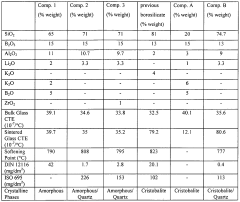
- A borosilicate glass composition with silicon dioxide, boric oxide, aluminum oxide, and at least one alkali oxide, which resists devitrification without the addition of inhibitor oxides, maintaining a suitable coefficient of thermal expansion and mechanical strength.
Borosilicate glass containing zinc oxide
PatentWO2002051764A2
Innovation
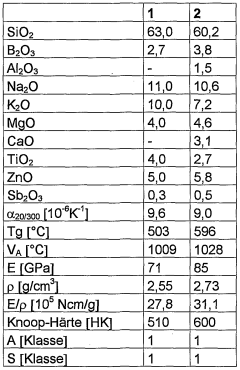
- Borosilicate glasses containing specific compositions such as 58-67% SiO2, 1-5% B2O3, up to 5% Al2O3, 8-17% Na2O, 3-12% MgO, 1-5% TiO2, and 2-8% ZnO, without Li2O, BaO, or P2O5, which enhance mechanical strength, chemical resistance, and crystallization stability, allowing for economical production and high-quality surface finishing.
Temperature Effects on Glass Viscosity
Temperature plays a crucial role in determining the viscosity of borosilicate glass, significantly impacting its processing and final properties. As the temperature increases, the viscosity of borosilicate glass decreases exponentially, following the Arrhenius equation. This relationship is fundamental to understanding and controlling glass behavior during manufacturing and application processes.
At lower temperatures, borosilicate glass exhibits high viscosity, behaving as a rigid solid. As the temperature rises, the glass transitions through various stages, including the strain point, annealing point, and softening point. These critical temperatures are essential reference points for glass processing and are specific to the composition of borosilicate glass.
The working range of borosilicate glass, where it can be shaped and formed, typically occurs between 1000°C and 1500°C. Within this range, the viscosity is low enough for the glass to be manipulated but high enough to maintain its shape. The precise working temperature depends on the specific composition and desired viscosity for the intended application.
Temperature fluctuations during processing can lead to significant variations in glass viscosity, potentially causing defects or inconsistencies in the final product. Therefore, precise temperature control is crucial in borosilicate glass manufacturing. Advanced temperature monitoring and control systems are employed to maintain stable conditions throughout the production process.
The temperature-viscosity relationship of borosilicate glass is also influenced by its chemical composition. The presence of boron oxide (B2O3) in the glass network contributes to its unique thermal properties, including a lower coefficient of thermal expansion compared to soda-lime glass. This characteristic makes borosilicate glass more resistant to thermal shock, expanding its range of applications.
Understanding the temperature effects on borosilicate glass viscosity is essential for optimizing manufacturing processes, such as glass blowing, molding, and drawing. It also informs the design of annealing schedules to relieve internal stresses and improve the mechanical strength of the final product. Furthermore, this knowledge is crucial for predicting glass behavior in high-temperature applications, such as laboratory glassware and industrial process equipment.
Research in this area continues to focus on developing more accurate models to predict viscosity changes across a wide temperature range, considering the complex interactions between different glass components. These efforts aim to enhance process control and enable the development of borosilicate glass compositions with tailored viscosity-temperature profiles for specific applications.
At lower temperatures, borosilicate glass exhibits high viscosity, behaving as a rigid solid. As the temperature rises, the glass transitions through various stages, including the strain point, annealing point, and softening point. These critical temperatures are essential reference points for glass processing and are specific to the composition of borosilicate glass.
The working range of borosilicate glass, where it can be shaped and formed, typically occurs between 1000°C and 1500°C. Within this range, the viscosity is low enough for the glass to be manipulated but high enough to maintain its shape. The precise working temperature depends on the specific composition and desired viscosity for the intended application.
Temperature fluctuations during processing can lead to significant variations in glass viscosity, potentially causing defects or inconsistencies in the final product. Therefore, precise temperature control is crucial in borosilicate glass manufacturing. Advanced temperature monitoring and control systems are employed to maintain stable conditions throughout the production process.
The temperature-viscosity relationship of borosilicate glass is also influenced by its chemical composition. The presence of boron oxide (B2O3) in the glass network contributes to its unique thermal properties, including a lower coefficient of thermal expansion compared to soda-lime glass. This characteristic makes borosilicate glass more resistant to thermal shock, expanding its range of applications.
Understanding the temperature effects on borosilicate glass viscosity is essential for optimizing manufacturing processes, such as glass blowing, molding, and drawing. It also informs the design of annealing schedules to relieve internal stresses and improve the mechanical strength of the final product. Furthermore, this knowledge is crucial for predicting glass behavior in high-temperature applications, such as laboratory glassware and industrial process equipment.
Research in this area continues to focus on developing more accurate models to predict viscosity changes across a wide temperature range, considering the complex interactions between different glass components. These efforts aim to enhance process control and enable the development of borosilicate glass compositions with tailored viscosity-temperature profiles for specific applications.
Composition-Viscosity Relationships
The composition-viscosity relationships in borosilicate glass are complex and multifaceted, influenced by various factors including temperature, pressure, and the specific chemical makeup of the glass. Borosilicate glass, known for its low thermal expansion coefficient and high chemical durability, exhibits unique viscosity characteristics that are crucial for its manufacturing processes and applications.
The primary components of borosilicate glass - silica, boron oxide, and alkali oxides - play distinct roles in determining its viscosity. Silica, the main network former, contributes to the glass's high viscosity and resistance to flow. Boron oxide, while also a network former, can act as both a network modifier and an intermediate oxide, depending on its concentration and the presence of alkali oxides. This dual nature of boron oxide significantly impacts the glass's viscosity, often leading to non-linear relationships between composition and viscosity.
Alkali oxides, typically sodium or potassium oxide, act as network modifiers and generally decrease the viscosity of the glass. However, their effect is not straightforward and can vary based on their concentration and interaction with other components. The alkali content influences the distribution of boron between three-coordinated and four-coordinated states, known as the boron anomaly, which in turn affects the glass's viscosity.
The ratio of network formers to modifiers is a critical factor in determining the viscosity of borosilicate glass. Higher proportions of network formers generally result in higher viscosities, while increased modifier content tends to lower viscosity. However, this relationship is not always linear, and certain compositional ranges can lead to unexpected viscosity behaviors.
Temperature plays a crucial role in the composition-viscosity relationship. As temperature increases, the viscosity of borosilicate glass decreases, but the rate of change can vary significantly depending on the glass composition. This temperature dependence is often described using models such as the Vogel-Fulcher-Tammann (VFT) equation, which relates viscosity to temperature and composition-dependent parameters.
The presence of other oxides, even in small quantities, can have substantial effects on the viscosity of borosilicate glass. For instance, alumina can increase viscosity by strengthening the glass network, while certain transition metal oxides may have more complex effects depending on their oxidation state and concentration.
Understanding these composition-viscosity relationships is essential for tailoring borosilicate glass properties for specific applications. It enables the optimization of melting and forming processes, as well as the development of glasses with desired flow characteristics for various industrial and scientific uses.
The primary components of borosilicate glass - silica, boron oxide, and alkali oxides - play distinct roles in determining its viscosity. Silica, the main network former, contributes to the glass's high viscosity and resistance to flow. Boron oxide, while also a network former, can act as both a network modifier and an intermediate oxide, depending on its concentration and the presence of alkali oxides. This dual nature of boron oxide significantly impacts the glass's viscosity, often leading to non-linear relationships between composition and viscosity.
Alkali oxides, typically sodium or potassium oxide, act as network modifiers and generally decrease the viscosity of the glass. However, their effect is not straightforward and can vary based on their concentration and interaction with other components. The alkali content influences the distribution of boron between three-coordinated and four-coordinated states, known as the boron anomaly, which in turn affects the glass's viscosity.
The ratio of network formers to modifiers is a critical factor in determining the viscosity of borosilicate glass. Higher proportions of network formers generally result in higher viscosities, while increased modifier content tends to lower viscosity. However, this relationship is not always linear, and certain compositional ranges can lead to unexpected viscosity behaviors.
Temperature plays a crucial role in the composition-viscosity relationship. As temperature increases, the viscosity of borosilicate glass decreases, but the rate of change can vary significantly depending on the glass composition. This temperature dependence is often described using models such as the Vogel-Fulcher-Tammann (VFT) equation, which relates viscosity to temperature and composition-dependent parameters.
The presence of other oxides, even in small quantities, can have substantial effects on the viscosity of borosilicate glass. For instance, alumina can increase viscosity by strengthening the glass network, while certain transition metal oxides may have more complex effects depending on their oxidation state and concentration.
Understanding these composition-viscosity relationships is essential for tailoring borosilicate glass properties for specific applications. It enables the optimization of melting and forming processes, as well as the development of glasses with desired flow characteristics for various industrial and scientific uses.
Unlock deeper insights with PatSnap Eureka Quick Research — get a full tech report to explore trends and direct your research. Try now!
Generate Your Research Report Instantly with AI Agent
Supercharge your innovation with PatSnap Eureka AI Agent Platform!