

Signal Integrity vs Crosstalk Coupling
MAR 26, 20269 MIN READ
Generate Your Research Report Instantly with AI Agent
PatSnap Eureka helps you evaluate technical feasibility & market potential.
Signal Integrity Design Background and Objectives
Signal integrity has emerged as one of the most critical challenges in modern electronic system design, fundamentally driven by the relentless pursuit of higher data rates, increased circuit density, and miniaturization of electronic devices. As digital systems operate at frequencies extending into the multi-gigahertz range, the traditional assumptions of ideal signal transmission have become obsolete, necessitating sophisticated approaches to maintain signal quality and system reliability.
The evolution of signal integrity concerns parallels the advancement of semiconductor technology and packaging innovations. In early digital systems operating below 100 MHz, signal integrity issues were relatively manageable through basic design practices. However, as clock frequencies surpassed the gigahertz threshold and rise times decreased to picosecond ranges, electromagnetic effects previously considered negligible began to dominate system performance. This transition marked the beginning of signal integrity as a distinct engineering discipline.
Crosstalk coupling represents a particularly insidious manifestation of signal integrity degradation, arising from electromagnetic coupling between adjacent signal paths. This phenomenon occurs through both capacitive and inductive coupling mechanisms, where energy from an aggressor signal unintentionally transfers to nearby victim traces. The severity of crosstalk coupling intensifies with increasing frequency content, closer trace spacing, and longer parallel routing segments, making it a primary concern in high-density circuit board designs.
The fundamental objective of signal integrity design is to ensure reliable data transmission while minimizing electromagnetic interference effects. This encompasses maintaining signal amplitude within acceptable margins, controlling timing variations, and preventing excessive noise coupling between circuits. Achieving these objectives requires comprehensive understanding of transmission line theory, electromagnetic field interactions, and advanced simulation methodologies.
Contemporary signal integrity challenges extend beyond traditional crosstalk mitigation to encompass power delivery network optimization, simultaneous switching noise control, and electromagnetic compatibility considerations. The integration of high-speed digital, analog, and radio frequency circuits on single platforms further complicates the design landscape, demanding holistic approaches that address multiple interference mechanisms simultaneously.
The strategic importance of signal integrity design continues to escalate as emerging technologies such as artificial intelligence accelerators, 5G communications, and autonomous systems push performance boundaries. These applications demand unprecedented levels of signal fidelity while operating within increasingly constrained physical and power budgets, establishing signal integrity as a fundamental enabler of next-generation electronic systems.
The evolution of signal integrity concerns parallels the advancement of semiconductor technology and packaging innovations. In early digital systems operating below 100 MHz, signal integrity issues were relatively manageable through basic design practices. However, as clock frequencies surpassed the gigahertz threshold and rise times decreased to picosecond ranges, electromagnetic effects previously considered negligible began to dominate system performance. This transition marked the beginning of signal integrity as a distinct engineering discipline.
Crosstalk coupling represents a particularly insidious manifestation of signal integrity degradation, arising from electromagnetic coupling between adjacent signal paths. This phenomenon occurs through both capacitive and inductive coupling mechanisms, where energy from an aggressor signal unintentionally transfers to nearby victim traces. The severity of crosstalk coupling intensifies with increasing frequency content, closer trace spacing, and longer parallel routing segments, making it a primary concern in high-density circuit board designs.
The fundamental objective of signal integrity design is to ensure reliable data transmission while minimizing electromagnetic interference effects. This encompasses maintaining signal amplitude within acceptable margins, controlling timing variations, and preventing excessive noise coupling between circuits. Achieving these objectives requires comprehensive understanding of transmission line theory, electromagnetic field interactions, and advanced simulation methodologies.
Contemporary signal integrity challenges extend beyond traditional crosstalk mitigation to encompass power delivery network optimization, simultaneous switching noise control, and electromagnetic compatibility considerations. The integration of high-speed digital, analog, and radio frequency circuits on single platforms further complicates the design landscape, demanding holistic approaches that address multiple interference mechanisms simultaneously.
The strategic importance of signal integrity design continues to escalate as emerging technologies such as artificial intelligence accelerators, 5G communications, and autonomous systems push performance boundaries. These applications demand unprecedented levels of signal fidelity while operating within increasingly constrained physical and power budgets, establishing signal integrity as a fundamental enabler of next-generation electronic systems.
Market Demand for High-Speed Signal Processing Solutions
The global electronics industry is experiencing unprecedented demand for high-speed signal processing solutions as digital transformation accelerates across multiple sectors. Modern electronic systems require increasingly sophisticated signal integrity management capabilities to handle data rates that continue to escalate year over year. This demand stems from the proliferation of high-performance computing applications, advanced telecommunications infrastructure, and emerging technologies such as artificial intelligence and machine learning platforms.
Data centers represent one of the most significant growth drivers for high-speed signal processing solutions. Cloud computing providers and enterprise data centers are continuously upgrading their infrastructure to support higher bandwidth requirements and reduced latency specifications. These facilities require advanced signal integrity solutions to maintain reliable data transmission across complex interconnect systems while minimizing crosstalk interference between adjacent signal paths.
The telecommunications sector is undergoing a fundamental transformation with the widespread deployment of next-generation wireless networks and fiber-optic communication systems. Network equipment manufacturers face increasing pressure to deliver solutions that can handle multi-gigabit data rates while maintaining signal quality across diverse operating environments. This has created substantial market opportunities for companies specializing in crosstalk mitigation technologies and signal integrity optimization tools.
Consumer electronics manufacturers are also driving significant demand for high-speed signal processing capabilities. Modern smartphones, tablets, and gaming devices incorporate increasingly complex circuitry that operates at higher frequencies and tighter spacing constraints. These design challenges necessitate advanced signal integrity solutions to prevent performance degradation caused by electromagnetic interference and crosstalk coupling effects.
The automotive industry represents an emerging but rapidly expanding market segment for high-speed signal processing solutions. Advanced driver assistance systems, autonomous vehicle technologies, and in-vehicle entertainment platforms require robust signal integrity management to ensure reliable operation in challenging electromagnetic environments. This sector demands solutions that can maintain signal quality while meeting stringent automotive reliability and safety standards.
Industrial automation and Internet of Things applications are creating additional market demand for specialized signal processing solutions. Manufacturing facilities increasingly rely on high-speed communication networks to connect sensors, controllers, and monitoring systems. These applications require signal integrity solutions that can operate reliably in harsh industrial environments while maintaining precise timing and data accuracy requirements.
Data centers represent one of the most significant growth drivers for high-speed signal processing solutions. Cloud computing providers and enterprise data centers are continuously upgrading their infrastructure to support higher bandwidth requirements and reduced latency specifications. These facilities require advanced signal integrity solutions to maintain reliable data transmission across complex interconnect systems while minimizing crosstalk interference between adjacent signal paths.
The telecommunications sector is undergoing a fundamental transformation with the widespread deployment of next-generation wireless networks and fiber-optic communication systems. Network equipment manufacturers face increasing pressure to deliver solutions that can handle multi-gigabit data rates while maintaining signal quality across diverse operating environments. This has created substantial market opportunities for companies specializing in crosstalk mitigation technologies and signal integrity optimization tools.
Consumer electronics manufacturers are also driving significant demand for high-speed signal processing capabilities. Modern smartphones, tablets, and gaming devices incorporate increasingly complex circuitry that operates at higher frequencies and tighter spacing constraints. These design challenges necessitate advanced signal integrity solutions to prevent performance degradation caused by electromagnetic interference and crosstalk coupling effects.
The automotive industry represents an emerging but rapidly expanding market segment for high-speed signal processing solutions. Advanced driver assistance systems, autonomous vehicle technologies, and in-vehicle entertainment platforms require robust signal integrity management to ensure reliable operation in challenging electromagnetic environments. This sector demands solutions that can maintain signal quality while meeting stringent automotive reliability and safety standards.
Industrial automation and Internet of Things applications are creating additional market demand for specialized signal processing solutions. Manufacturing facilities increasingly rely on high-speed communication networks to connect sensors, controllers, and monitoring systems. These applications require signal integrity solutions that can operate reliably in harsh industrial environments while maintaining precise timing and data accuracy requirements.
Current Crosstalk Challenges in Signal Integrity Design
Modern high-speed digital systems face unprecedented challenges in managing crosstalk coupling effects that significantly impact signal integrity performance. As data rates continue to escalate beyond 100 Gbps and circuit densities increase exponentially, traditional design methodologies struggle to maintain acceptable signal quality levels. The fundamental challenge lies in the electromagnetic coupling between adjacent transmission lines, which creates unwanted interference that can corrupt data transmission and compromise system reliability.
Near-end crosstalk (NEXT) and far-end crosstalk (FEXT) represent the primary coupling mechanisms that designers must address. NEXT occurs when energy couples from an aggressor line to a victim line at the same end, creating immediate interference that can overwhelm receiver sensitivity. FEXT manifests as coupled energy traveling in the same direction as the victim signal, potentially causing timing violations and amplitude distortions that degrade bit error rates.
The proliferation of differential signaling standards has introduced additional complexity through mode conversion effects. Common-mode to differential-mode coupling transforms balanced signals into unbalanced interference, while differential-mode to common-mode conversion can violate electromagnetic compatibility requirements. These mode conversion phenomena become particularly problematic in high-density connector interfaces and via transition regions where geometric asymmetries are unavoidable.
Advanced packaging technologies present unique crosstalk challenges that traditional PCB design rules cannot adequately address. Three-dimensional integrated circuits, system-in-package configurations, and through-silicon via structures create complex electromagnetic environments where conventional isolation techniques prove insufficient. The reduced physical dimensions and increased layer counts in these advanced packages amplify coupling coefficients and extend the frequency range over which crosstalk effects remain significant.
Power delivery network interactions with signal crosstalk represent an emerging challenge area. Simultaneous switching noise couples with crosstalk mechanisms to create composite interference patterns that are difficult to predict using traditional simulation approaches. The dynamic impedance variations caused by power supply fluctuations can modulate crosstalk coupling strength, leading to time-varying interference characteristics that complicate system-level timing analysis.
Measurement and characterization of crosstalk effects at multi-gigahertz frequencies pose significant technical obstacles. Traditional time-domain reflectometry techniques lack sufficient bandwidth and dynamic range to accurately capture fast-edge crosstalk transients. Vector network analyzer measurements require sophisticated de-embedding procedures to separate intrinsic crosstalk from measurement fixture effects, while maintaining phase accuracy across wide frequency ranges remains challenging.
The integration of artificial intelligence and machine learning algorithms into signal integrity design flows has revealed new crosstalk optimization challenges. While these tools can identify complex coupling patterns that human designers might overlook, they require extensive training datasets that accurately represent real-world manufacturing variations and environmental conditions. The black-box nature of many AI optimization algorithms also makes it difficult to understand and validate the physical mechanisms underlying their crosstalk mitigation strategies.
Near-end crosstalk (NEXT) and far-end crosstalk (FEXT) represent the primary coupling mechanisms that designers must address. NEXT occurs when energy couples from an aggressor line to a victim line at the same end, creating immediate interference that can overwhelm receiver sensitivity. FEXT manifests as coupled energy traveling in the same direction as the victim signal, potentially causing timing violations and amplitude distortions that degrade bit error rates.
The proliferation of differential signaling standards has introduced additional complexity through mode conversion effects. Common-mode to differential-mode coupling transforms balanced signals into unbalanced interference, while differential-mode to common-mode conversion can violate electromagnetic compatibility requirements. These mode conversion phenomena become particularly problematic in high-density connector interfaces and via transition regions where geometric asymmetries are unavoidable.
Advanced packaging technologies present unique crosstalk challenges that traditional PCB design rules cannot adequately address. Three-dimensional integrated circuits, system-in-package configurations, and through-silicon via structures create complex electromagnetic environments where conventional isolation techniques prove insufficient. The reduced physical dimensions and increased layer counts in these advanced packages amplify coupling coefficients and extend the frequency range over which crosstalk effects remain significant.
Power delivery network interactions with signal crosstalk represent an emerging challenge area. Simultaneous switching noise couples with crosstalk mechanisms to create composite interference patterns that are difficult to predict using traditional simulation approaches. The dynamic impedance variations caused by power supply fluctuations can modulate crosstalk coupling strength, leading to time-varying interference characteristics that complicate system-level timing analysis.
Measurement and characterization of crosstalk effects at multi-gigahertz frequencies pose significant technical obstacles. Traditional time-domain reflectometry techniques lack sufficient bandwidth and dynamic range to accurately capture fast-edge crosstalk transients. Vector network analyzer measurements require sophisticated de-embedding procedures to separate intrinsic crosstalk from measurement fixture effects, while maintaining phase accuracy across wide frequency ranges remains challenging.
The integration of artificial intelligence and machine learning algorithms into signal integrity design flows has revealed new crosstalk optimization challenges. While these tools can identify complex coupling patterns that human designers might overlook, they require extensive training datasets that accurately represent real-world manufacturing variations and environmental conditions. The black-box nature of many AI optimization algorithms also makes it difficult to understand and validate the physical mechanisms underlying their crosstalk mitigation strategies.
Existing Crosstalk Coupling Reduction Techniques
01 Differential signaling and balanced transmission line design
Differential signaling techniques can be employed to reduce crosstalk and improve signal integrity by transmitting signals on paired conductors with opposite polarity. Balanced transmission line structures help minimize electromagnetic interference by ensuring equal and opposite currents flow through the signal paths. This approach reduces common-mode noise and enhances immunity to external interference. Proper impedance matching and controlled spacing between differential pairs further optimize signal quality and reduce coupling effects.- Differential signaling and balanced transmission line design: Differential signaling techniques can be employed to reduce crosstalk and improve signal integrity by transmitting signals on paired conductors with opposite polarity. Balanced transmission line structures help minimize electromagnetic interference by ensuring equal and opposite currents flow through the signal paths, effectively canceling out radiated emissions. This approach significantly reduces susceptibility to external noise and crosstalk between adjacent signal lines, making it particularly effective for high-speed data transmission applications.
- Shielding and grounding structures for EMI reduction: Implementation of shielding structures and proper grounding techniques can effectively mitigate electromagnetic interference and crosstalk coupling. Shielding layers can be strategically placed between signal traces or around sensitive circuits to block electromagnetic fields. Ground planes and guard traces provide low-impedance return paths and act as barriers to prevent coupling between signals. These structures are essential for maintaining signal quality in high-density circuit designs where multiple signals operate in close proximity.
- Signal trace routing and spacing optimization: Optimizing the physical layout of signal traces through careful routing and spacing can minimize crosstalk and improve signal integrity. Increasing the distance between parallel signal traces reduces capacitive and inductive coupling. Implementing orthogonal routing strategies where traces on adjacent layers run perpendicular to each other further decreases crosstalk. Controlled impedance routing ensures signal reflections are minimized, maintaining signal quality throughout the transmission path.
- Termination and impedance matching techniques: Proper termination and impedance matching are critical for maintaining signal integrity and reducing reflections that can cause crosstalk and electromagnetic interference. Termination resistors can be placed at the end of transmission lines to absorb signal energy and prevent reflections. Impedance matching between drivers, transmission lines, and receivers ensures maximum power transfer and minimal signal distortion. These techniques are particularly important in high-frequency applications where even small impedance mismatches can significantly degrade signal quality.
- Active crosstalk cancellation and compensation circuits: Active circuit techniques can be implemented to detect and cancel crosstalk effects in real-time, improving overall signal quality. Compensation circuits can sense the crosstalk-induced noise on victim lines and generate cancellation signals to counteract the interference. Adaptive equalization and pre-emphasis techniques can be employed to compensate for signal degradation caused by crosstalk and other channel impairments. These active methods are particularly useful in high-speed communication systems where passive techniques alone may be insufficient.
02 Shielding and grounding structures for EMI reduction
Electromagnetic shielding structures can be implemented to contain and redirect electromagnetic fields, preventing interference between adjacent signal paths. Ground plane configurations and via placement strategies help establish low-impedance return paths for high-frequency signals. Multi-layer board designs with dedicated ground and power planes provide effective isolation between signal layers. Shielding techniques include the use of conductive barriers, guard traces, and grounded metal enclosures to minimize radiation and susceptibility to external interference.Expand Specific Solutions03 Signal routing and trace geometry optimization
Careful routing of signal traces with controlled spacing and geometry can significantly reduce crosstalk coupling between adjacent conductors. Techniques include maintaining adequate separation between parallel traces, minimizing parallel run lengths, and using orthogonal routing on adjacent layers. Trace width and thickness optimization ensures proper impedance control and reduces signal reflections. Serpentine routing and length matching techniques help maintain signal timing integrity in high-speed applications.Expand Specific Solutions04 Termination and impedance matching techniques
Proper termination schemes at signal endpoints prevent reflections and ringing that can degrade signal quality and increase crosstalk. Impedance matching throughout the signal path ensures maximum power transfer and minimizes standing waves. Various termination methods include series termination, parallel termination, and AC termination, each suited for different applications. Controlled impedance design of transmission lines maintains signal integrity by matching the characteristic impedance of the medium to the source and load impedances.Expand Specific Solutions05 Filtering and decoupling for noise suppression
Filtering circuits and decoupling capacitors can be strategically placed to suppress high-frequency noise and reduce electromagnetic interference. Power supply decoupling at integrated circuit pins helps maintain stable voltage levels and reduces noise coupling into signal paths. Common-mode and differential-mode filters attenuate unwanted frequency components while preserving signal integrity. Ferrite beads and inductors provide additional impedance at high frequencies to block noise propagation between circuit sections.Expand Specific Solutions
Key Players in Signal Integrity and PCB Design Industry
The signal integrity versus crosstalk coupling technology landscape represents a mature yet rapidly evolving sector driven by increasing data rates and miniaturization demands. The industry is experiencing significant growth, with market expansion fueled by 5G deployment, high-speed computing, and IoT proliferation. Technology maturity varies across segments, with established players like Intel, Huawei Technologies, and CommScope Technologies leading in advanced signal processing solutions, while companies such as MediaTek and SK Hynix drive innovation in semiconductor implementations. Academic institutions including Zhejiang University, Fudan University, and Xidian University contribute fundamental research breakthroughs. The competitive landscape shows consolidation among tier-one suppliers like TE Connectivity and Nokia Telecommunications, while emerging players such as Guangxin Weidianzi focus on specialized low-power applications, indicating a dynamic ecosystem balancing established expertise with innovative approaches to address next-generation connectivity challenges.
CommScope Technologies LLC
Technical Solution: CommScope specializes in connectivity solutions with advanced crosstalk mitigation technologies for high-density cabling systems. Their approach focuses on cable design optimization using twisted pair configurations with varying twist rates to minimize alien crosstalk between adjacent cables. The company implements sophisticated shielding techniques including individual pair shielding and overall cable shielding to reduce electromagnetic coupling. CommScope utilizes advanced materials with controlled dielectric properties and develops proprietary connector designs that maintain signal integrity while minimizing near-end and far-end crosstalk. Their solutions include comprehensive testing methodologies and certification processes to ensure compliance with industry standards for signal quality and crosstalk performance.
Strengths: Deep expertise in cable and connectivity solutions, proven performance in high-density installations, comprehensive testing capabilities. Weaknesses: Solutions primarily focused on passive components, limited active signal processing capabilities.
Huawei Technologies Co., Ltd.
Technical Solution: Huawei has developed comprehensive signal integrity solutions for telecommunications infrastructure, focusing on high-speed digital signal transmission and crosstalk reduction in dense connector environments. Their approach includes advanced PCB design rules with optimized via structures, ground plane segmentation strategies, and implementation of guard traces for critical signal paths. Huawei utilizes proprietary electromagnetic simulation tools combined with machine learning algorithms to predict and mitigate crosstalk coupling in complex multi-board systems. Their solutions incorporate adaptive filtering techniques and real-time signal conditioning to maintain signal quality in harsh electromagnetic environments typical of base station deployments.
Strengths: Strong expertise in telecommunications applications, comprehensive system-level approach, advanced simulation capabilities. Weaknesses: Limited availability of solutions outside telecommunications sector, geopolitical restrictions may limit technology access.
Core Patents in Signal Integrity Optimization
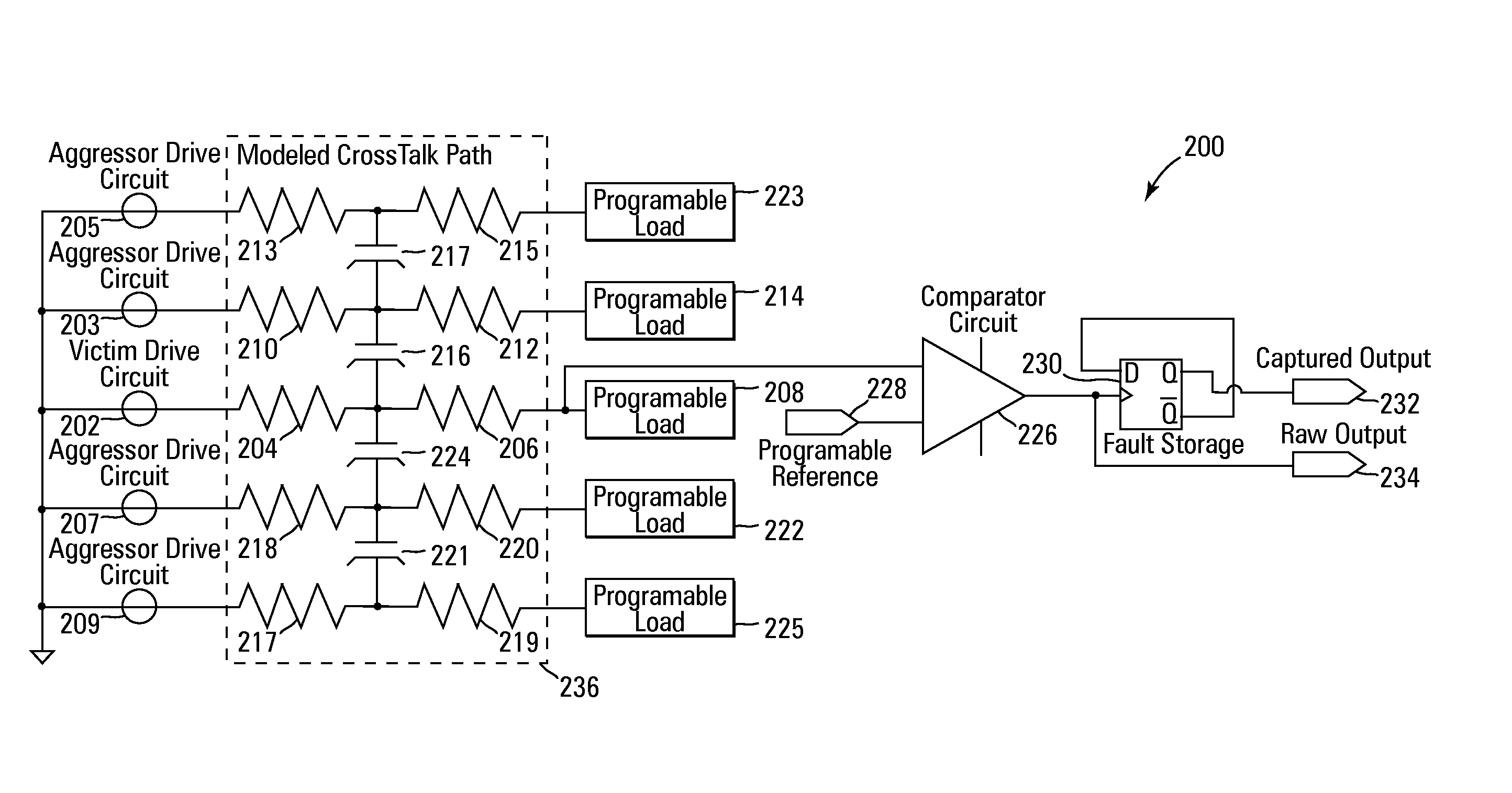
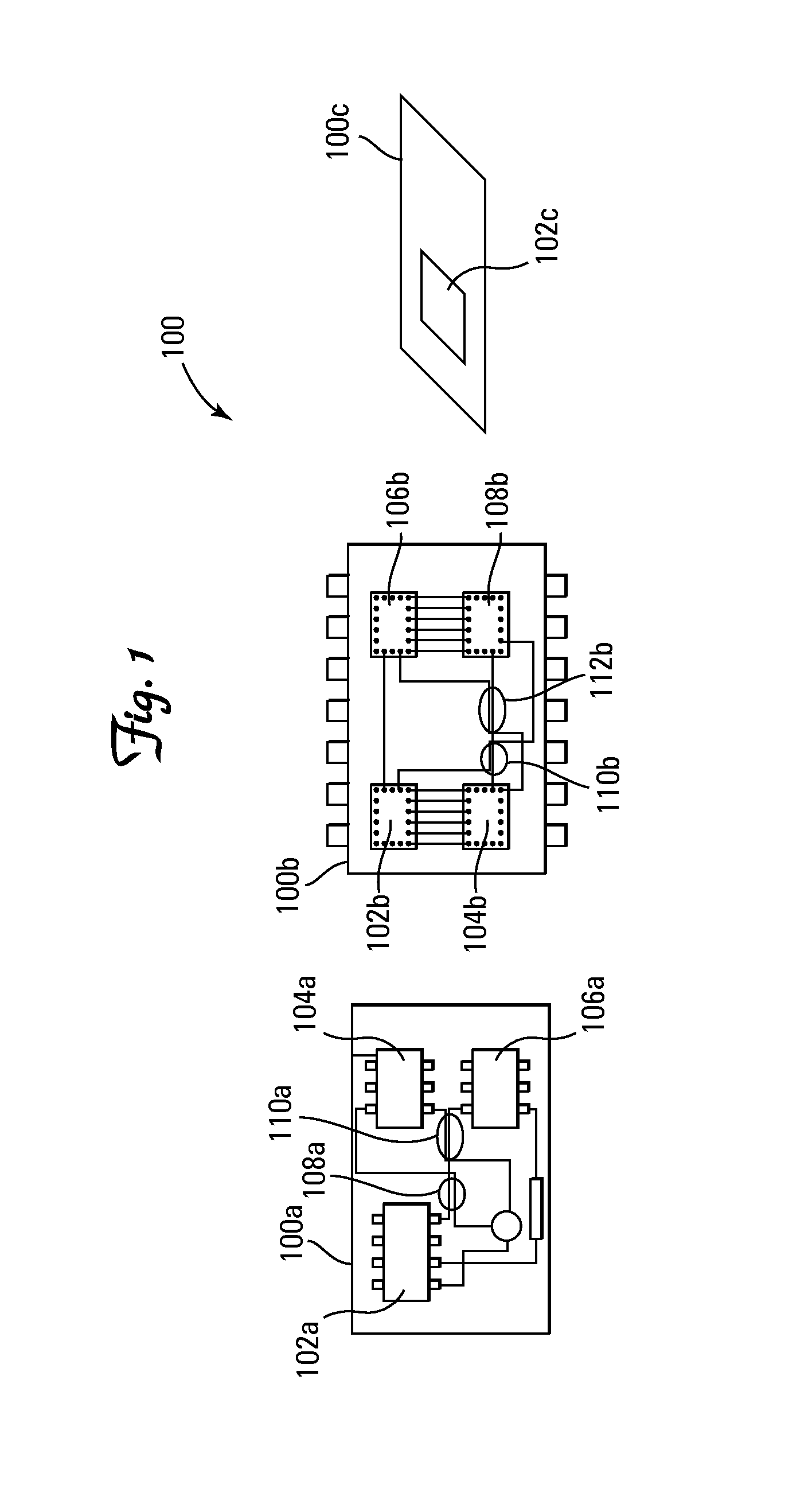
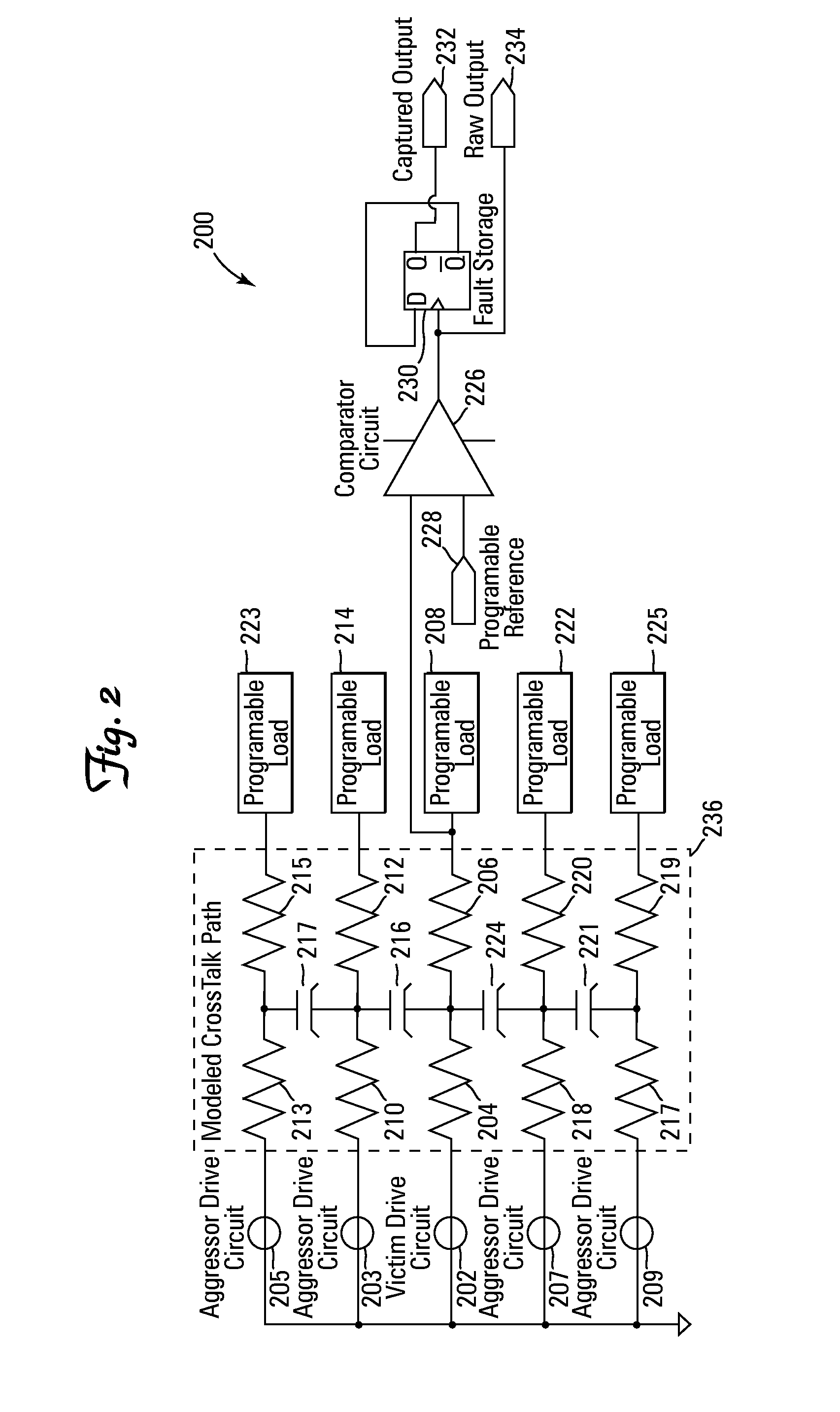
System and method for signal integrity testing of electronic circuits
PatentInactiveUS7225420B2
Innovation
- A system and method using programmable victim and aggressor lines, along with programmable drive capability and loading, to measure signal crosstalk by comparing output signals with reference signals, identifying levels of coupling noise through customizable crosstalk structures.

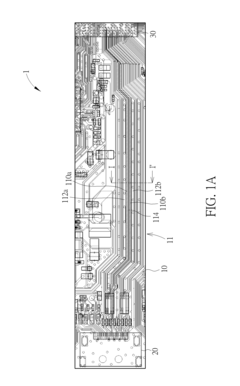
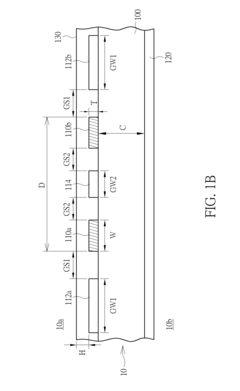
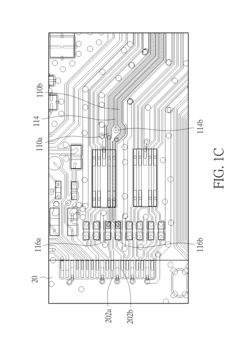
SGS or gsgsg pattern for signal transmitting channel, and PCB assembly, chip package using such SGS or gsgsg pattern
PatentActiveUS20160120034A1
Innovation
- The implementation of a SGS or GSGSG channel circuit design in printed circuit boards and chip packages, featuring a pair of differential signal traces sandwiched by ground guard lines and an intervening reference trace, which helps in achieving the required impedance matching for high-speed signal transmission, conforming to specifications like MHL, using a cost-effective 2-layer PCB without sacrificing routing space.
EMC Compliance Standards for Signal Integrity
Electromagnetic Compatibility (EMC) compliance standards play a crucial role in ensuring signal integrity performance meets regulatory requirements across various industries. These standards establish mandatory limits for electromagnetic emissions and immunity, directly impacting how crosstalk coupling must be managed in electronic systems. The primary international standards include IEC 61000 series, CISPR publications, and regional standards such as FCC Part 15 in North America and EN 55032 in Europe.
The IEC 61000-4-19 standard specifically addresses test and measurement techniques for immunity to conducted, differential mode disturbances, which directly relates to crosstalk coupling scenarios. This standard defines test methods for evaluating how systems respond to unwanted signals coupled between conductors, establishing performance criteria that designers must meet to ensure compliance.
CISPR 25 automotive EMC standard addresses conducted and radiated emissions in vehicle environments, where signal integrity challenges are particularly severe due to harsh electromagnetic environments. The standard specifies limits for conducted emissions on power leads and other cables, requiring careful consideration of crosstalk mitigation techniques during design phases.
Military and aerospace applications follow MIL-STD-461 requirements, which impose stricter limits on both emissions and susceptibility. These standards mandate comprehensive testing of conducted emissions (CE101, CE102) and conducted susceptibility (CS101, CS114, CS116) that directly correlate with signal integrity performance under crosstalk conditions.
Compliance testing typically involves measuring conducted emissions using Line Impedance Stabilization Networks (LISN) and specialized receivers to detect unwanted coupling between signal paths. The standards define specific frequency ranges, measurement bandwidths, and limit lines that must be satisfied.
Modern standards increasingly recognize the importance of signal integrity in EMC compliance, with recent updates incorporating requirements for high-speed digital interfaces and differential signaling systems. These evolving requirements necessitate integrated design approaches where signal integrity and EMC considerations are addressed simultaneously rather than as separate design phases.
The IEC 61000-4-19 standard specifically addresses test and measurement techniques for immunity to conducted, differential mode disturbances, which directly relates to crosstalk coupling scenarios. This standard defines test methods for evaluating how systems respond to unwanted signals coupled between conductors, establishing performance criteria that designers must meet to ensure compliance.
CISPR 25 automotive EMC standard addresses conducted and radiated emissions in vehicle environments, where signal integrity challenges are particularly severe due to harsh electromagnetic environments. The standard specifies limits for conducted emissions on power leads and other cables, requiring careful consideration of crosstalk mitigation techniques during design phases.
Military and aerospace applications follow MIL-STD-461 requirements, which impose stricter limits on both emissions and susceptibility. These standards mandate comprehensive testing of conducted emissions (CE101, CE102) and conducted susceptibility (CS101, CS114, CS116) that directly correlate with signal integrity performance under crosstalk conditions.
Compliance testing typically involves measuring conducted emissions using Line Impedance Stabilization Networks (LISN) and specialized receivers to detect unwanted coupling between signal paths. The standards define specific frequency ranges, measurement bandwidths, and limit lines that must be satisfied.
Modern standards increasingly recognize the importance of signal integrity in EMC compliance, with recent updates incorporating requirements for high-speed digital interfaces and differential signaling systems. These evolving requirements necessitate integrated design approaches where signal integrity and EMC considerations are addressed simultaneously rather than as separate design phases.
Advanced Simulation Tools for Signal Integrity Analysis
The evolution of signal integrity analysis has been fundamentally transformed by the development of sophisticated simulation tools that address the complex challenges of crosstalk coupling in modern electronic systems. These advanced computational platforms have emerged as essential instruments for engineers dealing with increasingly dense circuit layouts and higher frequency operations where traditional analytical methods prove insufficient.
Contemporary simulation environments leverage full-wave electromagnetic field solvers that provide comprehensive analysis of signal propagation characteristics. Tools such as ANSYS HFSS, Keysight ADS, and Cadence Sigrity employ finite element method and method of moments algorithms to accurately model three-dimensional electromagnetic interactions. These platforms enable precise prediction of crosstalk mechanisms by solving Maxwell's equations across complex geometries, accounting for frequency-dependent material properties and multi-layered substrate effects.
Machine learning integration represents a significant advancement in simulation capabilities, with AI-enhanced tools now capable of pattern recognition in crosstalk behavior and automated optimization of circuit layouts. These intelligent systems can process vast datasets from previous simulations to predict coupling effects and suggest mitigation strategies, significantly reducing design iteration cycles.
Time-domain and frequency-domain hybrid simulation approaches have become increasingly prevalent, allowing engineers to analyze both transient crosstalk effects and steady-state coupling simultaneously. Advanced tools now incorporate statistical analysis capabilities, enabling Monte Carlo simulations that account for manufacturing tolerances and environmental variations in crosstalk predictions.
Cloud-based simulation platforms have revolutionized accessibility and computational power, enabling complex multi-physics simulations that combine electromagnetic, thermal, and mechanical effects. These distributed computing environments allow for massive parallel processing of signal integrity problems, making previously computationally prohibitive analyses feasible for routine design verification.
The integration of measurement correlation features in modern simulation tools ensures validation against real-world performance, with automated calibration routines that enhance prediction accuracy for crosstalk coupling scenarios across diverse applications.
Contemporary simulation environments leverage full-wave electromagnetic field solvers that provide comprehensive analysis of signal propagation characteristics. Tools such as ANSYS HFSS, Keysight ADS, and Cadence Sigrity employ finite element method and method of moments algorithms to accurately model three-dimensional electromagnetic interactions. These platforms enable precise prediction of crosstalk mechanisms by solving Maxwell's equations across complex geometries, accounting for frequency-dependent material properties and multi-layered substrate effects.
Machine learning integration represents a significant advancement in simulation capabilities, with AI-enhanced tools now capable of pattern recognition in crosstalk behavior and automated optimization of circuit layouts. These intelligent systems can process vast datasets from previous simulations to predict coupling effects and suggest mitigation strategies, significantly reducing design iteration cycles.
Time-domain and frequency-domain hybrid simulation approaches have become increasingly prevalent, allowing engineers to analyze both transient crosstalk effects and steady-state coupling simultaneously. Advanced tools now incorporate statistical analysis capabilities, enabling Monte Carlo simulations that account for manufacturing tolerances and environmental variations in crosstalk predictions.
Cloud-based simulation platforms have revolutionized accessibility and computational power, enabling complex multi-physics simulations that combine electromagnetic, thermal, and mechanical effects. These distributed computing environments allow for massive parallel processing of signal integrity problems, making previously computationally prohibitive analyses feasible for routine design verification.
The integration of measurement correlation features in modern simulation tools ensures validation against real-world performance, with automated calibration routines that enhance prediction accuracy for crosstalk coupling scenarios across diverse applications.
Unlock deeper insights with PatSnap Eureka Quick Research — get a full tech report to explore trends and direct your research. Try now!
Generate Your Research Report Instantly with AI Agent
Supercharge your innovation with PatSnap Eureka AI Agent Platform!