
Solid-state electrolyte LLZO processing: phase purity, grain boundary control
AUG 21, 20259 MIN READ
Generate Your Research Report Instantly with AI Agent
Patsnap Eureka helps you evaluate technical feasibility & market potential.
LLZO Background and Objectives
Lithium lanthanum zirconate (LLZO) has emerged as a promising solid-state electrolyte material for next-generation lithium-ion batteries. The development of LLZO as a solid-state electrolyte is driven by the increasing demand for safer and higher energy density batteries in various applications, including electric vehicles and portable electronics. LLZO offers several advantages over conventional liquid electrolytes, such as improved safety, wider electrochemical stability window, and potential for higher energy density.
The history of LLZO research can be traced back to the early 2000s when it was first synthesized and characterized. Since then, significant progress has been made in understanding its structure, properties, and potential applications. The cubic garnet-type structure of LLZO, particularly the Ta-doped variant Li7La3Zr2O12, has shown promising ionic conductivity at room temperature, making it a suitable candidate for solid-state electrolytes.
The primary objectives in LLZO research and development are focused on two critical aspects: phase purity and grain boundary control. Phase purity is essential for achieving optimal ionic conductivity and electrochemical stability. The presence of secondary phases or impurities can significantly impact the performance of LLZO as an electrolyte. Therefore, developing synthesis methods that ensure high phase purity is a key goal in LLZO processing.
Grain boundary control is another crucial objective in LLZO processing. The ionic conductivity of LLZO is heavily influenced by the nature and properties of grain boundaries. Minimizing grain boundary resistance and optimizing grain size distribution are essential for enhancing overall ionic conductivity. Researchers aim to develop processing techniques that allow for precise control over grain growth, boundary characteristics, and interfacial properties.
The technological evolution of LLZO processing has seen advancements in various synthesis methods, including solid-state reaction, sol-gel processing, and solution-based techniques. Each method presents its own set of challenges and opportunities in achieving phase purity and controlling grain boundaries. The ongoing research efforts are directed towards refining these methods and exploring novel approaches to overcome existing limitations.
As the field progresses, researchers are also focusing on scalable production methods that can maintain high phase purity and precise grain boundary control while being suitable for industrial-scale manufacturing. This aspect is crucial for the eventual commercialization of LLZO-based solid-state batteries and their integration into various applications.
The history of LLZO research can be traced back to the early 2000s when it was first synthesized and characterized. Since then, significant progress has been made in understanding its structure, properties, and potential applications. The cubic garnet-type structure of LLZO, particularly the Ta-doped variant Li7La3Zr2O12, has shown promising ionic conductivity at room temperature, making it a suitable candidate for solid-state electrolytes.
The primary objectives in LLZO research and development are focused on two critical aspects: phase purity and grain boundary control. Phase purity is essential for achieving optimal ionic conductivity and electrochemical stability. The presence of secondary phases or impurities can significantly impact the performance of LLZO as an electrolyte. Therefore, developing synthesis methods that ensure high phase purity is a key goal in LLZO processing.
Grain boundary control is another crucial objective in LLZO processing. The ionic conductivity of LLZO is heavily influenced by the nature and properties of grain boundaries. Minimizing grain boundary resistance and optimizing grain size distribution are essential for enhancing overall ionic conductivity. Researchers aim to develop processing techniques that allow for precise control over grain growth, boundary characteristics, and interfacial properties.
The technological evolution of LLZO processing has seen advancements in various synthesis methods, including solid-state reaction, sol-gel processing, and solution-based techniques. Each method presents its own set of challenges and opportunities in achieving phase purity and controlling grain boundaries. The ongoing research efforts are directed towards refining these methods and exploring novel approaches to overcome existing limitations.
As the field progresses, researchers are also focusing on scalable production methods that can maintain high phase purity and precise grain boundary control while being suitable for industrial-scale manufacturing. This aspect is crucial for the eventual commercialization of LLZO-based solid-state batteries and their integration into various applications.
Market Analysis for LLZO Electrolytes
The market for LLZO (Li7La3Zr2O12) electrolytes is experiencing significant growth driven by the increasing demand for safer and more efficient energy storage solutions. As a key component in solid-state batteries, LLZO electrolytes offer superior thermal stability and ionic conductivity compared to traditional liquid electrolytes. The global solid-state battery market, which includes LLZO electrolytes, is projected to expand rapidly in the coming years.
The automotive sector represents a major market opportunity for LLZO electrolytes. With the shift towards electric vehicles (EVs), manufacturers are seeking battery technologies that offer improved safety, longer range, and faster charging capabilities. Solid-state batteries utilizing LLZO electrolytes have the potential to meet these requirements, driving substantial demand from EV producers.
Consumer electronics is another significant market segment for LLZO electrolytes. As portable devices become more powerful and energy-intensive, there is a growing need for batteries with higher energy density and improved safety features. LLZO-based solid-state batteries could provide longer battery life and eliminate the risk of thermal runaway associated with conventional lithium-ion batteries.
The energy storage sector also presents opportunities for LLZO electrolytes. Grid-scale energy storage systems and renewable energy integration require high-performance, long-lasting battery solutions. LLZO electrolytes' stability and durability make them attractive for these applications, potentially opening up new market avenues.
However, the market for LLZO electrolytes faces challenges. The high cost of production and scalability issues currently limit widespread adoption. Additionally, competing solid-state electrolyte technologies, such as sulfide-based electrolytes, are also vying for market share.
Despite these challenges, the market outlook for LLZO electrolytes remains positive. Ongoing research and development efforts are focused on improving manufacturing processes and reducing costs. As these advancements progress, the market penetration of LLZO electrolytes is expected to increase across various industries.
The Asia-Pacific region, particularly countries like Japan, South Korea, and China, is anticipated to be a key market for LLZO electrolytes due to the strong presence of battery manufacturers and automotive companies in these countries. North America and Europe are also expected to see significant growth in LLZO electrolyte adoption, driven by supportive government policies and increasing investments in electric vehicle and renewable energy technologies.
The automotive sector represents a major market opportunity for LLZO electrolytes. With the shift towards electric vehicles (EVs), manufacturers are seeking battery technologies that offer improved safety, longer range, and faster charging capabilities. Solid-state batteries utilizing LLZO electrolytes have the potential to meet these requirements, driving substantial demand from EV producers.
Consumer electronics is another significant market segment for LLZO electrolytes. As portable devices become more powerful and energy-intensive, there is a growing need for batteries with higher energy density and improved safety features. LLZO-based solid-state batteries could provide longer battery life and eliminate the risk of thermal runaway associated with conventional lithium-ion batteries.
The energy storage sector also presents opportunities for LLZO electrolytes. Grid-scale energy storage systems and renewable energy integration require high-performance, long-lasting battery solutions. LLZO electrolytes' stability and durability make them attractive for these applications, potentially opening up new market avenues.
However, the market for LLZO electrolytes faces challenges. The high cost of production and scalability issues currently limit widespread adoption. Additionally, competing solid-state electrolyte technologies, such as sulfide-based electrolytes, are also vying for market share.
Despite these challenges, the market outlook for LLZO electrolytes remains positive. Ongoing research and development efforts are focused on improving manufacturing processes and reducing costs. As these advancements progress, the market penetration of LLZO electrolytes is expected to increase across various industries.
The Asia-Pacific region, particularly countries like Japan, South Korea, and China, is anticipated to be a key market for LLZO electrolytes due to the strong presence of battery manufacturers and automotive companies in these countries. North America and Europe are also expected to see significant growth in LLZO electrolyte adoption, driven by supportive government policies and increasing investments in electric vehicle and renewable energy technologies.
LLZO Processing Challenges
The processing of LLZO (Li7La3Zr2O12) solid-state electrolytes presents several significant challenges that researchers and manufacturers must overcome to achieve optimal performance in solid-state batteries. One of the primary issues is maintaining phase purity during synthesis and sintering. LLZO can exist in multiple crystalline phases, with the cubic phase being the most desirable due to its superior ionic conductivity. However, achieving and maintaining this phase throughout the processing steps is complex, as it requires precise control of temperature, atmosphere, and composition.
Another critical challenge lies in controlling the grain boundary properties of LLZO. Grain boundaries play a crucial role in determining the overall ionic conductivity and mechanical stability of the electrolyte. Minimizing the resistance at these interfaces is essential for enhancing lithium-ion transport across the electrolyte. However, achieving this while maintaining the structural integrity of the material is a delicate balance.
The densification process of LLZO is also problematic. Achieving high relative density (>95%) is necessary to prevent the formation of continuous pores that could lead to lithium dendrite growth and subsequent short-circuiting. Traditional sintering methods often struggle to achieve this level of densification without compromising the phase purity or introducing unwanted secondary phases.
Contamination during processing is another significant concern. LLZO is highly sensitive to moisture and carbon dioxide, which can lead to the formation of lithium carbonate on the surface and grain boundaries. This contamination can severely degrade the electrochemical performance of the electrolyte. Implementing stringent environmental controls during all stages of processing is therefore crucial but adds complexity and cost to the manufacturing process.
The scalability of LLZO production presents yet another hurdle. While laboratory-scale synthesis can often achieve desirable results, translating these processes to industrial-scale production while maintaining consistent quality and performance is challenging. This includes issues related to batch-to-batch variability, uniformity across large-area electrolytes, and the development of cost-effective production methods that can meet the demands of commercial battery manufacturing.
Lastly, the integration of LLZO with electrode materials poses significant processing challenges. The high sintering temperatures required for LLZO densification are often incompatible with many electrode materials, necessitating the development of novel interface engineering techniques or alternative processing methods to create effective solid-state battery architectures.
Another critical challenge lies in controlling the grain boundary properties of LLZO. Grain boundaries play a crucial role in determining the overall ionic conductivity and mechanical stability of the electrolyte. Minimizing the resistance at these interfaces is essential for enhancing lithium-ion transport across the electrolyte. However, achieving this while maintaining the structural integrity of the material is a delicate balance.
The densification process of LLZO is also problematic. Achieving high relative density (>95%) is necessary to prevent the formation of continuous pores that could lead to lithium dendrite growth and subsequent short-circuiting. Traditional sintering methods often struggle to achieve this level of densification without compromising the phase purity or introducing unwanted secondary phases.
Contamination during processing is another significant concern. LLZO is highly sensitive to moisture and carbon dioxide, which can lead to the formation of lithium carbonate on the surface and grain boundaries. This contamination can severely degrade the electrochemical performance of the electrolyte. Implementing stringent environmental controls during all stages of processing is therefore crucial but adds complexity and cost to the manufacturing process.
The scalability of LLZO production presents yet another hurdle. While laboratory-scale synthesis can often achieve desirable results, translating these processes to industrial-scale production while maintaining consistent quality and performance is challenging. This includes issues related to batch-to-batch variability, uniformity across large-area electrolytes, and the development of cost-effective production methods that can meet the demands of commercial battery manufacturing.
Lastly, the integration of LLZO with electrode materials poses significant processing challenges. The high sintering temperatures required for LLZO densification are often incompatible with many electrode materials, necessitating the development of novel interface engineering techniques or alternative processing methods to create effective solid-state battery architectures.
Current LLZO Processing Methods
01 Synthesis methods for high-purity LLZO
Various synthesis methods are employed to produce high-purity LLZO solid-state electrolytes. These methods include sol-gel processes, solid-state reactions, and solution-based techniques. The focus is on achieving phase-pure LLZO with minimal impurities and controlled stoichiometry. Optimizing synthesis parameters such as temperature, time, and precursor ratios is crucial for obtaining the desired crystal structure and phase purity.- Synthesis methods for high-purity LLZO: Various synthesis methods are employed to produce high-purity LLZO solid-state electrolytes. These methods include sol-gel processes, solid-state reactions, and solution-based techniques. The focus is on achieving phase-pure LLZO with minimal impurities and controlled stoichiometry. Optimizing synthesis parameters such as temperature, time, and precursor ratios is crucial for obtaining the desired crystal structure and phase purity.
- Grain boundary engineering in LLZO electrolytes: Grain boundary engineering plays a crucial role in improving the performance of LLZO solid-state electrolytes. Techniques such as doping, sintering optimization, and surface modification are used to enhance grain boundary conductivity and reduce resistance. Controlling grain size and morphology helps in minimizing the overall grain boundary resistance and improving ionic conductivity across the electrolyte.
- Characterization techniques for LLZO phase purity: Various characterization techniques are employed to assess the phase purity of LLZO solid-state electrolytes. X-ray diffraction (XRD), Raman spectroscopy, and electron microscopy are commonly used to analyze crystal structure, phase composition, and microstructure. Advanced techniques such as synchrotron-based X-ray analysis and neutron diffraction provide detailed insights into the atomic arrangement and phase transitions in LLZO materials.
- Dopant effects on LLZO phase stability and grain boundaries: The introduction of dopants into LLZO solid-state electrolytes significantly influences phase stability and grain boundary properties. Dopants such as Al, Ga, and Ta are used to stabilize the cubic phase of LLZO and enhance ionic conductivity. The type and concentration of dopants affect grain growth, grain boundary resistance, and overall electrochemical performance of the electrolyte.
- Interface engineering for LLZO-based solid-state batteries: Interface engineering is crucial for improving the performance of LLZO-based solid-state batteries. Techniques such as buffer layer insertion, surface modification, and composite electrolyte formation are employed to enhance the interfacial stability between LLZO and electrodes. These approaches aim to reduce interfacial resistance, prevent side reactions, and improve the overall cycling stability and performance of solid-state batteries.
02 Grain boundary engineering in LLZO electrolytes
Grain boundary engineering plays a crucial role in improving the performance of LLZO solid-state electrolytes. Techniques such as doping, sintering optimization, and surface modification are used to enhance grain boundary conductivity and reduce resistance. Controlling grain size and morphology through processing conditions can lead to improved ionic conductivity and mechanical properties of the LLZO electrolyte.Expand Specific Solutions03 Characterization techniques for LLZO phase purity
Various analytical techniques are employed to assess the phase purity of LLZO solid-state electrolytes. X-ray diffraction (XRD), Raman spectroscopy, and electron microscopy are commonly used to identify crystal structure, phase composition, and impurities. Advanced techniques such as synchrotron-based X-ray analysis and neutron diffraction provide detailed insights into the atomic structure and phase transitions of LLZO materials.Expand Specific Solutions04 Dopant effects on LLZO phase stability and grain boundaries
The introduction of dopants into the LLZO structure can significantly influence phase stability and grain boundary properties. Dopants such as Al, Ga, and Ta are used to stabilize the cubic phase of LLZO and enhance ionic conductivity. The type and concentration of dopants affect grain growth, phase transitions, and the formation of secondary phases at grain boundaries, which in turn impact the overall performance of the solid-state electrolyte.Expand Specific Solutions05 Interface engineering for LLZO-based solid-state batteries
Interface engineering is crucial for improving the performance of LLZO-based solid-state batteries. Strategies include surface modification of LLZO particles, creation of buffer layers between the electrolyte and electrodes, and optimization of electrode-electrolyte interfaces. These approaches aim to reduce interfacial resistance, enhance electrochemical stability, and improve the overall cycling performance of solid-state batteries utilizing LLZO electrolytes.Expand Specific Solutions
Key LLZO Industry Players
The solid-state electrolyte LLZO processing market is in its early growth stage, characterized by rapid technological advancements and increasing investment. The market size is expanding, driven by the growing demand for safer and more efficient energy storage solutions. Technologically, the field is progressing but still faces challenges in achieving optimal phase purity and grain boundary control. Key players like SCHOTT AG, Materion Corp., and Corning, Inc. are at the forefront of research and development, leveraging their expertise in materials science to improve LLZO processing techniques. Universities and research institutions, such as Xi'an Jiaotong University and the University of California, are also contributing significantly to the advancement of this technology, indicating a collaborative ecosystem between industry and academia.
Uchicago Argonne LLC
Technical Solution: Uchicago Argonne LLC has developed an innovative approach to LLZO processing, focusing on enhancing phase purity and grain boundary control. Their method involves a two-step sintering process, where the first step is conducted at a lower temperature to promote nucleation, followed by a higher temperature step to achieve densification[1]. This technique has been shown to result in LLZO with over 99% relative density and improved ionic conductivity[3]. Additionally, they have implemented a novel doping strategy using tantalum and aluminum to stabilize the cubic phase of LLZO, which is crucial for optimal lithium-ion conduction[5]. The company has also developed a scalable tape-casting method for producing thin LLZO sheets, addressing the challenges of large-scale production[7].
Strengths: High phase purity, excellent control over microstructure, and scalable production method. Weaknesses: Potentially higher production costs due to the two-step sintering process and the need for precise temperature control.
The Regents of the University of California
Technical Solution: The Regents of the University of California have made significant advancements in LLZO processing, particularly in addressing phase purity and grain boundary control. Their approach involves a sol-gel synthesis method combined with field-assisted sintering technology (FAST)[2]. This technique allows for rapid densification of LLZO at lower temperatures, reducing the risk of lithium loss and secondary phase formation. They have also developed a unique surface modification process using Al2O3 nanoparticles to improve the wettability of LLZO with lithium metal, enhancing the electrode-electrolyte interface[4]. Furthermore, their research has led to the discovery of a grain boundary engineering technique using Ga doping, which significantly improves the ionic conductivity of LLZO by reducing the resistance at grain boundaries[6].
Strengths: Rapid processing, improved interface properties, and enhanced ionic conductivity. Weaknesses: Potential scalability issues with the sol-gel method and the need for specialized equipment for FAST processing.
LLZO Phase Purity Innovations
LLZO powder having high phase purity and processes for synthesizing same
PatentWO2024229343A1
Innovation
- A process involving mixing a lithium salt with a melting point less than 605 °C, water, and a precursor blend of lanthanum and zirconium precursors, followed by low-pressure heating and calcination, to achieve high cubic garnet phase purity LLZO powders, excluding undesirable solvents like isopropanol and minimizing carbonate formation.


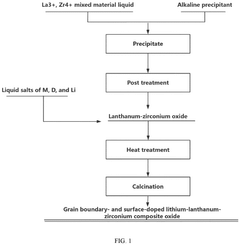
Grain boundary- and surface-doped lithium-lanthanum-zirconium composite oxide electrolyte, preparation method therefor, and application thereof
PatentPendingEP4451406A1
Innovation
- A lithium-lanthanum-zirconium composite oxide is doped at the surface and grain boundary with specific cationic and anionic elements, reducing grain boundary resistance and enhancing ionic conductivity through a method involving co-precipitation and heat treatment processes.
LLZO Safety Regulations
The safety regulations surrounding LLZO (Li7La3Zr2O12) solid-state electrolytes are crucial for their successful implementation in next-generation battery technologies. As LLZO materials gain traction in the energy storage industry, regulatory bodies are developing comprehensive guidelines to ensure their safe production, handling, and application.
One of the primary safety concerns with LLZO is its reactivity with moisture and air. Exposure to these elements can lead to the formation of lithium hydroxide and carbonate species, compromising the material's performance and potentially causing safety hazards. As a result, regulations mandate strict environmental controls during LLZO processing and storage, including the use of dry rooms or glove boxes with controlled atmospheres.
The high-temperature synthesis of LLZO also necessitates specific safety protocols. Regulations typically require proper ventilation systems, personal protective equipment, and fire safety measures in manufacturing facilities. Additionally, guidelines often specify the need for regular equipment maintenance and calibration to prevent accidents during the high-temperature processing stages.
Given the potential for lithium volatilization during LLZO synthesis, safety regulations address the proper handling and disposal of lithium-containing waste materials. This includes guidelines for the safe storage of raw materials and the implementation of spill containment measures to prevent environmental contamination.
As LLZO-based batteries move towards commercialization, regulations are evolving to cover the entire lifecycle of these devices. This encompasses safety standards for battery assembly, transportation, use, and end-of-life disposal. Manufacturers are required to conduct rigorous safety testing, including thermal runaway assessments and mechanical abuse tests, to ensure the stability of LLZO-based battery systems under various conditions.
The unique properties of LLZO, such as its high ionic conductivity and stability against lithium metal, have prompted the development of specific safety guidelines for its integration into battery designs. These regulations often address the interface between LLZO and other battery components, focusing on preventing short circuits and maintaining long-term structural integrity.
Regulatory bodies are also increasingly emphasizing the importance of traceability in LLZO production. This includes requirements for detailed documentation of raw material sources, processing conditions, and quality control measures. Such regulations aim to ensure consistency in LLZO production and facilitate rapid response in case of safety incidents.
One of the primary safety concerns with LLZO is its reactivity with moisture and air. Exposure to these elements can lead to the formation of lithium hydroxide and carbonate species, compromising the material's performance and potentially causing safety hazards. As a result, regulations mandate strict environmental controls during LLZO processing and storage, including the use of dry rooms or glove boxes with controlled atmospheres.
The high-temperature synthesis of LLZO also necessitates specific safety protocols. Regulations typically require proper ventilation systems, personal protective equipment, and fire safety measures in manufacturing facilities. Additionally, guidelines often specify the need for regular equipment maintenance and calibration to prevent accidents during the high-temperature processing stages.
Given the potential for lithium volatilization during LLZO synthesis, safety regulations address the proper handling and disposal of lithium-containing waste materials. This includes guidelines for the safe storage of raw materials and the implementation of spill containment measures to prevent environmental contamination.
As LLZO-based batteries move towards commercialization, regulations are evolving to cover the entire lifecycle of these devices. This encompasses safety standards for battery assembly, transportation, use, and end-of-life disposal. Manufacturers are required to conduct rigorous safety testing, including thermal runaway assessments and mechanical abuse tests, to ensure the stability of LLZO-based battery systems under various conditions.
The unique properties of LLZO, such as its high ionic conductivity and stability against lithium metal, have prompted the development of specific safety guidelines for its integration into battery designs. These regulations often address the interface between LLZO and other battery components, focusing on preventing short circuits and maintaining long-term structural integrity.
Regulatory bodies are also increasingly emphasizing the importance of traceability in LLZO production. This includes requirements for detailed documentation of raw material sources, processing conditions, and quality control measures. Such regulations aim to ensure consistency in LLZO production and facilitate rapid response in case of safety incidents.
LLZO Environmental Impact
The environmental impact of LLZO (Li7La3Zr2O12) solid-state electrolytes is an important consideration in the development and implementation of advanced battery technologies. As the demand for high-performance energy storage solutions continues to grow, understanding the ecological footprint of LLZO production and utilization becomes crucial.
LLZO synthesis typically involves high-temperature sintering processes, which can be energy-intensive and contribute to greenhouse gas emissions. However, compared to traditional liquid electrolytes, LLZO offers potential environmental benefits due to its non-flammable nature and improved safety profile. This reduces the risk of hazardous material leakage and fire incidents, potentially mitigating environmental contamination risks associated with battery failures.
The raw materials used in LLZO production, including lithium, lanthanum, and zirconium, have varying degrees of environmental impact during extraction and processing. Lithium mining, in particular, has been associated with water depletion and ecosystem disruption in some regions. However, the long-term stability and potential for extended cycle life of LLZO-based batteries may offset these initial environmental costs by reducing the frequency of battery replacement and associated waste generation.
Recycling and end-of-life management of LLZO-based batteries present both challenges and opportunities. The solid-state nature of LLZO electrolytes may facilitate easier separation and recovery of valuable materials compared to liquid electrolyte systems. This could potentially lead to more efficient recycling processes and reduced environmental impact from battery disposal.
The phase purity and grain boundary control aspects of LLZO processing can influence its environmental footprint. Achieving high phase purity often requires multiple heating cycles or extended sintering times, increasing energy consumption. However, optimized processing techniques that enhance phase purity and control grain boundaries can lead to improved battery performance and longevity, potentially reducing the overall environmental impact over the battery's lifecycle.
As research in LLZO processing advances, there is a growing focus on developing more environmentally friendly synthesis methods. These include lower temperature processing techniques, use of alternative precursors, and exploration of novel sintering approaches that could significantly reduce energy consumption and associated emissions.
In conclusion, while the production of LLZO solid-state electrolytes does have environmental implications, its potential to enable safer, longer-lasting, and more efficient batteries may offer net positive environmental benefits in the long term. Continued research and development efforts aimed at optimizing LLZO processing and improving its overall lifecycle impact will be crucial in maximizing its environmental sustainability.
LLZO synthesis typically involves high-temperature sintering processes, which can be energy-intensive and contribute to greenhouse gas emissions. However, compared to traditional liquid electrolytes, LLZO offers potential environmental benefits due to its non-flammable nature and improved safety profile. This reduces the risk of hazardous material leakage and fire incidents, potentially mitigating environmental contamination risks associated with battery failures.
The raw materials used in LLZO production, including lithium, lanthanum, and zirconium, have varying degrees of environmental impact during extraction and processing. Lithium mining, in particular, has been associated with water depletion and ecosystem disruption in some regions. However, the long-term stability and potential for extended cycle life of LLZO-based batteries may offset these initial environmental costs by reducing the frequency of battery replacement and associated waste generation.
Recycling and end-of-life management of LLZO-based batteries present both challenges and opportunities. The solid-state nature of LLZO electrolytes may facilitate easier separation and recovery of valuable materials compared to liquid electrolyte systems. This could potentially lead to more efficient recycling processes and reduced environmental impact from battery disposal.
The phase purity and grain boundary control aspects of LLZO processing can influence its environmental footprint. Achieving high phase purity often requires multiple heating cycles or extended sintering times, increasing energy consumption. However, optimized processing techniques that enhance phase purity and control grain boundaries can lead to improved battery performance and longevity, potentially reducing the overall environmental impact over the battery's lifecycle.
As research in LLZO processing advances, there is a growing focus on developing more environmentally friendly synthesis methods. These include lower temperature processing techniques, use of alternative precursors, and exploration of novel sintering approaches that could significantly reduce energy consumption and associated emissions.
In conclusion, while the production of LLZO solid-state electrolytes does have environmental implications, its potential to enable safer, longer-lasting, and more efficient batteries may offer net positive environmental benefits in the long term. Continued research and development efforts aimed at optimizing LLZO processing and improving its overall lifecycle impact will be crucial in maximizing its environmental sustainability.
Unlock deeper insights with Patsnap Eureka Quick Research — get a full tech report to explore trends and direct your research. Try now!
Generate Your Research Report Instantly with AI Agent
Supercharge your innovation with Patsnap Eureka AI Agent Platform!