
Solid-State Transformers in Hydrogen-Powered Plants: Capacity Selection
APR 20, 20269 MIN READ
Generate Your Research Report Instantly with AI Agent
Patsnap Eureka helps you evaluate technical feasibility & market potential.
Solid-State Transformer Technology Background and Objectives
Solid-state transformers represent a paradigm shift from traditional electromagnetic transformers, utilizing power electronic devices and high-frequency switching technology to achieve voltage transformation, isolation, and power conditioning. Unlike conventional transformers that rely on magnetic coupling through iron cores, SSTs employ semiconductor switches, high-frequency transformers, and advanced control systems to provide enhanced functionality and performance characteristics.
The evolution of SST technology traces back to the 1970s when power electronics began advancing rapidly. Initial developments focused on basic DC-DC conversion applications, but the technology has progressively expanded to encompass complex AC-AC transformation with bidirectional power flow capabilities. The integration of wide bandgap semiconductors such as silicon carbide and gallium nitride has significantly accelerated SST development, enabling higher switching frequencies, improved efficiency, and reduced system size.
In hydrogen-powered plants, SSTs serve critical roles in power management and grid integration. These facilities typically generate electricity through fuel cells or hydrogen combustion turbines, producing power at varying voltage levels that require sophisticated transformation and conditioning before grid connection. The intermittent nature of renewable energy sources used for hydrogen production creates additional complexity in power system design, necessitating advanced power electronic solutions.
The primary technical objectives for SST implementation in hydrogen-powered plants center on achieving optimal power conversion efficiency, typically targeting values exceeding 95% across varying load conditions. Power quality enhancement represents another crucial objective, with SSTs designed to provide superior harmonic mitigation, voltage regulation, and reactive power compensation compared to conventional transformers. Grid integration capabilities must support bidirectional power flow, enabling hydrogen plants to both consume power during hydrogen production phases and inject power during electricity generation periods.
Capacity selection objectives focus on matching SST ratings with plant operational requirements while maintaining economic viability. This involves determining optimal power ratings that accommodate peak generation capacity, transient conditions during startup and shutdown sequences, and potential future expansion scenarios. The modular nature of SST technology enables scalable solutions, allowing capacity adjustments through parallel operation of multiple units.
Advanced control and monitoring capabilities represent key technological objectives, with SSTs incorporating real-time power flow management, fault detection and isolation, and communication interfaces for smart grid integration. These systems must demonstrate high reliability and availability, particularly given the critical nature of hydrogen plant operations in industrial applications and grid stability maintenance.
The evolution of SST technology traces back to the 1970s when power electronics began advancing rapidly. Initial developments focused on basic DC-DC conversion applications, but the technology has progressively expanded to encompass complex AC-AC transformation with bidirectional power flow capabilities. The integration of wide bandgap semiconductors such as silicon carbide and gallium nitride has significantly accelerated SST development, enabling higher switching frequencies, improved efficiency, and reduced system size.
In hydrogen-powered plants, SSTs serve critical roles in power management and grid integration. These facilities typically generate electricity through fuel cells or hydrogen combustion turbines, producing power at varying voltage levels that require sophisticated transformation and conditioning before grid connection. The intermittent nature of renewable energy sources used for hydrogen production creates additional complexity in power system design, necessitating advanced power electronic solutions.
The primary technical objectives for SST implementation in hydrogen-powered plants center on achieving optimal power conversion efficiency, typically targeting values exceeding 95% across varying load conditions. Power quality enhancement represents another crucial objective, with SSTs designed to provide superior harmonic mitigation, voltage regulation, and reactive power compensation compared to conventional transformers. Grid integration capabilities must support bidirectional power flow, enabling hydrogen plants to both consume power during hydrogen production phases and inject power during electricity generation periods.
Capacity selection objectives focus on matching SST ratings with plant operational requirements while maintaining economic viability. This involves determining optimal power ratings that accommodate peak generation capacity, transient conditions during startup and shutdown sequences, and potential future expansion scenarios. The modular nature of SST technology enables scalable solutions, allowing capacity adjustments through parallel operation of multiple units.
Advanced control and monitoring capabilities represent key technological objectives, with SSTs incorporating real-time power flow management, fault detection and isolation, and communication interfaces for smart grid integration. These systems must demonstrate high reliability and availability, particularly given the critical nature of hydrogen plant operations in industrial applications and grid stability maintenance.
Market Demand for Hydrogen Power Plant Infrastructure
The global hydrogen economy is experiencing unprecedented momentum, driven by ambitious decarbonization targets and substantial government investments worldwide. Major economies including the European Union, United States, Japan, and China have committed billions in funding for hydrogen infrastructure development, creating a robust foundation for market expansion. This policy support, combined with corporate sustainability mandates, is generating significant demand for comprehensive hydrogen power plant infrastructure solutions.
Industrial sectors are increasingly recognizing hydrogen as a critical pathway to achieve net-zero emissions, particularly in hard-to-abate industries such as steel production, chemical manufacturing, and heavy transportation. These sectors require reliable, high-capacity power infrastructure that can efficiently integrate hydrogen fuel cells with existing electrical grids. The demand extends beyond basic power generation to encompass sophisticated electrical management systems capable of handling variable loads and ensuring grid stability.
The renewable energy integration challenge is creating substantial market opportunities for advanced power electronics in hydrogen facilities. As hydrogen production increasingly relies on renewable sources through electrolysis, power plants must accommodate intermittent energy inputs while maintaining consistent output. This requirement drives demand for intelligent power conversion and distribution systems that can optimize energy flow and storage coordination.
Utility-scale hydrogen power plants are emerging as key components in grid modernization strategies, particularly for providing long-duration energy storage and grid balancing services. Electric utilities are investing in hydrogen infrastructure to complement solar and wind installations, creating demand for power systems that can seamlessly transition between different energy sources and storage modes.
The transportation sector's shift toward hydrogen fuel cell vehicles is generating additional infrastructure requirements, including hydrogen refueling stations integrated with local power grids. These facilities require sophisticated electrical systems capable of managing high-power charging demands while maintaining grid stability and power quality.
Geographic expansion of hydrogen projects is accelerating globally, with significant developments in regions possessing abundant renewable resources or existing industrial hydrogen demand. This geographic diversification is creating varied market requirements, from large-scale industrial complexes to distributed generation systems, each requiring tailored electrical infrastructure solutions that can adapt to local grid conditions and regulatory frameworks.
Industrial sectors are increasingly recognizing hydrogen as a critical pathway to achieve net-zero emissions, particularly in hard-to-abate industries such as steel production, chemical manufacturing, and heavy transportation. These sectors require reliable, high-capacity power infrastructure that can efficiently integrate hydrogen fuel cells with existing electrical grids. The demand extends beyond basic power generation to encompass sophisticated electrical management systems capable of handling variable loads and ensuring grid stability.
The renewable energy integration challenge is creating substantial market opportunities for advanced power electronics in hydrogen facilities. As hydrogen production increasingly relies on renewable sources through electrolysis, power plants must accommodate intermittent energy inputs while maintaining consistent output. This requirement drives demand for intelligent power conversion and distribution systems that can optimize energy flow and storage coordination.
Utility-scale hydrogen power plants are emerging as key components in grid modernization strategies, particularly for providing long-duration energy storage and grid balancing services. Electric utilities are investing in hydrogen infrastructure to complement solar and wind installations, creating demand for power systems that can seamlessly transition between different energy sources and storage modes.
The transportation sector's shift toward hydrogen fuel cell vehicles is generating additional infrastructure requirements, including hydrogen refueling stations integrated with local power grids. These facilities require sophisticated electrical systems capable of managing high-power charging demands while maintaining grid stability and power quality.
Geographic expansion of hydrogen projects is accelerating globally, with significant developments in regions possessing abundant renewable resources or existing industrial hydrogen demand. This geographic diversification is creating varied market requirements, from large-scale industrial complexes to distributed generation systems, each requiring tailored electrical infrastructure solutions that can adapt to local grid conditions and regulatory frameworks.
Current SST Capacity Selection Challenges in H2 Plants
The integration of solid-state transformers in hydrogen-powered plants presents unique capacity selection challenges that differ significantly from conventional power systems. Unlike traditional electromagnetic transformers, SSTs must handle the complex power flow patterns inherent in hydrogen production facilities, where electrolysis processes create highly variable and non-linear load profiles. The intermittent nature of renewable energy sources typically feeding these plants compounds the difficulty in determining optimal SST capacity ratings.
One of the primary challenges stems from the bidirectional power flow requirements in modern hydrogen facilities. These plants often operate in grid-tied configurations where excess hydrogen can be converted back to electricity through fuel cells during peak demand periods. SSTs must accommodate both the high-power electrolysis loads during hydrogen production and the reverse power flow during electricity generation, requiring sophisticated capacity planning that accounts for both operational modes.
The electrochemical nature of hydrogen production introduces additional complexity through harmonic distortion and power quality issues. Electrolyzers generate significant harmonic content that can stress SST components beyond their rated capacity, even when operating within apparent power limits. This necessitates derating considerations that are not typically encountered in conventional applications, making standard capacity selection methodologies inadequate.
Thermal management represents another critical challenge in SST capacity selection for hydrogen plants. The high-frequency switching operations in SSTs generate substantial heat, while hydrogen production environments often have strict temperature control requirements for safety and efficiency. The interaction between ambient temperature variations, cooling system limitations, and the thermal characteristics of power electronic components creates a complex optimization problem for capacity determination.
Dynamic load variations pose significant challenges as hydrogen production rates fluctuate based on renewable energy availability and grid conditions. SSTs must handle rapid load changes without compromising system stability or efficiency, requiring capacity margins that account for transient conditions rather than just steady-state operations.
The lack of standardized capacity selection guidelines specifically tailored for hydrogen applications further complicates the design process. Existing methodologies developed for conventional power systems fail to address the unique operational characteristics of hydrogen plants, leaving engineers to rely on conservative oversizing approaches that may result in suboptimal economic performance.
One of the primary challenges stems from the bidirectional power flow requirements in modern hydrogen facilities. These plants often operate in grid-tied configurations where excess hydrogen can be converted back to electricity through fuel cells during peak demand periods. SSTs must accommodate both the high-power electrolysis loads during hydrogen production and the reverse power flow during electricity generation, requiring sophisticated capacity planning that accounts for both operational modes.
The electrochemical nature of hydrogen production introduces additional complexity through harmonic distortion and power quality issues. Electrolyzers generate significant harmonic content that can stress SST components beyond their rated capacity, even when operating within apparent power limits. This necessitates derating considerations that are not typically encountered in conventional applications, making standard capacity selection methodologies inadequate.
Thermal management represents another critical challenge in SST capacity selection for hydrogen plants. The high-frequency switching operations in SSTs generate substantial heat, while hydrogen production environments often have strict temperature control requirements for safety and efficiency. The interaction between ambient temperature variations, cooling system limitations, and the thermal characteristics of power electronic components creates a complex optimization problem for capacity determination.
Dynamic load variations pose significant challenges as hydrogen production rates fluctuate based on renewable energy availability and grid conditions. SSTs must handle rapid load changes without compromising system stability or efficiency, requiring capacity margins that account for transient conditions rather than just steady-state operations.
The lack of standardized capacity selection guidelines specifically tailored for hydrogen applications further complicates the design process. Existing methodologies developed for conventional power systems fail to address the unique operational characteristics of hydrogen plants, leaving engineers to rely on conservative oversizing approaches that may result in suboptimal economic performance.
Existing SST Sizing Methodologies for H2 Plants
01 High-capacity solid-state transformer design and architecture
Solid-state transformers can be designed with enhanced capacity through optimized circuit topologies and multi-stage power conversion architectures. These designs incorporate advanced semiconductor devices and modular configurations to handle higher power ratings while maintaining efficiency. The architecture may include cascaded converter stages, parallel operation of multiple modules, and intelligent control systems to distribute load effectively across the transformer components.- High-capacity solid-state transformer design and architecture: Solid-state transformers with enhanced capacity can be achieved through optimized design architectures that incorporate multiple power conversion stages, modular configurations, and advanced semiconductor devices. These designs focus on increasing power handling capabilities while maintaining efficiency and reliability. The architecture typically includes cascaded converter topologies, parallel connection of power modules, and intelligent control systems to manage higher power throughput.
- Thermal management systems for capacity enhancement: Effective thermal management is critical for increasing the capacity of solid-state transformers. Advanced cooling techniques including liquid cooling, heat pipe technology, and optimized heat sink designs enable higher power density and capacity. Proper thermal design prevents overheating of semiconductor components and allows the transformer to operate at higher power levels without degradation in performance or reliability.
- Power semiconductor device selection and configuration: The capacity of solid-state transformers is significantly influenced by the choice and arrangement of power semiconductor devices. Wide bandgap semiconductors and advanced switching devices enable higher voltage and current ratings. Parallel and series configurations of these devices, along with proper gate driving circuits, allow for scalable capacity increases while maintaining switching efficiency and minimizing losses.
- Control strategies for high-capacity operation: Advanced control algorithms and strategies are essential for managing solid-state transformers at higher capacity levels. These include adaptive control methods, load balancing techniques, and fault-tolerant control schemes that ensure stable operation under varying load conditions. The control systems monitor and regulate voltage, current, and power flow to maximize capacity utilization while protecting the transformer components from overload conditions.
- Modular and scalable capacity expansion methods: Modular design approaches enable flexible capacity expansion of solid-state transformers through the addition of power conversion modules. These methods allow for incremental capacity increases based on application requirements. The modular architecture facilitates maintenance, redundancy, and system upgrades while providing scalability from low to high power ratings through standardized building blocks and interconnection schemes.
02 Thermal management for capacity enhancement
Effective thermal management systems are critical for increasing the capacity of solid-state transformers. Advanced cooling techniques including liquid cooling, heat pipe technology, and optimized heat sink designs enable higher power density operation. Proper thermal design allows the transformer to operate at higher current levels without exceeding temperature limits, thereby increasing overall capacity while ensuring reliability and longevity of semiconductor components.Expand Specific Solutions03 Magnetic core and winding optimization
The capacity of solid-state transformers can be enhanced through optimized magnetic core materials and winding configurations. High-frequency operation enabled by solid-state switching allows for compact magnetic designs with improved power density. Advanced core materials with low losses and high saturation flux density, combined with optimized winding arrangements, enable higher power throughput in smaller volumes while minimizing losses.Expand Specific Solutions04 Power semiconductor device selection and configuration
The capacity of solid-state transformers is significantly influenced by the selection and configuration of power semiconductor devices. Wide bandgap semiconductors and advanced silicon devices with higher voltage and current ratings enable greater power handling capability. Parallel connection of multiple devices, optimized gate drive circuits, and protection mechanisms allow for scalable capacity increases while maintaining switching performance and efficiency.Expand Specific Solutions05 Control strategies for capacity utilization
Advanced control algorithms and strategies optimize the capacity utilization of solid-state transformers. These include dynamic load balancing, adaptive modulation techniques, and real-time monitoring systems that maximize power throughput while preventing overload conditions. Intelligent control systems can adjust operating parameters based on load conditions, temperature, and grid requirements to fully utilize the transformer's capacity while ensuring safe operation.Expand Specific Solutions
Key Players in SST and Hydrogen Power Industry
The solid-state transformer market for hydrogen-powered plants represents an emerging sector at the intersection of advanced power electronics and clean energy infrastructure. The industry is in its early development stage, with significant growth potential driven by the global hydrogen economy expansion. Market size remains relatively modest but is projected to experience substantial growth as hydrogen production scales up globally. Technology maturity varies significantly among market participants, with established power electronics companies like Delta Electronics, Sungrow Power Supply, and Hitachi leveraging their existing transformer and power conversion expertise to develop solid-state solutions. Traditional energy giants such as State Grid Corp. of China and Sinopec are driving infrastructure deployment, while specialized hydrogen companies like Ohmium International and HyAxiom focus on integrated electrolyzer systems. Automotive leaders including Audi and Bosch contribute advanced power electronics from their electric vehicle experience. The competitive landscape shows a convergence of diverse technological capabilities, from semiconductor expertise at TDK Electronics to industrial automation knowledge at companies like Robert Bosch, creating a dynamic ecosystem where capacity selection optimization becomes crucial for efficient hydrogen plant operations.
State Grid Corp. of China
Technical Solution: State Grid Corporation of China has invested significantly in solid-state transformer research and development for next-generation power grid applications, including hydrogen production facilities. Their SST technology focuses on grid integration and power quality management for large-scale hydrogen plants. The company has developed standardized capacity selection guidelines for SST deployment in hydrogen applications, considering factors such as electrolyzer efficiency curves, grid stability requirements, and renewable energy integration. Their SST solutions feature advanced grid synchronization capabilities and fault ride-through performance, with modular designs supporting installations from 5MW to 100MW. State Grid's approach emphasizes standardization and cost optimization for widespread deployment in China's hydrogen infrastructure development.
Strengths: Large-scale deployment experience, standardized solutions, strong grid integration capabilities. Weaknesses: Limited international market presence, focus primarily on Chinese market requirements and standards.
Sungrow Power Supply Co., Ltd.
Technical Solution: Sungrow has developed advanced solid-state transformer solutions specifically designed for renewable energy integration and hydrogen production facilities. Their SST technology incorporates high-frequency isolation transformers with silicon carbide (SiC) power semiconductors, enabling power conversion efficiency exceeding 98% in hydrogen electrolysis applications. The company's modular SST design allows for scalable capacity selection from 1MW to 10MW units, with intelligent power management systems that optimize energy flow between grid connection, energy storage, and hydrogen production equipment. Their SST solutions feature advanced grid-tie capabilities with reactive power compensation and harmonic filtering, essential for maintaining power quality in hydrogen-powered plants.
Strengths: High conversion efficiency, modular scalability, proven renewable energy integration experience. Weaknesses: Limited experience in large-scale hydrogen plant deployments, higher initial costs compared to conventional transformers.
Core Innovations in SST Capacity Optimization
SST system with multiple LVDC outputs
PatentActiveIN202247054943A
Innovation
- An electrical interconnection circuit with at least two independent LVDC buses and an interconnecting DC/DC converter that re-routes power to equalize load across MVDC to LVDC converters, reducing the number of conversion stages by using a single interconnecting DC/DC converter to manage power between buses, thereby simplifying the circuit and reducing power ratings.
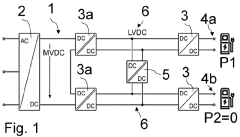
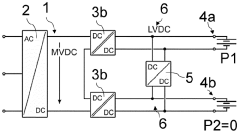
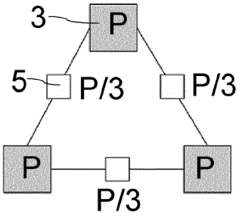
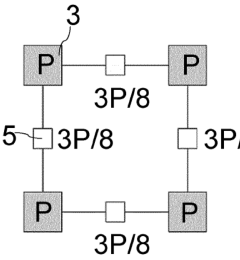
Solid-state transformer, power supply device and data center
PatentPendingEP4287475A1
Innovation
- A solid-state transformer design featuring a housing with an insulation base and conductive enclosure, where power conversion units are placed in an accommodating cavity with clearances to meet safety and insulation requirements, reducing the need for insulation materials and enhancing power density by optimizing the use of space.


Safety Standards for SST in Hydrogen Environments
The deployment of solid-state transformers in hydrogen-powered plants necessitates adherence to stringent safety standards specifically designed for hydrogen environments. These standards address the unique hazards associated with hydrogen's high flammability, low ignition energy, and tendency for rapid flame propagation. Current regulatory frameworks combine traditional electrical safety requirements with hydrogen-specific protocols to ensure comprehensive protection.
International standards such as IEC 60079 series for explosive atmospheres and ISO 14687 for hydrogen fuel quality provide foundational guidelines for SST implementation. These standards mandate specific design requirements including intrinsically safe electrical components, explosion-proof enclosures, and enhanced grounding systems. The classification of hazardous zones around hydrogen equipment directly influences SST installation requirements and operational parameters.
Electrical safety standards for SSTs in hydrogen environments emphasize enhanced insulation coordination and arc fault protection. The presence of hydrogen gas requires specialized consideration for electrical switching operations, as conventional arc suppression methods may be inadequate. Standards mandate the use of sealed switching devices, inert gas-filled compartments, or solid-state switching technologies that eliminate arcing risks entirely.
Ventilation and gas detection requirements form critical components of safety standards for hydrogen facilities. SST installations must incorporate continuous hydrogen monitoring systems with automatic shutdown capabilities when gas concentrations approach lower explosive limits. Ventilation systems must maintain adequate air changes to prevent hydrogen accumulation, particularly in enclosed spaces housing electrical equipment.
Fire suppression and emergency response protocols specific to hydrogen environments require specialized approaches due to hydrogen's unique combustion characteristics. Standards mandate the use of water spray systems rather than traditional fire suppression agents, as hydrogen flames are nearly invisible and require specific detection methods. Emergency shutdown procedures must account for the rapid response times necessary when dealing with hydrogen incidents.
Material compatibility standards address the potential for hydrogen embrittlement in SST components. Metallic components exposed to hydrogen environments must meet specific material grades and testing requirements to prevent degradation over time. Sealing materials and gaskets require certification for hydrogen service to maintain system integrity and prevent leakage.
International standards such as IEC 60079 series for explosive atmospheres and ISO 14687 for hydrogen fuel quality provide foundational guidelines for SST implementation. These standards mandate specific design requirements including intrinsically safe electrical components, explosion-proof enclosures, and enhanced grounding systems. The classification of hazardous zones around hydrogen equipment directly influences SST installation requirements and operational parameters.
Electrical safety standards for SSTs in hydrogen environments emphasize enhanced insulation coordination and arc fault protection. The presence of hydrogen gas requires specialized consideration for electrical switching operations, as conventional arc suppression methods may be inadequate. Standards mandate the use of sealed switching devices, inert gas-filled compartments, or solid-state switching technologies that eliminate arcing risks entirely.
Ventilation and gas detection requirements form critical components of safety standards for hydrogen facilities. SST installations must incorporate continuous hydrogen monitoring systems with automatic shutdown capabilities when gas concentrations approach lower explosive limits. Ventilation systems must maintain adequate air changes to prevent hydrogen accumulation, particularly in enclosed spaces housing electrical equipment.
Fire suppression and emergency response protocols specific to hydrogen environments require specialized approaches due to hydrogen's unique combustion characteristics. Standards mandate the use of water spray systems rather than traditional fire suppression agents, as hydrogen flames are nearly invisible and require specific detection methods. Emergency shutdown procedures must account for the rapid response times necessary when dealing with hydrogen incidents.
Material compatibility standards address the potential for hydrogen embrittlement in SST components. Metallic components exposed to hydrogen environments must meet specific material grades and testing requirements to prevent degradation over time. Sealing materials and gaskets require certification for hydrogen service to maintain system integrity and prevent leakage.
Grid Integration Requirements for H2-Powered SSTs
The integration of solid-state transformers in hydrogen-powered plants requires adherence to stringent grid connection standards and regulatory frameworks. These facilities must comply with IEEE 1547 standards for distributed energy resources, which mandate specific voltage regulation, frequency response, and power quality requirements. Additionally, hydrogen plants utilizing SSTs must meet IEC 61850 communication protocols for seamless grid monitoring and control integration.
Power quality specifications represent a critical aspect of grid integration for H2-powered SST systems. Voltage harmonic distortion must remain below 5% total harmonic distortion (THD) at the point of common coupling, while individual harmonic components should not exceed 3%. The SST's advanced power electronics enable superior harmonic filtering compared to conventional transformers, but proper design considerations must account for the variable load characteristics inherent in hydrogen production processes.
Grid stability requirements necessitate that SST-equipped hydrogen facilities provide ancillary services including voltage support, frequency regulation, and reactive power compensation. The bidirectional power flow capability of SSTs enables these plants to function as grid-stabilizing assets during periods of renewable energy intermittency. Fast response times of less than 100 milliseconds for voltage regulation and sub-second frequency response capabilities are typically mandated by transmission system operators.
Fault ride-through capabilities constitute another essential grid integration requirement. SSTs in hydrogen plants must maintain operation during grid voltage sags of up to 50% for durations exceeding 1 second, while providing controlled disconnection sequences for more severe disturbances. The inherent galvanic isolation provided by SSTs enhances system protection compared to conventional transformer configurations.
Communication and cybersecurity protocols form the backbone of modern grid integration requirements. SST systems must implement IEC 62351 security standards for power system communications, ensuring encrypted data transmission and authentication protocols. Real-time monitoring capabilities must provide grid operators with visibility into hydrogen plant operations, including electrolyzer load profiles, power consumption patterns, and available grid support services.
Interconnection studies and grid impact assessments are mandatory for large-scale hydrogen facilities. These evaluations examine the cumulative effects of SST integration on local grid stability, short-circuit current contributions, and protection coordination schemes. The modular nature of SST technology facilitates phased deployment strategies that minimize grid integration complexity while enabling scalable capacity expansion.
Power quality specifications represent a critical aspect of grid integration for H2-powered SST systems. Voltage harmonic distortion must remain below 5% total harmonic distortion (THD) at the point of common coupling, while individual harmonic components should not exceed 3%. The SST's advanced power electronics enable superior harmonic filtering compared to conventional transformers, but proper design considerations must account for the variable load characteristics inherent in hydrogen production processes.
Grid stability requirements necessitate that SST-equipped hydrogen facilities provide ancillary services including voltage support, frequency regulation, and reactive power compensation. The bidirectional power flow capability of SSTs enables these plants to function as grid-stabilizing assets during periods of renewable energy intermittency. Fast response times of less than 100 milliseconds for voltage regulation and sub-second frequency response capabilities are typically mandated by transmission system operators.
Fault ride-through capabilities constitute another essential grid integration requirement. SSTs in hydrogen plants must maintain operation during grid voltage sags of up to 50% for durations exceeding 1 second, while providing controlled disconnection sequences for more severe disturbances. The inherent galvanic isolation provided by SSTs enhances system protection compared to conventional transformer configurations.
Communication and cybersecurity protocols form the backbone of modern grid integration requirements. SST systems must implement IEC 62351 security standards for power system communications, ensuring encrypted data transmission and authentication protocols. Real-time monitoring capabilities must provide grid operators with visibility into hydrogen plant operations, including electrolyzer load profiles, power consumption patterns, and available grid support services.
Interconnection studies and grid impact assessments are mandatory for large-scale hydrogen facilities. These evaluations examine the cumulative effects of SST integration on local grid stability, short-circuit current contributions, and protection coordination schemes. The modular nature of SST technology facilitates phased deployment strategies that minimize grid integration complexity while enabling scalable capacity expansion.
Unlock deeper insights with Patsnap Eureka Quick Research — get a full tech report to explore trends and direct your research. Try now!
Generate Your Research Report Instantly with AI Agent
Supercharge your innovation with Patsnap Eureka AI Agent Platform!