

Solid-State Transformers Vs Balanced Transformers: Power Matching
APR 20, 20269 MIN READ
Generate Your Research Report Instantly with AI Agent
PatSnap Eureka helps you evaluate technical feasibility & market potential.
SST vs Balanced Transformer Power Matching Background
The evolution of power conversion technologies has been fundamentally shaped by the increasing demands for efficiency, reliability, and grid integration capabilities in modern electrical systems. Traditional magnetic transformers have served as the backbone of power distribution networks for over a century, providing galvanic isolation and voltage transformation through electromagnetic induction principles. However, the emergence of power electronics and semiconductor technologies has introduced solid-state transformers as a revolutionary alternative approach to power conversion and management.
The concept of power matching between different transformer technologies has gained critical importance as electrical grids transition toward smart grid architectures and renewable energy integration. Power matching encompasses not only the fundamental electrical characteristics such as voltage and current ratings, but also dynamic response capabilities, harmonic management, and bidirectional power flow requirements that modern applications demand.
Solid-state transformers represent a paradigm shift from conventional magnetic coupling to electronic switching-based power conversion. These devices utilize high-frequency switching techniques combined with magnetic isolation to achieve voltage transformation while simultaneously providing advanced functionalities such as power quality improvement, reactive power compensation, and grid synchronization capabilities. The technology leverages wide-bandgap semiconductors including silicon carbide and gallium nitride devices to achieve higher switching frequencies and improved efficiency compared to traditional silicon-based solutions.
Balanced transformers, representing an evolution of conventional transformer design, incorporate advanced magnetic core materials and winding configurations to optimize power transfer characteristics while maintaining the fundamental electromagnetic induction principles. These transformers focus on minimizing losses, reducing harmonic distortion, and improving load balancing across multiple phases through sophisticated design methodologies.
The convergence of these technologies addresses critical challenges in modern power systems, including the need for improved power quality, enhanced grid stability, and seamless integration of distributed energy resources. As renewable energy penetration increases and load profiles become more dynamic, the ability to efficiently match power characteristics between sources and loads has become paramount for maintaining grid reliability and optimizing energy utilization across diverse applications ranging from industrial facilities to residential microgrids.
The concept of power matching between different transformer technologies has gained critical importance as electrical grids transition toward smart grid architectures and renewable energy integration. Power matching encompasses not only the fundamental electrical characteristics such as voltage and current ratings, but also dynamic response capabilities, harmonic management, and bidirectional power flow requirements that modern applications demand.
Solid-state transformers represent a paradigm shift from conventional magnetic coupling to electronic switching-based power conversion. These devices utilize high-frequency switching techniques combined with magnetic isolation to achieve voltage transformation while simultaneously providing advanced functionalities such as power quality improvement, reactive power compensation, and grid synchronization capabilities. The technology leverages wide-bandgap semiconductors including silicon carbide and gallium nitride devices to achieve higher switching frequencies and improved efficiency compared to traditional silicon-based solutions.
Balanced transformers, representing an evolution of conventional transformer design, incorporate advanced magnetic core materials and winding configurations to optimize power transfer characteristics while maintaining the fundamental electromagnetic induction principles. These transformers focus on minimizing losses, reducing harmonic distortion, and improving load balancing across multiple phases through sophisticated design methodologies.
The convergence of these technologies addresses critical challenges in modern power systems, including the need for improved power quality, enhanced grid stability, and seamless integration of distributed energy resources. As renewable energy penetration increases and load profiles become more dynamic, the ability to efficiently match power characteristics between sources and loads has become paramount for maintaining grid reliability and optimizing energy utilization across diverse applications ranging from industrial facilities to residential microgrids.
Market Demand for Advanced Power Matching Solutions
The global power electronics market is experiencing unprecedented growth driven by the increasing demand for efficient power conversion and management solutions across multiple industries. Traditional magnetic transformers, while reliable, face significant limitations in terms of size, weight, and dynamic response capabilities, creating substantial market opportunities for advanced power matching technologies.
Smart grid infrastructure development represents one of the most significant demand drivers for advanced power matching solutions. Utilities worldwide are investing heavily in grid modernization projects that require sophisticated power conversion systems capable of handling bidirectional power flows, voltage regulation, and harmonic mitigation. These applications demand transformers that can provide real-time control and adaptive power matching capabilities far beyond what conventional transformers can deliver.
The renewable energy sector continues to fuel demand for advanced power matching technologies. Solar and wind installations require power conversion systems that can efficiently interface variable renewable sources with grid infrastructure. The intermittent nature of renewable energy sources necessitates sophisticated power matching solutions that can maintain grid stability while maximizing energy harvest efficiency.
Electric vehicle charging infrastructure presents another rapidly expanding market segment. Fast-charging stations require compact, high-efficiency power conversion systems capable of delivering precise power levels while maintaining power quality standards. The space constraints and performance requirements of EV charging applications favor solid-state solutions over traditional transformer-based systems.
Industrial automation and manufacturing sectors are increasingly adopting advanced power matching solutions to improve energy efficiency and reduce operational costs. Modern manufacturing facilities require precise power control for motor drives, heating systems, and process equipment. The ability to dynamically adjust power delivery based on load conditions offers significant energy savings and operational flexibility.
Data centers and telecommunications infrastructure represent high-value market segments with stringent efficiency and reliability requirements. These applications demand power conversion systems with minimal losses, compact form factors, and high reliability. The growing demand for edge computing and 5G infrastructure further amplifies the need for advanced power matching solutions.
The aerospace and defense industries require lightweight, high-performance power conversion systems for aircraft, satellites, and military applications. These sectors prioritize power density, reliability, and environmental resilience, driving demand for innovative transformer technologies that can operate under extreme conditions while maintaining optimal power matching performance.
Smart grid infrastructure development represents one of the most significant demand drivers for advanced power matching solutions. Utilities worldwide are investing heavily in grid modernization projects that require sophisticated power conversion systems capable of handling bidirectional power flows, voltage regulation, and harmonic mitigation. These applications demand transformers that can provide real-time control and adaptive power matching capabilities far beyond what conventional transformers can deliver.
The renewable energy sector continues to fuel demand for advanced power matching technologies. Solar and wind installations require power conversion systems that can efficiently interface variable renewable sources with grid infrastructure. The intermittent nature of renewable energy sources necessitates sophisticated power matching solutions that can maintain grid stability while maximizing energy harvest efficiency.
Electric vehicle charging infrastructure presents another rapidly expanding market segment. Fast-charging stations require compact, high-efficiency power conversion systems capable of delivering precise power levels while maintaining power quality standards. The space constraints and performance requirements of EV charging applications favor solid-state solutions over traditional transformer-based systems.
Industrial automation and manufacturing sectors are increasingly adopting advanced power matching solutions to improve energy efficiency and reduce operational costs. Modern manufacturing facilities require precise power control for motor drives, heating systems, and process equipment. The ability to dynamically adjust power delivery based on load conditions offers significant energy savings and operational flexibility.
Data centers and telecommunications infrastructure represent high-value market segments with stringent efficiency and reliability requirements. These applications demand power conversion systems with minimal losses, compact form factors, and high reliability. The growing demand for edge computing and 5G infrastructure further amplifies the need for advanced power matching solutions.
The aerospace and defense industries require lightweight, high-performance power conversion systems for aircraft, satellites, and military applications. These sectors prioritize power density, reliability, and environmental resilience, driving demand for innovative transformer technologies that can operate under extreme conditions while maintaining optimal power matching performance.
Current SST and Balanced Transformer Technology Status
Solid-State Transformers represent a paradigm shift in power conversion technology, utilizing semiconductor-based switching devices and high-frequency operation to achieve compact, intelligent power transformation. Current SST implementations primarily employ silicon carbide (SiC) and gallium nitride (GaN) power semiconductors, enabling switching frequencies ranging from 10 kHz to 100 kHz. Leading manufacturers like ABB, Siemens, and General Electric have developed prototype systems with power ratings from 1 MVA to 10 MVA, demonstrating voltage regulation capabilities within ±1% and power factor correction exceeding 0.95.
The technological maturity of SSTs varies significantly across different power ranges. Low-power applications below 100 kW have achieved commercial viability with efficiency levels reaching 96-98%. Medium-voltage applications between 1-35 kV remain in advanced development stages, with several pilot projects demonstrating successful grid integration. High-voltage transmission applications above 35 kV are still in research phases, facing challenges related to semiconductor voltage ratings and thermal management.
Balanced transformers, representing the evolution of conventional magnetic transformers, incorporate advanced core materials and optimized winding configurations to achieve superior power matching characteristics. Current implementations utilize amorphous steel cores and nanocrystalline materials, reducing no-load losses by 60-80% compared to traditional silicon steel transformers. Major manufacturers including Hitachi Energy, Schneider Electric, and Eaton have commercialized balanced transformer designs with efficiency ratings exceeding 99.5% at rated load conditions.
The power matching capabilities of balanced transformers have been enhanced through intelligent tap-changing mechanisms and real-time impedance adjustment systems. Modern designs incorporate digital control systems enabling dynamic load balancing across three-phase networks with response times under 100 milliseconds. These systems demonstrate superior harmonic mitigation, reducing total harmonic distortion to less than 3% under varying load conditions.
Current challenges in SST technology include semiconductor reliability under high-voltage stress, electromagnetic interference management, and standardization of control protocols. The absence of established grid codes for SST integration creates regulatory barriers for widespread deployment. Manufacturing costs remain 3-5 times higher than conventional transformers, primarily due to expensive wide-bandgap semiconductors and complex control systems.
Balanced transformer technology faces constraints related to magnetic core saturation under fault conditions and limited dynamic response capabilities compared to electronic alternatives. While offering superior efficiency and reliability, these systems lack the advanced functionalities of SSTs, such as power quality enhancement and bidirectional power flow control.
The technological maturity of SSTs varies significantly across different power ranges. Low-power applications below 100 kW have achieved commercial viability with efficiency levels reaching 96-98%. Medium-voltage applications between 1-35 kV remain in advanced development stages, with several pilot projects demonstrating successful grid integration. High-voltage transmission applications above 35 kV are still in research phases, facing challenges related to semiconductor voltage ratings and thermal management.
Balanced transformers, representing the evolution of conventional magnetic transformers, incorporate advanced core materials and optimized winding configurations to achieve superior power matching characteristics. Current implementations utilize amorphous steel cores and nanocrystalline materials, reducing no-load losses by 60-80% compared to traditional silicon steel transformers. Major manufacturers including Hitachi Energy, Schneider Electric, and Eaton have commercialized balanced transformer designs with efficiency ratings exceeding 99.5% at rated load conditions.
The power matching capabilities of balanced transformers have been enhanced through intelligent tap-changing mechanisms and real-time impedance adjustment systems. Modern designs incorporate digital control systems enabling dynamic load balancing across three-phase networks with response times under 100 milliseconds. These systems demonstrate superior harmonic mitigation, reducing total harmonic distortion to less than 3% under varying load conditions.
Current challenges in SST technology include semiconductor reliability under high-voltage stress, electromagnetic interference management, and standardization of control protocols. The absence of established grid codes for SST integration creates regulatory barriers for widespread deployment. Manufacturing costs remain 3-5 times higher than conventional transformers, primarily due to expensive wide-bandgap semiconductors and complex control systems.
Balanced transformer technology faces constraints related to magnetic core saturation under fault conditions and limited dynamic response capabilities compared to electronic alternatives. While offering superior efficiency and reliability, these systems lack the advanced functionalities of SSTs, such as power quality enhancement and bidirectional power flow control.
Existing Power Matching Solutions and Approaches
01 Solid-state transformer topology and control methods
Solid-state transformers utilize power electronic converters to replace traditional magnetic transformers, enabling voltage conversion and power flow control through semiconductor switching devices. Advanced control algorithms are implemented to manage power conversion stages, regulate voltage levels, and ensure stable operation. These systems incorporate modular multilevel converter topologies and digital control strategies to achieve efficient power transformation with improved dynamic response and controllability compared to conventional transformers.- Solid-state transformer topology and control methods: Solid-state transformers utilize power electronic converters to replace traditional magnetic transformers, enabling voltage conversion and power flow control through semiconductor switching devices. Advanced control algorithms are implemented to manage power conversion stages, regulate voltage levels, and ensure stable operation. These systems incorporate modular multilevel converter topologies and digital control strategies to achieve efficient power transformation with improved dynamic response and controllability compared to conventional transformers.
- Balanced transformer design for impedance matching: Balanced transformers are designed to provide impedance matching between different circuit stages while maintaining signal balance and reducing common-mode noise. These transformers feature symmetrical winding configurations that ensure equal impedance on both sides of the balanced line. The design incorporates specific turns ratios and coupling coefficients to achieve optimal power transfer and minimize signal distortion in balanced transmission systems.
- Power matching networks for maximum power transfer: Power matching techniques involve designing impedance matching networks to maximize power transfer between source and load. These networks utilize transformer-based circuits with carefully calculated impedance ratios to minimize reflection losses and optimize energy delivery. The matching networks can be implemented using various topologies including autotransformers and coupled inductors, with designs tailored to specific frequency ranges and power levels to achieve efficient power coupling.
- Multi-winding transformer configurations for power distribution: Multi-winding transformer designs enable simultaneous power distribution to multiple loads with different voltage requirements. These configurations incorporate multiple secondary windings with independent voltage ratings and current handling capabilities. The design optimizes magnetic coupling between windings while managing leakage inductance and ensuring proper load isolation. Such transformers are particularly useful in applications requiring multiple output voltages from a single primary source.
- High-frequency transformer design for power conversion: High-frequency transformers are optimized for operation in switching power supplies and resonant converters, utilizing specialized core materials and winding techniques to minimize losses at elevated frequencies. The design addresses parasitic capacitance, skin effect, and proximity effect to maintain efficiency. Core geometries and materials are selected to reduce hysteresis and eddy current losses while maintaining adequate magnetic coupling. These transformers enable compact power conversion systems with improved power density.
02 Balanced transformer winding configurations
Balanced transformers employ specialized winding arrangements to achieve symmetrical impedance characteristics and equal voltage distribution across multiple phases. The winding configurations are designed to minimize unbalanced currents and provide consistent power transfer. These designs incorporate specific turn ratios, connection schemes, and geometric arrangements to maintain balance under various load conditions and improve overall system performance.Expand Specific Solutions03 Power matching and impedance optimization
Power matching techniques are employed to maximize power transfer efficiency between source and load by optimizing impedance relationships. These methods involve adaptive impedance matching circuits, tuning networks, and compensation strategies to minimize reflection losses and ensure optimal power delivery. The systems dynamically adjust matching parameters based on operating conditions to maintain high efficiency across varying load scenarios.Expand Specific Solutions04 Multi-stage power conversion architectures
Multi-stage conversion architectures integrate multiple power processing stages to achieve voltage transformation, isolation, and power conditioning. These systems combine AC-DC, DC-DC, and DC-AC conversion stages with intermediate energy storage and filtering. The cascaded topology enables flexible voltage regulation, improved power quality, and enhanced fault tolerance through distributed control and modular design approaches.Expand Specific Solutions05 Thermal management and packaging for power transformers
Advanced thermal management solutions are implemented to dissipate heat generated by power semiconductor devices and magnetic components in transformer systems. These include heat sink designs, cooling channel configurations, and thermal interface materials optimized for high power density applications. Packaging techniques integrate thermal, electrical, and mechanical considerations to ensure reliable operation under high temperature conditions while maintaining compact form factors.Expand Specific Solutions
Key Players in SST and Power Electronics Industry
The solid-state transformers versus balanced transformers power matching technology represents an emerging sector within the broader power electronics industry, currently in its early-to-mid development stage with significant growth potential driven by renewable energy integration and grid modernization demands. The market demonstrates substantial scale opportunities, evidenced by major players like ABB Ltd., Hitachi Energy, and Siemens Gamesa actively investing in advanced transformer technologies. Technology maturity varies significantly across participants, with established industrial giants such as Huawei Digital Power Technologies, Delta Electronics, and Samsung Electronics leveraging their extensive R&D capabilities alongside specialized companies like IONATE Ltd. developing innovative hybrid solutions. Academic institutions including Tsinghua University, Nanyang Technological University, and Georgia Tech Research Corp. contribute fundamental research, while utility companies like State Grid Corp. of China drive practical implementation requirements, creating a competitive landscape characterized by both technological innovation and market application challenges.
Huawei Digital Power Technologies Co Ltd
Technical Solution: Huawei Digital Power has developed intelligent solid-state transformer solutions leveraging their expertise in power electronics and digital control systems. Their SST architecture employs three-stage conversion topology with DC-link coupling, enabling flexible power matching through AI-driven optimization algorithms. The system incorporates wide bandgap devices and high-frequency magnetic components to achieve compact form factors while maintaining high efficiency. Huawei's approach emphasizes smart grid integration with advanced communication protocols and cloud-based monitoring capabilities. Their power matching strategy utilizes machine learning algorithms to predict load patterns and optimize transformer parameters in real-time, supporting both grid-forming and grid-following operational modes for renewable energy integration and microgrid applications.
Strengths: Advanced digital control capabilities, AI-enhanced optimization, strong R&D investment in power electronics. Weaknesses: Limited market presence in traditional power infrastructure, regulatory challenges in some regions.
Hitachi Energy Ltd.
Technical Solution: Hitachi Energy has developed advanced solid-state transformer technology featuring modular multilevel converter (MMC) architecture with integrated power electronics and magnetic components. Their SST solutions incorporate wide bandgap semiconductors like SiC MOSFETs to achieve higher switching frequencies and improved power density. The company's approach focuses on bidirectional power flow control, voltage regulation, and harmonic filtering capabilities. Their SST designs enable power matching through intelligent control algorithms that optimize voltage and current waveforms across different grid conditions. The technology supports medium voltage applications ranging from 3.3kV to 35kV with power ratings up to several MVA, making it suitable for grid integration of renewable energy sources and industrial applications.
Strengths: High power density, excellent grid integration capabilities, proven industrial track record. Weaknesses: Higher initial costs compared to conventional transformers, complex control systems requiring specialized maintenance.
Core Innovations in SST Power Matching Patents
Power balnce apparatus for solid-state transformer system
PatentActiveKR1020200066441A
Innovation
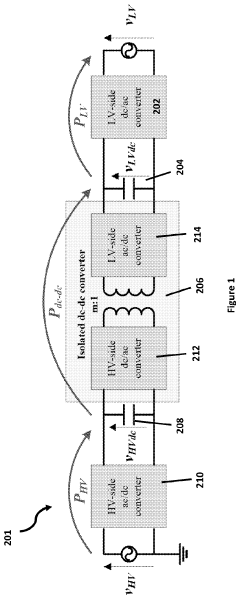
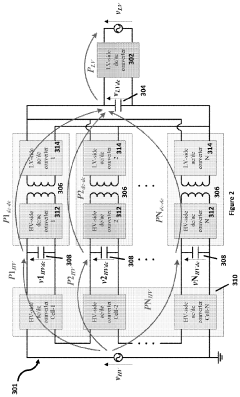
- A power balance control device that includes input-side and output-side switch elements for DC/DC converters, controlled by phase control signals to maintain equal DC link voltages and voltages/currents across converters, ensuring balanced power exchange regardless of operation mode.


Solid state transformer controller
PatentActiveUS20230402936A1
Innovation
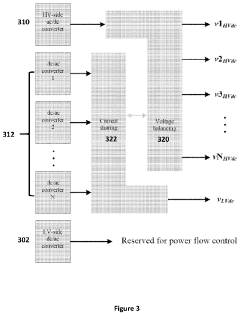
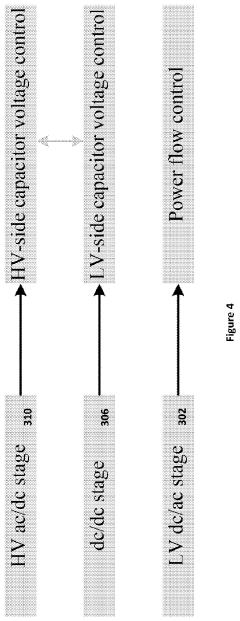
- A decoupled control system for SSTs, comprising a stored energy controller, power flow controller, and energy balancing controllers, each configured to operate independently to manage energy within capacitors, eliminate voltage ripples, and regulate power flow without requiring voltage balancing or power sharing mechanisms, allowing for separate deployment of stages and reduced hardware requirements.
Grid Integration Standards for Power Transformers
Grid integration standards for power transformers represent a critical framework governing the deployment and operation of both solid-state transformers (SSTs) and balanced transformers in modern electrical networks. These standards establish fundamental requirements for voltage regulation, frequency response, harmonic distortion limits, and power quality metrics that directly impact the power matching capabilities between different transformer technologies.
The IEEE C57 series and IEC 60076 standards provide comprehensive guidelines for transformer performance characteristics, with specific emphasis on load tap changers, voltage regulation ranges, and impedance matching requirements. For solid-state transformers, emerging standards such as IEEE 2030.10 address unique integration challenges including bidirectional power flow management, dynamic voltage support, and advanced grid services that traditional balanced transformers cannot provide.
Power matching compliance requires adherence to grid codes that specify acceptable voltage deviation limits, typically ±5% to ±10% depending on the voltage level and regional requirements. Solid-state transformers demonstrate superior compliance through their inherent voltage regulation capabilities and real-time power factor correction, while balanced transformers rely on mechanical tap changers and external reactive power compensation to meet these standards.
Interconnection standards mandate specific protection schemes and fault ride-through capabilities that influence power matching performance. SSTs offer programmable protection functions and faster fault response times, enabling better coordination with grid protection systems. Conversely, balanced transformers require conventional protection relays and may experience longer clearing times that can affect power matching stability during grid disturbances.
Recent updates to grid integration standards increasingly emphasize renewable energy integration and microgrid compatibility, areas where solid-state transformers excel due to their advanced control capabilities. These evolving requirements are reshaping power matching criteria to include dynamic response characteristics, energy storage integration support, and enhanced grid resilience features that favor SST deployment in critical applications.
The IEEE C57 series and IEC 60076 standards provide comprehensive guidelines for transformer performance characteristics, with specific emphasis on load tap changers, voltage regulation ranges, and impedance matching requirements. For solid-state transformers, emerging standards such as IEEE 2030.10 address unique integration challenges including bidirectional power flow management, dynamic voltage support, and advanced grid services that traditional balanced transformers cannot provide.
Power matching compliance requires adherence to grid codes that specify acceptable voltage deviation limits, typically ±5% to ±10% depending on the voltage level and regional requirements. Solid-state transformers demonstrate superior compliance through their inherent voltage regulation capabilities and real-time power factor correction, while balanced transformers rely on mechanical tap changers and external reactive power compensation to meet these standards.
Interconnection standards mandate specific protection schemes and fault ride-through capabilities that influence power matching performance. SSTs offer programmable protection functions and faster fault response times, enabling better coordination with grid protection systems. Conversely, balanced transformers require conventional protection relays and may experience longer clearing times that can affect power matching stability during grid disturbances.
Recent updates to grid integration standards increasingly emphasize renewable energy integration and microgrid compatibility, areas where solid-state transformers excel due to their advanced control capabilities. These evolving requirements are reshaping power matching criteria to include dynamic response characteristics, energy storage integration support, and enhanced grid resilience features that favor SST deployment in critical applications.
Energy Efficiency Regulations Impact on Design
Energy efficiency regulations have emerged as a critical driving force shaping the design paradigms of both solid-state transformers and balanced transformers in power matching applications. The implementation of stringent efficiency standards, such as the DOE efficiency requirements and international IEC standards, has fundamentally altered the engineering approach to transformer design, compelling manufacturers to prioritize efficiency optimization over traditional cost-minimization strategies.
The regulatory landscape has established minimum efficiency thresholds that directly influence the selection between solid-state and balanced transformer architectures. Solid-state transformers, while offering superior controllability and power quality features, face significant challenges in meeting efficiency regulations due to semiconductor switching losses and complex control circuitry power consumption. These losses become particularly pronounced at partial load conditions, where many efficiency regulations now mandate specific performance criteria.
Conversely, balanced transformers benefit from inherently high efficiency characteristics of magnetic coupling, typically achieving 98-99% efficiency under rated conditions. However, regulatory requirements for harmonic distortion limits and power factor correction have necessitated additional filtering and compensation circuits, potentially compromising their efficiency advantages. The integration of these auxiliary systems must be carefully optimized to maintain compliance while preserving overall system efficiency.
Recent regulatory developments have introduced dynamic efficiency requirements that evaluate performance across varying load profiles rather than single operating points. This shift particularly impacts solid-state transformer designs, which must now incorporate advanced power management algorithms and adaptive switching strategies to maintain regulatory compliance across diverse operating conditions. The implementation of wide-bandgap semiconductors has become increasingly critical to meet these evolving standards.
The regulatory emphasis on lifecycle efficiency assessment has also influenced material selection and thermal management strategies in both transformer types. Designers must now consider long-term efficiency degradation mechanisms and implement predictive maintenance capabilities to ensure sustained regulatory compliance throughout the equipment's operational lifetime, fundamentally reshaping the design optimization process for power matching applications.
The regulatory landscape has established minimum efficiency thresholds that directly influence the selection between solid-state and balanced transformer architectures. Solid-state transformers, while offering superior controllability and power quality features, face significant challenges in meeting efficiency regulations due to semiconductor switching losses and complex control circuitry power consumption. These losses become particularly pronounced at partial load conditions, where many efficiency regulations now mandate specific performance criteria.
Conversely, balanced transformers benefit from inherently high efficiency characteristics of magnetic coupling, typically achieving 98-99% efficiency under rated conditions. However, regulatory requirements for harmonic distortion limits and power factor correction have necessitated additional filtering and compensation circuits, potentially compromising their efficiency advantages. The integration of these auxiliary systems must be carefully optimized to maintain compliance while preserving overall system efficiency.
Recent regulatory developments have introduced dynamic efficiency requirements that evaluate performance across varying load profiles rather than single operating points. This shift particularly impacts solid-state transformer designs, which must now incorporate advanced power management algorithms and adaptive switching strategies to maintain regulatory compliance across diverse operating conditions. The implementation of wide-bandgap semiconductors has become increasingly critical to meet these evolving standards.
The regulatory emphasis on lifecycle efficiency assessment has also influenced material selection and thermal management strategies in both transformer types. Designers must now consider long-term efficiency degradation mechanisms and implement predictive maintenance capabilities to ensure sustained regulatory compliance throughout the equipment's operational lifetime, fundamentally reshaping the design optimization process for power matching applications.
Unlock deeper insights with PatSnap Eureka Quick Research — get a full tech report to explore trends and direct your research. Try now!
Generate Your Research Report Instantly with AI Agent
Supercharge your innovation with PatSnap Eureka AI Agent Platform!