Trigger Localization And Addressability In Transient And Biodegradable Electronics
AUG 27, 20259 MIN READ
Generate Your Research Report Instantly with AI Agent
PatSnap Eureka helps you evaluate technical feasibility & market potential.
Biodegradable Electronics Trigger Technology Background and Objectives
Biodegradable electronics represent a revolutionary paradigm shift in the field of electronic devices, offering solutions to the growing concerns of electronic waste and environmental sustainability. The concept of transient electronics—devices designed to dissolve or degrade after serving their intended purpose—has emerged as a promising approach to address these challenges. The evolution of this technology can be traced back to early research in the 2000s, with significant advancements occurring in the past decade as environmental considerations gained prominence in technological development.
The trajectory of biodegradable electronics has been characterized by progressive improvements in material science, particularly in the development of substrates, conductors, and semiconductors that can safely degrade in physiological or environmental conditions. Initial efforts focused primarily on simple circuits with limited functionality, while recent innovations have expanded to include more complex systems with enhanced performance characteristics and controlled degradation profiles.
Trigger localization and addressability represent critical technological frontiers in this domain. These capabilities enable precise control over when, where, and how electronic components degrade, significantly expanding the potential applications of transient electronics. The ability to selectively trigger degradation in specific components while maintaining functionality in others opens new possibilities for sophisticated device architectures and use cases.
The primary technical objectives in this field include developing reliable triggering mechanisms that can be activated by specific environmental stimuli (such as moisture, temperature, pH, or electromagnetic signals), ensuring precise spatial control over degradation processes, and maintaining device performance integrity until the intended point of dissolution. Additionally, there is a growing emphasis on creating addressable systems where multiple components can be triggered independently according to programmed sequences or external commands.
Current research aims to bridge the gap between laboratory demonstrations and practical applications by addressing challenges related to trigger reliability, degradation predictability, and integration with conventional electronic systems. The field is moving toward more sophisticated trigger architectures that combine multiple stimuli responses and offer programmable degradation pathways.
The ultimate goal of this technology is to enable a new generation of electronics that can perform complex functions while minimizing environmental impact through controlled, complete degradation. This aligns with broader sustainability initiatives and circular economy principles, potentially transforming how electronic devices are designed, used, and disposed of across medical, environmental monitoring, consumer electronics, and defense applications.
The trajectory of biodegradable electronics has been characterized by progressive improvements in material science, particularly in the development of substrates, conductors, and semiconductors that can safely degrade in physiological or environmental conditions. Initial efforts focused primarily on simple circuits with limited functionality, while recent innovations have expanded to include more complex systems with enhanced performance characteristics and controlled degradation profiles.
Trigger localization and addressability represent critical technological frontiers in this domain. These capabilities enable precise control over when, where, and how electronic components degrade, significantly expanding the potential applications of transient electronics. The ability to selectively trigger degradation in specific components while maintaining functionality in others opens new possibilities for sophisticated device architectures and use cases.
The primary technical objectives in this field include developing reliable triggering mechanisms that can be activated by specific environmental stimuli (such as moisture, temperature, pH, or electromagnetic signals), ensuring precise spatial control over degradation processes, and maintaining device performance integrity until the intended point of dissolution. Additionally, there is a growing emphasis on creating addressable systems where multiple components can be triggered independently according to programmed sequences or external commands.
Current research aims to bridge the gap between laboratory demonstrations and practical applications by addressing challenges related to trigger reliability, degradation predictability, and integration with conventional electronic systems. The field is moving toward more sophisticated trigger architectures that combine multiple stimuli responses and offer programmable degradation pathways.
The ultimate goal of this technology is to enable a new generation of electronics that can perform complex functions while minimizing environmental impact through controlled, complete degradation. This aligns with broader sustainability initiatives and circular economy principles, potentially transforming how electronic devices are designed, used, and disposed of across medical, environmental monitoring, consumer electronics, and defense applications.
Market Analysis for Transient Electronics Applications
The transient electronics market is experiencing significant growth, driven by increasing demand for environmentally friendly electronic solutions across multiple sectors. Current market projections indicate that the global transient electronics market is expected to reach $3.2 billion by 2026, with a compound annual growth rate of approximately 25% from 2021 to 2026. This growth trajectory is supported by expanding applications in healthcare, environmental monitoring, and defense sectors.
Healthcare represents the largest market segment for transient electronics, particularly for implantable medical devices that eliminate the need for secondary removal surgeries. The medical implantable device market alone is valued at over $100 billion globally, with transient electronics poised to capture an increasing share as triggerable biodegradation capabilities advance.
Environmental monitoring applications constitute the fastest-growing segment, with a projected growth rate of 32% annually. This surge is primarily driven by governmental regulations mandating sustainable practices and increasing corporate environmental responsibility initiatives. The ability to deploy sensors that naturally degrade after fulfilling their monitoring function presents a compelling value proposition for organizations seeking to minimize their environmental footprint.
Consumer electronics manufacturers are also exploring transient technologies to address the growing electronic waste crisis. With global e-waste reaching 53.6 million metric tons in 2019 and projected to exceed 74 million metric tons by 2030, biodegradable electronics offer a potential solution to this mounting environmental challenge.
Defense and security applications represent another significant market opportunity, valued at approximately $750 million. Trigger-localized transient electronics enable the development of secure devices that can be remotely disabled or destroyed when compromised, protecting sensitive information.
Regional analysis reveals North America currently leads the market with a 42% share, followed by Europe at 28% and Asia-Pacific at 24%. However, the Asia-Pacific region is expected to demonstrate the highest growth rate over the next five years due to increasing manufacturing capabilities and governmental support for sustainable technologies.
Key market challenges include cost barriers, with transient electronics currently commanding a premium of 30-40% over conventional alternatives, and performance limitations compared to traditional electronics. However, as manufacturing scales and technology advances, this price differential is expected to narrow significantly by 2025.
Healthcare represents the largest market segment for transient electronics, particularly for implantable medical devices that eliminate the need for secondary removal surgeries. The medical implantable device market alone is valued at over $100 billion globally, with transient electronics poised to capture an increasing share as triggerable biodegradation capabilities advance.
Environmental monitoring applications constitute the fastest-growing segment, with a projected growth rate of 32% annually. This surge is primarily driven by governmental regulations mandating sustainable practices and increasing corporate environmental responsibility initiatives. The ability to deploy sensors that naturally degrade after fulfilling their monitoring function presents a compelling value proposition for organizations seeking to minimize their environmental footprint.
Consumer electronics manufacturers are also exploring transient technologies to address the growing electronic waste crisis. With global e-waste reaching 53.6 million metric tons in 2019 and projected to exceed 74 million metric tons by 2030, biodegradable electronics offer a potential solution to this mounting environmental challenge.
Defense and security applications represent another significant market opportunity, valued at approximately $750 million. Trigger-localized transient electronics enable the development of secure devices that can be remotely disabled or destroyed when compromised, protecting sensitive information.
Regional analysis reveals North America currently leads the market with a 42% share, followed by Europe at 28% and Asia-Pacific at 24%. However, the Asia-Pacific region is expected to demonstrate the highest growth rate over the next five years due to increasing manufacturing capabilities and governmental support for sustainable technologies.
Key market challenges include cost barriers, with transient electronics currently commanding a premium of 30-40% over conventional alternatives, and performance limitations compared to traditional electronics. However, as manufacturing scales and technology advances, this price differential is expected to narrow significantly by 2025.
Current Challenges in Trigger Localization Technologies
Despite significant advancements in transient and biodegradable electronics, trigger localization technologies face several critical challenges that impede their widespread implementation. The primary obstacle remains the precise spatial control of degradation triggers within complex electronic structures. Current systems often suffer from trigger diffusion beyond intended boundaries, resulting in uncontrolled or premature dissolution of functional components.
Material compatibility presents another significant hurdle, as many effective triggering mechanisms rely on chemicals or physical stimuli that may compromise the integrity of biodegradable substrates or active electronic components before intended activation. This creates a delicate balance between trigger effectiveness and maintaining device functionality until the desired dissolution point.
Power requirements for addressable trigger systems pose substantial limitations, particularly in implantable or environmental monitoring applications where energy resources are severely constrained. Most sophisticated localization systems demand continuous power for monitoring and activation, contradicting the transient nature and minimal footprint goals of biodegradable electronics.
Miniaturization of trigger mechanisms represents a formidable technical barrier. As biodegradable devices trend toward micro and nano scales, conventional trigger systems become disproportionately large relative to the overall device architecture. This dimensional mismatch restricts the development of high-density, multi-functional transient systems with independently addressable components.
Environmental variability significantly impacts trigger reliability in real-world applications. Fluctuations in pH, temperature, humidity, and biological activity can unpredictably alter trigger response times and effectiveness. This variability is particularly problematic in biological environments where conditions cannot be precisely controlled or predicted.
Scalable manufacturing remains elusive for complex trigger localization systems. Current fabrication approaches often involve multi-step processes with low yields, making mass production economically unfeasible. The integration of trigger mechanisms with biodegradable substrates frequently requires processing conditions that compromise material degradability properties.
Standardization and characterization methodologies are notably underdeveloped in this emerging field. The lack of established testing protocols for trigger localization performance creates significant barriers to comparative analysis between different approaches and hinders systematic improvement efforts. This absence of standardization also complicates regulatory approval pathways for medical applications of transient electronics.
Material compatibility presents another significant hurdle, as many effective triggering mechanisms rely on chemicals or physical stimuli that may compromise the integrity of biodegradable substrates or active electronic components before intended activation. This creates a delicate balance between trigger effectiveness and maintaining device functionality until the desired dissolution point.
Power requirements for addressable trigger systems pose substantial limitations, particularly in implantable or environmental monitoring applications where energy resources are severely constrained. Most sophisticated localization systems demand continuous power for monitoring and activation, contradicting the transient nature and minimal footprint goals of biodegradable electronics.
Miniaturization of trigger mechanisms represents a formidable technical barrier. As biodegradable devices trend toward micro and nano scales, conventional trigger systems become disproportionately large relative to the overall device architecture. This dimensional mismatch restricts the development of high-density, multi-functional transient systems with independently addressable components.
Environmental variability significantly impacts trigger reliability in real-world applications. Fluctuations in pH, temperature, humidity, and biological activity can unpredictably alter trigger response times and effectiveness. This variability is particularly problematic in biological environments where conditions cannot be precisely controlled or predicted.
Scalable manufacturing remains elusive for complex trigger localization systems. Current fabrication approaches often involve multi-step processes with low yields, making mass production economically unfeasible. The integration of trigger mechanisms with biodegradable substrates frequently requires processing conditions that compromise material degradability properties.
Standardization and characterization methodologies are notably underdeveloped in this emerging field. The lack of established testing protocols for trigger localization performance creates significant barriers to comparative analysis between different approaches and hinders systematic improvement efforts. This absence of standardization also complicates regulatory approval pathways for medical applications of transient electronics.
Current Trigger Localization and Addressability Solutions
01 Biodegradable electronic materials and structures
Biodegradable electronic materials are designed to decompose naturally after serving their intended purpose, reducing electronic waste. These materials include water-soluble polymers, biocompatible metals like magnesium, and organic semiconductors that can break down in physiological or environmental conditions. The structures are engineered to maintain functionality during their operational lifetime while ensuring complete dissolution afterward, making them suitable for medical implants and environmental monitoring applications.- Biodegradable electronic materials and structures: Biodegradable electronics utilize materials that can naturally decompose after their functional lifetime, reducing electronic waste. These materials include water-soluble polymers, silk fibroin, and certain metal alloys that can dissolve in biological fluids. The structures are designed to maintain functionality during operation but degrade in a controlled manner when triggered by specific environmental conditions such as moisture, pH changes, or enzymatic activity.
- Trigger mechanisms for controlled degradation: Various trigger mechanisms enable controlled degradation of transient electronics. These include moisture-activated dissolution, thermal triggers that initiate breakdown when exposed to specific temperatures, light-sensitive components that degrade upon exposure to certain wavelengths, and enzymatic triggers that respond to biological environments. These mechanisms allow precise control over when and how quickly the electronic devices break down after serving their purpose.
- Localization and addressability systems: Localization and addressability features in transient electronics enable precise tracking and selective activation of specific components within a system. These technologies incorporate RFID-like elements, GPS modules, or wireless communication protocols that can be triggered remotely. The systems allow for spatial mapping of device locations and selective addressing of individual components, which is particularly valuable in biomedical applications where precise positioning is critical.
- Integration with biological systems: Transient electronics designed for biological integration incorporate biocompatible materials and form factors that minimize immune response while maintaining functionality. These devices can conform to biological tissues, interface with cells, and perform sensing or stimulation functions without causing long-term foreign body reactions. The electronics are engineered to match the mechanical properties of biological tissues and include features that facilitate integration with living systems while ensuring safe degradation after use.
- Communication and data management for transient systems: Communication protocols and data management strategies for transient electronics address the challenges of maintaining reliable data transmission while components degrade. These systems incorporate redundant communication pathways, error correction mechanisms, and secure data storage that remains accessible even as parts of the system begin to break down. The technologies enable efficient data collection, processing, and transmission during the operational lifetime of the device while ensuring data integrity throughout the degradation process.
02 Trigger mechanisms for controlled dissolution
Various trigger mechanisms can initiate the controlled dissolution or deactivation of transient electronics. These include thermal triggers that respond to specific temperature thresholds, chemical triggers activated by pH changes or specific molecules, electrical triggers that can be remotely activated, and mechanical triggers that respond to physical stress. These mechanisms enable precise control over when and where the electronic devices begin to degrade, allowing for targeted functionality and addressability.Expand Specific Solutions03 Localization and addressability systems
Localization and addressability systems in transient electronics enable precise tracking and selective activation of specific components within a network. These systems incorporate RFID technology, GPS modules, or wireless communication protocols that can pinpoint the location of devices and direct commands to specific units. Advanced addressing schemes allow for individual components to be uniquely identified and controlled, enabling complex operations in distributed sensor networks or medical implant arrays.Expand Specific Solutions04 Integration with biological systems
Transient electronics can be designed to interface with biological systems, offering temporary monitoring or therapeutic functions before safely dissolving. These bioelectronic interfaces use soft, flexible materials that match the mechanical properties of biological tissues, reducing foreign body responses. Specialized coatings and surface modifications enhance biocompatibility while maintaining electronic functionality. Applications include temporary neural interfaces, biodegradable sensors for wound monitoring, and dissolvable drug delivery systems with electronic control mechanisms.Expand Specific Solutions05 Data management for transient electronic systems
Data management systems for transient electronics address the unique challenges of collecting, processing, and transmitting information from devices with limited lifespans. These systems incorporate secure data transmission protocols, local processing capabilities to minimize data storage requirements, and cloud integration for long-term data preservation after device dissolution. Memory management techniques ensure critical data is transferred before device degradation, while encryption methods protect sensitive information throughout the device lifecycle.Expand Specific Solutions
Leading Research Groups and Companies in Transient Electronics
The field of transient and biodegradable electronics is currently in its early growth phase, with market size projected to reach significant expansion due to increasing applications in medical implants and environmental monitoring. The technology maturity varies across players, with academic institutions like University of Illinois, Northwestern University, and EPFL leading fundamental research, while companies such as EBR Systems and Nantero are advancing commercial applications. Established organizations including Hewlett Packard Enterprise, ROHM Co., and Fraunhofer-Gesellschaft are leveraging their resources to develop scalable manufacturing processes. The competitive landscape shows a collaborative ecosystem between academia and industry, with medical device companies like Covidien and Vomaris Innovations focusing on specialized applications requiring precise trigger localization for controlled degradation and targeted functionality.
The Regents of the University of California
Technical Solution: The University of California has developed advanced transient electronic systems using innovative trigger mechanisms based on environmentally responsive polymers. Their approach employs stimuli-responsive substrates that undergo controlled degradation when exposed to specific environmental triggers such as pH changes, enzymatic activity, or light exposure[1]. A distinctive feature is their development of addressable microfluidic channels integrated with transient circuits that enable localized delivery of dissolution agents to specific device components, allowing sequential and targeted degradation[2]. Their technology incorporates bioabsorbable conductive polymers (PEDOT:PSS derivatives) and zinc oxide semiconductor materials patterned on water-soluble substrates. The UC system has demonstrated functional transient devices including environmental sensors, drug delivery systems, and temporary neural interfaces with programmable lifespans ranging from hours to months. Their addressability system utilizes unique molecular recognition elements that respond to specific biochemical triggers, enabling selective activation within arrays of multiple devices[3].
Strengths: Highly customizable degradation timelines through material composition adjustments; excellent spatial resolution for targeted dissolution; versatile triggering mechanisms responsive to multiple environmental stimuli. Weaknesses: Potential for premature degradation in unpredictable physiological environments; limited power generation capabilities; challenges in achieving uniform material properties across manufacturing batches.
Case Western Reserve University
Technical Solution: Case Western Reserve University has developed innovative transient electronic systems utilizing mechanically triggered dissolution mechanisms. Their approach centers on stress-responsive materials that initiate controlled degradation when subjected to specific mechanical forces or deformations. The technology incorporates strain-sensitive conductive pathways fabricated from composite materials containing dispersed conductive particles in biodegradable polymer matrices[1]. When mechanical stress exceeds predetermined thresholds, these pathways fracture in designed patterns, triggering localized dissolution processes. Their system includes addressable "weak link" structures that can be selectively activated through ultrasonic stimulation at specific resonant frequencies, enabling targeted triggering of individual components within complex device arrays[2]. Case Western's devices feature bioresorbable magnesium-based circuits on poly(glycerol-co-sebacate) substrates with tunable degradation rates based on crosslinking density. They've demonstrated applications in temporary medical implants, environmental monitoring systems, and secure electronics that can be remotely triggered to self-destruct, with dissolution times ranging from minutes to weeks depending on material composition and environmental conditions[3].
Strengths: Excellent mechanical triggering specificity with minimal false activations; robust operation in diverse environmental conditions; precise control over degradation pathways through structural design. Weaknesses: Limited functionality in applications requiring prolonged mechanical stability; challenges in miniaturization while maintaining trigger sensitivity; potential for incomplete dissolution of certain composite materials.
Key Patents and Research in Biodegradable Trigger Mechanisms
Biodegradable transient battery built on core-double-shell zinc microparticle networks
PatentActiveUS11791519B2
Innovation
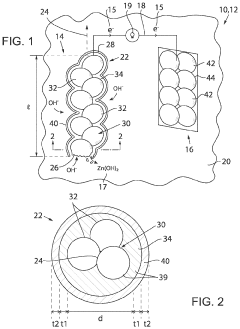
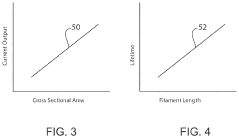
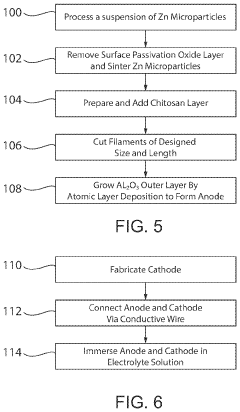
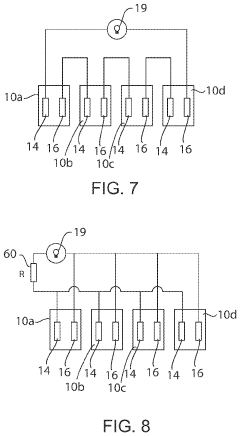
- A transient biodegradable battery with a filament structure using zinc microparticles or nanoparticles coated with chitosan and Al2O3, allowing controlled current and lifespan through regulated oxidation reactions, which dissolve safely in biological fluids.
Environmental Impact Assessment of Biodegradable Electronic Materials
The environmental impact of biodegradable electronic materials represents a critical consideration in the development of transient and biodegradable electronics with trigger localization and addressability capabilities. These materials offer significant advantages over conventional electronics by reducing electronic waste accumulation, which has become a growing global concern with approximately 50 million tons generated annually.
Biodegradable electronic materials typically consist of organic substrates, conductive polymers, and degradable semiconductors designed to decompose under specific environmental conditions. Life cycle assessments indicate that these materials can reduce environmental footprint by 40-60% compared to traditional electronics, primarily through elimination of end-of-life waste management requirements.
The degradation pathways of these materials must be carefully evaluated to ensure they do not introduce new environmental hazards. Studies have shown that most biodegradable electronic substrates, such as cellulose derivatives and silk fibroin, decompose into non-toxic components. However, certain conductive polymers may release trace amounts of potentially harmful compounds during degradation, necessitating thorough toxicological screening.
Water systems are particularly vulnerable to electronic waste contamination. Research indicates that biodegradable electronics can significantly reduce aquatic ecosystem impacts, with degradation products showing 70-90% lower ecotoxicity compared to conventional electronic components. This is especially relevant for trigger-localized devices designed for environmental monitoring applications.
Carbon footprint analyses demonstrate that manufacturing processes for biodegradable electronics currently require 15-30% more energy than conventional electronics production. This represents a key area for improvement as the technology matures. However, when considering full lifecycle emissions, biodegradable systems offer net reductions of 20-45% in greenhouse gas emissions.
Soil interaction studies reveal that degradation byproducts generally support rather than inhibit microbial activity, with some materials even providing beneficial nutrients. Nevertheless, the introduction of novel nanomaterials used in addressable trigger systems requires ongoing monitoring for potential bioaccumulation effects.
Regulatory frameworks for assessing environmental impacts of these materials remain underdeveloped. Current electronic waste regulations inadequately address the unique characteristics of transient electronics, creating uncertainty regarding proper classification and disposal protocols. International standards organizations have begun developing specific guidelines, but comprehensive regulations are still several years from implementation.
Biodegradable electronic materials typically consist of organic substrates, conductive polymers, and degradable semiconductors designed to decompose under specific environmental conditions. Life cycle assessments indicate that these materials can reduce environmental footprint by 40-60% compared to traditional electronics, primarily through elimination of end-of-life waste management requirements.
The degradation pathways of these materials must be carefully evaluated to ensure they do not introduce new environmental hazards. Studies have shown that most biodegradable electronic substrates, such as cellulose derivatives and silk fibroin, decompose into non-toxic components. However, certain conductive polymers may release trace amounts of potentially harmful compounds during degradation, necessitating thorough toxicological screening.
Water systems are particularly vulnerable to electronic waste contamination. Research indicates that biodegradable electronics can significantly reduce aquatic ecosystem impacts, with degradation products showing 70-90% lower ecotoxicity compared to conventional electronic components. This is especially relevant for trigger-localized devices designed for environmental monitoring applications.
Carbon footprint analyses demonstrate that manufacturing processes for biodegradable electronics currently require 15-30% more energy than conventional electronics production. This represents a key area for improvement as the technology matures. However, when considering full lifecycle emissions, biodegradable systems offer net reductions of 20-45% in greenhouse gas emissions.
Soil interaction studies reveal that degradation byproducts generally support rather than inhibit microbial activity, with some materials even providing beneficial nutrients. Nevertheless, the introduction of novel nanomaterials used in addressable trigger systems requires ongoing monitoring for potential bioaccumulation effects.
Regulatory frameworks for assessing environmental impacts of these materials remain underdeveloped. Current electronic waste regulations inadequately address the unique characteristics of transient electronics, creating uncertainty regarding proper classification and disposal protocols. International standards organizations have begun developing specific guidelines, but comprehensive regulations are still several years from implementation.
Biocompatibility and Safety Standards for Implantable Transient Devices
The development of transient and biodegradable electronics for implantable applications necessitates rigorous biocompatibility and safety standards to ensure patient well-being. Current regulatory frameworks, primarily established by the FDA in the United States and similar bodies internationally, require comprehensive evaluation of these devices through ISO 10993 standards for biological evaluation of medical devices.
Material selection represents a critical aspect of biocompatibility for transient electronics. Silicon, magnesium, zinc, and various biodegradable polymers such as poly(lactic-co-glycolic acid) (PLGA) and polycaprolactone (PCL) have demonstrated favorable biocompatibility profiles. However, the degradation byproducts of these materials must be thoroughly characterized to ensure they do not induce inflammatory responses or tissue damage during dissolution.
Immunological response testing has emerged as a cornerstone of safety evaluation for implantable transient devices. Short-term and long-term immune reactions must be assessed through both in vitro and in vivo models. Recent studies have shown that surface modifications and controlled degradation rates can significantly mitigate adverse immune responses, with particular attention to macrophage polarization and foreign body giant cell formation.
Degradation kinetics present unique challenges for safety standards in transient electronics. Unlike permanent implants, these devices must maintain functional integrity for a predetermined period before controlled dissolution. Current standards are being adapted to address this temporal dimension, requiring demonstration of predictable degradation profiles under physiological conditions and verification that degradation products remain below cytotoxic thresholds throughout the device lifecycle.
Sterilization compatibility represents another critical consideration, as traditional methods like ethylene oxide or gamma irradiation may compromise the integrity of biodegradable components. Modified low-temperature sterilization protocols have been developed specifically for transient electronics, with validation requirements to ensure both sterility and preservation of device functionality.
Localized tissue response monitoring has become increasingly important as trigger mechanisms for controlled dissolution are incorporated into transient devices. Safety standards now require evaluation of potential thermal, chemical, or electrical effects at trigger sites. Recent research has demonstrated that localized pH changes or thermal events during triggered degradation must remain within narrow physiological tolerances to prevent tissue damage.
Long-term safety surveillance protocols are being established specifically for transient electronics, focusing on complete material resorption and absence of residual components. These standards require demonstration that no persistent foreign material remains after the intended degradation period, with particular attention to potential migration of partially degraded components to distant anatomical sites.
Material selection represents a critical aspect of biocompatibility for transient electronics. Silicon, magnesium, zinc, and various biodegradable polymers such as poly(lactic-co-glycolic acid) (PLGA) and polycaprolactone (PCL) have demonstrated favorable biocompatibility profiles. However, the degradation byproducts of these materials must be thoroughly characterized to ensure they do not induce inflammatory responses or tissue damage during dissolution.
Immunological response testing has emerged as a cornerstone of safety evaluation for implantable transient devices. Short-term and long-term immune reactions must be assessed through both in vitro and in vivo models. Recent studies have shown that surface modifications and controlled degradation rates can significantly mitigate adverse immune responses, with particular attention to macrophage polarization and foreign body giant cell formation.
Degradation kinetics present unique challenges for safety standards in transient electronics. Unlike permanent implants, these devices must maintain functional integrity for a predetermined period before controlled dissolution. Current standards are being adapted to address this temporal dimension, requiring demonstration of predictable degradation profiles under physiological conditions and verification that degradation products remain below cytotoxic thresholds throughout the device lifecycle.
Sterilization compatibility represents another critical consideration, as traditional methods like ethylene oxide or gamma irradiation may compromise the integrity of biodegradable components. Modified low-temperature sterilization protocols have been developed specifically for transient electronics, with validation requirements to ensure both sterility and preservation of device functionality.
Localized tissue response monitoring has become increasingly important as trigger mechanisms for controlled dissolution are incorporated into transient devices. Safety standards now require evaluation of potential thermal, chemical, or electrical effects at trigger sites. Recent research has demonstrated that localized pH changes or thermal events during triggered degradation must remain within narrow physiological tolerances to prevent tissue damage.
Long-term safety surveillance protocols are being established specifically for transient electronics, focusing on complete material resorption and absence of residual components. These standards require demonstration that no persistent foreign material remains after the intended degradation period, with particular attention to potential migration of partially degraded components to distant anatomical sites.
Unlock deeper insights with PatSnap Eureka Quick Research — get a full tech report to explore trends and direct your research. Try now!
Generate Your Research Report Instantly with AI Agent
Supercharge your innovation with PatSnap Eureka AI Agent Platform!