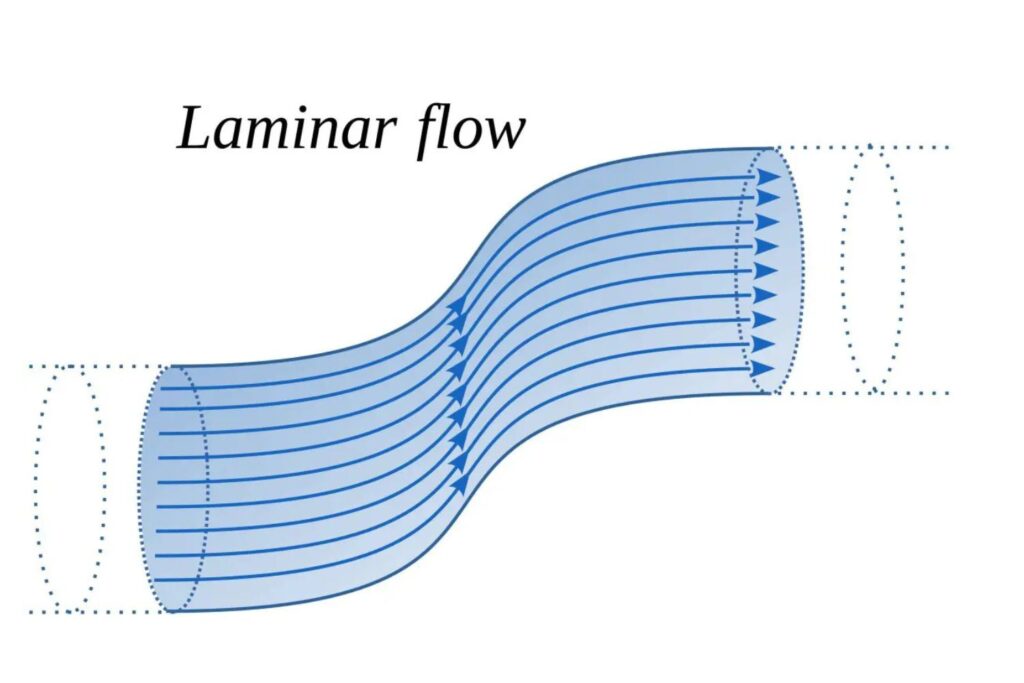
Laminar flow describes the streamlined movement of fluid particles in parallel layers with minimal disruption. Unlike turbulent flow, laminar flow enables consistent velocity, reduced drag, and enhanced precision, making it critical in high-performance engineering and environmental control systems.
As global industries pivot toward energy efficiency, cleaner manufacturing, and precision technology, laminar flow is gaining traction in sectors from aerospace and microfluidics to sustainable architecture and advanced manufacturing.
This article explores the foundational properties of laminar flow, its categorized application domains, comparative strengths and weaknesses, emerging research frontiers, and how innovators can leverage this principle for next-gen system design.
Material Composition & Key Properties
Laminar flow isn’t a material but a fluid dynamic state. Its key characteristics stem from the Navier-Stokes equations under low Reynolds numbers (Re < ~2300 in pipes):
- Velocity Consistency: Fluid particles move in uniform layers, minimizing cross-currents.
- Low Energy Loss: Reduced internal friction translates into energy efficiency.
- Predictable Patterns: Facilitates accurate simulation and control in system design.
- Enhanced Heat/Mass Transfer Control: Ideal for precision thermal regulation and diffusion.
- Reduced Contamination: Especially beneficial in cleanrooms and biosafety environments.
Common control methods include flow channel design, pressure gradients, flow restrictors, and surface smoothing or micro-patterning.
Application Domains & Working Mechanisms
This section explores how laminar flow is applied across key industries, combining functional background with physical mechanisms and research frontiers.
✈️ Aerospace & Transportation Systems
Laminar flow plays a pivotal role in reducing aerodynamic drag on aircraft wings, fuselages, and automotive surfaces. By maintaining orderly flow regimes across these surfaces, engineers can achieve higher fuel efficiency and better stability. Modern strategies employ boundary layer suction, wing shaping, and hybrid laminar flow control (HLFC) systems to prolong laminar regions.
Research Focus: Computational modeling, boundary layer control, and hybrid laminar flow control (HLFC) techniques.
Explore More In:
- Laminar Flow: Enhancing Aerodynamics in Aviation
- How Laminar Flow Enhances Aerospace Engineering?
- The Future of Laminar Flow in Automotive Design
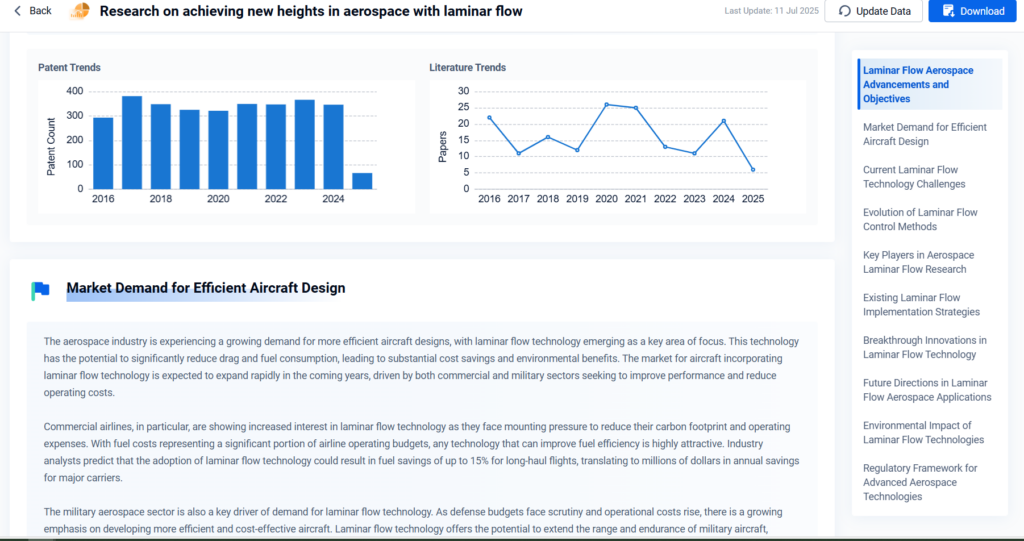
- Achieving New Heights in Aerospace with Laminar Flow
🌡 Cleanrooms & Biomedical Environments
In pharmaceutical manufacturing, hospitals, and microelectronics facilities, unidirectional laminar airflow is crucial for contamination control. Vertical or horizontal airflow across HEPA filters ensures minimal turbulence, reducing the spread of airborne pathogens or particles.
Research Focus: Smart sensors in biosafety cabinets, HEPA-filter integration, and flow uniformity optimization.
Explore More In:
- How to Implement Laminar Flow in Cleanroom Environments?
- The Use of Laminar Flow in Modern Medical Facilities
- Laminar Flow in Biomedical Devices: Current Trends
- Investigating Laminar Flow for Airborne Pathogen Control
⚙️ Industrial & HVAC System Design
In factories, laboratories, and HVAC systems, laminar flow ensures safe air handling, efficient particle filtration, and uniform thermal distribution. It improves heat exchanger effectiveness and reduces contamination in precision manufacturing.
Research Focus: CFD simulation, nanostructured vent surfaces, and energy-saving HVAC retrofits.
Explore More In:
- Advancements in Laminar Flow for HVAC Systems
- Laminar Flow: Innovations in Pollution Control
- How to Enhance Heat Transfer with Laminar Flow?
- Optimizing Laminar Flow Channels for Resource Management
🧪 Microfluidics & Chemical Engineering
Laminar flow enables tightly controlled chemical reactions and fluid behavior in microscale devices. With negligible mixing between adjacent layers, it’s ideal for medical diagnostics, nanoparticle synthesis, and lab-on-chip applications.
Research Focus: Organ-on-a-chip systems, lab-on-chip diagnostics, and inertial microfluidics.
Explore More In:
- Laminar Flow Applications in Microfluidic Devices
- Laminar Flow Technology in Nanoparticle Delivery
- Advanced Laminar Flow Techniques in Chemical Synthesis
- How Laminar Flow Supports Advanced Manufacturing Techniques?
🌍 Sustainable Infrastructure & Energy Systems
Laminar flow aids in reducing energy usage in building ventilation, water distribution, and clean energy systems. Its efficiency and predictability make it vital for low-emission architecture, green transportation, and heat recovery systems.
Research Focus: Smart grid integration, vertical farming, renewable energy interfaces, and building automation.
Explore More In:
- How to Maximize Energy Savings with Laminar Flow?
- Laminar Flow Applications in Electronic Cooling Systems
- Laminar Flow Control in Spacecraft Design
- Laminar Flow Strategies for Sustainable Architecture
Comparative Advantages & Limitations
Advantages:
- ✓ Energy-efficient due to reduced internal friction
- ✓ Enhances flow predictability and system control
- ✓ Ideal for contamination-sensitive environments
- ✓ Facilitates high-precision heat and mass transfer
Limitations:
- Low flow rates may be insufficient for high-throughput systems
- Requires controlled geometries and surfaces to maintain stability
- Prone to transition to turbulence if Re exceeds critical value
- Implementation costs can be high in retrofitting or large-scale systems
Future Outlook & Research Frontiers
Laminar flow is evolving from a niche engineering solution to a foundational element of sustainable and precision-based systems.
Key Trends to Watch:
- AI-optimized CFD Models: Accelerating laminar system design
- Self-regulating Smart Channels: Real-time adjustments to preserve laminarity
- 3D-Printed Flow Structures: Enhanced control in biomedical and aerospace fields
- Integrated Sensors: Monitoring transitions to turbulence in real time
- Sustainable Ventilation: Low-energy climate systems for green buildings
Conclusion & Key Takeaways
Laminar flow is more than a fluid mechanics concept—it’s a transformative tool for cleaner, smarter, and more efficient systems. From micro-scale diagnostics to macro-scale transportation, its applications are wide-ranging and increasingly critical.
Whether you’re optimizing aerospace design or reimagining smart infrastructure, now is the time to explore laminar flow as a foundation for next-gen performance.
Accelerate Innovation with PatSnap Eureka AI Agent
Ready to future-proof your fluid dynamics strategy?
PatSnap Eureka AI Agent empowers R&D teams to uncover laminar flow innovations, benchmark aerodynamic breakthroughs, and explore hidden technical trends—all in one platform.
👉 Book a free PatSnap Eureka AI Agent demo today and streamline your innovation pipeline.