Indoor unit antifreeze control method for air conditioner and air conditioner

A control method and indoor unit technology, applied in the direction of refrigeration and liquefaction, refrigerators, refrigeration components, etc., can solve the problems of inability to judge the freezing situation of indoor units, set anti-freezing mode, etc., and achieve the effect of intelligent and flexible anti-freezing operation

CN108413565BActive Publication Date: 2020-09-25QINGDAO HAIER AIR CONDITIONER GENERAL CORP LTD +1
14 Cites 0 Cited by

Patent Information

Authority / Receiving Office
CN · China
Patent Type
Patents(China)
Current Assignee / Owner
Publication Date
2020-09-25

Smart Images

  • Figure 1
    Figure 1
  • Figure 2
    Figure 2
Patent Text Reader

Abstract

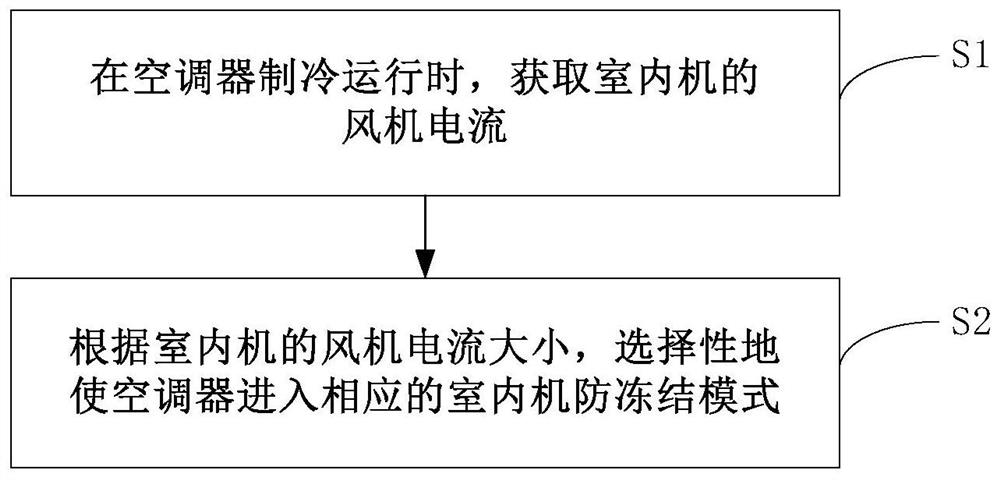
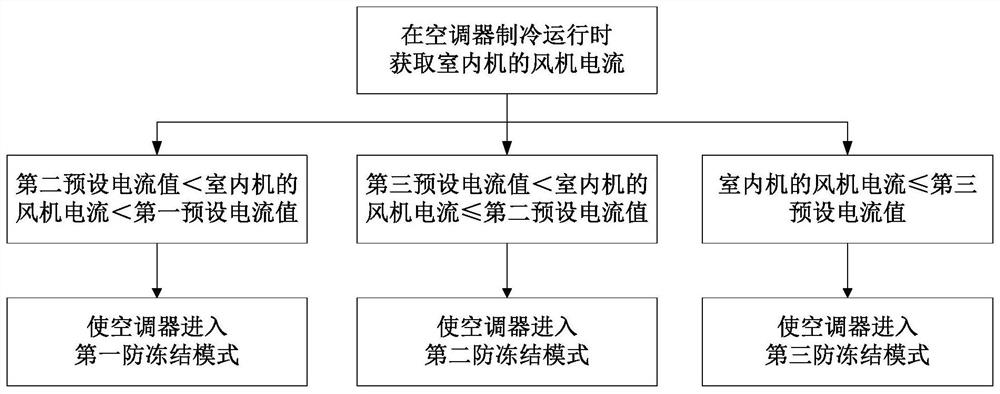
The invention belongs to the technical field of air conditioners, and in particular relates to an indoor unit anti-freezing control method for the air conditioner and the air conditioner. The invention aims to solve the problem that the existing air conditioner not only cannot accurately judge the freezing condition of the indoor unit, but also does not set a corresponding anti-freezing mode according to the different freezing conditions of the indoor unit. The indoor unit anti-freezing control method of the present invention includes: when the air conditioner is in cooling operation, obtaining the fan current of the indoor unit; according to the magnitude of the fan current of the indoor unit, selectively enabling the air conditioner to enter the corresponding anti-freezing mode of the indoor unit; so that The air conditioner of the present invention can select different anti-freezing modes according to different freezing conditions of the indoor unit, so that on the basis of effectively ensuring that the indoor unit can be deiced quickly, it can also effectively avoid the incompatibility of the anti-freezing mode in the operation of the existing air conditioner. It is easy to cause energy waste and poor deicing effect.
Need to check novelty before this filing date? Find Prior Art

Description

technical field

[0001] The invention belongs to the technical field of air conditioners, and in particular relates to an indoor unit anti-freezing control method for the air conditioner and the air conditioner. Background technique

[0002] With the continuous improvement of people's living standards, people have also put forward higher and higher requirements for the living environment. In order to maintain a comfortable ambient temperature, air conditioners have become an essential device in people's lives. Generally, an air conditioner includes an indoor unit, an outdoor unit, and a circulation loop for connecting the indoor unit and the outdoor unit. The heat exchange medium in the air conditioner continuously exchanges heat between the outdoor unit and the indoor unit through the circulation loop, thereby achieving a change in room temperature. Effect. Taking the cooling operation of the air conditioner as an example, the coil of the indoor unit is always at a low tem...

Examples

Embodiment Construction

[0021] Preferred embodiments of the present invention are described below with reference to the accompanying drawings. Those skilled in the art should understand that these embodiments are only used to explain the technical principles of the present invention, and are not intended to limit the protection scope of the present invention. For example, although the various steps of the method of the present invention are described in a specific order in the present application, these orders are not limiting, and those skilled in the art can perform the steps in different orders without departing from the basic principles of the present invention. Follow the steps described.

[0022] Based on the existing air conditioner proposed in the background technology, not only cannot accurately judge the freezing situation of the indoor unit, but also does not set the corresponding anti-freezing mode according to the different freezing conditions of the indoor unit, so that the heat exchang...