
Image Based Turing Test
a turing test and image technology, applied in the field of image based turing test, can solve the problems of web bots generally having malicious intent, computer programs are generally not able to solve such a test on its own, and are susceptible to being deceived
Patent Information
- Authority / Receiving Office
- US · United States
- Patent Type
- Applications(United States)
- Current Assignee / Owner
- Publication Date
- 2008-03-13
- Estimated Expiration
- Not applicable · inactive patent
Smart Images
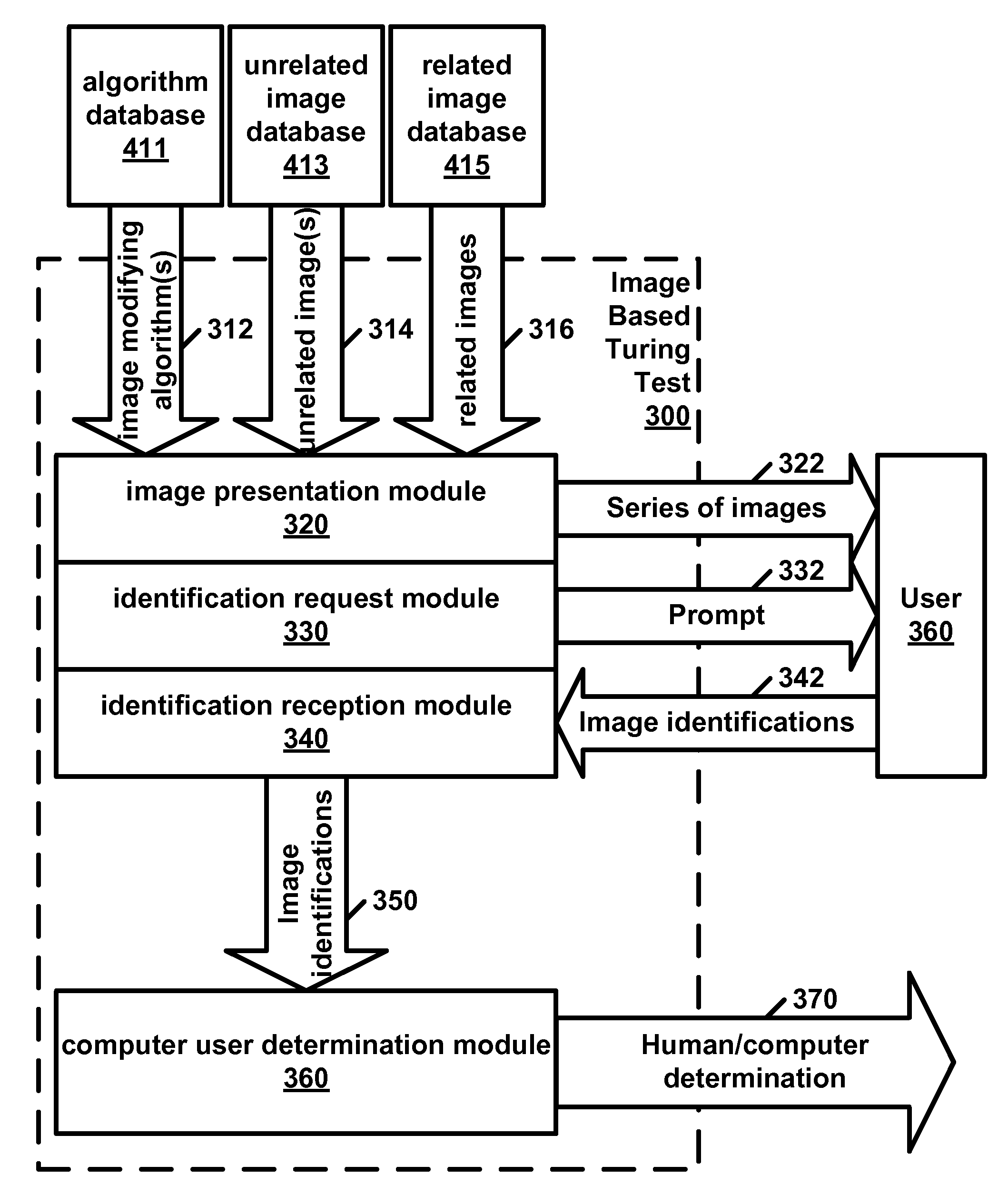
Figure 1 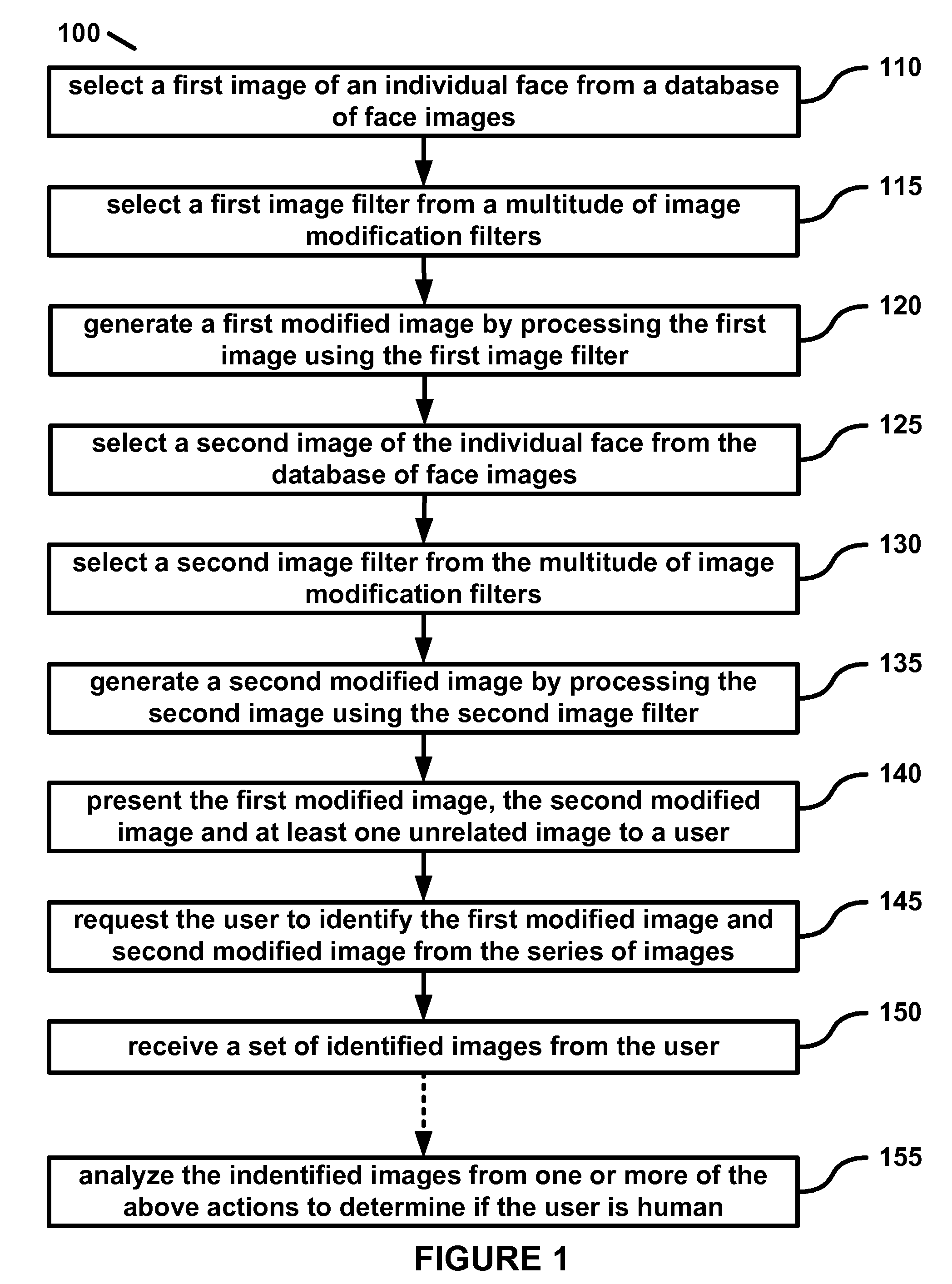
Figure 2 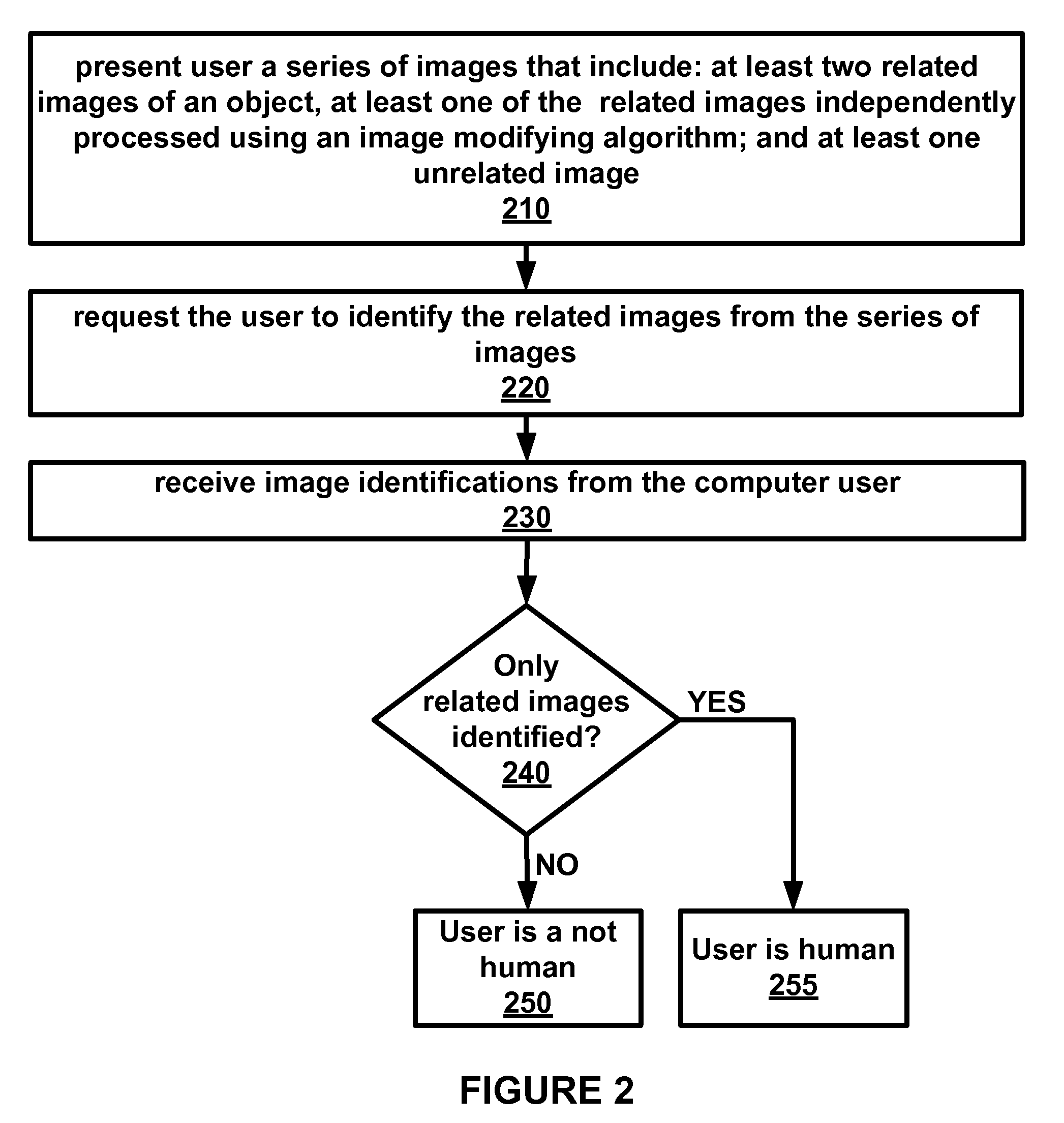
Figure 3
Abstract
Description
CROSS-REFERENCE TO RELATED APPLICATIONS
[0001] This application claims the benefit of U.S. Provisional Application No. 60 / 825,458, filed Sep. 13, 2006, entitled “An Automated Public Turing Test,” which is hereby incorporated by reference in its entirety.BACKGROUND
[0002] Web-based services are becoming more and more ubiquitous and in many situations, these web based services are replacing human-to-human interactions. Schemes which implicitly assume that the other party on the internet is a human, are susceptible to being deceived by programs which pretend to be humans. Such web bots generally have a malicious intent. Thus, the need to authenticate that the other party on the web-based service is a human and not a potentially malicious program is on the rise.
[0003] Human Interactive Proofs (HIPs) are schemes which require an interaction from a human user that is tough for a program to simulate. CAPTCHAs are a class of HIPs which are tests that are so designed that humans can easily ...
Examples
Embodiment Construction
[0022] Embodiments of the present invention are image based CAPTCHA's that a human can pass, independently of the person's familiarity with any particular language or culture. Disclosed are several embodiments that present related and unrelated images, many or all of which have been subjected to a distortion, to a computer user. The computer user is then asked to identify those images that are related. A determination is then made as to whether the computer user is a human being or not based on the computer users ability to properly identify the related images.
[0023]FIG. 1 is a flow diagram of a CAPTCHA that uses images of human faces as per an aspect of an embodiment of the present invention. This embodiment takes advantage of the fact that recognizing human faces is a relatively difficult task for computers, but is relatively easy for humans. In the test, photographs of human faces may be distorted using different image processing transformations. The photographs may be obtained ...