
Isotropic bonded NdFeB magnet and magnetic roller consisting of same
An isotropic, NdFeB technology, applied in the direction of magnetic objects, magnetic materials, permanent magnets, etc., can solve the problems of difficulty in obtaining a homogeneous magnetic field, affecting imaging quality, and high production costs, and achieves difficult demagnetization and high remanence , The effect of strong magnetic properties
Patent Information
- Authority / Receiving Office
- CN · China
- Patent Type
- Patents(China)
- Current Assignee / Owner
- Publication Date
- 2013-06-12
Smart Images
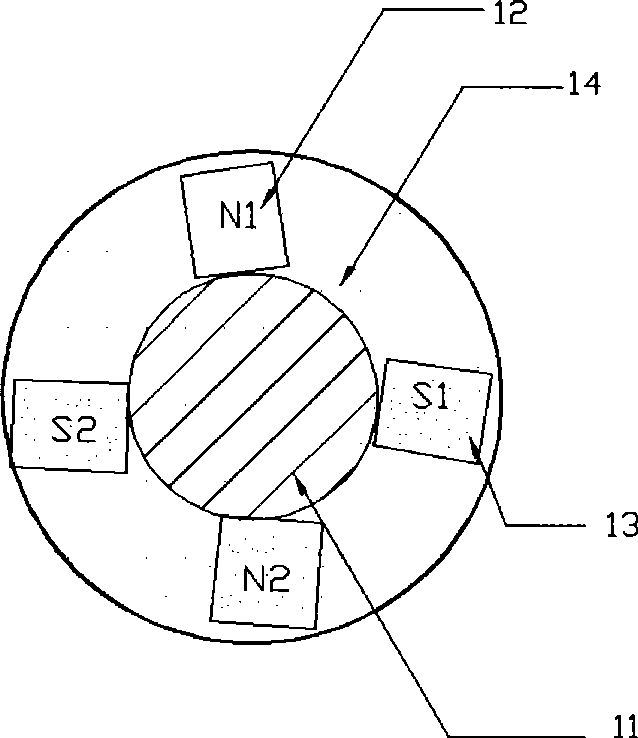
Figure 1 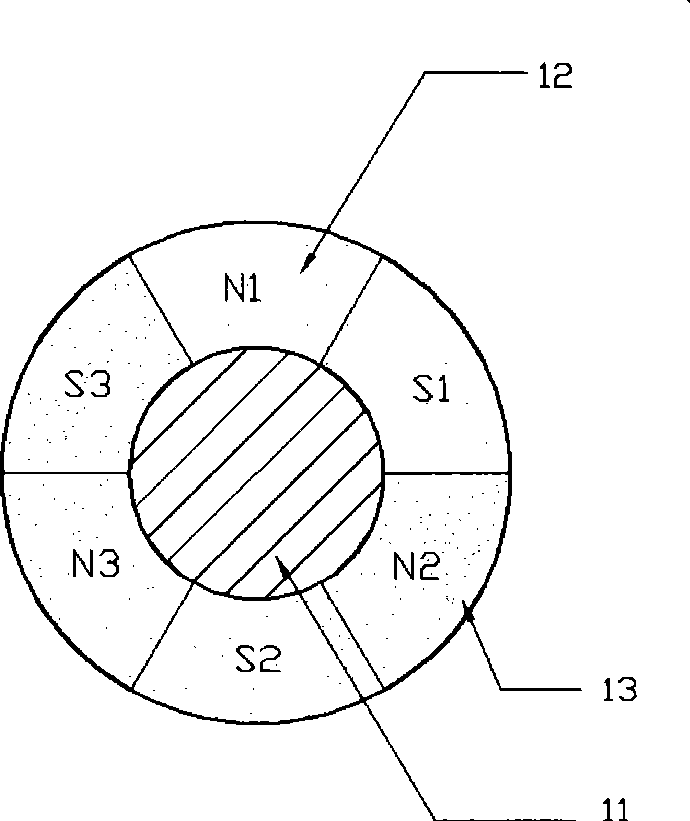
Figure 2 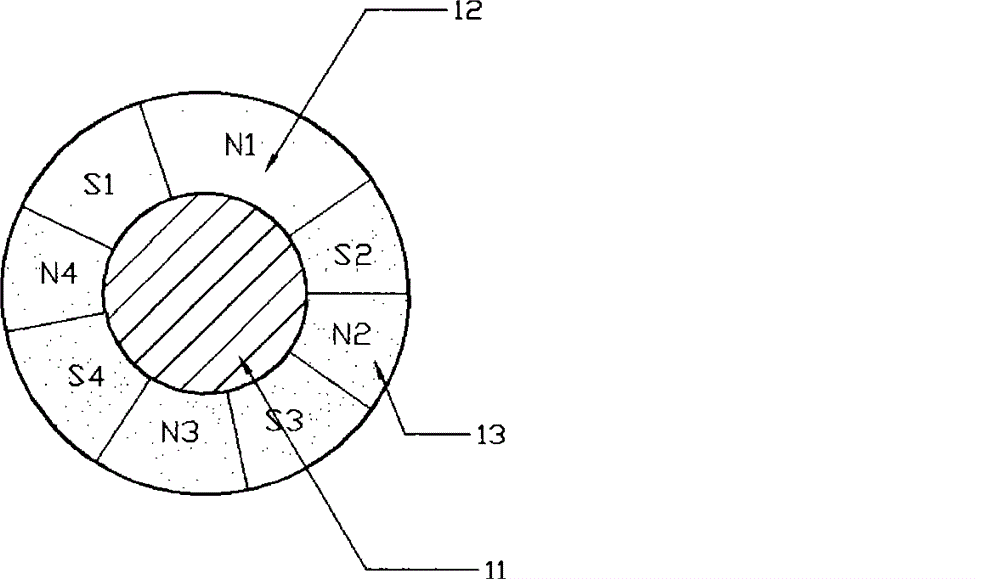
Figure 3
Abstract
Description
technical field
[0001] The invention relates to the technical field of magnetic rollers used in printers and copiers. Background technique
[0002] The magnetic roller is the key component of development in laser printers and copiers, and its performance is directly related to the quality of imaging. At present, a typical magnetic roller includes a mandrel, a cylindrical permanent magnet fixed on the outside of the said mandrel, the surface of the permanent magnet has a plurality of magnetic poles extending in the axial direction, the magnetic roller is covered with a sleeve, and the magnetic roller can be relatively sleeved. Drum turns. Its working principle is: through the relative rotation of the magnetic roller and the sleeve, the magnetic roller absorbs the magnetic developer onto the surface of the sleeve, and then transports it to the developing area and develops it by electrostatic charge. Usually such a magnetic roller has an outer diameter of 10-60 mm, a length o...
Examples
Embodiment 1
[0053] A magnetic roller, structured as figure 1 As shown, there are four magnetic poles, and one magnetic pole N1 is composed of an isotropic bonded NdFeB magnet 12 . 11 is the mandrel of magnetic roller, and all the other magnetic poles are made up of ferrite permanent magnet 13, and 14 is the resin for filling.
[0054] The magnetic pole N1 is composed of an isotropic bonded NdFeB magnet, and the ratio of each component of the magnet is as follows (weight):
[0055] Bonded NdFeB permanent magnet powder 86%,
[0056] Ferrite permanent magnet powder 10%
[0057] Bonding resin 4%
[0058] The particle size of the bonded NdFeB permanent magnet powder is about 70-100 μm;
[0059] The particle size of ferrite magnetic powder is 0.9~1.2μm;
[0060] The bonding resin is selected from polyamide resin nylon 6 and nylon 12, and the weight ratio of nylon 6 and nylon 12 is 1:1;
[0061] Said isotropic bonded NdFeB magnets are prepared as follows:
[0062] Firstly, the above raw m...
Embodiment 2
[0068] A magnetic roller, structured as figure 2 , with 6 magnetic poles, two of which, N1 and S1, are composed of isotropic bonded NdFeB magnets. 11 is the mandrel of magnetic roller, and residual magnetic pole is made up of ferrite permanent magnet 13.
[0069] The magnetic poles N1 and S1 are composed of isotropic bonded NdFeB magnets, and the ratio of each component of the magnets is as follows: (weight)
[0070] Bonded NdFeB permanent magnet powder 78%,
[0071] Ferrite permanent magnet powder 15%
[0072] Bonding resin 7%
[0073] The particle size of the bonded NdFeB permanent magnet powder is about 70-100 μm;
[0074] The particle size of ferrite magnetic powder is 0.9~1.2μm;
[0075] The binding resin is selected from nylon 6, nylon 12 and nylon 6-12, and the weight ratio of nylon 6, nylon 12 and nylon 6-12 is 1:1:1;
[0076] Said isotropic bonded NdFeB magnets are prepared as follows:
[0077] Firstly, the above raw materials are accurately weighed according ...
Embodiment 3
[0083] A magnetic roller, structured as image 3 , There are 8 magnetic poles, two of which, N1 and S1, are composed of isotropic bonded NdFeB magnets. 11 is the mandrel of magnetic roller, and residual magnetic pole is made up of ferrite permanent magnet 13.
[0084] The magnetic poles N1 and S1 are composed of isotropic bonded NdFeB magnets, and the ratio of each component of the magnets is as follows: (weight)
[0085] Bonded NdFeB permanent magnet powder 70%,
[0086] Ferrite permanent magnet powder 20%
[0087] Bonding resin 10%
[0088] The particle size of the bonded NdFeB permanent magnet powder is about 70-100 μm;
[0089] The particle size of ferrite magnetic powder is 0.9~1.5μm;
[0090] The binding resin is selected from nylon 6, nylon 66 and nylon 12, and the weight ratio of nylon 6, nylon 66 and nylon 12 is 2:1:1;
[0091] Said isotropic bonded NdFeB magnets are prepared as follows:
[0092] Firstly, the above raw materials are accurately weighed according...