
Spherical focal plane-based sub viewing field step gaze imaging optical system
An optical system and staring imaging technology, applied in optics, optical components, instruments, etc., can solve problems such as occlusion, achieve strong scalability, solve complex system integration difficulties, and solve large-scale device requirements.
Patent Information
- Authority / Receiving Office
- CN · China
- Patent Type
- Patents(China)
- Current Assignee / Owner
- Publication Date
- 2013-02-13
- Estimated Expiration
- Not applicable · inactive patent
Smart Images
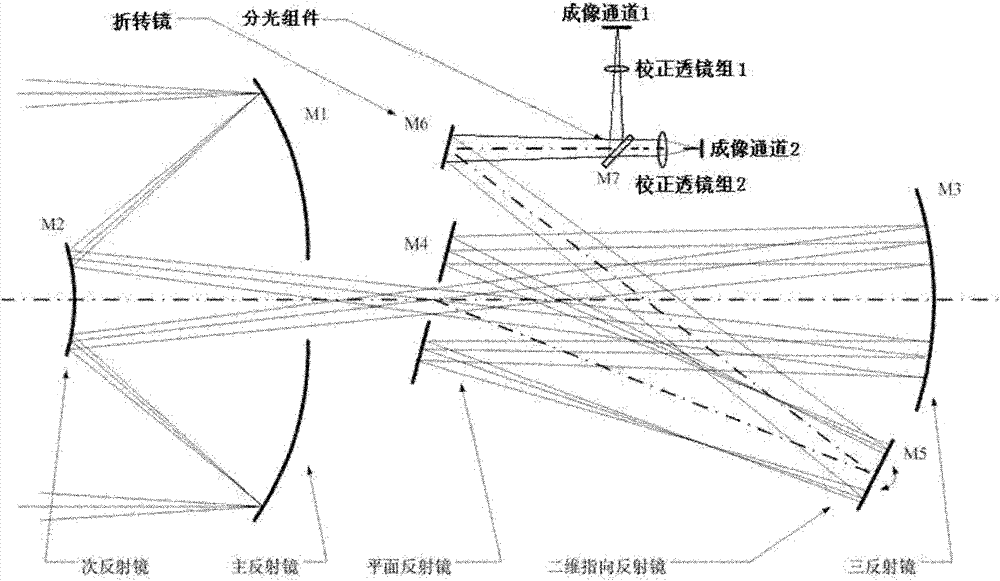
Figure 1 
Figure 2 
Figure 3
Abstract
Description
technical field
[0001] The invention belongs to the technical field of optical remote sensing imaging, and relates to a sub-field of view step staring imaging optical system based on a spherical focal surface. Background technique
[0002] In the field of optical remote sensing imaging, the requirements for large-scale wide staring imaging and multi-spectral composite imaging are getting higher and higher. The scale of the existing area array focal plane detectors is far from meeting the needs of practical applications, and has gradually become a bottleneck restricting the development of optical remote sensing imaging. . In order to solve the problem that the size of the area array detector is too small, the commonly used technical means at home and abroad include: area array detector splicing technology and sub-field step staring imaging technology.
[0003] (1) Area array detector splicing technology
[0004] There are many methods for splicing technology of area array d...
Examples
Embodiment Construction
[0024] The present invention will be further described below in conjunction with accompanying drawing and specific embodiment:
[0025] Such as figure 1 As shown, a sub-field of view step staring imaging optical system based on a spherical focal surface proposed by the present invention includes a front coaxial three-mirror main optical system, a two-dimensional pointing mirror system in the middle, a beam splitting component, and a rear The sub-field of view imaging channel correction lens group and the corresponding area array detector are combined.
[0026] The working principle of the entire optical system is: the target light enters the coaxial three-mirror main optical system, and reaches the two-dimensional pointing mirror system after four reflections; through the stepping motion of the pointing mirror, the light of each sub-field of view is introduced to the refracting mirror system one by one. The rotating mirror is reflected by it to the beam splitting component; a...