
Flat-pipe microchannel aluminum radiator
A technology of micro-channel and heat sink, which is applied in the direction of cooling/ventilation/heating transformation, etc. It can solve the problems of poor heat dissipation effect of high-power variable frequency fan drive module, affecting the normal operation of air conditioners, and unsatisfactory heat dissipation effect, etc., to achieve good heat dissipation effect , Low production cost, and the effect of reducing volume
Patent Information
- Authority / Receiving Office
- CN · China
- Patent Type
- Applications(China)
- Current Assignee / Owner
- Publication Date
- 2012-10-10
- Estimated Expiration
- Not applicable · inactive patent
Smart Images
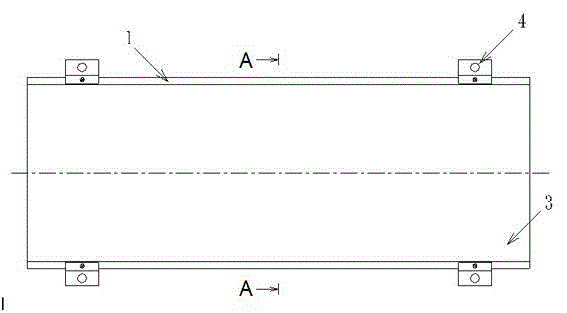
Figure 1 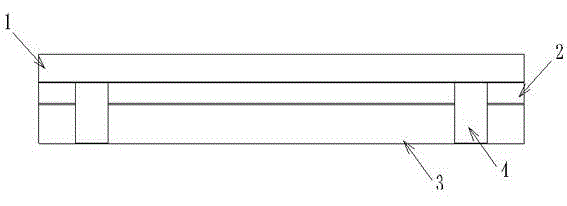
Figure 2 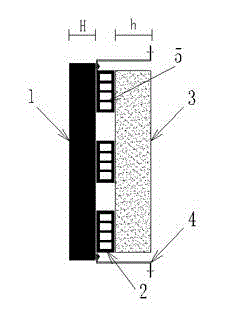
Figure 3
Abstract
Description
technical field
[0001] The invention relates to a radiator for an air conditioner, in particular to an aluminum radiator for an air conditioner. Background technique
[0002] At present, the air-conditioning power supply modules, high-power variable frequency compressor drive modules and high-power variable frequency fan drive modules on the market usually use toothed aluminum heat sinks for heat dissipation. The tooth-shaped aluminum heat sink is installed outside the air conditioner electrical box. In order to facilitate heat dissipation, the tooth-shaped aluminum heat sink must be exposed to the external environment to ensure direct contact with the flowing air to improve heat dissipation efficiency. Therefore, the installation and use of the tooth-shaped aluminum heat sink requires complex waterproof measures for the air-conditioning electrical box, and also puts forward high requirements for the installation process of the air-conditioning electrical box in the air-con...
Examples
Embodiment 1
[0026] Such as Figure 1-3 As shown, the flat tube microchannel aluminum radiator of this embodiment includes an aluminum plate 1 and an insulating layer 3 fixed on the air conditioner electrical box (not shown in the figure), the material of the insulating layer 3 is rubber, and the aluminum plate 1 and the insulating layer Two flat tube microchannel heat exchange tubes 2 are arranged between layers 3, the flat tube microchannel heat exchange tube 2 is an aluminum tube, and the flat tube microchannel heat exchange tube 2 is a hollow pipe structure, the flat tube microchannel heat exchange tube Two sets of heat exchange grids 5 are arranged in the cavity of 2.
[0027] The thickness H of the aluminum plate 1 is 3.0mm, and the outer edges of the upper and lower ends of the aluminum plate 1 protrude from the outer edges of the upper and lower ends of the insulation layer 3, and the outer edges of the upper and lower ends of the aluminum plate 1 protrude from the outer edges. Fi...
Embodiment 2
[0030] The difference between this embodiment and embodiment 1 is:
[0031] The material of the insulation layer 3 is plastic;
[0032] Three flat tube microchannel heat exchange tubes 2 are arranged between the aluminum plate 1 and the insulation layer 3, and three sets of heat exchange grids 5 are arranged in the cavity of the flat tube microchannel heat exchange tube 2;
[0033] The thickness H of the aluminum plate 1 is 8.0 mm, and the thickness h of the flat tube microchannel heat exchange tube 2 is 8.0 mm.
Embodiment 3
[0035] The difference between this embodiment and embodiment 1 is:
[0036] Three flat tube microchannel heat exchange tubes 2 are arranged between the aluminum plate 1 and the insulation layer 3, and four sets of heat exchange grids 5 are arranged in the cavity of the flat tube microchannel heat exchange tube 2;
[0037] The thickness H of the aluminum plate 1 is 5.0 mm, and the thickness h of the flat tube microchannel heat exchange tube 2 is 6.0 mm.