
Double SVC coordination control device
A technology of coordinated control and thyristor control, applied in harmonic reduction devices, reactive power adjustment/elimination/compensation, flexible AC transmission systems, etc. accident capacity, improved stability, effect of improved stability and reliability
Patent Information
- Authority / Receiving Office
- CN · China
- Current Assignee / Owner
- Publication Date
- 2014-06-04
Smart Images
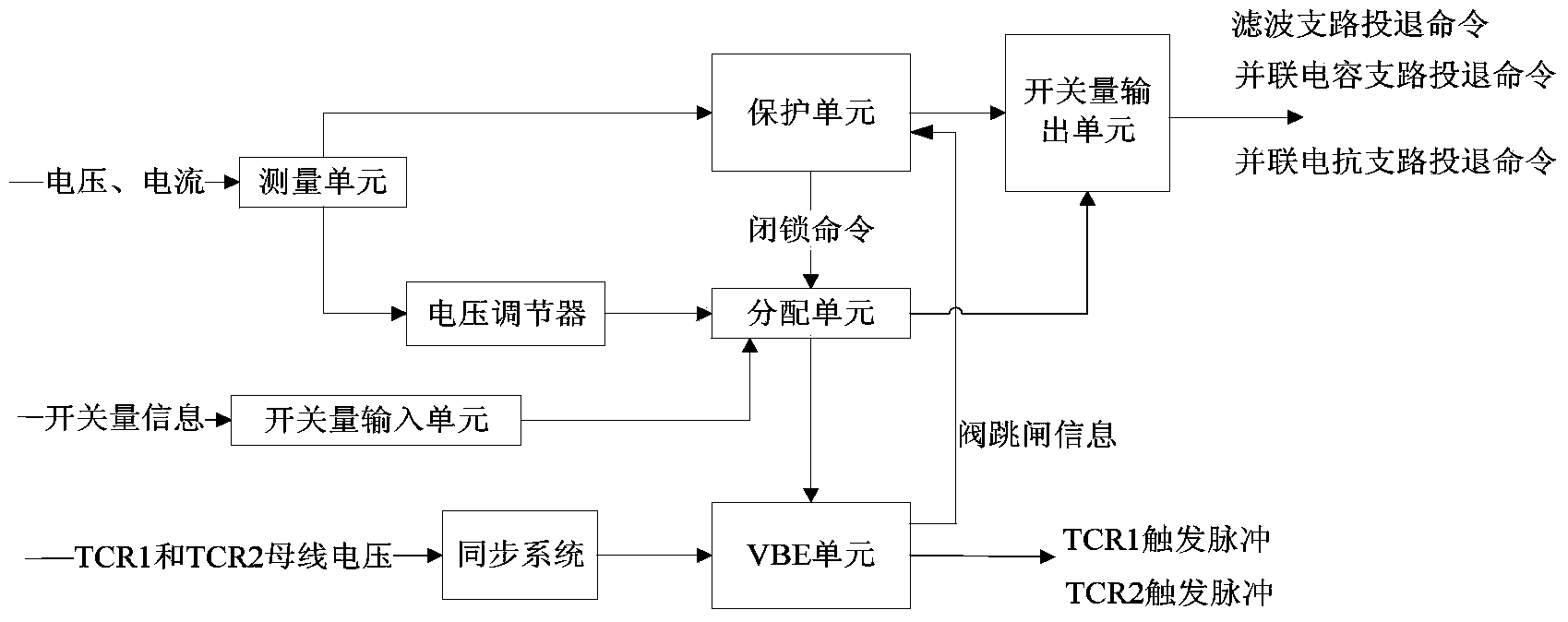
Figure 1 
Figure 2 
Figure 3
Abstract
Description
technical field
[0001] The invention relates to a control device of a static var compensation device SVC in an electric power system, in particular to a double-set SVC coordination control device. Background technique
[0002] Static var compensator (SVC) is more and more widely used in power system, and its main purpose is to stabilize the grid voltage and provide necessary reactive power compensation. If the short-circuit current level in the area where the SVC is connected is low, there will be more obvious interactions between independently controlled SVC devices, resulting in grid instability.
[0003] The low-voltage side of the two main transformers in the substation is generally operated separately, and a set of SVC devices is installed on each section of the bus. The control range of each SVC includes the thyristor-controlled reactor (TCR) of the main transformer, the filter branch, Parallel tolerating branch and resisting branch. The control target of the two set...
Examples
Embodiment Construction
[0055] The specific implementation manners of the present invention will be further described in detail below in conjunction with the accompanying drawings.
[0056] The structural block diagram of the dual sets of SVC coordinated control devices provided by the present invention is as follows: figure 1 As shown, each set of SVC main circuit mainly includes thyristor controlled reactor (TCR), passive filter, shunt capacitor and shunt reactor. Among them, TCR and shunt reactor are used to output inductive reactive power, and passive filter and shunt capacitor are used to output capacitive reactive power. The reactive power output by the SVC can be continuously adjusted by changing the firing angle of the TCR. The passive filter is also used to suppress the harmonics generated by the TCR and the background harmonics in the system, and can also avoid the occurrence of parallel resonance to amplify certain harmonic currents in the system.
[0057] Such as figure 1 As shown, the...