
Method for logging in to client side omitting password entering and supporting SIP
A technology of SIP protocol and login method, which is applied in the field of password-free client login, which can solve problems such as cumbersome operation steps, high login risk, and brute-force guessing, and achieve the effects of simplifying the login process, protecting user privacy, and reducing user operations
Patent Information
- Authority / Receiving Office
- CN · China
- Patent Type
- Applications(China)
- Current Assignee / Owner
- Publication Date
- 2014-07-09
- Estimated Expiration
- Not applicable · inactive patent
Smart Images
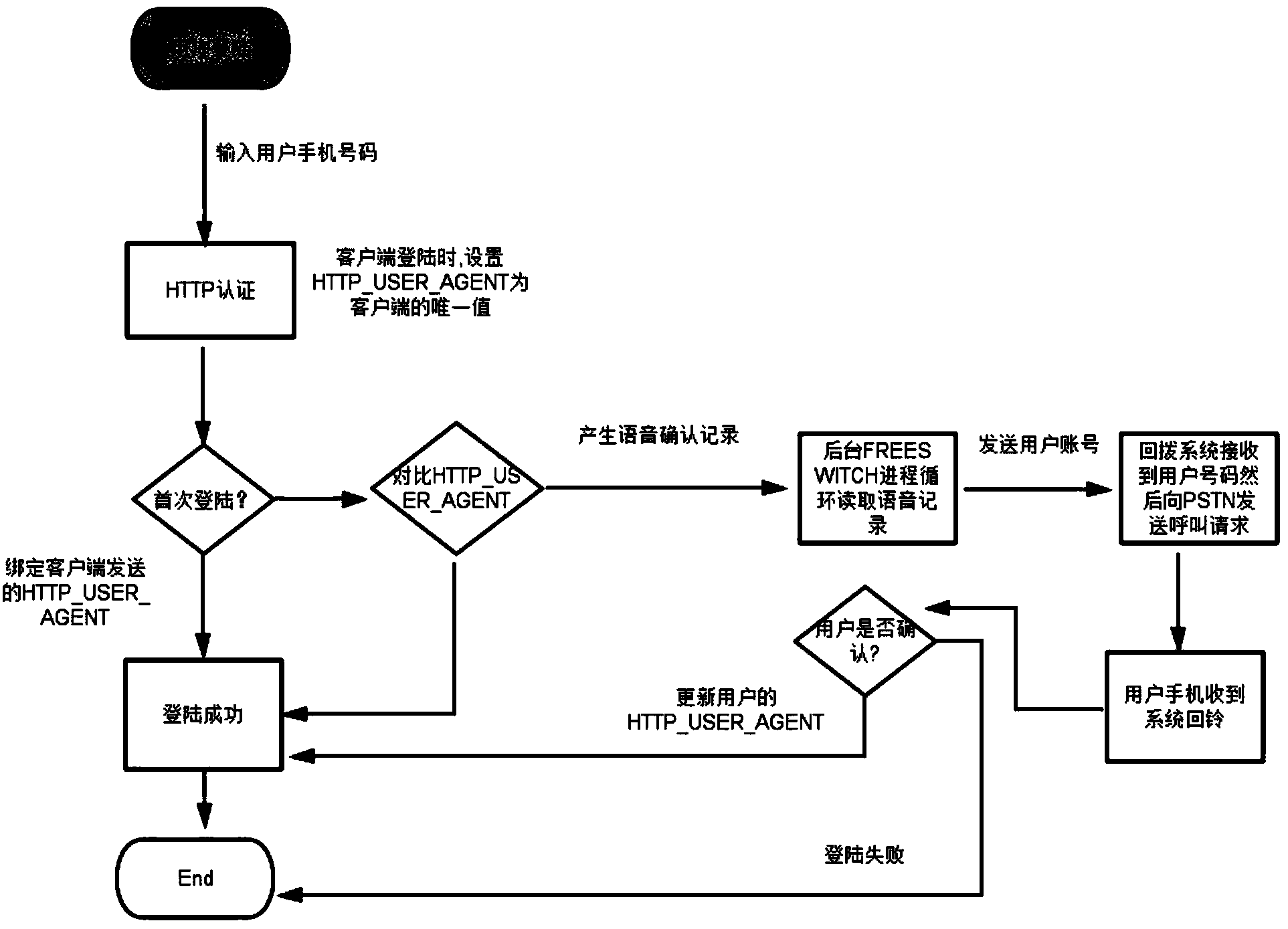
Figure 1
Abstract
Description
technical field
[0001] The invention relates to a login method of a client, in particular to a login method of a password-free client supporting the SIP protocol. Background technique
[0002] In recent years, Internet telephony has been widely popular. As an Internet telephony client SIP login protocol, it is a general VOIP registration protocol. It provides a series of protocol formats such as login, call request, and DTMF, and is widely used in various applications. among. Clients that support the SIP protocol need to provide the user's authentication password to verify the authenticity and validity of the user. After the user successfully logs in, he can perform subsequent operations, such as making calls, sending DTMF key information, etc. The traditional login method Both require the user to enter a password, and the operation steps are cumbersome. When entering the password, there may be weak passwords and the possibility of brute force guessing. The login risk is re...
Examples
Embodiment Construction
[0018] Below in conjunction with accompanying drawing and specific embodiment the present invention is described in further detail:
[0019] Such as figure 1 As shown, a login method of a password-free client that supports the SIP protocol, the login of the client includes the following steps:
[0020] (1) User login: enter the mobile phone number, click the login button, the client will obtain the unique value of the mobile phone, set it to the HTTP_USER_AGENT value, and upload the user's mobile phone number and unique value to the server by sending an HTTPPOST request, and enter the next step;
[0021] (2) The server queries whether the user logs in for the first time;
[0022] a. If you log in for the first time, record the current unique value (record the unique code of the user's mobile phone, take the IMEI for Android phones, and get the advertising ID for Apple phones) and return user-related data, and enter step (3);
[0023] B. the user is not logging in for the fir...