
A gene circuit based on lung cancer marker detection
A technology of markers and genes, applied in the field of synthetic biology, can solve the problems of gene circuit system construction, joint debugging and parameter optimization, etc., and achieve the effects of strong anti-interference ability, overcoming interference, and stable output
Patent Information
- Authority / Receiving Office
- CN · China
- Patent Type
- Patents(China)
- Current Assignee / Owner
- Publication Date
- 2016-06-08
Smart Images
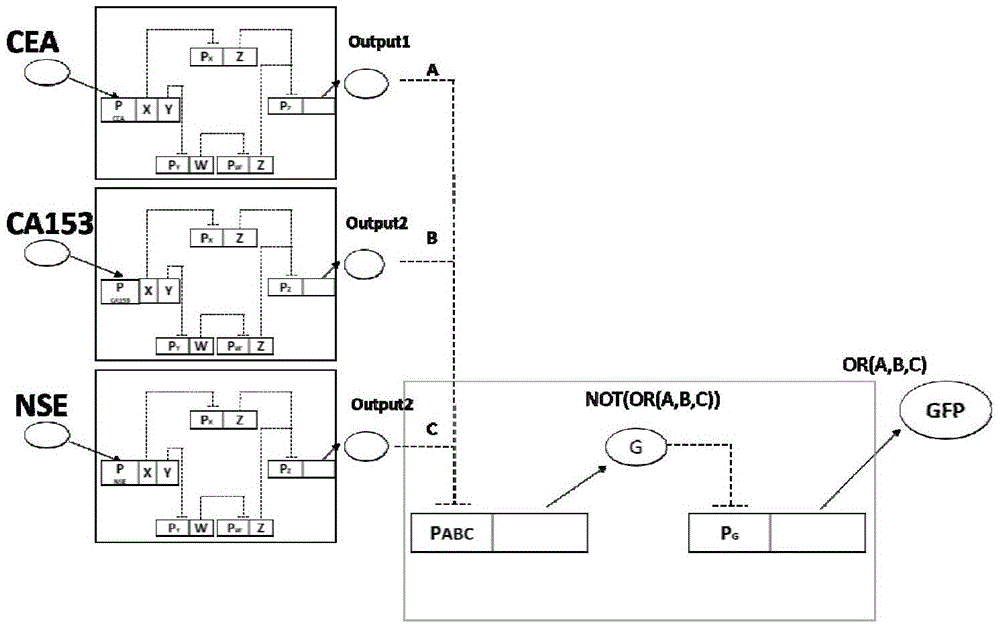
Figure 1 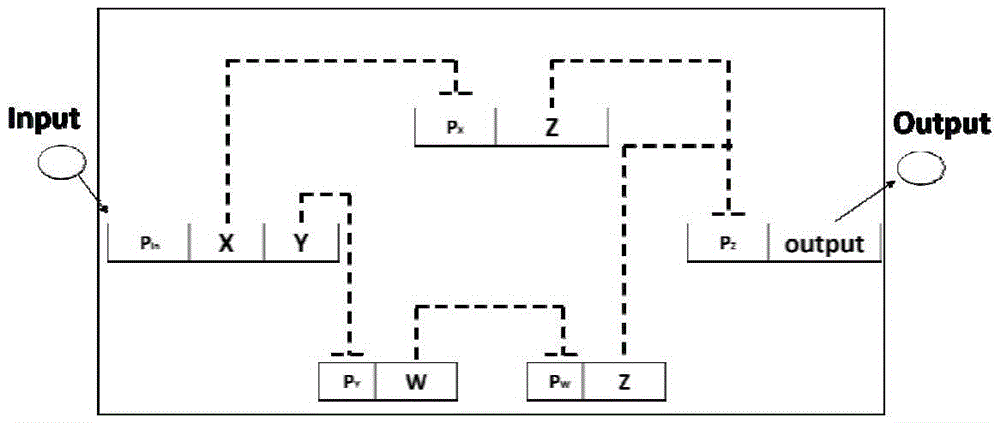
Figure 2 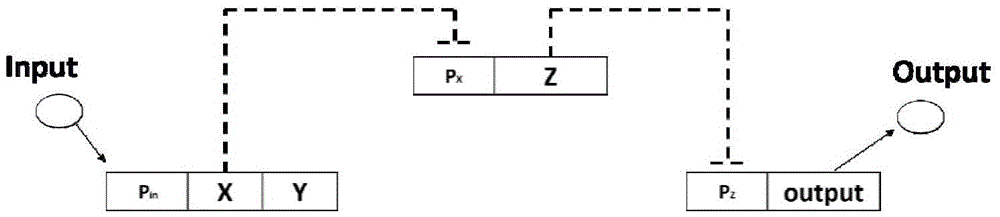
Figure 3
Abstract
Description
technical field
[0001] The invention relates to a detection gene circuit based on lung cancer markers, which belongs to the technical field of synthetic biology. Background technique
[0002] Tumor markers are chemical substances that reflect the presence of tumors. They either do not exist in normal adult tissues, or their content in tumor tissues greatly exceeds that in normal tissues. Their existence or quantitative changes can indicate the nature of tumors, so as to understand the histogenesis, cell differentiation, and cell functions of tumors. Helping tumor diagnosis, classification, prognosis judgment and treatment guidance. Tumor marker testing is a newer test that can catch cancer at an earlier stage. The traditional methods for detecting tumor markers are serum testing, tissue sections, and immunoassays. The cost and experimental requirements are very high, and there are certain risks.
[0003] In the past few centuries, the development of molecular biology and ...
Examples
Embodiment Construction
[0021] See figure 1 , figure 2 , image 3 , Figure 4 , Figure 5 , Figure 6 , Figure 7 As shown, a gene circuit based on lung cancer marker detection in the present invention is implemented as follows: it consists of a marker single-index detection module and a fusion circuit module, and the two modules are sequentially connected to each other. The single index detection module of the detection object detects three lung cancer markers (CEA, CA153, NSE) respectively, and when the concentration of the detected marker is higher than the threshold level, the circuit module can output a pulse signal to the next level fusion circuit. The fusion circuit module is formed by sequentially connecting a three-port input inverter ABC-G and an inverter G-GFP, and the function of the fusion circuit module is to send a pulse signal at any one of the above marker single index detection modules At this time, the green fluorescent protein GFP is output for alarm.
[0022] figure 1 I...