
Network coding and path protection-based optical network single-link fault protection method
A network coding and path protection technology, applied in the field of communication, can solve problems such as large traffic differences, increased end-to-end delay of protected data packets, buffer overflow, etc.
Patent Information
- Authority / Receiving Office
- CN · China
- Patent Type
- Applications(China)
- Current Assignee / Owner
- Publication Date
- 2017-05-10
- Estimated Expiration
- Not applicable · inactive patent
Smart Images
Figure 1 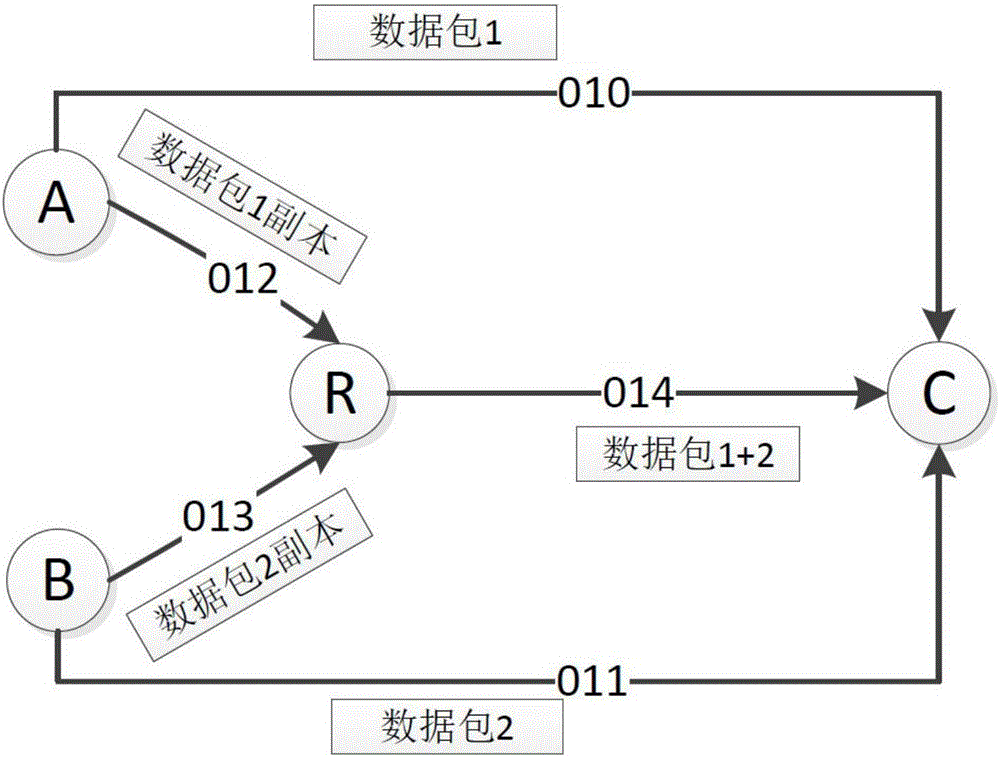
Figure 2 
Figure 3
Abstract
Description
technical field
[0001] The invention relates to a redundant path protection method in an optical network, which belongs to the technical field of communication. Background technique
[0002] With the high degree of informatization in modern society, the scale of the Internet continues to expand. At the same time, the types of network services continue to increase, and the proportion of multimedia technologies combining audio and video is increasing. As a result, Internet traffic is increasing exponentially. All of these put forward higher requirements on network bandwidth and switching system capacity. The all-optical network is considered to be a network that can meet the rapidly growing bandwidth demand in the future. Since the transmission capacity carried by each wavelength in an optical network can be as high as gigabits per second, network failures (such as link breaks and node failures) will cause a large number of service interruptions, resulting in immeasurable eco...
Examples
Embodiment Construction
[0043] Below in conjunction with accompanying drawing, technical scheme of the present invention is described in detail:
[0044] (1) The protection network where different source nodes and the same destination node pairs are encoded
[0045] Such as Figure 4 In the optical core network shown, nodes A, B, C, and R are 6 different core nodes, and these nodes have functions of a source node, a destination node, and a relay node. R acts as the relay node for the node pair A-C and B-C, such as Figure 4 As shown, there are cache spaces corresponding to node pairs A-C and B-C in R, and each space can cache up to 5 data packets. The relay node needs to choose a node that is neighbor to both node A and node B. The unidirectional link 010 connects core nodes A and C, and the arrow indicates that the data flow direction is from A to C. Links 011-014 are all unidirectional links, where the direction of data flow is shown by the arrow. Data packet 1 is a data packet newly arrived a...