
Continuous chromatography system and chromatography method
A chromatographic system and packing layer technology, applied in separation methods, chemical instruments and methods, solid adsorbent liquid separation, etc., can solve problems that affect experimental efficiency and time-consuming
Patent Information
- Authority / Receiving Office
- CN · China
- Current Assignee / Owner
- Publication Date
- 2017-07-07
Smart Images
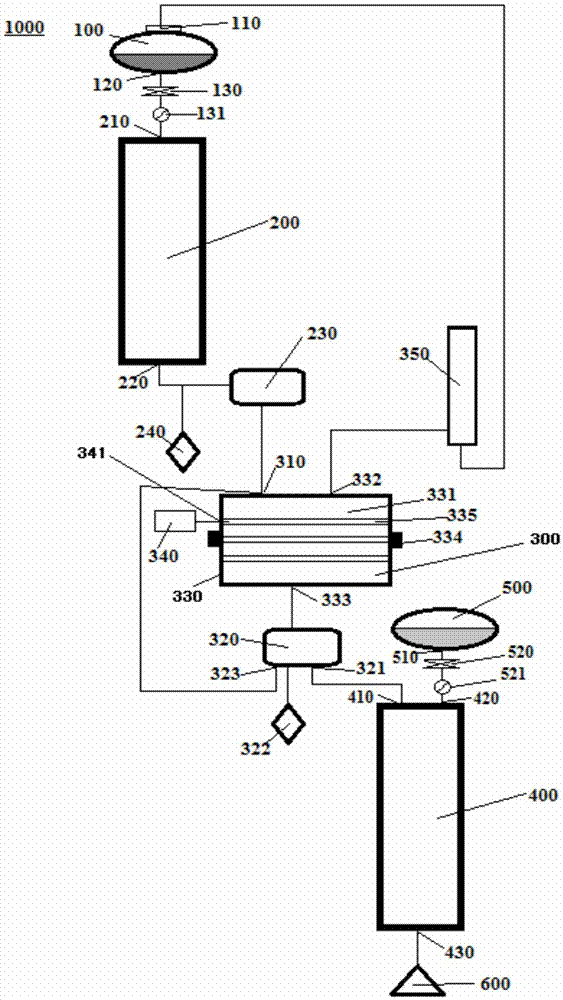
Figure 1
Abstract
Description
technical field
[0001] The invention belongs to the field of pharmaceutical or chemical synthesis, and specifically relates to a continuous chromatography system and a chromatography method. Background technique
[0002] Column chromatography is a common separation and purification method in the field of pharmaceutical or chemical synthesis. In view of the physical properties of substances, especially for natural products, more than two chromatography processes with different fillers are often required to achieve the separation effect. In the prior art, a rotary evaporator is usually used to concentrate the liquid collected from the previous chromatography, and then to perform further chromatography, which takes a long time and affects the efficiency of the experiment.
[0003] Therefore, continuous chromatography systems and chromatography methods still need to be further improved. Contents of the invention
[0004] The present invention aims at solving one of the techni...
Examples
Embodiment Construction
[0033] Embodiments of the present invention are described in detail below, examples of which are shown in the drawings, wherein the same or similar reference numerals designate the same or similar elements or elements having the same or similar functions throughout. The embodiments described below by referring to the figures are exemplary and are intended to explain the present invention and should not be construed as limiting the present invention.
[0034] In describing the present invention, it should be understood that the terms "center", "longitudinal", "transverse", "length", "width", "thickness", "upper", "lower", "front", " Back", "Left", "Right", "Vertical", "Horizontal", "Top", "Bottom", "Inner", "Outer", "Clockwise", "Counterclockwise", "Axial" , "radial", "circumferential" and other indicated orientations or positional relationships are based on the orientations or positional relationships shown in the drawings, which are only for the convenience of describing the ...