
Pre-distributed Key Management Method for Heterogeneous Wireless Sensor Networks
A wireless sensor and sensor network technology, applied in wireless communication, network topology, electrical components, etc., can solve the problems of large node resource consumption, repeated keys, and poor invulnerability of the q-composite scheme, so as to reduce storage requirements, Improves security and reduces the possibility of duplication of keys
Patent Information
- Authority / Receiving Office
- CN · China
- Patent Type
- Patents(China)
- Current Assignee / Owner
- Publication Date
- 2020-04-07
- Estimated Expiration
- Not applicable · inactive patent
Smart Images
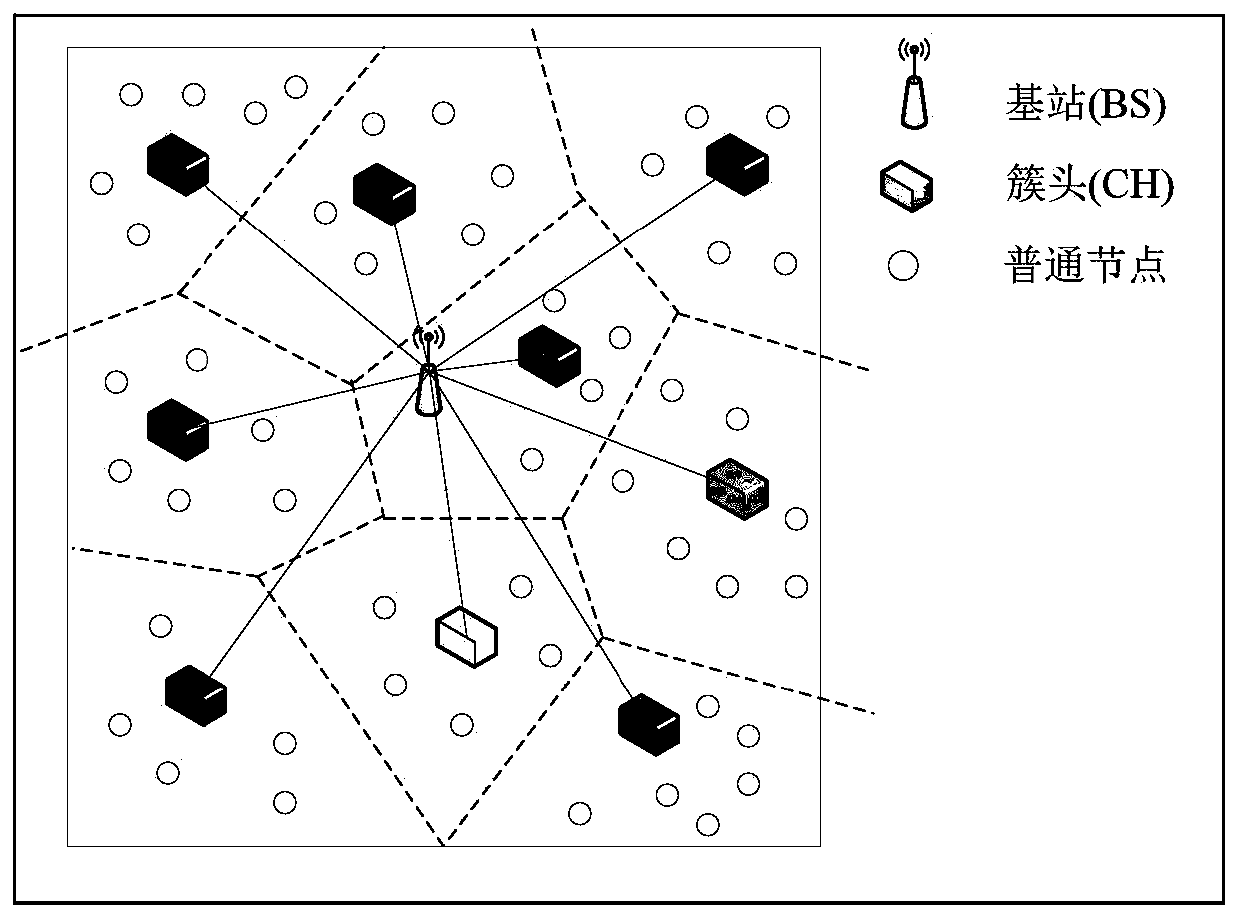
Figure 1 
Figure 2 
Figure 3
Abstract
Description
technical field
[0001] The invention relates to a network pre-distributed key management method. Background technique
[0002] With the wide application of wireless sensor networks, its security issues also arise at the historic moment. The security mechanism of wireless sensor network includes secure routing, secure positioning, topology management, data fusion and so on. Key management is a fundamental issue in the security of wireless sensor networks. Since WSN security attracted people's attention, isomorphic WSN key management has become a research hotspot for scholars; the basic random key pre-distribution scheme, referred to as the E-G scheme, is simple to implement, has low computational complexity and low storage requirements, but due to the The scheme is based on probability, so the security of the network is low, and at the same time, the possibility of key repetition in this scheme is relatively high. The q-composite scheme proposed by Chan et al. is an improv...
Examples
specific Embodiment approach 1
[0025] Specific implementation mode 1: The specific process of the heterogeneous wireless sensor network pre-distributed key management method in this implementation mode is as follows:
[0026] Step 1. Construct the HWSN cluster model;
[0027] HWSN is a heterogeneous wireless sensor network;
[0028] Step 2. Under the HWSN cluster model built in step 1, establish a SAAP solution; the process is:
[0029] The SAAP scheme is an asymmetric pre-distributed key management scheme based on Schnorr identity authentication;
[0030] Step 21, establishing the Schnorr identity authentication stage;
[0031] Step 22, on the basis of step 21, establish a key pre-distribution stage;
[0032] Step 23: On the basis of Step 21 and Step 22, legal authentication nodes in the network enter the shared key discovery stage;
[0033] Step two and four, after executing steps two and three, if the LN node has not established a pairing key with a neighbor node, it enters the stage of setting the p...
specific Embodiment approach 2
[0036] Embodiment 2: The difference between this embodiment and Embodiment 1 is that the HWSN cluster model is constructed in the step 1; the specific process is:
[0037] Let CH (cluster head node) and LN (ordinary node) be randomly and uniformly distributed in the network, among which CH is an energy-gathering cluster head. During the initialization process of the sensor network, each cluster head node CH broadcasts a Hello message to its nearby LN nodes with maximum power and random delay. After the LN node receives the Hello message from one or G cluster head nodes CH, it passes The cluster head selection method selects the CH with the strongest signal strength as the cluster head (the CH with the strongest signal in the Hello message received by the LN is used as the cluster head), and each LN node records the Hello messages received from other cluster head nodes CH, When the cluster head selection fails, other cluster head nodes CH will serve as backup cluster heads;
...
specific Embodiment approach 3
[0042] Specific embodiment three: this embodiment is different from specific embodiment one or two: set up the Schnorr identity authentication stage in the described step two one; Concrete process is:
[0043] In order to further enhance the security of the network, each LN node in the cluster must first be authenticated before the shared key stage;
[0044] Step 211, according to the HWSN cluster model constructed in step 1, the sensor network is initialized;
[0045] The sensor network initialization process is divided into two steps:
[0046] (1) Select the public parameters of the sensor network;
[0047] The sensor network selects two prime numbers p and q, and p and q satisfy q|p-1, q≥2 140 ,p≥2 512 , the sensor network at Choose a prime number g with order q above, and g q ≡1(modp);
[0048] q|p-1 is q is a prime factor of order p-1;
[0049] (2) Node selection key in the sensor network;
[0050] Any LN node A in the sensor network, at node A according to the ran...