
Node management method based on centralized P2P system
A node management and centralized technology, applied in the multimedia field, can solve the problems of not considering the dynamic off-network of nodes, single node selection and screening standards, etc., and achieve the effect of maintaining stable service quality, ensuring stability, and improving service quality
Patent Information
- Authority / Receiving Office
- CN · China
- Patent Type
- Applications(China)
- Current Assignee / Owner
- Publication Date
- 2017-10-24
Smart Images
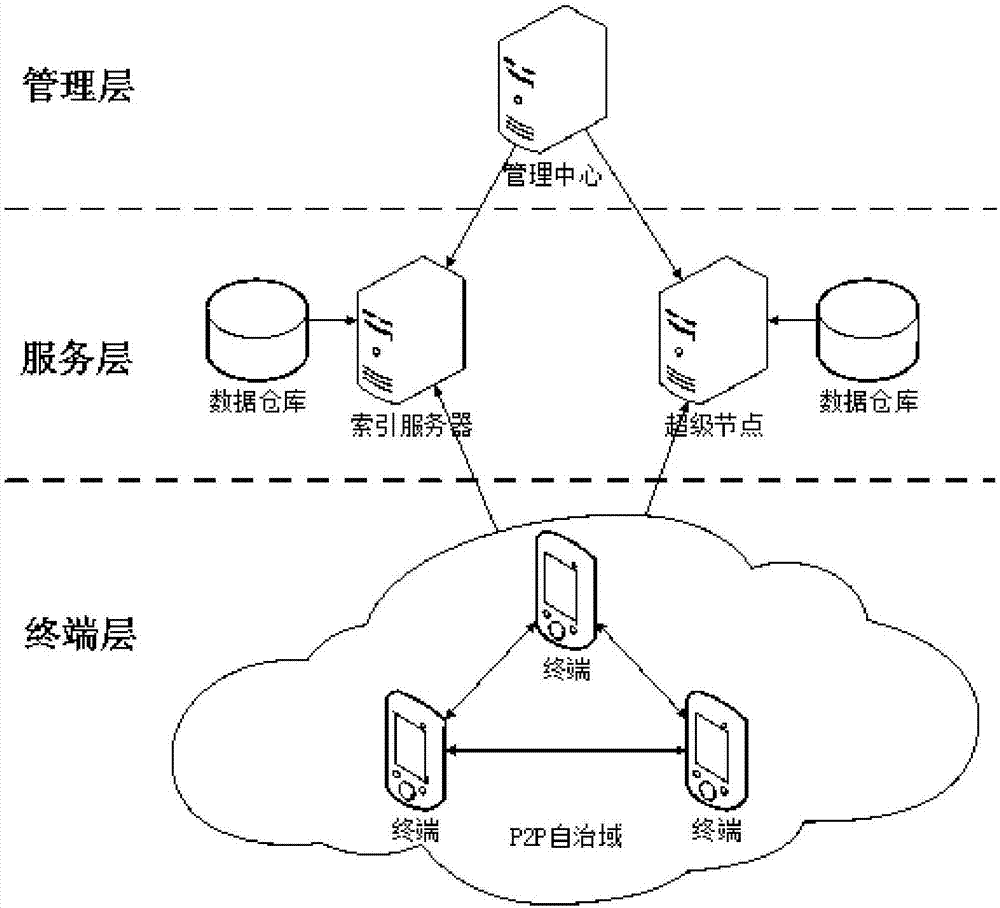
Figure 1 
Figure 2 
Figure 3
Abstract
Description
technical field
[0001] The invention is a node management method based on a centralized P2P system, which belongs to the field of multimedia technology. Background technique
[0002] Peer-to-Peer (P2P) technology is an important way for streaming media system to distribute content. Compared with the content distribution technology under the traditional C / S (client / server) architecture, the P2P system enables the terminal to use its own computing, storage, and transmission capabilities to achieve content sharing and interaction, and has the ability to maintain large-scale users. The advantage of higher transmission performance. The centralized P2P system is a typical structure of the P2P system. The centralized P2P system has a central index server to collect and store the basic information and content distribution of all nodes in the P2P network. When a node requests content, it first sends a request to the index server, and the index server responds and returns a group of...
Examples
Embodiment Construction
[0028] In order to make the object, technical solution and advantages of the present invention clearer, the present invention will be further described in detail below in conjunction with the accompanying drawings and embodiments. It should be understood that the specific embodiments described here are only used to explain the present invention, not to limit the present invention.
[0029] Such as figure 1 As shown, the centralized P2P system architecture of the present invention is divided into a management layer, a service layer, and a terminal layer according to functions. The management center server of the management layer realizes content management and node management of the entire P2P system through communication with the service layer. The service layer includes an index server and a super node, where the index server is responsible for collecting the basic information of the terminal and content distribution, so as to provide content location services for the termin...