
A One-Class Collaborative Filtering Method Fused with Personality Traits and Item Labels
A collaborative filtering, single-classification technology, applied in special data processing applications, instruments, data processing applications, etc., can solve the problems of cold start of new users, and achieve the effect of overcoming cold start, overcoming cold start problems, and high reliability
Patent Information
- Authority / Receiving Office
- CN · China
- Patent Type
- Patents(China)
- Current Assignee / Owner
- Publication Date
- 2021-06-29
Smart Images
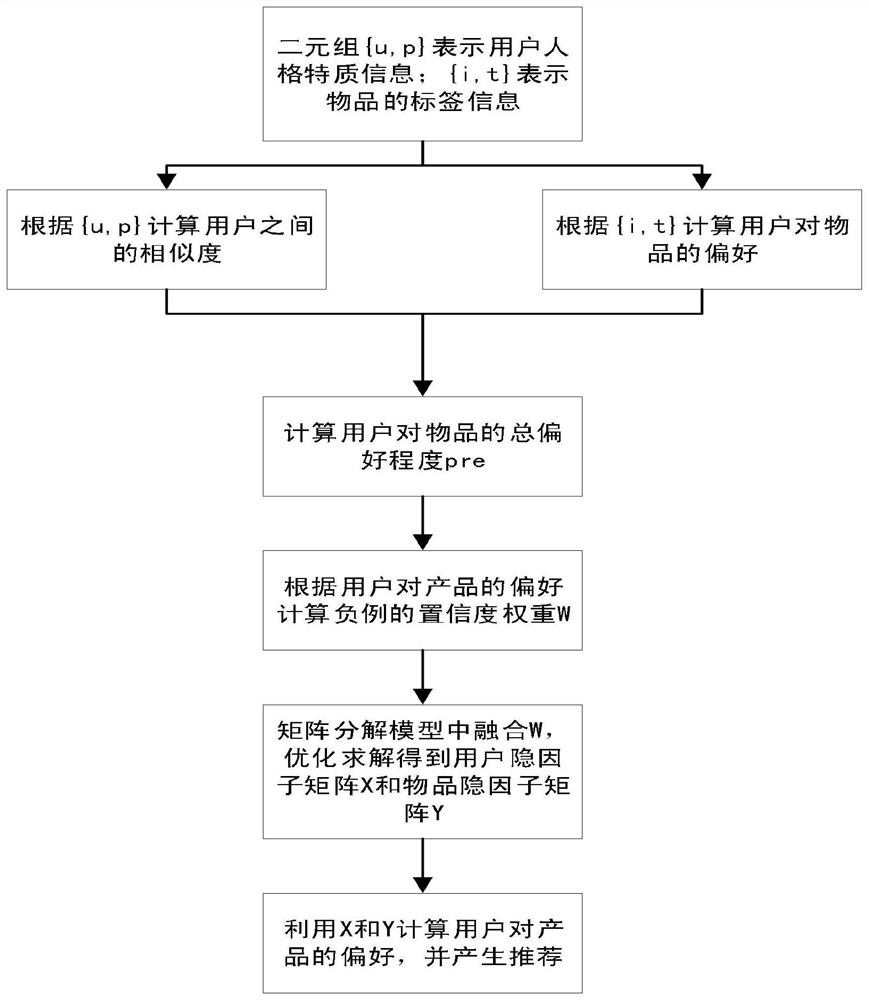
Figure 1 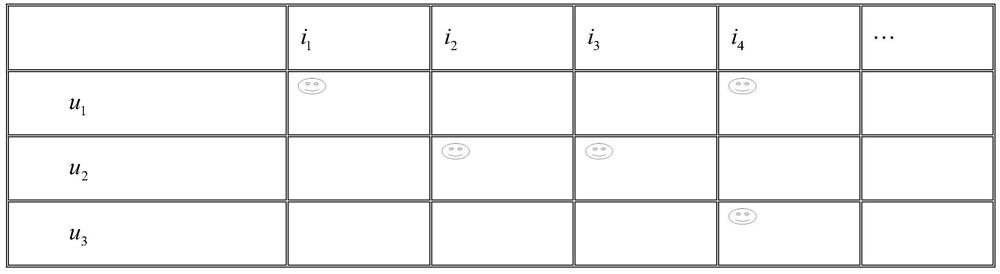
Figure 2 
Figure 3
Abstract
Description
technical field
[0001] The invention belongs to the field of electronic commerce, in particular to a matrix decomposition method (PTMF) combining personality traits and item labels. Background technique
[0002] With the development of information technology, the expansion of information resources and the rapid development of e-commerce, it has become a difficult and expensive obstacle for users to find product information they are interested in; Effectively improving the purchase rate of users has become their primary consideration. Recommender systems can overcome this obstacle by providing users with personalized items, products or services that meet user needs. Collaborative filtering technology is one of the earliest and most successful technologies for personalized recommendation applications. It can provide technical support for users' purchase decisions based on the similarity between items or users. Collaborative filtering has been extended and practically applied...
Examples
Embodiment Construction
[0042] In this example, if figure 1 As shown, a single-category collaborative filtering method that combines personality traits and item tags is carried out in the following steps:
[0043] Step 1. Use the two-dimensional table R={u,i} to represent the user’s behavior records on items, use the two-dimensional table P={u,p} to represent the user’s personality trait data, and use the two-dimensional table T={i,tag } represents the tag data of the item; among them, u={u 1 ,u 2 ,...,u n ,...,u |N|} represents the set of users, u n Indicates the nth user, n=1,2,...,|N|, |N| indicates the total number of users; i={i 1 ,i 2 ,...,i m ,...,i |M|} represents a collection of items, i m Indicates the mth item, m=1,2,..., |M|, |M| indicates the total number of items; p={p 1 ,p 2 ,...,p n ,...,p |N|}Represents the information set of user personality traits, p n Indicates the nth user u n personality traits and have: Indicates the nth user u n The jth personality trait of ...