
TSN scheduling method oriented to real-time application demand
A scheduling method and real-time application technology, applied in digital transmission systems, electrical components, transmission systems, etc., to achieve the effect of solving constrained optimization problems and avoiding network queues
Patent Information
- Authority / Receiving Office
- CN · China
- Patent Type
- Applications(China)
- Current Assignee / Owner
- Publication Date
- 2018-11-13
- Estimated Expiration
- Not applicable · inactive patent
Smart Images
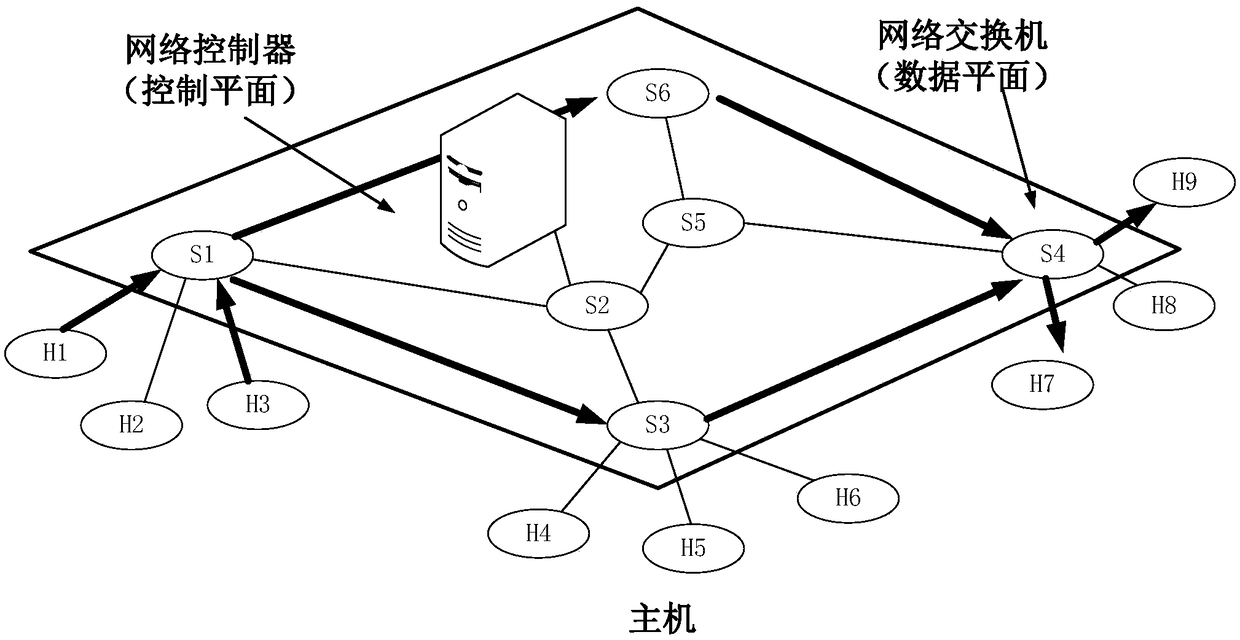
Figure 1 
Figure 2 
Figure 3
Abstract
Description
technical field
[0001] The invention relates to the technical field of industrial wireless network resource allocation, in particular to a TSN scheduling method oriented to real-time application requirements. Background technique
[0002] A central feature of Industry 4.0 is networked cyber-physical systems, where physical processes are controlled by computers. Since many physical processes such as the motion control of a group of collaborative robots are highly time-sensitive, real-time communication networks are required to control these systems. To guarantee deterministic behavior of physical systems under control, real-time networks with deterministic bounded network delays and delay variations (jitter) are required. Traditionally fieldbuses have been used for this, and later with the development of Ethernet technology, which provides deterministic real-time properties for this, but the possibility of transporting real-time and non-real-time traffic on the same medium i...
Examples
Embodiment Construction
[0030] The present invention will be further described below in conjunction with the accompanying drawings and specific embodiments, and the purpose and effect of the present invention will be more obvious.
[0031] First, on the basis of software-defined network SDN, a logical centralized architecture of time-sensitive software-defined network TSSDN is established, such as figure 1 shown; to model the baseline network topology and time-triggered flow, we represent the baseline network topology as a directed graph G≡(V,E), where V is the set of nodes, and V≡(S∪H), where S and H are sets of switches and hosts respectively, E≡{(i,j)|i,j∈V and i,j are connected by network links} is a set of tuples representing network links; the time-triggered flow is represented by for a tuple ts i ≡(s i , d i ), where s i , d i ∈H,s i and d i are the source and destination of the flow, respectively; the set of slots available for spending is denoted as T≡{0,1,...,t max},t max Determine...