
Adaptive dynamic perception routing for Internet-of-vehicles driving environment
A driving environment and self-adaptive technology, applied in the field of Internet of Vehicles research, can solve problems such as excessive overhead, impact on communication link quality, and increased number of forwarding times, so as to prevent data packet delay from increasing, improve packet delivery rate, and prevent chaining. The effect of road disconnection
Patent Information
- Authority / Receiving Office
- CN · China
- Current Assignee / Owner
- Publication Date
- 2019-04-02
Smart Images
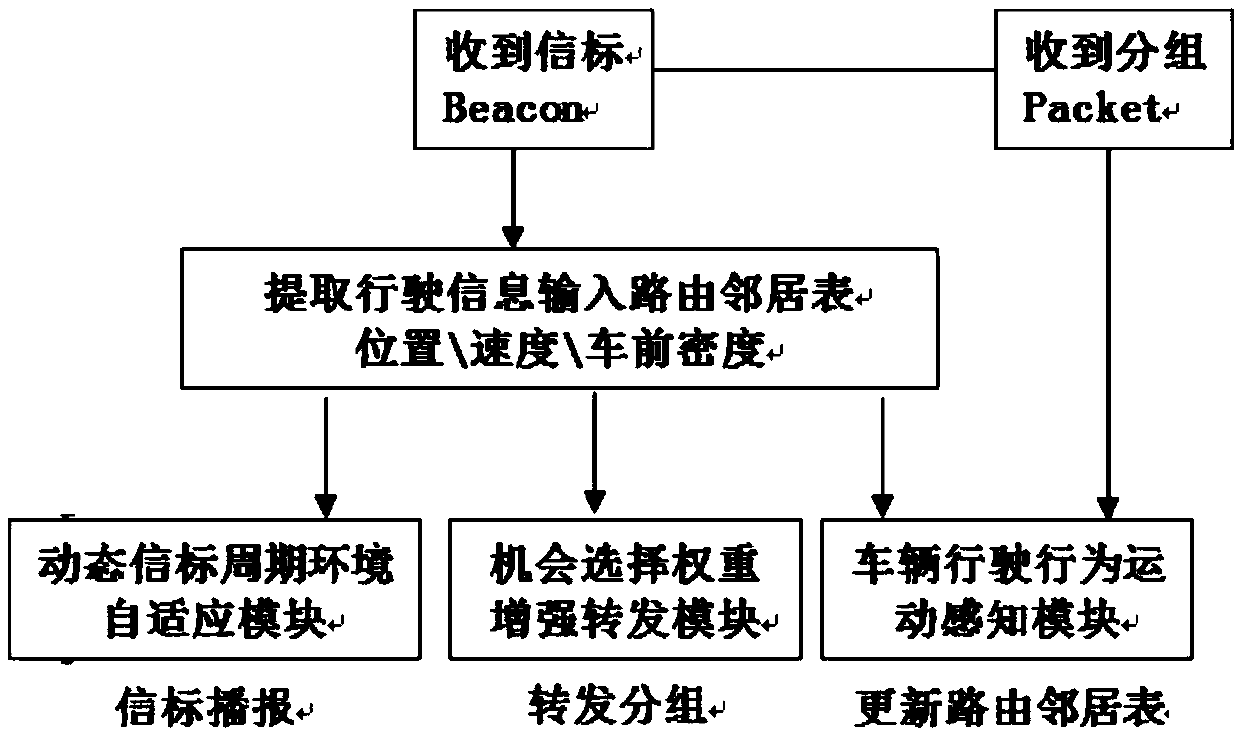
Figure 1 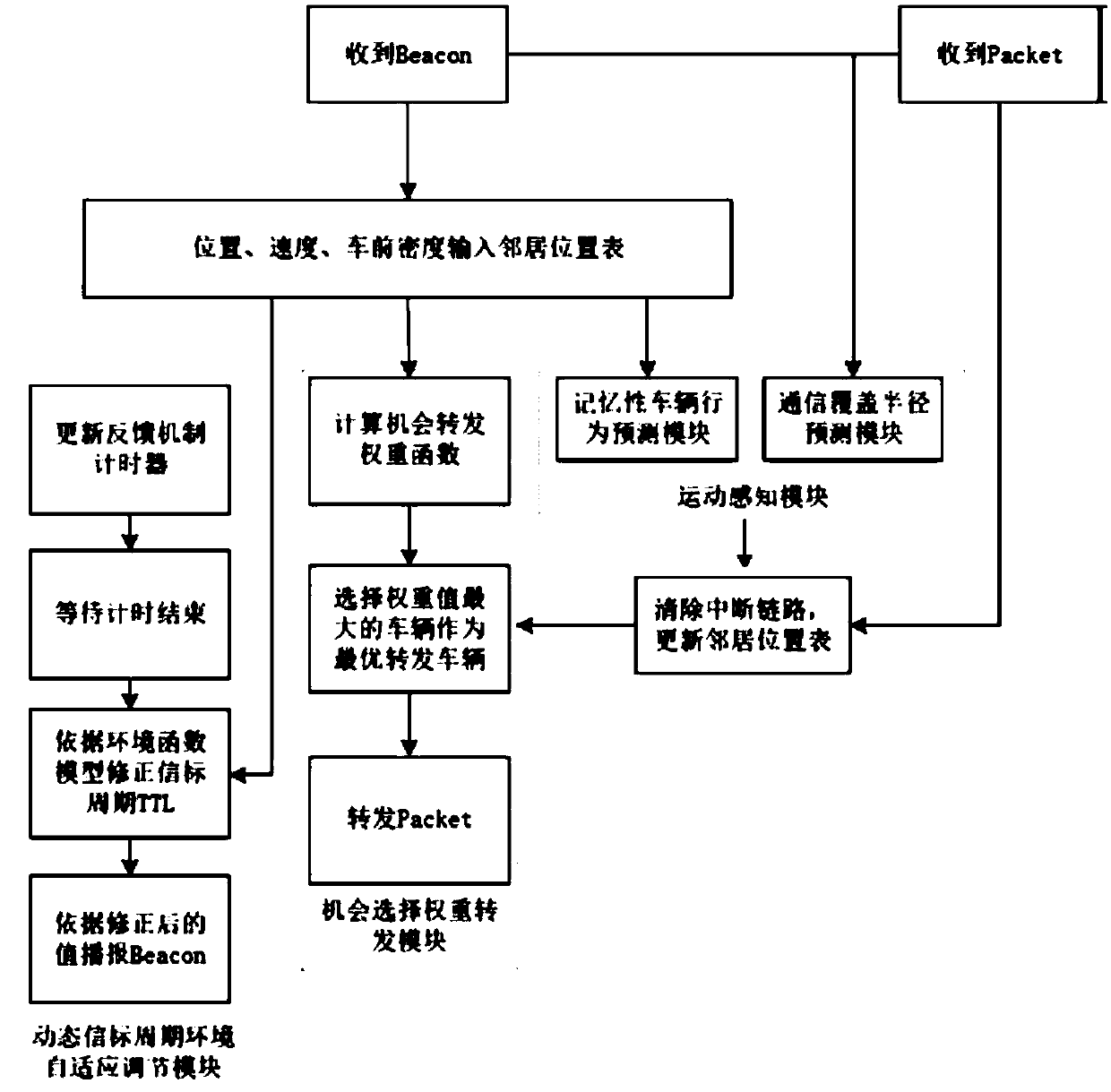
Figure 2 
Figure 3
Abstract
Description
technical field
[0001] The invention belongs to the technical field of Internet of Vehicles research, and in particular relates to an adaptive dynamic perception routing for the driving environment of the Internet of Vehicles. Background technique
[0002] With the advent of the 5G era and the rapid development of artificial intelligence and the Internet of Things, as an important part of smart cities, the blueprint for future urban intelligent transportation systems is gradually emerging. As a converged network, 5G can enable the acquisition of traffic conditions, low-latency communication, large-scale data storage, and real-time feedback of traffic forecasts, which promotes the development of intelligent collaboration technology between vehicles and vehicles, and vehicles and roads in the Internet of Vehicles.
[0003] In order to meet the forwarding quality required for the real-time broadcast of safety messages of the Internet of Vehicles, it is very urgent to solve the ...
Examples
Embodiment Construction
[0055] Below in conjunction with specific embodiment, further illustrate the present invention.
[0056] The present invention proposes an adaptive dynamic perception routing SaDaDR for the driving environment of the Internet of Vehicles application oriented to the Internet of Vehicles. The characteristics of routing SaDaDR are: specially designed vehicle motion behavior perception algorithm, traffic environment adaptive mechanism based on dynamic adaptive beacon period, and enhanced forwarding strategy based on opportunity weight. The advantage of this route is that it can dynamically predict the position of the vehicle and the quality of communication coverage; and it can adaptively adjust the broadcast interval of Beacon according to the change of traffic density and speed, so as to prevent the large delay caused by channel competition in the congested environment. , while solving the problem of network topology fragmentation in high-speed environments. Therefore, routing ...