
A small-volume heavy-duty multi-stage electric cylinder
An electric cylinder, small volume technology, applied in electric components, transmission devices, electromechanical devices, etc., can solve the problems of large vertical launch, large impact on stage change, etc., and achieve increased axial rigidity, reduced volume, and enhanced bearing capacity. Effect
Patent Information
- Authority / Receiving Office
- CN · China
- Patent Type
- Patents(China)
- Current Assignee / Owner
- Publication Date
- 2021-03-16
Smart Images
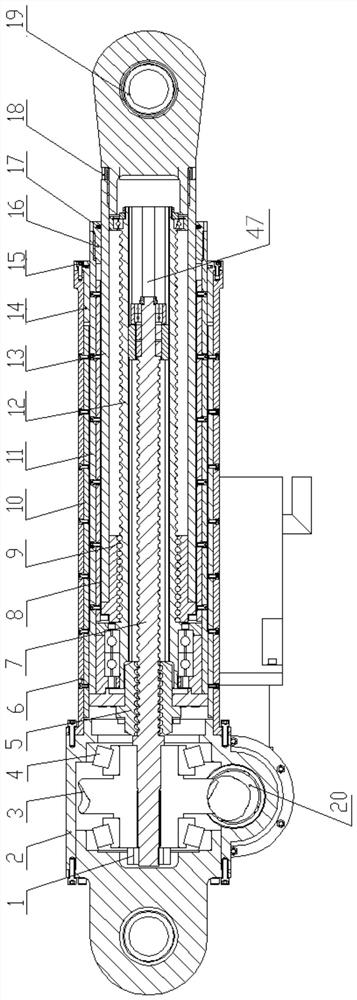
Figure 1 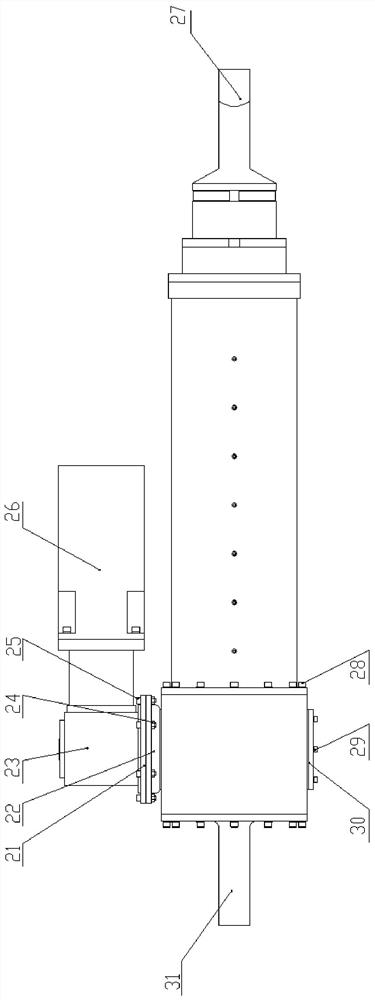
Figure 2 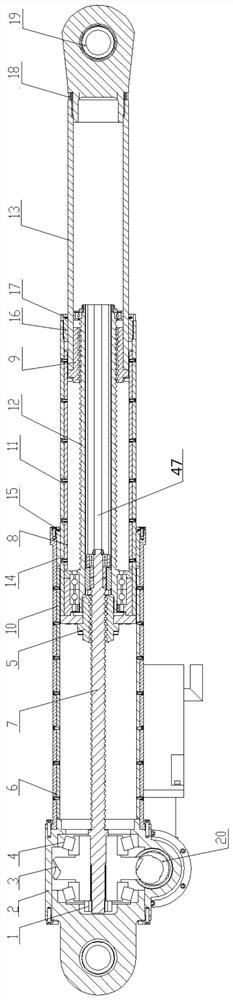
Figure 3
Abstract
Description
technical field
[0001] The invention relates to an electric cylinder mechanism, in particular to a small-volume heavy-duty multistage electric cylinder. Background technique
[0002] As the core actuator of all-electric combat vehicles, multi-degree-of-freedom robots and other equipment, electric cylinders have been widely used in vehicle leveling and erection, astronomical instrument observation and other fields. Due to the small expansion ratio, large volume, and small load capacity of ordinary electric cylinders, at present, multi-stage hydraulic cylinders are still used in fields such as vertical launches that require small installation space and long working strokes. During the working process of multi-stage hydraulic cylinders, there are problems such as large impact of changing stages and the phenomenon of "running, popping, dripping and leaking", which have always plagued large-scale vertical launches. Therefore, the study of multi-stage electric cylinders with larg...
Examples
Embodiment Construction
[0034] The present invention is described in further detail below in conjunction with accompanying drawing:
[0035] Such as Figure 1-4As shown, the electric cylinder body includes a planetary ball screw shaft 7, a hollow ball screw shaft 12, a guide rod 13, an inner support sleeve 11 and an outer support shell 6 coaxially nested sequentially from the inside to the outside, and the motor 26 passes through The planetary commutator 23 is connected with the worm 20 , the output shaft of the motor 26 is parallel to the planetary ball screw shaft 7 , and the worm 20 cooperates with it under the worm wheel 3 . The worm wheel 3 and the planetary ball screw shaft 7 are fastened and connected by threads, and are locked by the planetary ball screw end lock nut 1. The planetary ball screw end lock nut 1 is located at the position where the planetary ball screw shaft 7 passes through the worm wheel 3 one end. The planetary commutator 23 is connected through the adapter flange 21 of the...