
A Pedestrian Re-Identification Method Based on Global Distance Scale Loss Function
A pedestrian re-identification and loss function technology, applied in the field of computer vision, can solve the problem of lack of global statistical properties, and achieve the effect of reducing the risk of overfitting, improving performance, and wide application value
Patent Information
- Authority / Receiving Office
- CN · China
- Patent Type
- Patents(China)
- Current Assignee / Owner
- Publication Date
- 2021-06-08
Smart Images
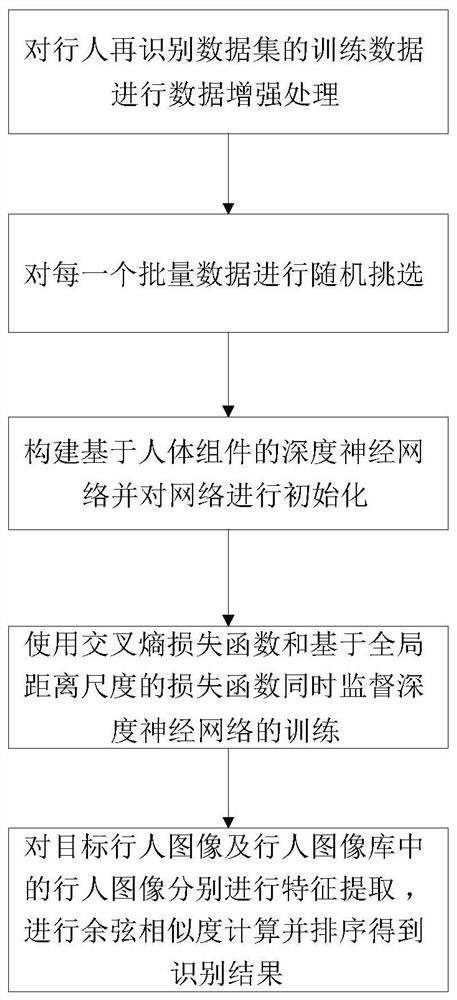
Figure 1 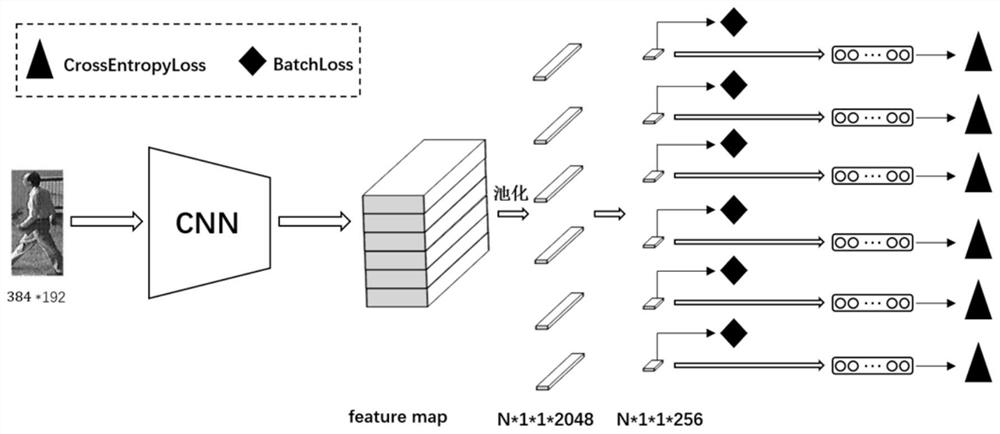
Figure 2 
Figure 3
Abstract
Description
technical field
[0001] The invention relates to the technical field of computer vision, in particular to a pedestrian re-identification method based on a global distance scale loss function. Background technique
[0002] With the development and advancement of deep learning and the increasing popularity of video surveillance technology, pedestrian re-identification technology has become more and more important because of its ability to search for pedestrians to be found among a large number of pedestrians.
[0003] In the process of the development of person re-identification technology from traditional metric learning to deeper and wider deep neural network learning, the measurement of distance is inseparable. Pedestrian re-identification technology can effectively shorten the distance between the same kind and increase the distance between the different kinds in the feature space. Based on distance metrics, researchers have proposed many loss functions for supervised netw...
Examples
Embodiment
[0036] Such as figure 1 Shown is a flowchart of a pedestrian re-identification method based on the global distance scale loss function. The specific steps include:
[0037] (1) Carry out data enhancement to the training data of pedestrian re-identification data set;
[0038] In this embodiment, data enhancement is performed on the training data of the data set Market-1501, specifically: for each pedestrian image, a point is randomly selected from the central area of the image as the center, and then a point of the same size as the original image is intercepted. Pedestrian images; repeat the above steps five times.
[0039] (2) Randomly select each batch of data;
[0040] In this embodiment, after the data enhancement is completed, 8 people are randomly selected in each batch, and each person randomly selects 6 pictures, and the batch size is N=8*6=48.
[0041] (3) Construct a deep neural network based on human body components and initialize the network;
[0042] In this ...