
Visual and auditory aesthetics evaluation method based on electroencephalogram signals and system
A technology of EEG signal and evaluation method, which is applied in the field of brain cognitive nerve function, can solve the problems of lack of objectivity of evaluation standards, and achieve the effect of rich treatment and high-precision recognition
Patent Information
- Authority / Receiving Office
- CN · China
- Patent Type
- Applications(China)
- Current Assignee / Owner
- Publication Date
- 2021-11-02
Smart Images
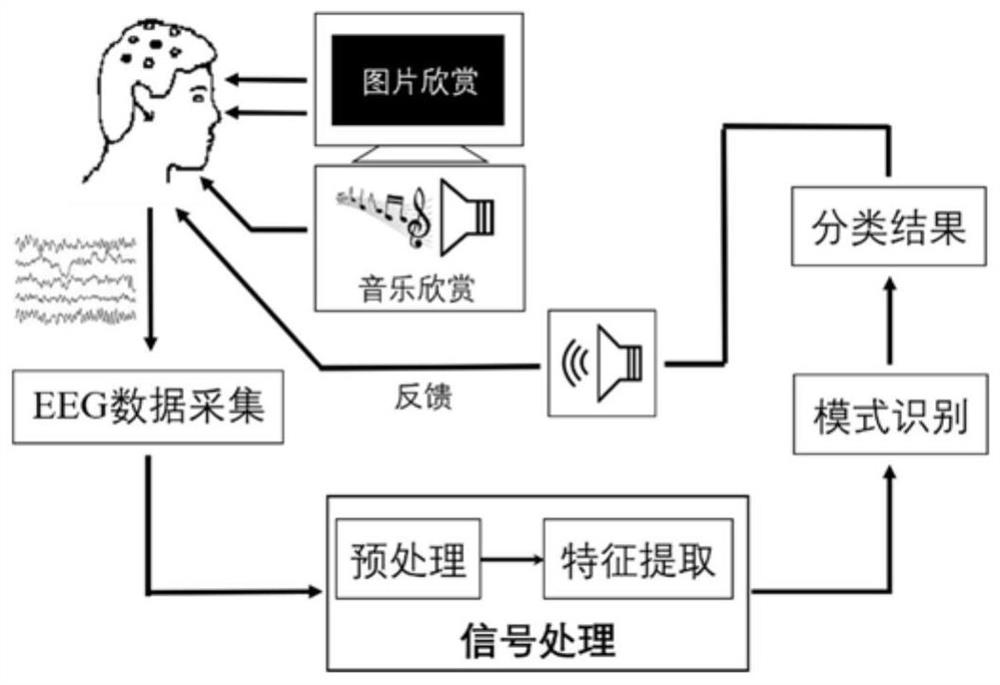
Figure 1 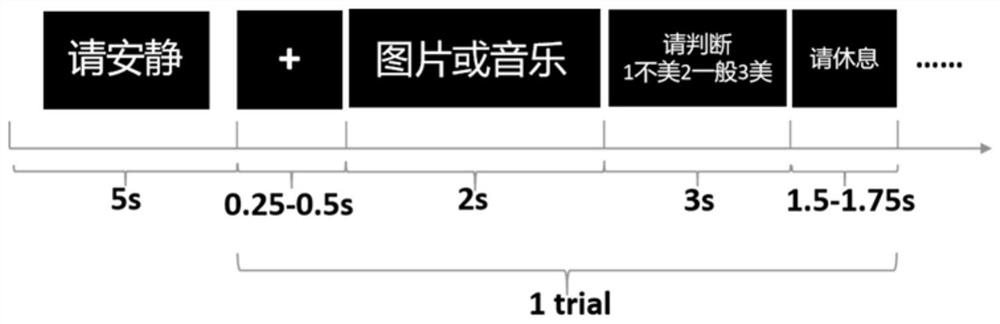
Figure 2 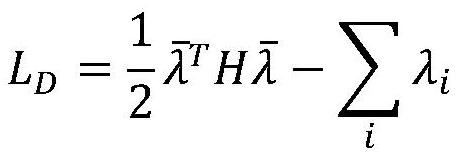
Figure 3
Abstract
Description
technical field
[0001] The present invention relates to the technical field of brain cognitive nerve function, in particular to an audio-visual aesthetic evaluation method and system based on EEG signals. Background technique
[0002] Beauty has been a topic of curiosity since ancient times. The quality evaluation of aesthetics has a wide influence on human social activities. The development of EEG technology provides technical means for the objective evaluation of aesthetics.
[0003] EEG (Electroencephalography, EEG) data is more focused on time-series brain changes, and is more in line with aesthetic activities related to thinking or action. Therefore, aesthetic-related features can be extracted through EEG data to achieve objective aesthetics of different degrees. Evaluation. At present, EEG technology is mainly divided into induced EEG technology and spontaneous EEG technology. Evoked EEG technology is a regular brain potential change produced under external task co...
Examples
Embodiment Construction
[0064] The present invention will be described in detail below in conjunction with specific embodiments. The following examples will help those skilled in the art to further understand the present invention, but do not limit the present invention in any form. It should be noted that those skilled in the art can make several changes and improvements without departing from the concept of the present invention. These all belong to the protection scope of the present invention.
[0065] The embodiment of the present invention provides an audio-visual aesthetic evaluation method based on EEG signals, mainly for the preprocessing of EEG data and the identification of participants' aesthetic judgments, by collecting the EEG signals of subjects when observing works or listening to music , extract aesthetic-related specific neural response frequency-domain features, train classifiers, classify and recognize subjects’ aesthetic judgments, and output subjects’ subjective judgments throu...