

Gradient-enhanced variable-fidelity proxy model modeling method
A technology of proxy model and modeling method, applied in the field of proxy model, can solve the problems of reducing modeling efficiency, increasing the dimension of correlation matrix, and not fully considering the physical meaning, so as to achieve the effect of strengthening prediction accuracy and ensuring calculation efficiency
Patent Information
- Authority / Receiving Office
- CN · China
- Current Assignee / Owner
- Publication Date
- 2021-12-31
Smart Images
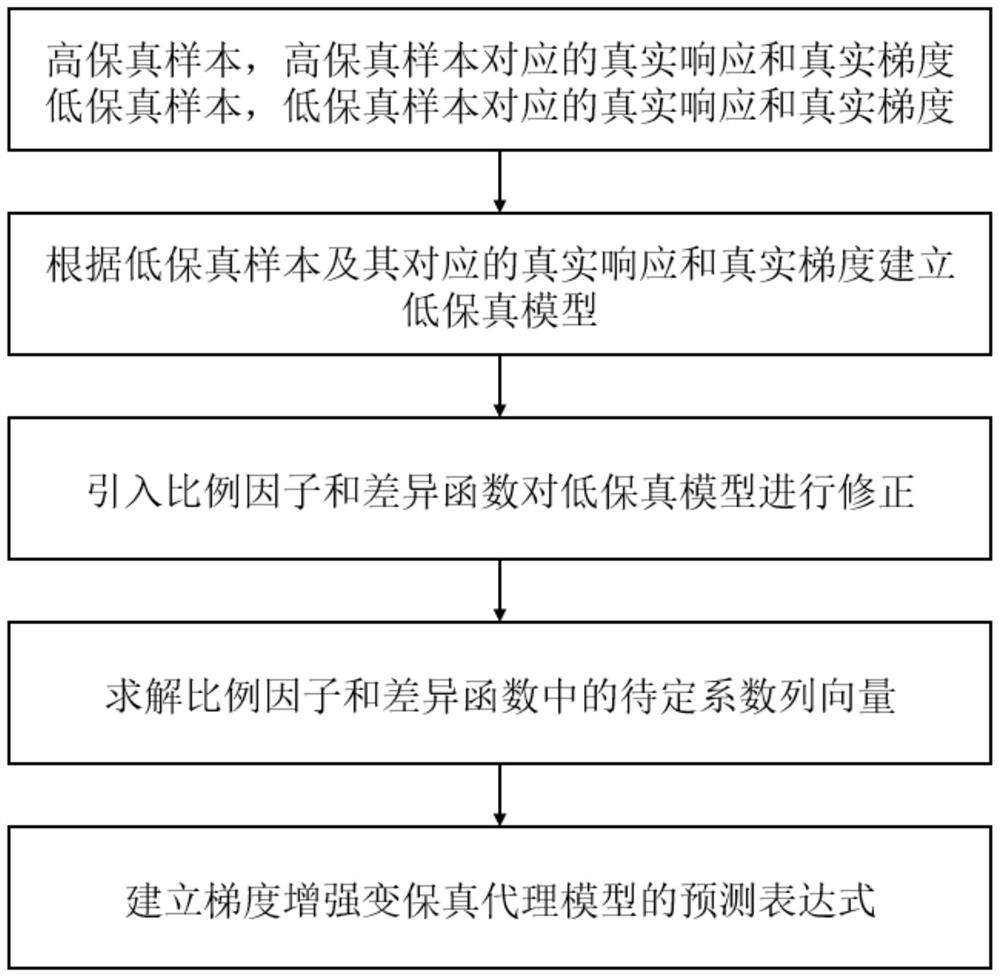
Figure 1 
Figure 2 
Figure 3
Abstract
Description
technical field
[0001] The invention belongs to the technical field of proxy models, and relates to a modeling method of a gradient-enhanced variable-fidelity proxy model. Background technique
[0002] The surrogate model establishes a mathematical approximation for the relationship between the design variables and the response of the complex system, focusing on solving the problems of excessive calculation in engineering design or the inability of existing computing resources to meet the computing needs. It has been used in different Scientific fields (such as design optimization, material design, reliability analysis, digital twins, and uncertainty quantification, etc.) have received extensive attention and applications. In addition, surrogate models can be of great help in dealing with noisy or missing data and in gaining insight into complex functional relationships between design variables and output responses.
[0003] Although the surrogate model method saves a lot o...
Examples
Embodiment Construction
[0016] The present invention will be further elaborated below in conjunction with the accompanying drawings and specific embodiments.
[0017] In order not to lose generality, there are n high-fidelity samples is the high-fidelity real response and high-fidelity real gradient corresponding to the i-th high-fidelity sample, where i=1, 2, ..., n; there are p low-fidelity samples x L ={x l1 , x l2 ,...,x lp}, is the high-fidelity true response and high-fidelity true gradient corresponding to the j-th low-fidelity sample. x hi (i=1, 2, ..., n) and x lj (j=1, 2, . . . , p) has a dimension of d. A gradient-enhanced variable-fidelity proxy model modeling method designed by the present invention, such as figure 1 As shown, the method includes the following steps:
[0018] (1) Build a low-fidelity model based on low-fidelity samples and their corresponding low-fidelity ground truth responses and low-fidelity ground truth gradients. The present invention uses the gradient-en...