
Radar target identification method based on adaptive neighborhood preserving projection
An adaptive neighborhood and projection-preserving technology, applied in character and pattern recognition, instruments, computer components, etc., can solve the problems of less recognition information and poor robustness, and achieve easy classification, enhanced generalization ability, and high promotion The effect of applying value
Patent Information
- Authority / Receiving Office
- CN · China
- Current Assignee / Owner
- Publication Date
- 2022-01-18
Smart Images
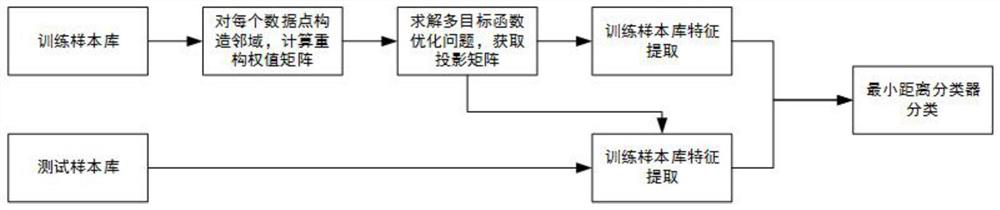
Figure 1 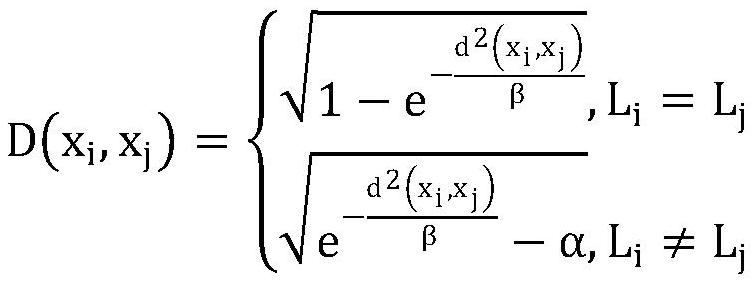
Figure 2 
Figure 3
Abstract
Description
technical field
[0001] The invention belongs to the technical field of radar target recognition. Background technique
[0002] The classification and recognition of hovering helicopters and small targets on the sea is a major problem in radar target recognition. The current solution is to detect whether there are adjustment features for classification and recognition. During the detection process, long-dwell and high-repetition frequency detection of the target is required. . However, with the increase of dwell time and repetition frequency, the dimension of JEM data also increases significantly, becoming the most important factor affecting the target recognition rate. In pattern recognition and machine learning theory, for such problems, data dimensionality reduction algorithm is an effective and practical means, which can map data to low-dimensional space, remove its irrelevant information to seek the essential characteristics of data.
[0003] The current mainstream dim...
Examples
Embodiment Construction
[0022] The present invention is a radar target recognition method based on adaptive neighborhood-preserving projection. For specific implementation steps, please refer to the appended figure 1 :
[0023] Step (1), constructing a neighborhood for each data point in the training sample library, and calculating the reconstruction weight matrix, the method is as follows:
[0024] Step A, constructing the variant difference distance, specifically:
[0025] In a given data sample set X={x 1 ,x 2 ,x 3 ,...,x N}, x i The category label of L is denoted as L i , and i={1,2,...,C}, where C is the total number of categories of samples, and the constructed variant difference distance is as follows:
[0026]
[0027] where d(x i ,x j )=||x i -x j || indicates the Euclidean distance between two data points, and the parameter β is the mean value of the Euclidean distance between sample points, which is used to control D(x i ,x j ), the parameter α is a constant value.
[0028...