
Bionic fiber and bionic fiber manufacturing device
A fiber and bionic technology, applied in fiber processing, rayon manufacturing, fiber chemical characteristics, etc., can solve the problems of long production cycle, hollowness cannot be effectively preserved for a long time, and products cannot achieve warmth retention, etc., to achieve excellent bulkiness, high Warmth retention and the effect of service life
Patent Information
- Authority / Receiving Office
- CN · China
- Patent Type
- Applications(China)
- Current Assignee / Owner
- Publication Date
- 2022-03-01
Smart Images
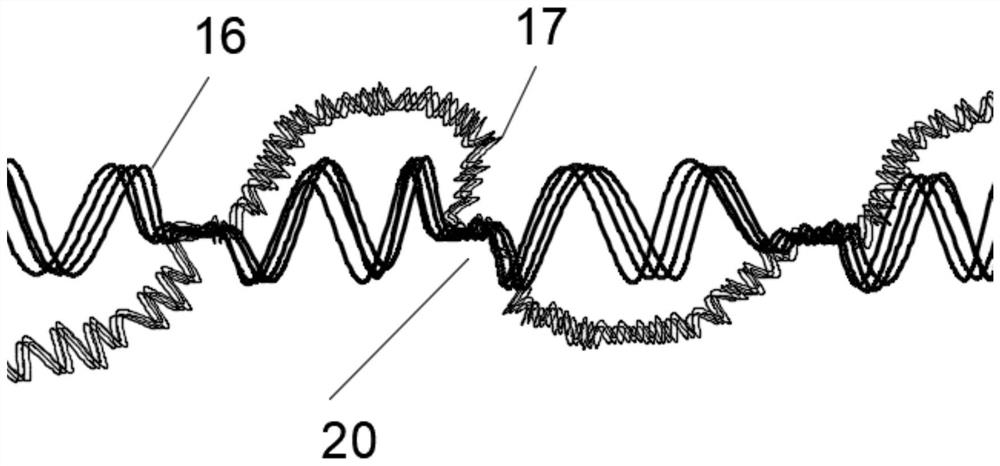
Figure 1 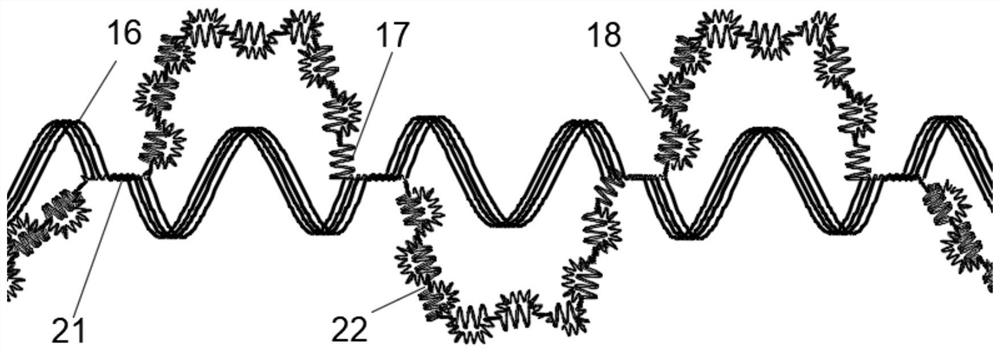
Figure 2 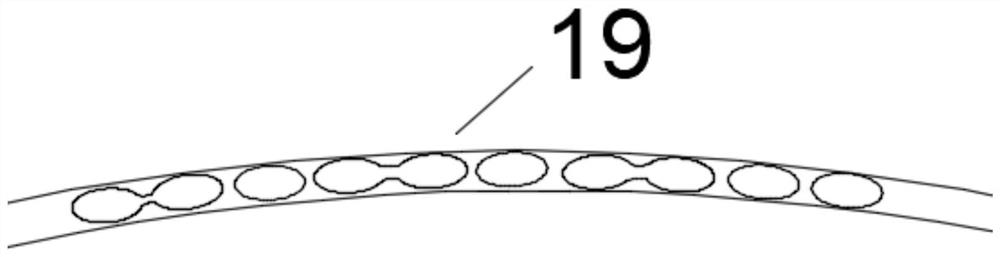
Figure 3
Abstract
Description
technical field
[0001] The invention relates to a bionic fiber and a device for manufacturing the bionic fiber. Background technique
[0002] Hollow fiber refers to a chemical fiber with a tubular cavity running through the axial direction of the fiber. It can be used for winter clothes, quilts and padding wadding. Good thermal effect. At the same time, the existence of the hollow also greatly reduces the weight of the fiber.
[0003] Goose down, as a natural fiber with strong thermal insulation effect, is widely used as the internal filler of thermal insulation products. Goose down fiber exists in the form of velvet. The velvet is composed of velvet core and velvet filaments. . It is precisely because of its unique structure, the multi-level velvet and the cavity structure of the velvet that it can accommodate more air, thus giving it higher warmth retention and bulkiness. However, as a natural fiber, goose down has a long production cycle and a relatively high price. ...
Examples
Embodiment Construction
[0027] Below, the structure and working principle of the present invention will be further described in conjunction with the accompanying drawings.
[0028] Such as figure 1 The illustrated biomimetic fibers include a first type of filament 16 and a second type of filament 17 . The second type of filament 17 is entangled on the surface of the first type of filament 16 to form a bionic fiber similar to velvet. The second type of filaments 17 and the first type of filaments 16 form network points 20 under the action of the network nozzles, making them entangled. Under different overfeeding conditions, the lengths of the filaments 16 and 17 between the two network points are different, thus forming a better three-dimensional structure. The first type of silk 16 is a bionic fiber main body, that is, the imitation velvet core structure, and the second type of silk 17 is attached to the surface of the first type of silk 16 by entanglement to form a velvet-like structure, and the m...