
Keyed self-locking battery pack for portable defibrillator
A defibrillator, portable technology, applied in the direction of cardiac defibrillator, battery pack components, battery circuit devices, etc., can solve the problems of battery body replacement, difficult portable defibrillator, etc.
Patent Information
- Authority / Receiving Office
- CN · China
- Patent Type
- Patents(China)
- Current Assignee / Owner
- Publication Date
- 2004-12-01
- Estimated Expiration
- Not applicable · inactive patent
Smart Images
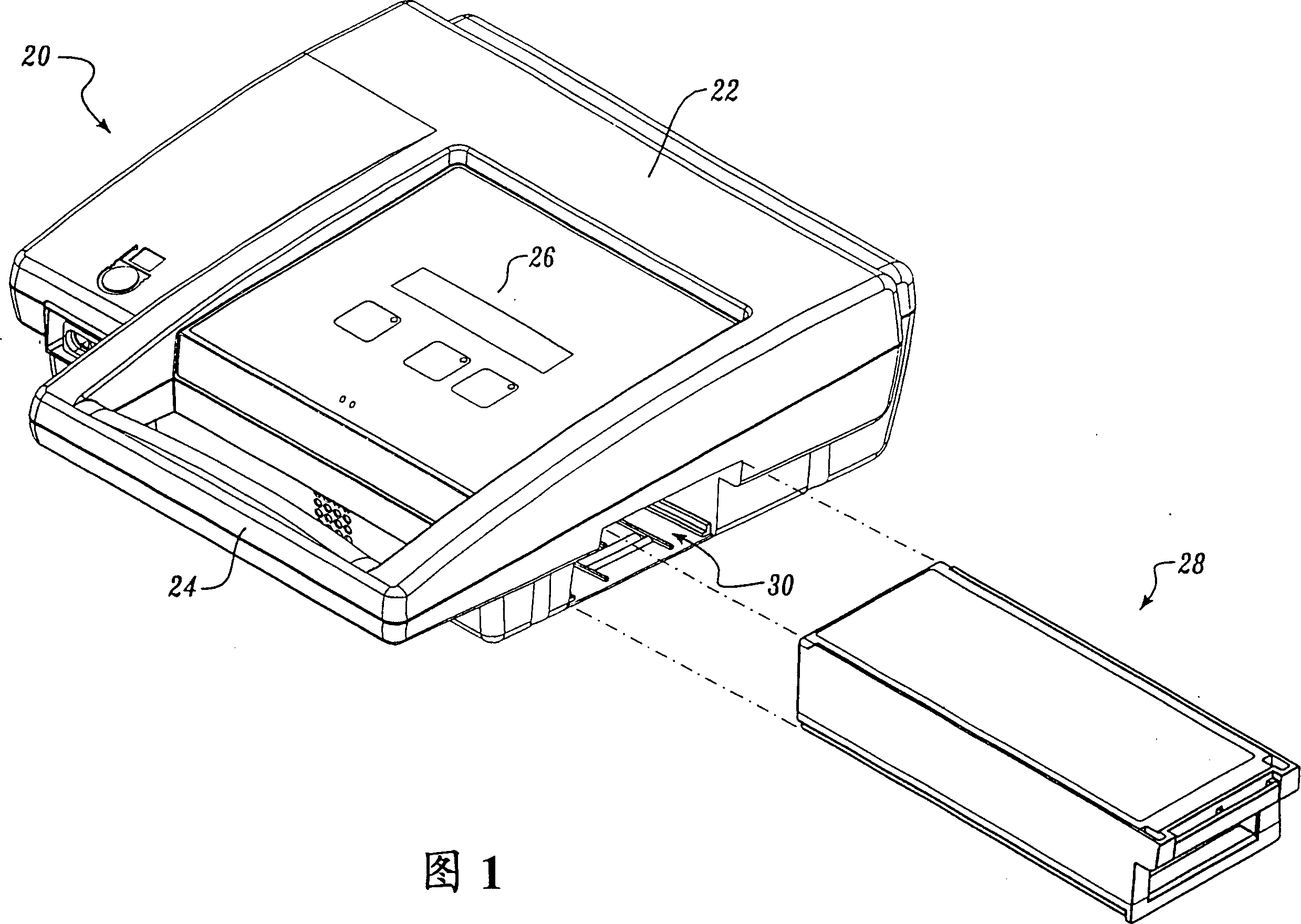
Figure 1 
Figure 2 
Figure 3
Abstract
Description
technical field
[0001] The present invention relates generally to power supplies for portable defibrillators, and more particularly to battery packs for portable defibrillators Background technique
[0002] Survival from heart disease depends on how quickly appropriate medical treatment is provided to patients who develop a heart attack. In order to reduce the response time to patients with cardiac events, it has been recognized that those who are generally the first to arrive at the emergency site, including emergency medicine specialists (EMTs), firefighters, police and even the public (hereinafter collectively referred to as "first Responders”) should be equipped with a portable defibrillator. A first responder equipped with a portable defibrillator will be more likely to successfully treat a patient than someone who arrives at the location later. Therefore, a defibrillator designed for use by first responders increases the overall success of treating cardiac patients. ...
Examples
Embodiment Construction
[0050] Figure 1 shows a portable defibrillator 20 for use by first responders during an emergency. The particular defibrillator shown in Figure 1 is the LIFEPAK(R) 500, manufactured and sold by Physio-Control Corporation of Redmond, Washington. For field use, the defibrillator 20 is constructed of an impact-resistant plastic housing 22 with a fixed handle 24 to allow the user to easily bring the defibrillator to the field. When in use, the defibrillator is preferably positioned with the defibrillator upper control panel 26 facing up toward the user. The control panel 26 includes a simplified interface that enables the user to operate the defibrillator after it has been connected to the patient. Appropriate keys are provided on the control panel to enable the user to turn the defibrillator on and off, to issue commands to the defibrillator to analyze the patient's electrocardiogram (ECG) applied to the defibrillator, and to enable the user to A defibrillation pulse is applied...