
Viscoelastic Surfactant Fluids Stable at High Brine Concentration and Methods of Using Same
a viscoelastic surfactant and high brine concentration technology, applied in the direction of sealing/packing, chemistry apparatus and processes, and well accessories, can solve the problems of high brine concentration and limited application range of heavy fluids to balance the well pressure, and achieves easy creation of turbulence, regained viscosity, and efficient jet
Patent Information
- Authority / Receiving Office
- US · United States
- Current Assignee / Owner
- Publication Date
- 2003-12-25
- Estimated Expiration
- Not applicable · inactive patent
Smart Images
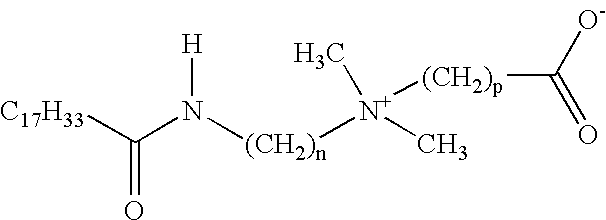
Figure 1 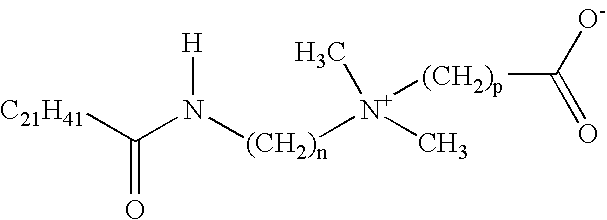
Figure 2 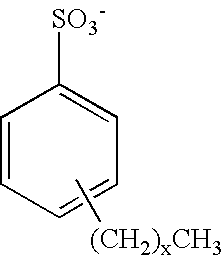
Figure 3
Abstract
Description
[0001] This Application is a continuation-in-part of U.S. Patent Application Ser. No.10 / 308,619, filed Dec. 3, 2002, which is incorporated by reference in its entirety, and which claimed the benefit of U.S. Provisional Pat. App. Ser. No. 60 / 336,455, filed Dec. 3, 2001. This application claims the benefit of U.S. Provisional App. Ser. No. 60 / 382,179, filed May 21, 2002.BACKGROUND OF INVENTION
[0002] This invention relates generally to the art of making and using oilfield treatment fluids viscosified with surfactants that gel in aqueous systems. More particularly it relates to making and using such fluids that tolerate high density brines. Most particularly it relates to making and using such fluids that are more viscous at higher temperatures in high density brines than in low density brines.
[0003] Viscous fluids play an important role in oilfield service applications ranging from fracturing fluids, gravel pack fluids, drilling fluids, cleanout fluids, acid diverting reagents, fractur...
Examples
example 2
[0060] Data from Fann 50 experiments showed that formulations of 7.5% and 10% BET-E-40 in 1.44 to 2.16 kg / L (12 to 18 ppg) CaCl.sub.2 and CaCl.sub.2 / CaBr.sub.2 mixtures had rheological stability beyond 149 .degree. C. (300 .degree. F.). FIG. 3 shows the rheology of 7.5% BET-E-40 in CaCl.sub.2 with densities ranging from (1.09 to 1.31 kg / L (9.1 to 10.9 ppg). The fluids shown in FIG. 3 also contained 1% methanol.
[0061] FIG. 4 shows the rheology of 10% BET-E-40 fluids in mixed CaCl.sub.2 and CaBr.sub.2 brines with fluid densities up to 1.81 kg / L (15.1 ppg). The CaBr.sub.2 / CaCl.sub.2 weight ratio in the 1.56 kg / L (13 ppg) fluid was about 2.0; the ratio in the other two fluids was about 2.8. The three fluids were shear thinning (in the conventional sense) over the entire temperature range shown. 1.81 kg / L (15.1 ppg) is the highest density available for this brine.
[0062] Table 3 shows rheological data from Fann 50 experiments for a fluid made with 10% as-received BET-E-40 in a 1.56 kg / L ...