

Bit rate contol method and device
a technology of bit rate control and transmission method, applied in the direction of transmission monitoring, data switching network, selective content distribution, etc., can solve the problems of increasing not producing the increase in the load on the call control, and difficult to increase the utilization efficiency of the network, so as to suppress the quality of real-time communication
Patent Information
- Authority / Receiving Office
- US · United States
- Patent Type
- Applications(United States)
- Current Assignee / Owner
- Publication Date
- 2005-05-19
- Estimated Expiration
- Not applicable · inactive patent
Smart Images
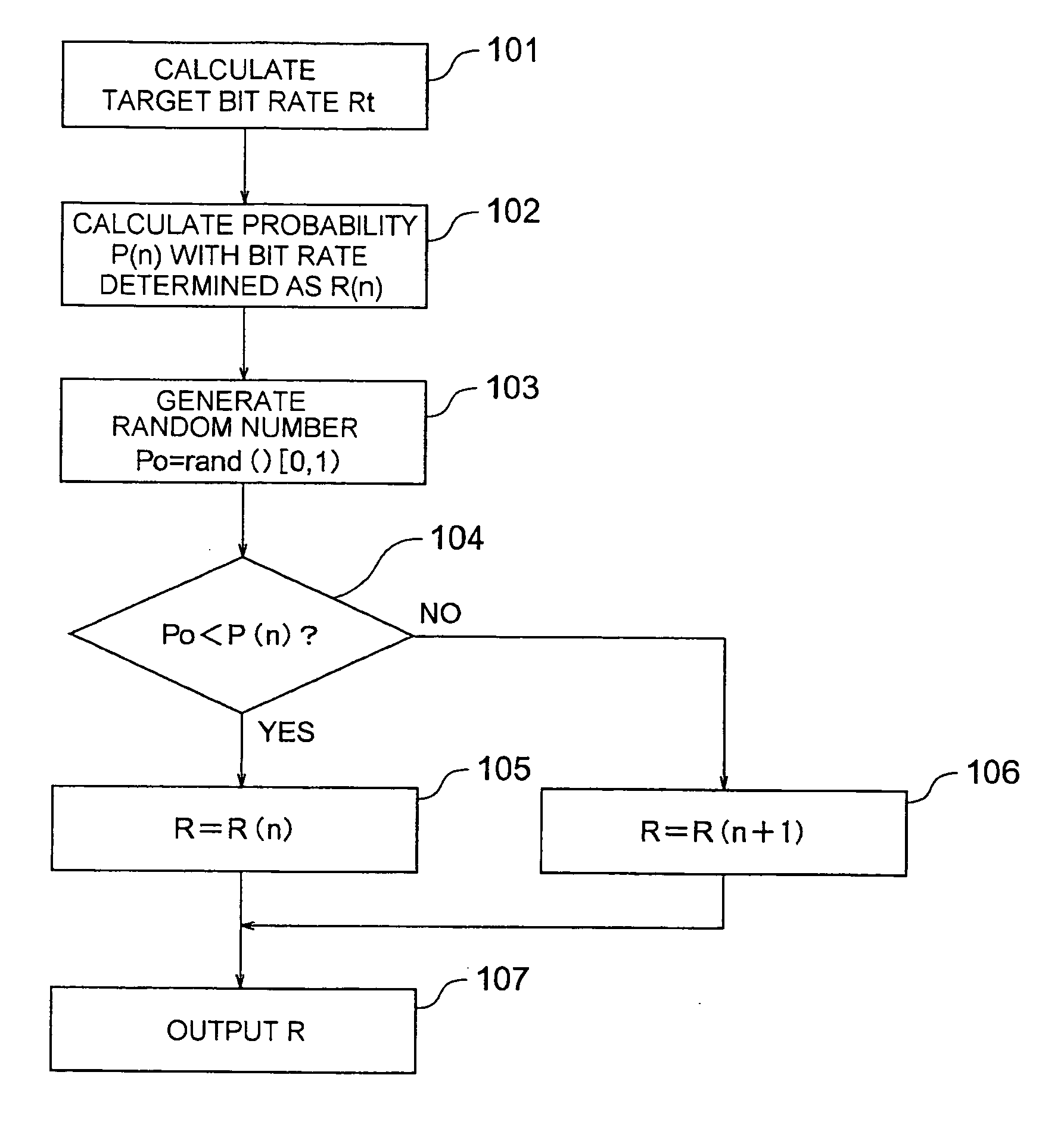
Figure 1 
Figure 2 
Figure 3
Abstract
Description
TECHNICAL FIELD
[0001] The present invention relates to a technique to transmit a real-time traffic such as sound data or image data and, more particularly, to a bit rate control method and apparatus thereof. BACKGROUND ART
[0002] As well known, since a circuit switching system used in, e.g., a conventional public telephone network occupies a communication line between both terminals irrespective of presence / absence of information to be transmitted, it is suitable for transmitting sounds or images in real time, whereas it is hard to increase a utilization efficiency of the network. Further, in the circuit switching system, since a call control which monitors a utilization ratio of the entire network in the connection between terminals is performed, there is also a problem that loads on the call control are increased as the number of terminals is increased.
[0003] On the other hand, since a packet exchange system does not occupy the line, a utilization efficiency of the network is hi...
Examples
first embodiment
(1) First Embodiment
[0056]FIG. 4 is a flowchart showing a bit rate control according to a first embodiment of the present invention. First, a target bit rate Rt is calculated by using a TCP-friendly control or the like based on the conventional AIMD or TFRC (step 101).
[0057] n with which R(n)≦Rt1) can be achieved is obtained with respect to this Rt, and a probability P that a transmission bit rate becomes R(n) is calculated by using such an expression as that the probability is increased as Rt is close to R(n), e.g., an expression (2) (step 102).
P(n)=(R(n+1)−Rt) / (R(n+1)−R(n)) (2)
[0058] It is to be noted that the probability P(n) can be also determined by retrieval using a table storing corresponding relationships between the target bit rate Rt and the probability P(n) as specific numeric values. In any case, such an expression or table is stored in a memory as change probability generation information in advance.
[0059] Then, a bit rate judgment based on the probability P(n) is ...
second embodiment
(2) Second Embodiment
[0063] In a second embodiment according to the present invention, the bit rate change probability is determined in dependent on a difference between a current transmission bit rate and a target bit rate, and the bit rate can be changed to only adjacent bit rates in this case in order to avoid large fluctuations in transmission bit rate.
[0064] 2. 1) Control Flow
[0065]FIG. 5 is a flowchart showing a bit rate control according to the second embodiment of the present invention. First, a target bit rate Rt is calculated like the first embodiment (step 101), and a judgment is made upon whether the target bit rate Rt is smaller than a current transmission bit rate R(n) (step 202). A judgment is made upon whether the transmission bit rate is decreased (bit rate decrease judgment: steps 204 to 207) if it is determined that Rt is smaller (YES at the step 202), and a judgment is made upon whether Rt is equal to the current transmission bit rate R(n) (step 203) in other c...
third embodiment
(3) Third Embodiment
[0096] In a third embodiment according to the present invention, a transmission bit rate is changed in accordance with a packet loss like the operation in AIMD. By making a judgment based on a probability when changing a transmission bit rate, the TCP-friendly control can be realized even if a settable bit rate is discrete.
[0097] 3. 1) Control Flow
[0098]FIG. 8 is a flowchart showing a bit rate control according to the third embodiment of the present invention. In FIG. 9, presence / absence of a packet loss is first detected based on the number of losses of received sound / image packets or a packet loss ratio notified from an opposite side terminal (step 301), and a judgment is made upon whether there is a packet loss (step 302).
[0099] If there is a packet loss (YES at the step 302), a judgment is made upon whether a transmission bit rate is lowered (bit rate decreased judgment: steps 303 to 306). If there is no packet loss (NO at the step 302), a judgment is made...