
Golf ball and mechanical analysis of the same
a golf ball and mechanical analysis technology, applied in golf clubs, instruments, force/torque/work measurement apparatus, etc., can solve the problem of reducing the computation accuracy of the whole, and achieve the same computation accuracy, increase the processing speed of computation, and enhance the computation accuracy at the time of the mechanical behavior of the golf ball analyzed by the finite element method
Patent Information
- Authority / Receiving Office
- US · United States
- Patent Type
- Applications(United States)
- Current Assignee / Owner
- Publication Date
- 2009-05-07
- Estimated Expiration
- Not applicable · inactive patent
Smart Images
Figure 1 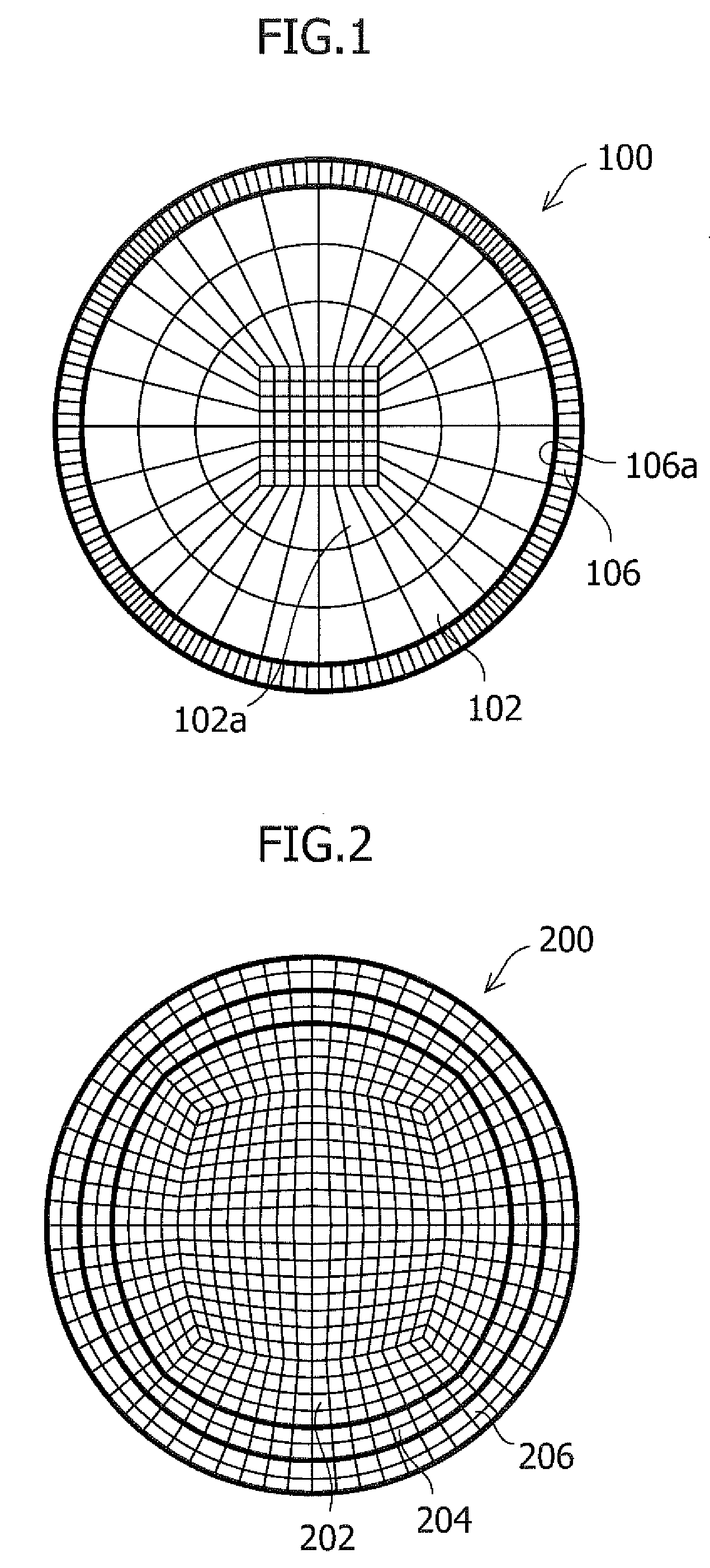
Figure 2 
Figure 3
Abstract
Description
CROSS REFERENCE TO RELATED APPLICATIONS
[0001] This application claims the benefit of U.S. Provisional Application No. 60 / 986,034 filed on Nov. 7, 2007, which is hereby incorporated by reference in its entirety.BACKGROUND
[0002] 1. Technical Field
[0003] The present invention relates to a golf ball and to a mechanical analysis of the golf ball. More particularly, the present invention relates to a golf ball and to an analysis method for simulating physical properties involving deformation of a golf ball by the finite element method using a model run on a computer.
[0004] 2. Description of the Related Art
[0005] The finite element method is known as a computation method capable of analyzing the properties of an object on a computer by sectioning an intricately-shaped object into discrete elements, and by evaluating any physical quantity in each of the elements. An advantage of the finite element method is that when this method is actually used, even if the user does not necessarily have advanc...
Examples
first embodiment
[0058]In some modes of the present invention, on each face of each element in the core zone, the aspect ratio is set so as to be not lower than 1.0 and not substantially higher than 1.5. Also, in a further preferable mode, the aspect ratio is set so as to be not lower than 1.0 and not substantially higher than 1.35. In an analysis method using a model having the aspect ratio specified above, a satisfactory analysis can be carried out for the spherical shape of a golf ball.
[0059]Furthermore, in the present invention, if the aspect ratio is set so as to be not lower than 1.0 and not substantially higher than 4.5 for all solid elements including other than the core zone, satisfactory analysis can be carried out. Also, further preferably, if the aspect ratio is set so as to be not lower than 1.0 and not substantially higher than 2.5, further satisfactory analysis can be carried out.
[0060]As described above, in the case in which the aspect ratio of solid element including other than the ...
second embodiment
[0061]Also, the element in the core zone can be specified by a volume ratio, not the aspect ratio. If the volume of an element having the maximum volume in the core zone has a volume of about 3.5 times or less, further preferably about 2.5 times or less, the volume of an element having the minimum volume, satisfactory analysis can be carried out.
[0062]Thus, in the case in which the volume ratio of element in the core zone is 4.5, sufficient computation accuracy is not obtained. However, in the case in which the volume ratio is about 3.5, high computation accuracy can be obtained, and in the case in which the volume ratio is about 2.5, further high computation accuracy can be obtained, and satisfactory analysis can be carried out.
third embodiment
[0063]In the embodiment of the present invention, the number of nodes in a model indicates the number of output points of the finite element method. Therefore, this embodiment achieves an effect of improved computation accuracy due to the increase in the number of output points. To confirm this effect, an analysis was made by changing the number of nodes provided on the element in the range of 8 to 20. As the result, it is found that in the case in which the number of nodes is set at 8, 12 or 16, sufficient computation accuracy is not obtained, and by comparison, in the case in which the number of nodes is set at 20, analysis can be carried out with high computation accuracy.