
Automated emergency power supply test featuring user selection of load percentage or exhaust temperature
a power supply and automatic technology, applied in power supply testing, instruments, electric devices, etc., can solve the problems of insufficient monitoring of the terminal voltage of the battery, inability to detect manual data collection methods, subtle and gradual, etc., to increase the overall reliability of the eps system, reduce the burden of staff, and increase reliability
Patent Information
- Authority / Receiving Office
- US · United States
- Patent Type
- Applications(United States)
- Current Assignee / Owner
- Publication Date
- 2012-05-03
Smart Images
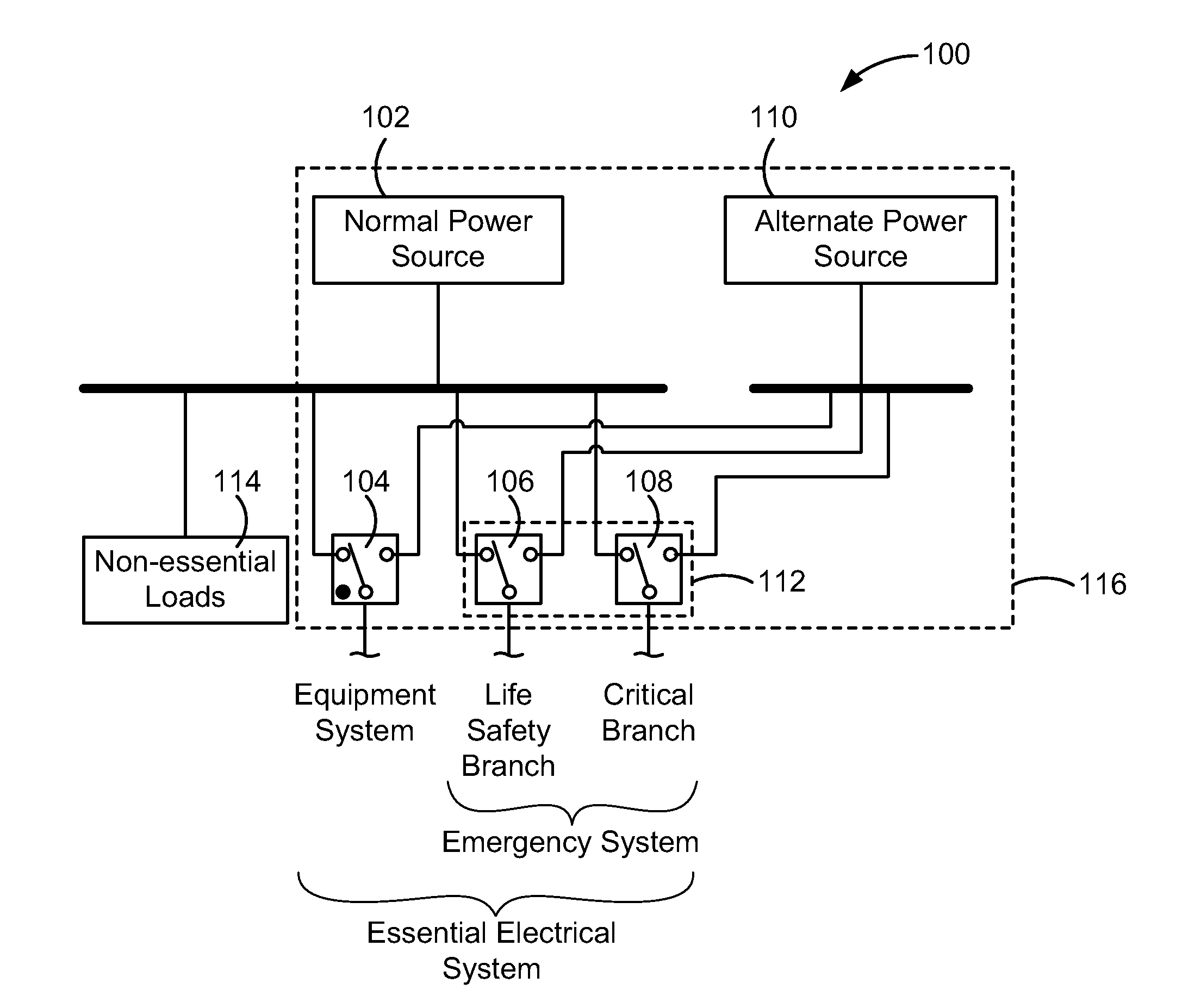
Figure 1 
Figure 2 
Figure 3
Abstract
Description
FIELD OF THE INVENTION
[0001] The present invention relates generally to automated emergency power supply systems.BACKGROUND OF THE INVENTION
[0002] It is not uncommon for back-up generation to fail in the case of an emergency due to insufficient testing and maintenance. In some cases, nominal run tests can actually create problems within the gensets that can affect operation in a true emergency situation (like wet stacking, where unburned fuel or carbon builds up in the exhaust system when the generator run times are too short or the test is performed outside recommended operating parameters).
[0003] The challenge is that comprehensive manual tests are difficult to coordinate and it is equally hard to effectively measure results. There are major challenges for multiple stakeholders in the hospital, including medical personnel, facility personnel, and the hospital administration. In short, manual testing of EPS systems is costly and inefficient.
[0004] The testing of emergency power supply ...
Examples
Embodiment Construction
[0108]FIG. 1 is a functional block diagram of an example electrical system 100 that normally supplies electrical current to electrical loads within a facility or building, such as a hospital or healthcare facility, from a normal power source 102. When power supplied by the normal power source 102, such as a main utility power source, is interrupted, automatic switching equipment 104, 106, 108 automatically switches power supplied by the normal power source 102 to an alternate power source 110, such as a generator or genset, as that term is understood by those skilled in the art of power systems, or a direct current (DC) power source such as a battery. In the case of a hospital, the electrical system 100 can include an emergency system 112 that supplies power to essential loads within the hospital that are supplied by life safety or critical branch circuits. Non-essential loads 114 in the hospital remain unpowered during a power outage from the normal power source 102. Within the ess...