
Radio communication system, radio base station, and communication control method
a radio base station and communication control technology, applied in the direction of digital transmission, wireless commuication services, transmission path sub-channel allocation, etc., can solve the problems of high interference levels of mobile terminals located at the edges of cells of small power base stations, and the excessive communication load thereon, so as to improve the reception quality of mobile terminals
Patent Information
- Authority / Receiving Office
- US · United States
- Current Assignee / Owner
- Publication Date
- 2015-04-30
- Estimated Expiration
- Not applicable · inactive patent
Smart Images
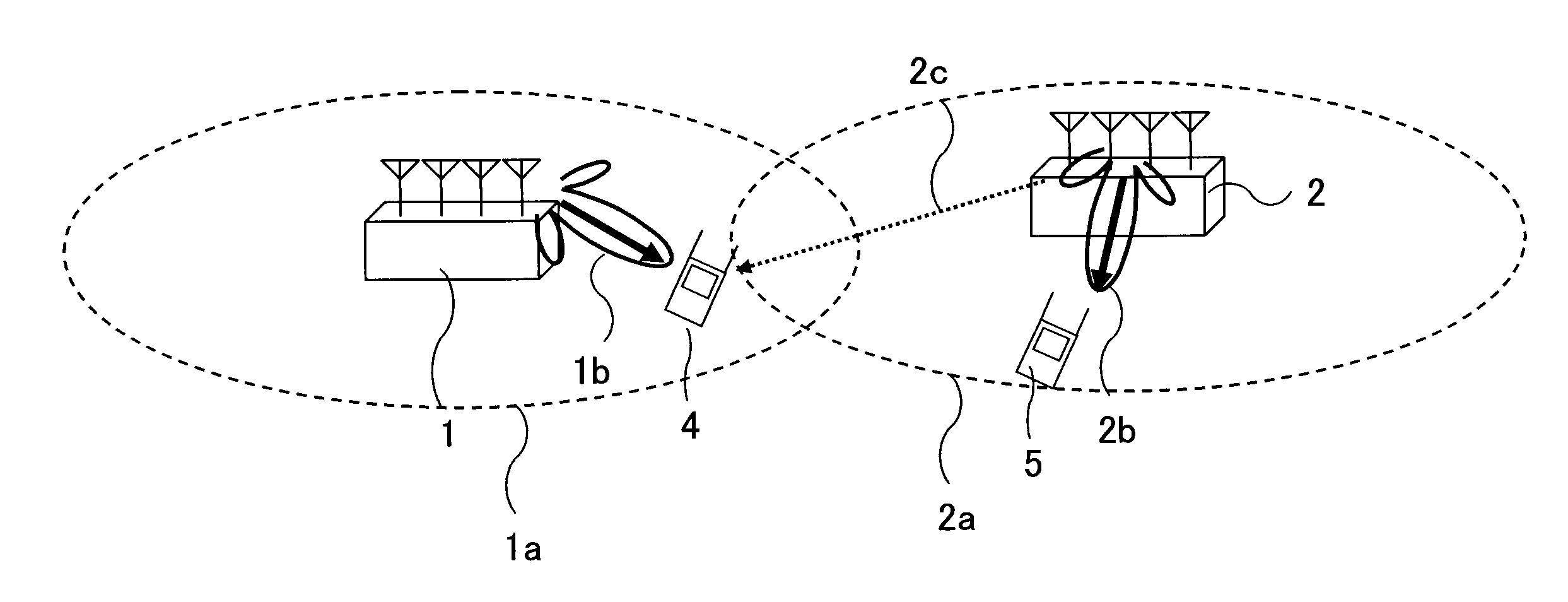
Figure 1 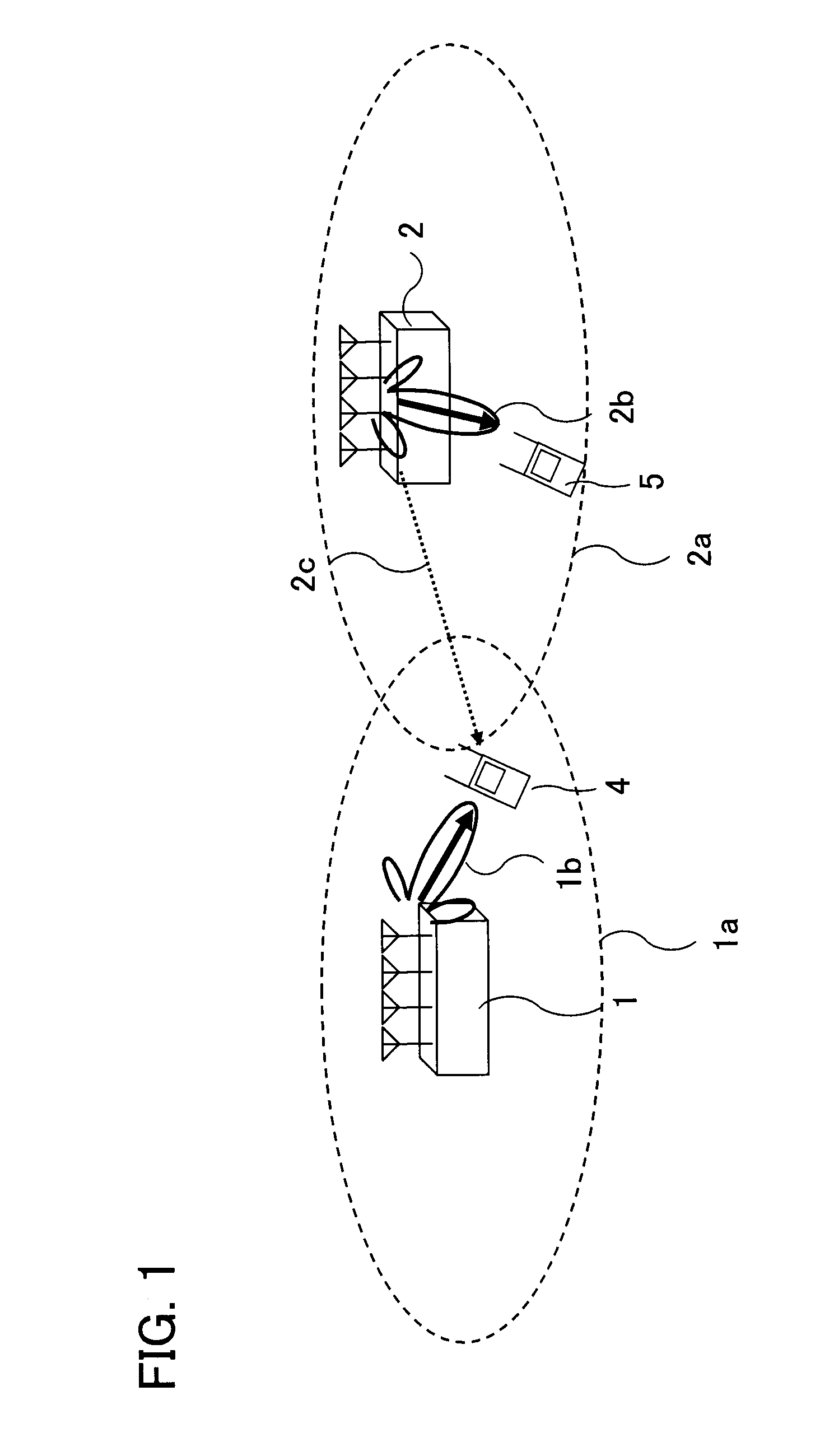
Figure 2 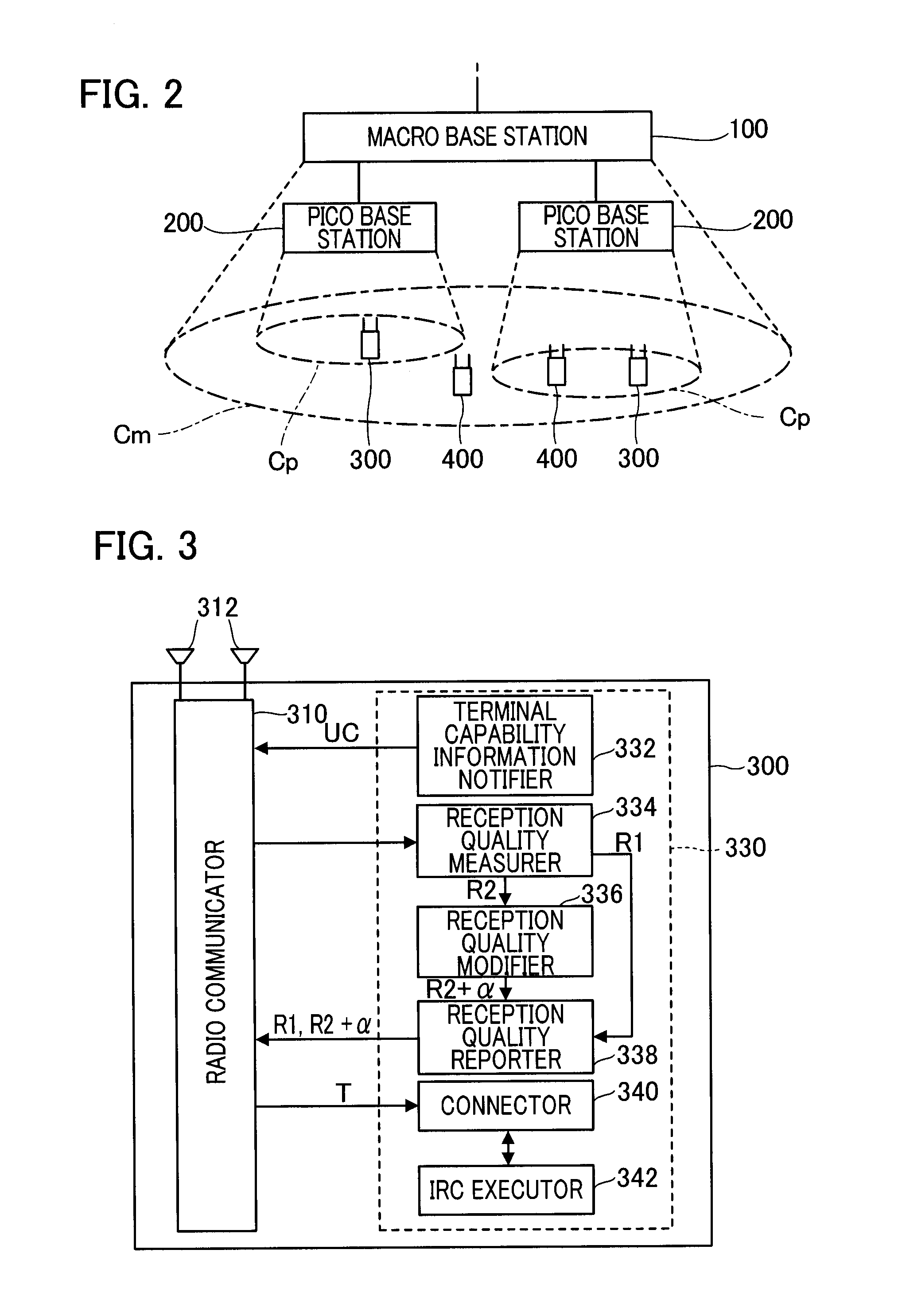
Figure 3
Abstract
Description
FIELD OF THE INVENTION
[0001] The present invention relates to a radio communication system, to a radio base station, and to a communication control method.BACKGROUND ART
[0002] In LTE (Long Term Evolution) Advanced in the 3GPP (Third Generation Partnership Project), OFDMA (Orthogonal Frequency Division Multiplexing Access) using MU-MIMO (multi-user multiple-input multiple-output) has been proposed. In the downlink transmission of MU-MIMO, one base station communicates not only with multiple mobile terminals (UE, user equipments), but also can transmit different data streams (layers) to one mobile terminal simultaneously.
[0003] In the LTE Advanced, a reception technology of the mobile terminal called Interference Rejection Combining is under consideration. The Interference Rejection Combining (IRC) is a technique to give weightings to signals obtained by respective reception antennas at a mobile terminal so as to suppress, at the mobile terminal, the interference of an interference radio...
Examples
first embodiment
[0057]FIG. 2 is a block diagram of a radio communication system according to the first embodiment of the present invention. This radio communication system has a macro base station (macro eNodeB (evolved Node B)) 100, pico base stations 200, IRC terminals 300 (UE, User Equipment) which are mobile terminals capable of executing the interference rejection combining (IRC) and non-IRC terminals 400 which are mobile terminals incapable of the interference rejection combining. In this embodiment, the pico base stations 200 are Remote Radio Heads (RRH). In the following description, the IRC terminal 300 and the non-IRC terminal 400 are sometimes referred to as a “user terminal” without distinguishing therebetween.
[0058]Each of the communication elements (the macro base station 100, the pico base stations 200, the IRC terminals 300, the non-IRC terminals 400, etc.) in the radio communication system performs radio communication according to a predetermined Radio Access Technology, e.g., the ...
second embodiment
[0110]In the first embodiment, the resource setter 134 of the macro base station 100 sets the number of protected subframes PSF in the radio frame F based on the proportion of the number of the IRC terminals 300 to the total number of user terminals connecting to the pico base stations 200. However, in the second embodiment, the resource setter 134 may set the number of protected subframes PSF in the radio frame F based on the traffic of the IRC terminals 300 to the total traffic of user terminals connecting to the pico base stations 200.
[0111]In the second embodiment, the configurations of the macro base station 100, the pico base stations 200, and the user terminal (the IRC terminal 300 and the non-IRC terminal 400) may be the same as those according to the first embodiment. The features that are the same as in the first embodiment will not be described here in detail. However, the following features are different.
[0112]The terminal capability determiner 232 (FIG. 6) of the contro...
third embodiment
[0119]In the above first embodiment, the resource setter 134 of the macro base station 100 sets the number of the protected subframes PSF in the radio frame F based on the proportion of the number of the IRC terminals 300 to the total number of user terminals connecting to the pico base stations 200. However, in the third embodiment, the resource setter 134 may set the number of protected subframes PSF in the radio frame F based on the number of the IRC terminals 300 to the total number of user terminals connecting to the macro base station 100.
[0120]In the third embodiment, the configuration of a user terminal (the IRC terminal 300 and the non-IRC terminal 400) may be the same as those according to the first embodiment. The features that are the same as in the first embodiment will not be described here in detail. However, as shown in FIG. 13, in the macro base station 100, the resource setter 134 sets the number of protected subframes PSF in the radio frame F based on a type of a ...