
Automatic artifact detection and pulse sequence modification in magnetic resonance imaging
a technology of magnetic resonance imaging and artifact detection, applied in the field of magnetic resonance imaging, can solve problems such as geometric distortion, anomalies within magnetic resonance images, artifacts or anomalies etc., and achieve the highest likelihood score of image improvement, improve the quality of a series of magnetic resonance images, and improve the effect of magnetic resonance images
Patent Information
- Authority / Receiving Office
- US · United States
- Patent Type
- Applications(United States)
- Current Assignee / Owner
- Publication Date
- 2021-05-27
Smart Images
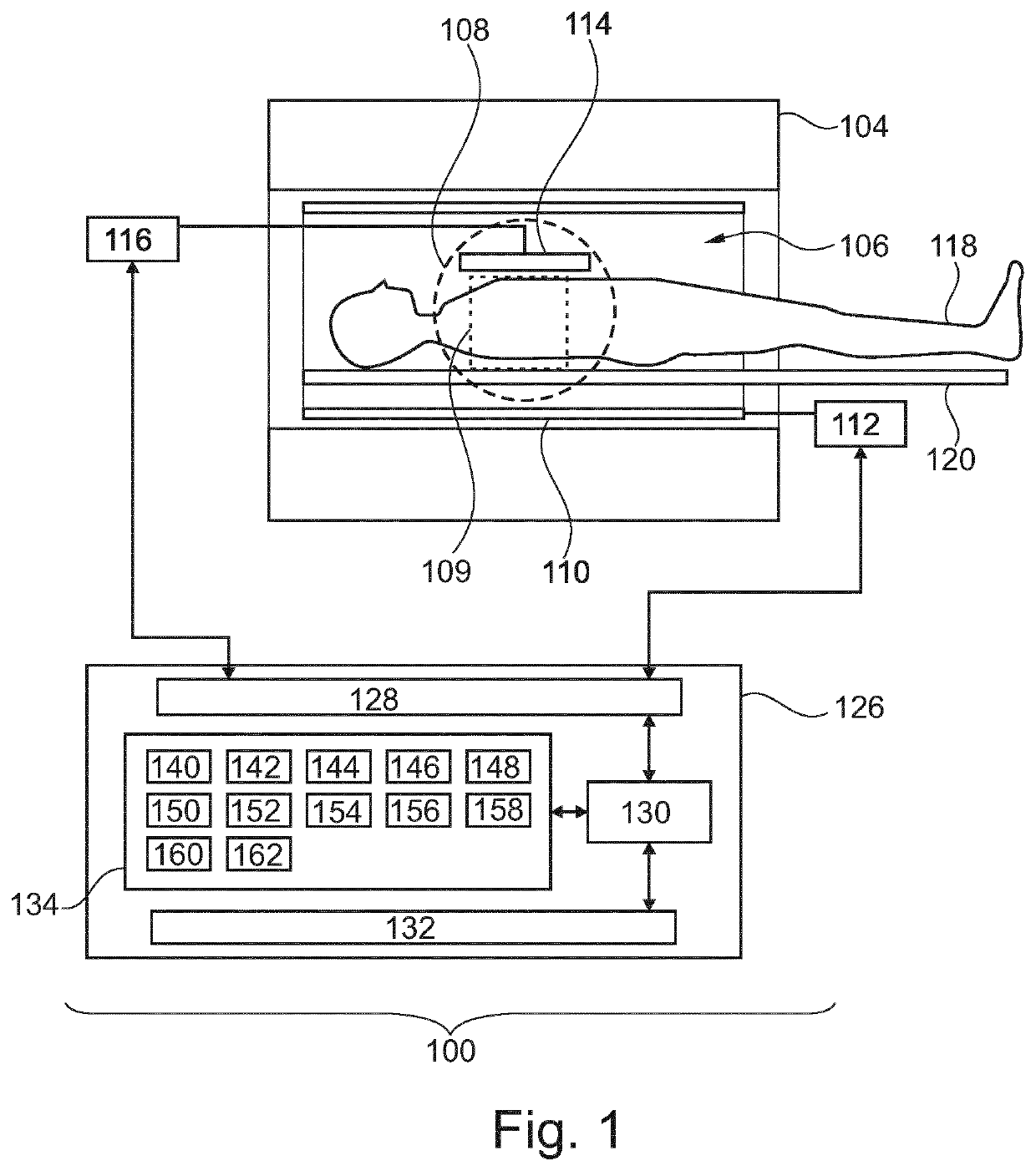
Figure 1 
Figure 2 
Figure 3
Abstract
Description
FIELD OF THE INVENTION
[0001] The invention relates to magnetic resonance imaging, in particular to reduction of artifacts during magnetic resonance imaging.BACKGROUND OF THE INVENTION
[0002] A large static magnetic field is used by Magnetic Resonance Imaging (MRI) scanners to align the nuclear spins of atoms as part of the procedure for producing images within the body of a subject. This large static magnetic field is referred to as the BO field or the main magnetic field. Various quantities or properties of the subject can be measured spatially using MRI. However, the acquisition of a magnetic resonance imaging data is not instantaneous and voluntary and / or involuntary subject motion can cause artifacts or anomalies with the magnetic resonance image. Additionally, incorrectly configuring the magnetic resonance imaging system or the presence of metallic implants with the subject can also cause anomalies within the magnetic resonance image. Among the most common problems are motion arti...
Examples
Embodiment Construction
[0061]Like numbered elements in these figures are either equivalent elements or perform the same function. Elements which have been discussed previously will not necessarily be discussed in later figures if the function is equivalent.
[0062]FIG. 1 shows an example of a magnetic resonance imaging system 100 with a magnet 104. The magnet 104 is a superconducting cylindrical type magnet with a bore 106 through it. The use of different types of magnets is also possible; for instance it is also possible to use both a split cylindrical magnet and a so called open magnet. A split cylindrical magnet is similar to a standard cylindrical magnet, except that the cryostat has been split into two sections to allow access to the iso-plane of the magnet, such magnets may for instance be used in conjunction with charged particle beam therapy. An open magnet has two magnet sections, one above the other with a space in-between that is large enough to receive a subject: the arrangement of the two secti...