
Flexible electroluminescent devices
a flexible, electroluminescent technology, applied in the direction of solid-state devices, semiconductor devices, organic semiconductor devices, etc., can solve the problems of complex and/or expensive encapsulation processes, difficult manufacturing and encapsulation of fel devices at low cost,
Patent Information
- Authority / Receiving Office
- US · United States
- Current Assignee / Owner
- Publication Date
- 2022-06-30
Smart Images
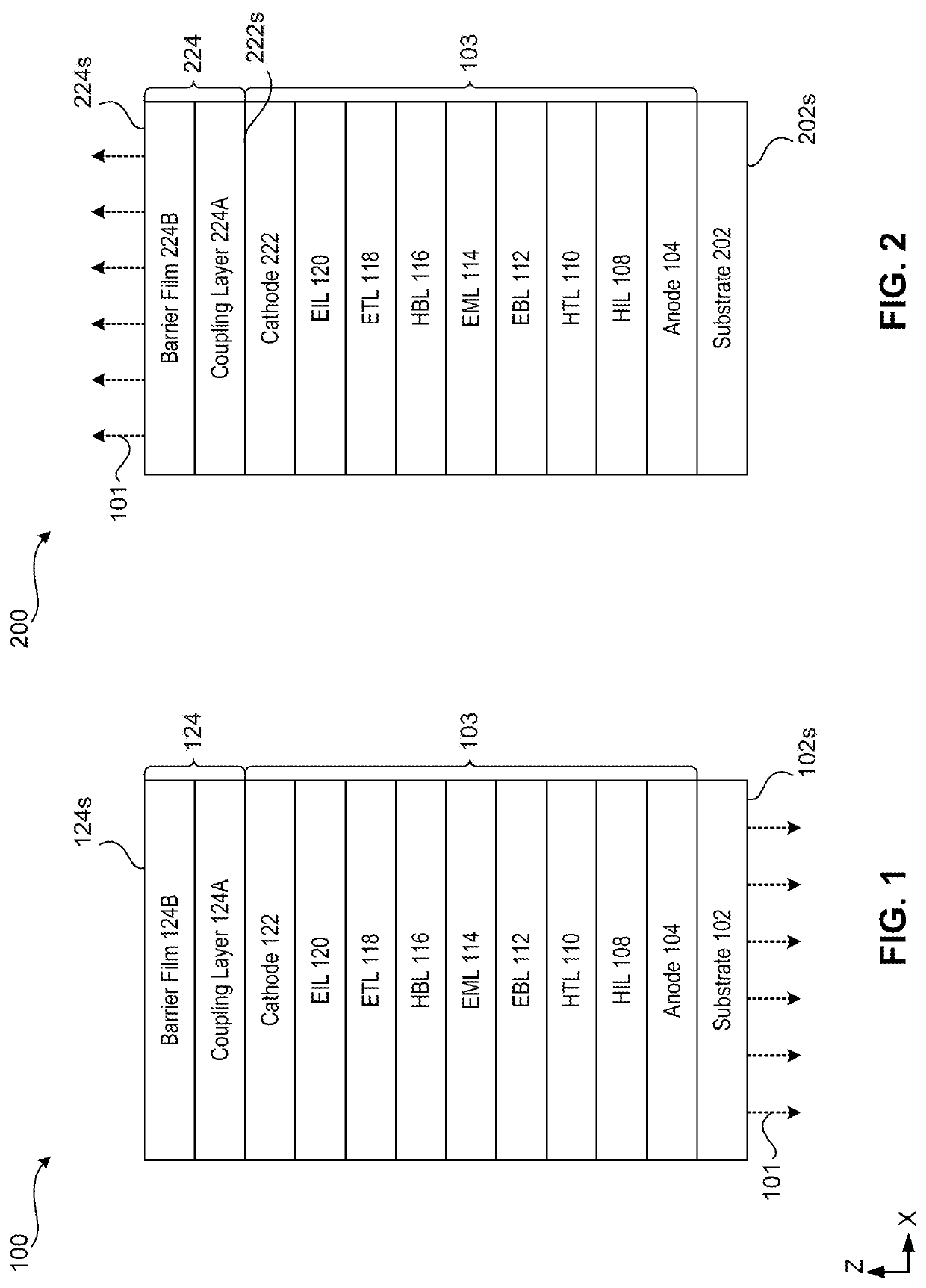
Figure 1 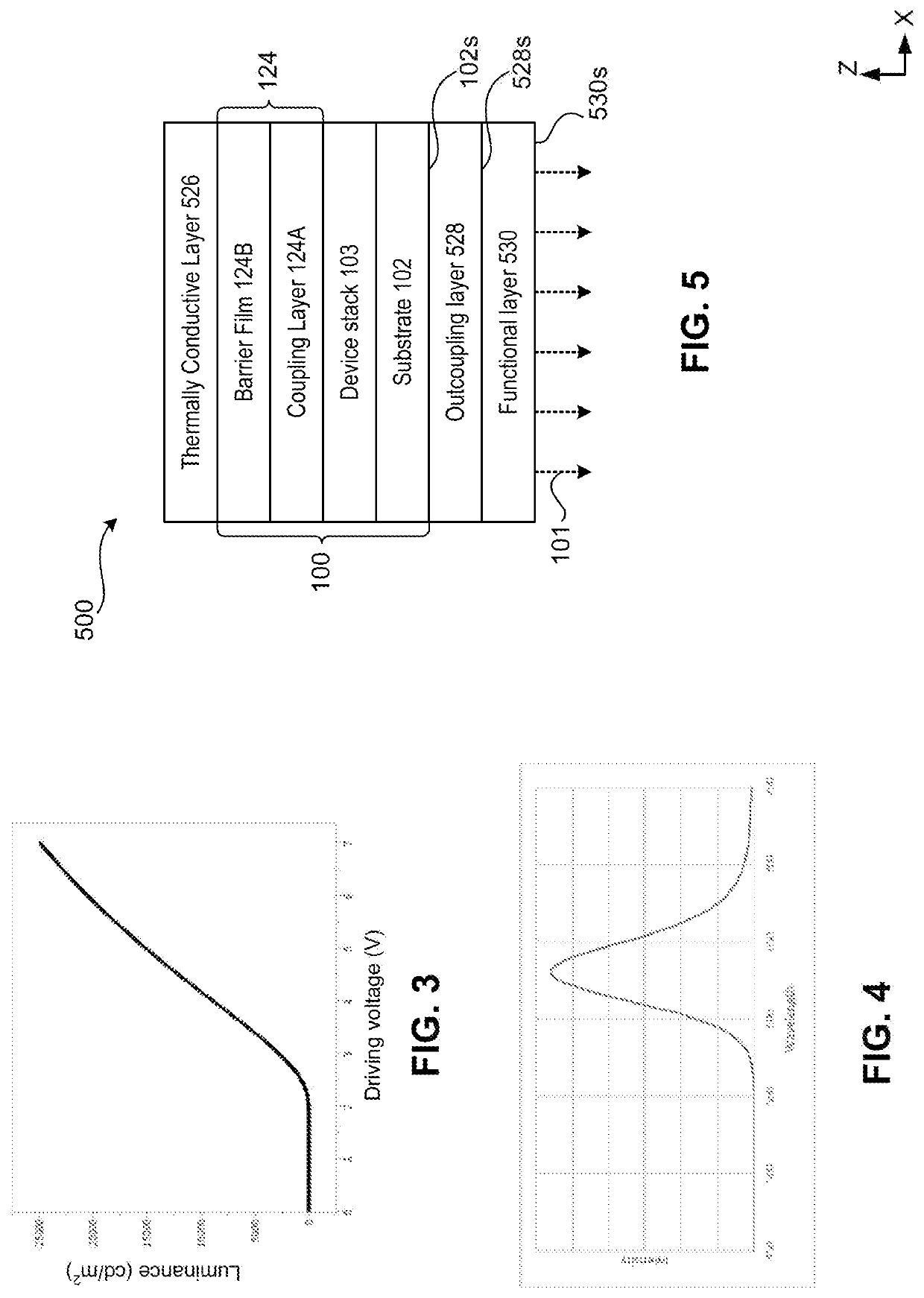
Figure 2 
Figure 3
Abstract
Description
BACKGROUND OF THE INVENTIONField
[0001] The present invention relates to electroluminescent devices (e.g., light emitting diodes (LEDs)) having luminescent nanostructure (e.g., quantum dot (QD)) based emission layers on flexible substrates.Background
[0002] Electroluminescent (EL) devices are used as light sources in displays (e.g., phones, tablets, monitors, televisions, or digital billboards) and medical applications (e.g., photomedicine). With the increase in demand for portable and wearable devices, EL devices (e.g., LEDs and organic LEDs (OLEDs)) have been made on lightweight and flexible substrates, which can be curved without causing structural and functional damage to the EL devices.
[0003] However, one of the challenges is producing flexile EL (FEL) devices that emit light with high brightness (also referred to as luminance) (e.g., brightness greater than about 20,000 candelas per square meter (cd / m2)) at low driving voltages (e.g., voltages less than about 8 volts(V)) for effect...
Examples
Embodiment Construction
[0026]Although specific configurations and arrangements may be discussed, it should be understood that this is done for illustrative purposes only. A person skilled in the pertinent art will recognize that other configurations and arrangements can be used without departing from the spirit and scope of the present invention. It will be apparent to a person skilled in the pertinent art that this invention can also be employed in a variety of other applications beyond those specifically mentioned herein. It should be appreciated that the particular implementations shown and described herein are examples and are not intended to otherwise limit the scope of the application in any way.
[0027]It is noted that references in the specification to “one embodiment,”“an embodiment,”“an example embodiment,” etc., indicate that the embodiment described may include a particular feature, structure, or characteristic, but every embodiment may not necessarily include the particular feature, structure, ...