
Switch with at least one flexible conductive member
a technology of flexible conductive and touchscreen, applied in the field of touchscreen, can solve the problem of not providing any additional advantage for these conventional materials, and achieve the effects of improving the mechanical properties maximizing the benefit of intrinsically conductive polymer coatings, and significantly improving the durability of touchscreens
Patent Information
- Authority / Receiving Office
- US · United States
- Current Assignee / Owner
- Publication Date
- 2002-10-22
- Estimated Expiration
- Not applicable · inactive patent
Smart Images
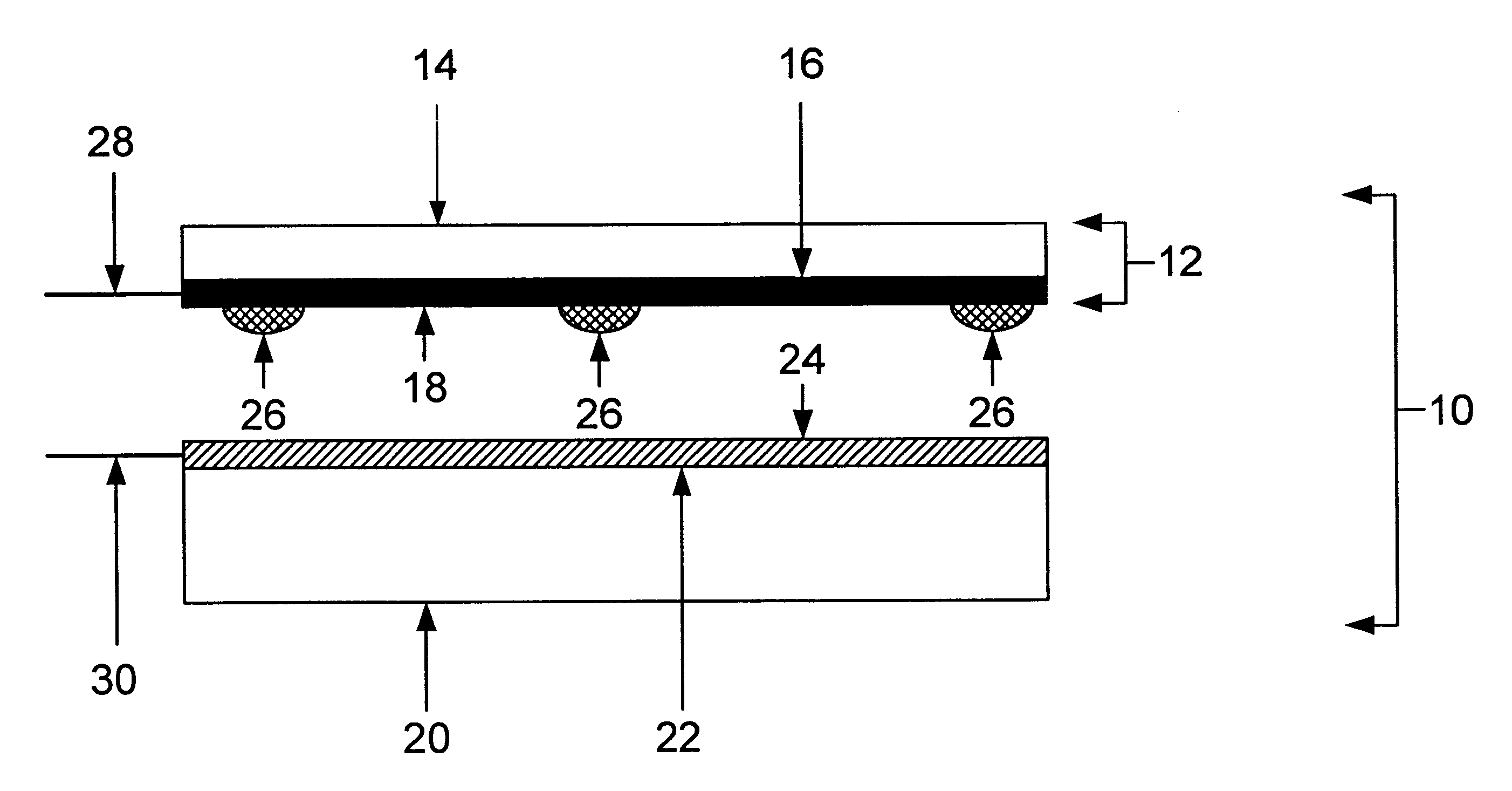
Figure 1 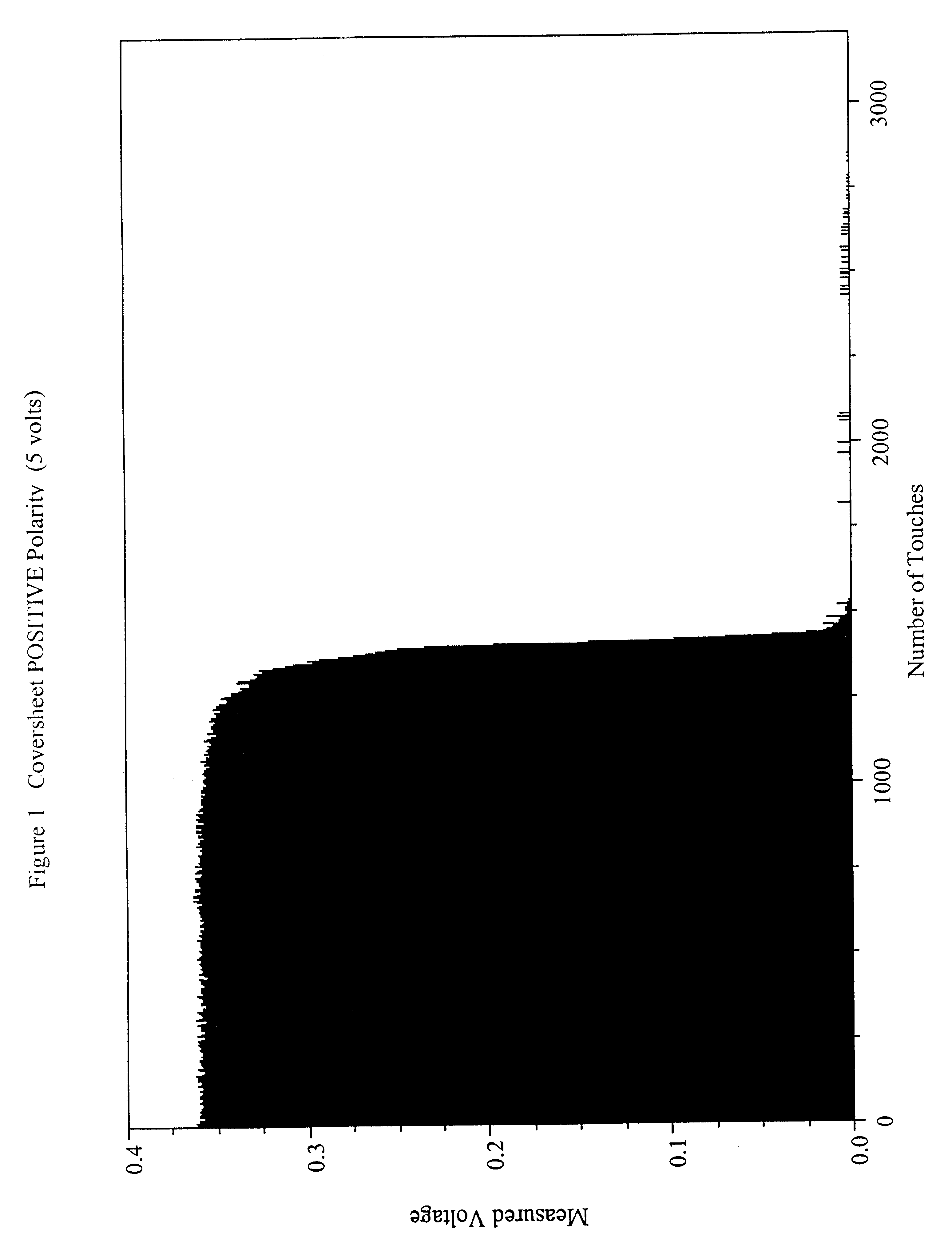
Figure 2 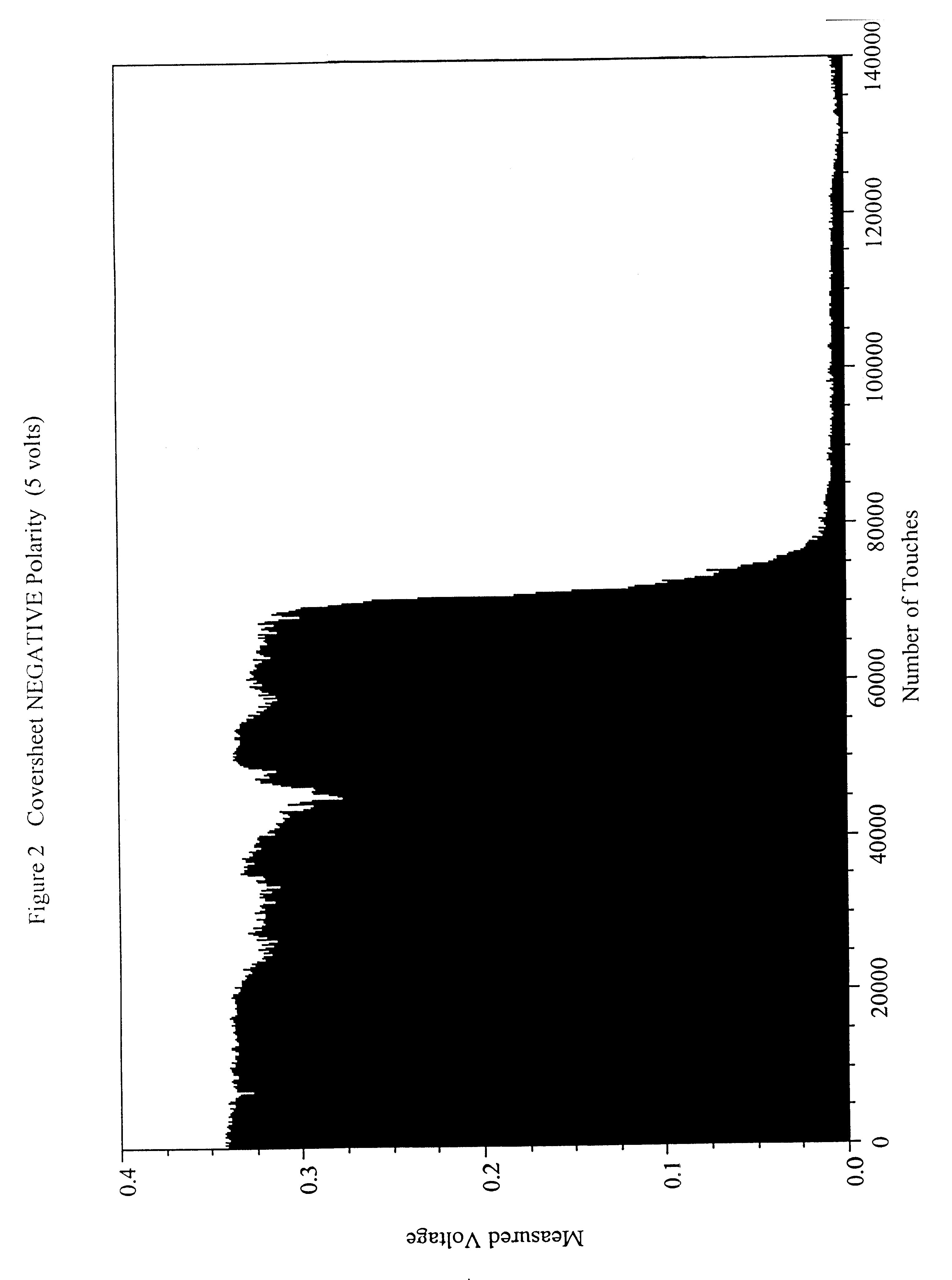
Figure 3
Abstract
Description
1. Field of the InventionThe present invention relates generally to switches. More specifically, the present invention relates to switches of the sort in which two conductive surfaces touch.2. Description of the Related ArtSwitches of the sort in which two conductive surfaces touch are used in such technologies as resistive touchscreens and membrane switches. For reasons of convenience and clarity, this background section describes resistive touchscreens.Touchscreens are used in the computer arts to input data. Rather than a user of a computer inputting data by using a keyboard or a mouse, the user inputs data via a touchscreen mounted on the monitor of the computer. Several patents have been issued regarding resistive touchscreens, including U.S. Pat. Nos. 4,306,110; 5,438,168; 5,541,370; 5,589,857; 5,818,430; and 5,844,175. The basic configuration of a resistive touchscreen comprises a coversheet generally comprising a first substrate, and a second substrate to which the covershee...
Examples
experiment 1
In this experiment a voltage potential of 5 volts dc was applied across the input terminals A and B; this voltage is commonly used in the touchscreen industry. The voltage of terminal A was positive with respect to terminal B, as taught in U.S. Pat. No. 5,766,515. If the electrical contact made by touching the coversheet and substrate into contact is degraded, the current flow during each contact will decrease and cause a decrease in the voltage drop across the series resistance.
Touchscreen failure can occur when the electrical contact is degraded to the extent that an appropriate electric circuit is not completed when the conductive surfaces are brought into contact. A fifty percent reduction in current, as indicated by a fifty percent decrease in the voltage drop across the series resistance, is a reasonable indication of touchscreen failure.
As shown in FIG. 1, a fifty percent reduction in voltage across the resistor was measured after approximately 1400 touches.
experiment 2
In this experiment, a voltage potential of 5 volts dc was also applied across the input terminals A and B; however, the polarity, as compared to Experiment 1, was reversed, i.e. terminal A had a negative voltage with respect to terminal B. As shown in FIG. 2, a fifty percent reduction in voltage across the resistor was not measured until after approximately 80,000 touches, a 57-fold improvement compared to the number of touches to failure in Experiment 1.
experiment 3
In this experiment, terminal A again had a positive voltage with respect to terminal B (similar to Experiment 1), but the voltage potential across the input terminals A and B was reduced from 5 volts dc to 0.5 volt dc. As shown in FIG. 3a, the voltage reduction across the resistor was negligible after approximately 130,000 touches. The experiment continued for more than 1.81 million touches. FIG. 3b shows that the voltage decrease across the last 120,000 touches of the test was only a few percent lower than the original voltage shown in FIG. 3a. A fifty percent reduction in voltage across the resistor was not measured during the entire experiment, which lasted for more than 1.81 million touches.