
Radio link protocol (RLP)/point-to-point protocol (PPP) design that passes corrupted data and error location information among layers in a wireless data transmission protocol
a wireless data transmission and radio link technology, applied in the field of wireless packet networks, can solve the problems of most streaming applications and real-time applications, packet losses can be random or bursty, and the wireless packet network encounters packet losses between a base station, so as to reduce or avoid unnecessary packet discarding, flexible and efficient packet delivery, the effect of improving performan
Patent Information
- Authority / Receiving Office
- US · United States
- Patent Type
- Patents(United States)
- Current Assignee / Owner
- Publication Date
- 2006-04-18
- Estimated Expiration
- Not applicable · inactive patent
Smart Images
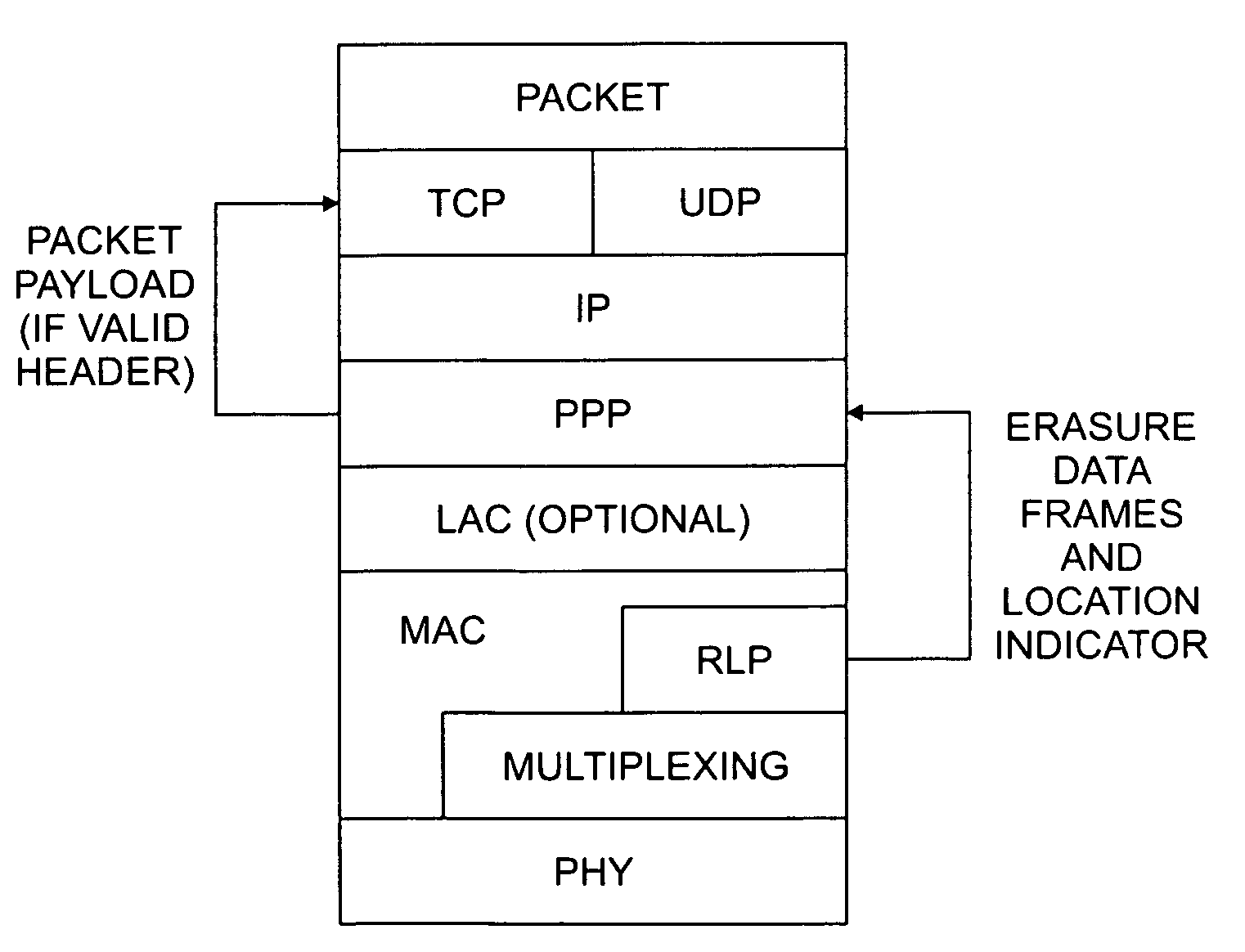
Figure 1 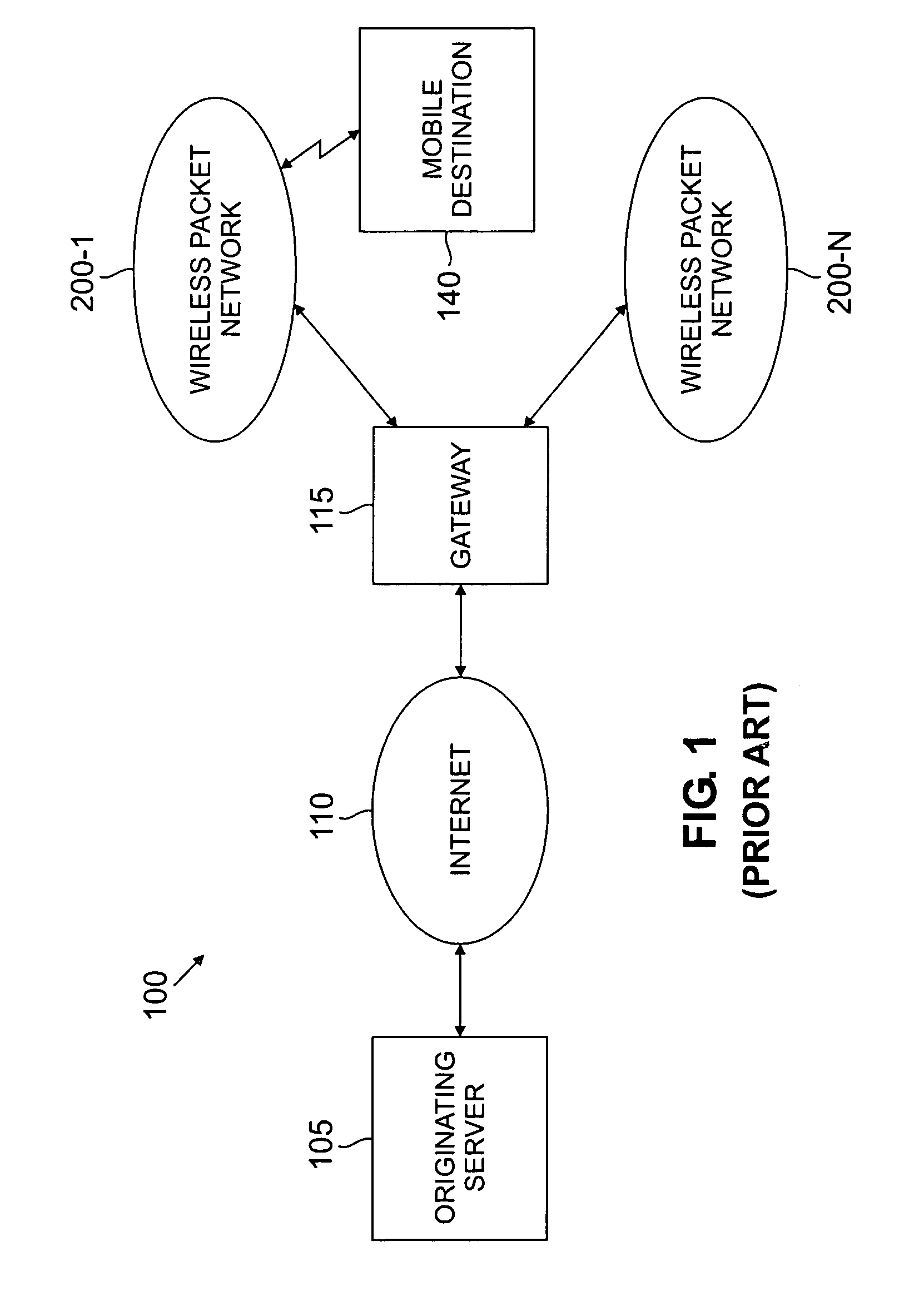
Figure 2 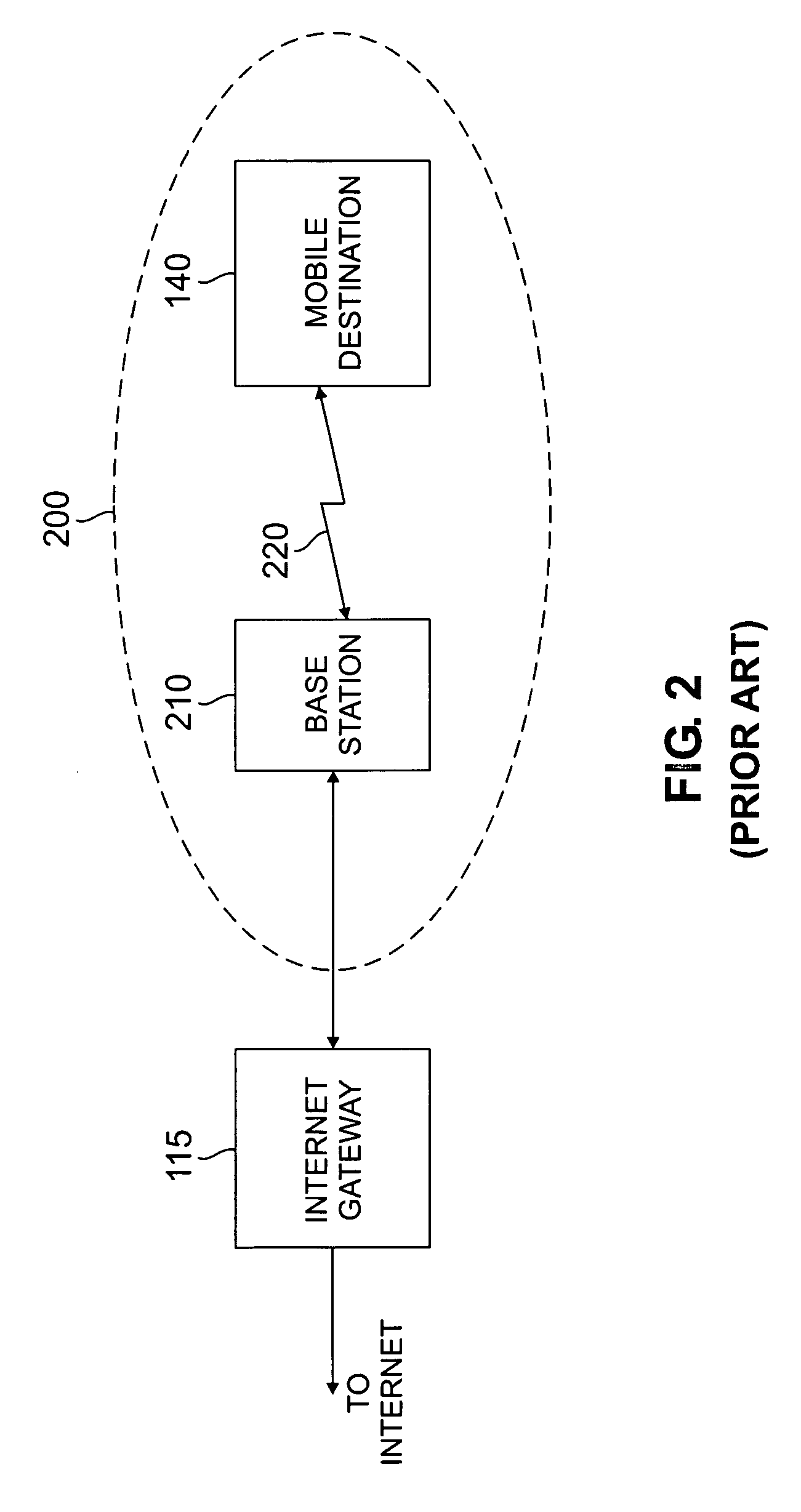
Figure 3
Abstract
Description
CROSS-REFERENCE TO RELATED APPLICATION
[0001] The present invention is related to U.S. patent application Ser. No. 09 / 668,242 entitled “Complete User Datagram Protocol (CUDP) for Wireless Multimedia Packet Networks Using Improved Packet Level Forward Error Correction (FEC) Coding,” filed contemporaneously herewith, assigned to the assignee of the present invention and incorporated by reference herein.FIELD OF THE INVENTION
[0002] The present invention relates generally to wireless packet networks, and more particularly, to methods and apparatus for reducing lost or corrupted packets in such wireless packet networks.BACKGROUND OF THE INVENTION
[0003] It is inevitable that future wireless services will support Internet Protocol (IP)-based multimedia applications. For example, current and emerging wireless networks allow (i) a user to download information from the Internet using a wireless communication device, (ii) Internet-to-mobile or mobile-to-mobile videoconferences, (iii) streaming of ...
Examples
Embodiment Construction
[0020]FIG. 1 illustrates a conventional heterogeneous network environment 100 that supports IP-Wireless data communications. Multimedia packets being sent from an originating server 105, through the Internet 110 and then over one or more wireless packet networks 200-n, shown in further detail in FIG. 2, to the mobile destination 140.
[0021]FIGS. 3A and 3B illustrate the protocol structures for the UMTS / CDMA 2000 standard and the (HDR) proposal respectively. For a more detailed discussion of the protocol structures for the UMTS / CDMA 2000 standard and the Qualcom HDR proposal, see E. Dahlman et al., “UMTS / IMT-2000 Based on Wide Band CDMA”, IEEE Communications Magazine, Vol. 36, No. 9, 70–80 (1998), ETSI UMTS YY.01, YY.02, CDMA2000:TIA / EIA / IS-2000 and P. Bender et al., “CDMA / HDR: A Bandwidth-Efficient High-Speed Wireless Data Services For Nomadic Users”, IEEE Communications Magazine, Vol. 38, No. 7: 70—77, July 2000, incorporated by reference herein. The RLP layer shown in FIGS. 3A and ...