
Non-lethal projectile with flowable payload
a payload and non-lethal technology, applied in the field of non-lethal projectiles, to achieve the effect of reducing the impact pressure, reducing the initial velocity of the projectile, and improving the maximum effective range and precision
Patent Information
- Authority / Receiving Office
- US · United States
- Patent Type
- Patents(United States)
- Current Assignee / Owner
- Publication Date
- 2010-04-06
- Estimated Expiration
- Not applicable · inactive patent
Smart Images
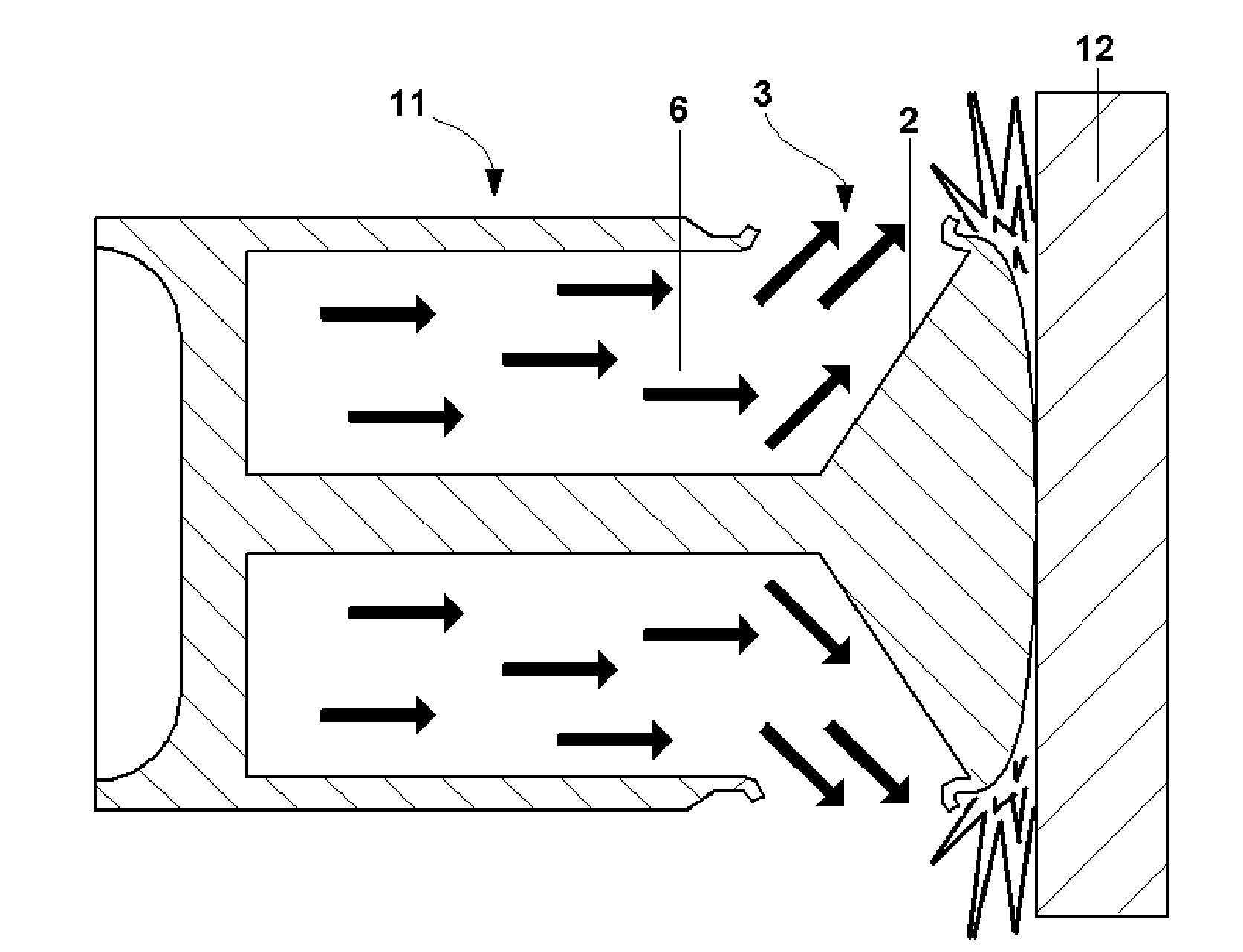
Figure 1 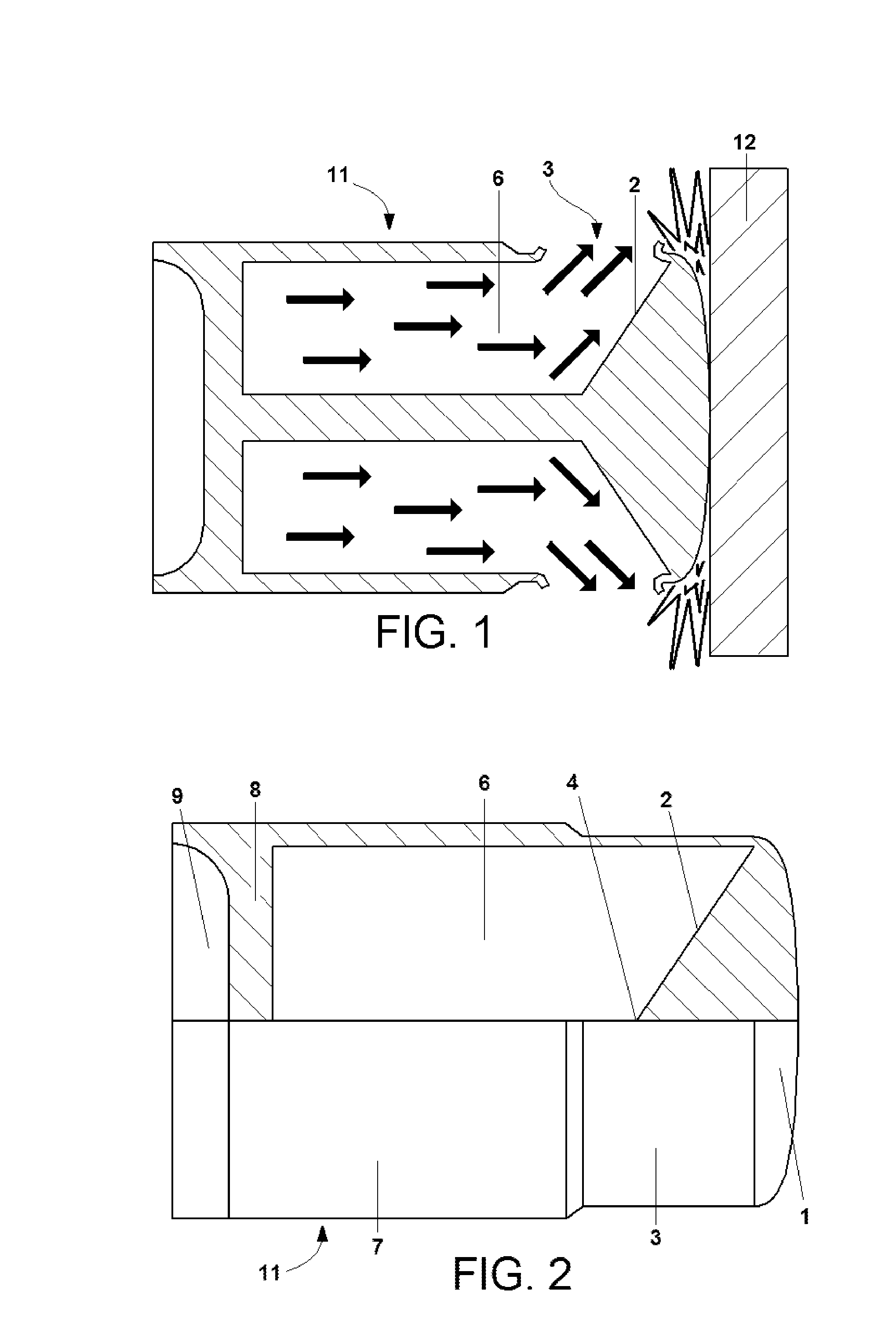
Figure 2 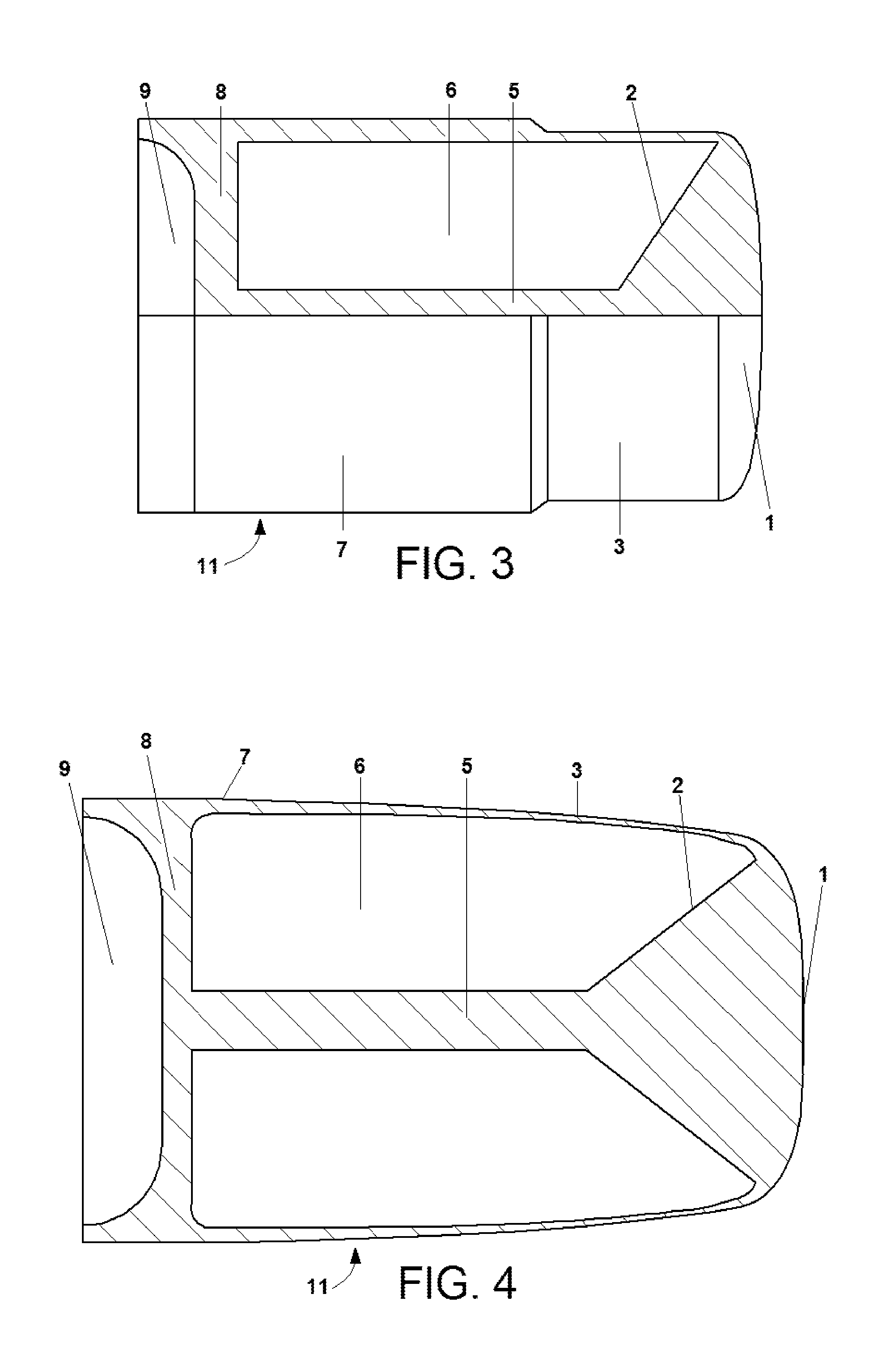
Figure 3
Abstract
Description
BACKGROUND OF THE INVENTION
[0001] The present invention relates to non-lethal projectiles that are filled with a flowable payload and designed to rupture upon impact with a target.
[0002] Non-lethal projectiles containing a flowable payload are basically used in three fields: the field of non-lethal kinetic energy projectiles, the field of non-lethal chemical projectiles and the field of marker projectiles.
[0003] Some projectile geometries were already proposed, trying to overcome simultaneously the following major problems:
[0004] a) keep the projectile's integrity during the feeding and firing procedures;
[0005] b) be stable in flight, hitting nose first;
[0006] c) rupture upon impact, causing controlled damage to the target.
[0007] In the field of non-lethal chemical projectiles, the U.S. Pat. No. 7,194,960 B2 describes a frangible projectile that ruptures upon impact, omnidirectionally dispersing an inhibiting powder payload. The impact creates a cloud of inhibiting powder substance over th...
Examples
Embodiment Construction
[0038]As can be seen in FIG. 1, the projectile of this invention consists of a solid capsule (11) that is filled by a flowable payload (6). When the projectile hits a target (12), the payload (6) is pushed forward by action of inertia. The inertial effect creates a pressure gradient with maximum value close to the point (1). By the effect of this pressure, the weakened area (3) ruptures, allowing the payload (6) to be radially spread out. A hydrodynamic structure (2) forces the radial flow of the payload (6), from the center to the periphery, against the weakened area (3).
[0039]The solid capsule (11) is made to be light weighted, using light structural materials, such as engineering plastics or aluminum alloys. Polyamides have been shown applicable. In opposite, the flowable payload (6) is selected to have the greater density, and consequently the greater total weight, as possible. However, this desirable high density shall not cause an elevation in viscosity that could harm the flo...