
Image recognition apparatus and image recognition method
a recognition apparatus and image recognition technology, applied in image enhancement, image analysis, instruments, etc., can solve the problems of long image recognition process and huge complexity of calculation of similarities, and achieve the effect of robust recognition of images
Patent Information
- Authority / Receiving Office
- US · United States
- Patent Type
- Patents(United States)
- Current Assignee / Owner
- Publication Date
- 2012-08-21
Smart Images
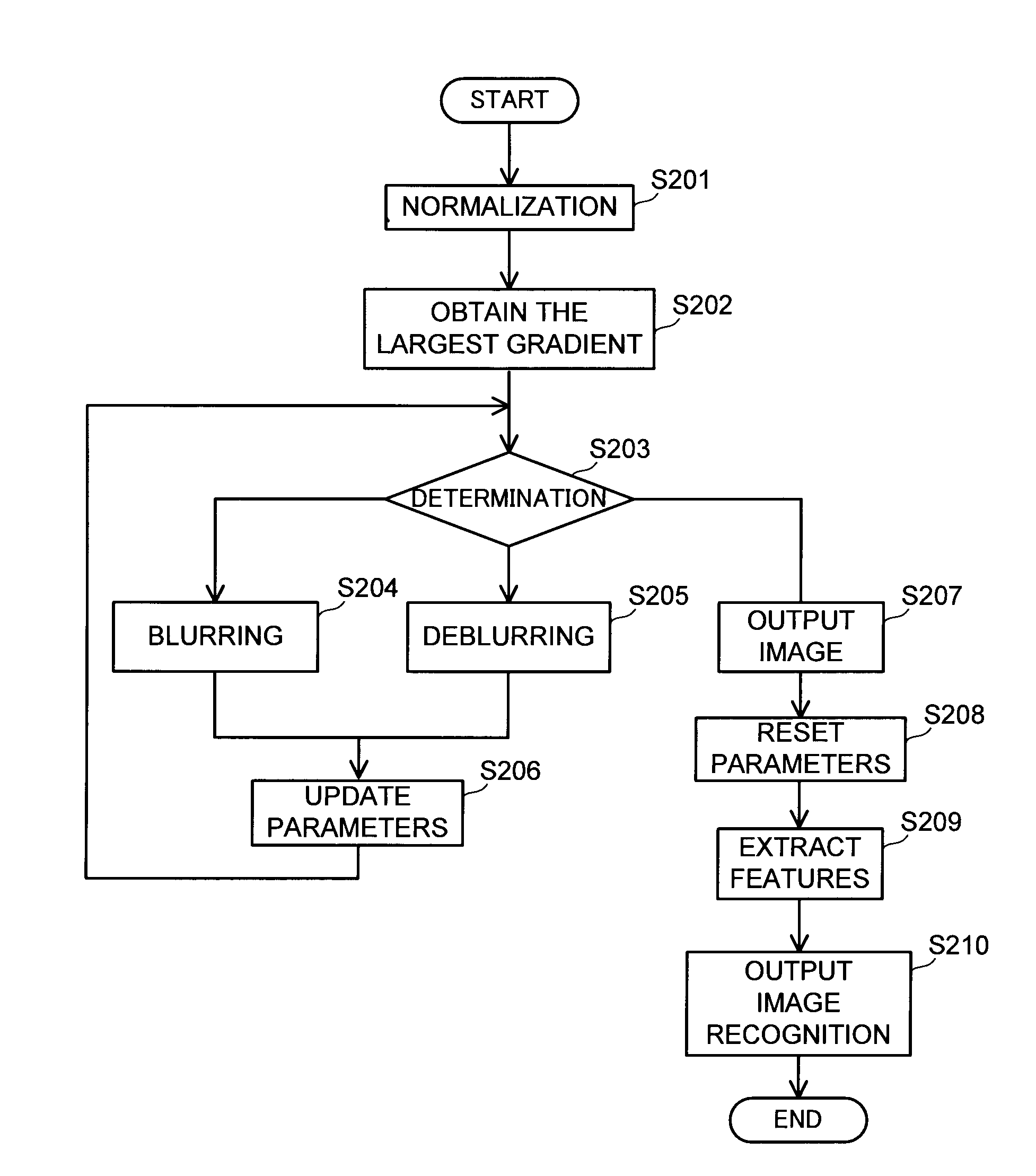
Figure 1 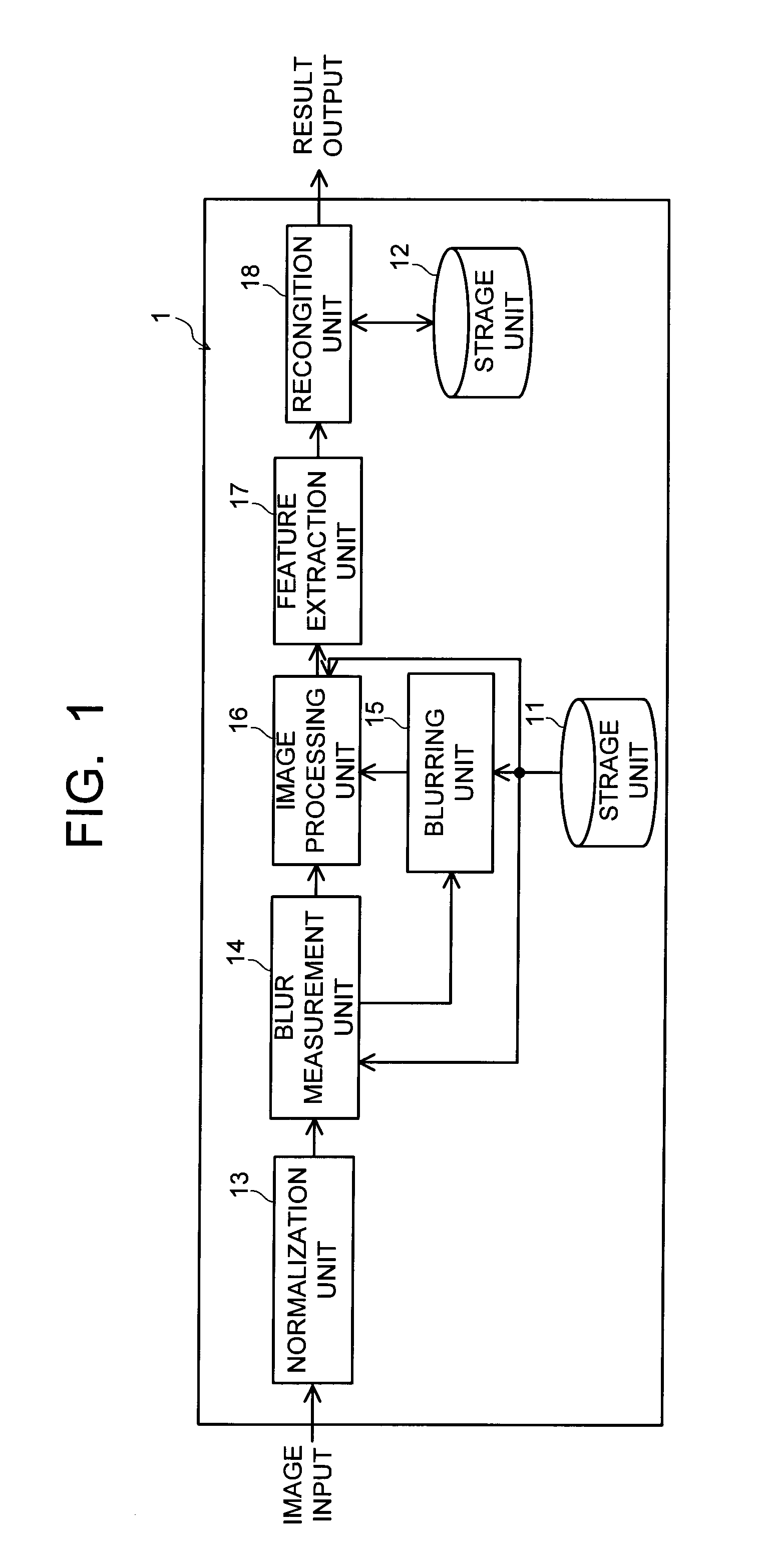
Figure 2 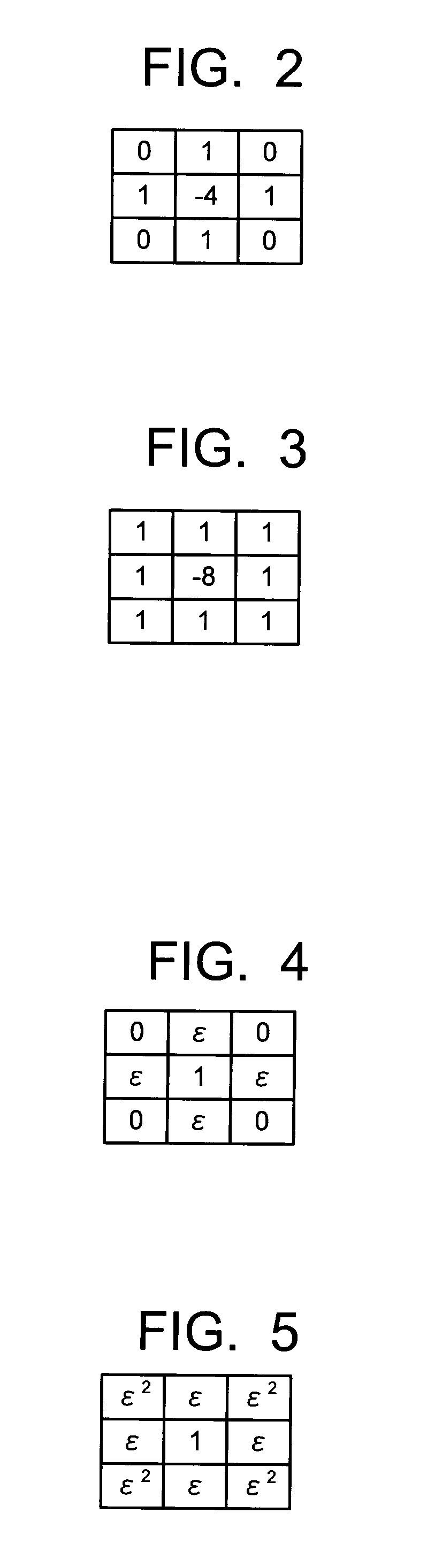
Figure 3
Abstract
Description
CROSS-REFERENCE TO RELATED APPLICATIONS
[0001] This application is based upon and claims the benefit of priority from the prior Japanese Patent Application No. 2009-040770, filed on Feb. 24, 2009; the entire contents of which are incorporated herein by reference.BACKGROUND OF THE INVENTION
[0002] 1. Field of the Invention
[0003] The present invention relates to an image recognition apparatus and an image recognition method which recognizes input images by comparing them with image patterns registered in a dictionary in advance.
[0004] 2. Description of the Related Art
[0005] A conventional image recognition apparatus generates a sampling pattern by performing predetermined processes on an input image and normalizing this image, and thereafter compares similarities between the sampling pattern and plural patterns registered in advance in the storage unit so as to recognize the input image. However, the complexity of the calculation of the similarities is enormous and an image recognition proce...
Examples
first embodiment
(First Embodiment)
[0025]It is known that, in image recognition, a recognition rate of image becomes high rather with moderately blurred images. Accordingly, an image recognition apparatus 1 according to a first embodiment measures the blur level of input images, subjects the image to blurring- or deblurring-processes so that the blur level coincides or approximates the predetermined value, and thereafter recognizes the image. Accordingly, the image recognition apparatus 1 according to the first embodiment is able to robustly recognize images regardless of the quality of the images.
[0026]Hereinafter, using FIG. 1 to FIG. 10, a structure of the image recognition apparatus 1 according to the first embodiment will be described. The image recognition apparatus 1 according to the first embodiment has a storage unit 11, a storage unit 12, a normalization unit 13, a blur measurement unit 14, a blurring unit 15, an image processing unit 16, a feature extraction unit 17 and a recognition unit...
second embodiment
(Second Embodiment)
[0077]In the first embodiment, an embodiment, in which the relation between the blur amount β and the largest absolute gradient M was obtained in advance, and the image is subjected to blurring- or deblurring-processes with the relation, was described. In the second embodiment, an embodiment will be described in which an image is subjected to blurring- or deblurring-processes until the largest absolute gradient M comes within a range calculated in advance by measurement.
[0078]FIG. 12 is a diagram showing an example of a structure of an image recognition apparatus 2 according to a second embodiment. Hereinafter, the image recognition apparatus 2 according to the second embodiment will be described using FIG. 12. The same components as those described with FIG. 1 are designated by the same reference numerals, and overlapping descriptions are omitted. In this second embodiment, the largest absolute gradient M is a parameter representing a blur level.
[0079]The image r...