
Electrolyte and sodium-ion battery
By using specific contents of sodium difluorophosphate and vinylene carbonate electrolyte in sodium ion batteries, the problems of low cycle life and low rate performance of sodium ion batteries are solved, and excellent low-temperature cycle performance, rate performance and first-time Coulomb efficiency are achieved.
Patent Information
- Application Number
- PCT/CN2024/124568
- Authority / Receiving Office
- WO · WO
- Patent Type
- Applications
- Current Assignee / Owner
- Priority Date
- 2023-11-10
- Filing Date
- 2024-10-12
- Publication Date
- 2025-05-15
AI Technical Summary
In actual applications, sodium ion batteries have problems such as low cycle life and low rate performance. Although the vinylene carbonate in the electrolyte can improve the efficiency of the first Coulomb, it will lead to deterioration of cycle performance and poor rate at low temperatures.
An electrolyte solution is developed, which includes a sodium salt main salt, a sodium salt auxiliary salt, an organic solvent and a first additive. The sodium salt auxiliary salt is sodium difluorophosphate, and the first additive is vinyl carbonate. By limiting its mass percentage content, a SEI film with high stability and a specific content of sodium ions and phosphorus elements is formed on the negative electrode surface of the battery, thereby improving the mobility of sodium ions and reducing radicals at active sites.
Significantly improve the low-temperature cycle performance, rate performance and first-time Coulomb efficiency of sodium ion batteries, extend the low-temperature cycle life of the battery, optimize the viscosity of the electrolyte, and improve the adsorption and separation of sodium ions in the negative electrode of the battery.
Smart Images
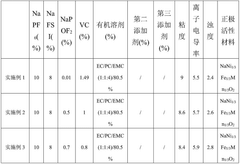
Figure PCTCN2024124568-FTAPPB-I100001 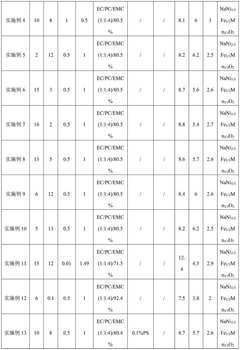
Figure PCTCN2024124568-FTAPPB-I100002 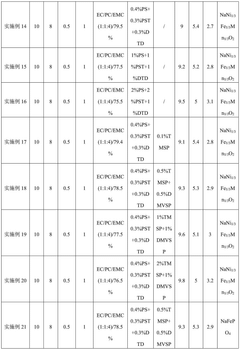
Figure PCTCN2024124568-FTAPPB-I100003
Abstract
Description
Electrolyte and sodium ion battery
[0001] This application claims priority to the Chinese patent application filed with the China Patent Office on November 10, 2023, with application number CN202311497398.X and application name “A kind of electrolyte and sodium ion battery”, the entire contents of which are incorporated by reference into this application. Technical Field
[0002] The present application relates to an electrolyte, and in particular to an electrolyte and a sodium ion battery, belonging to the technical field of sodium ion batteries. Background Art
[0003] Lithium-ion batteries (LIBs) are widely used in consumer electronics, electric vehicles, and energy storage due to their high energy density and excellent cycle performance. However, rising lithium salt prices have limited the development of LIBs due to their limited availability. Sodium, an element in the same main group as lithium, possesses very similar physical and chemical properties. Furthermore, sodium is more abundant on Earth than lithium and is less expensive, making it a promising candidate for large-scale energy storage. To date, research on NIBs has garnered widespread attention in both academia and industry.
[0004] However, sodium-ion batteries still face several challenges in practical applications, such as low cycle life and poor rate performance. Therefore, improving the performance of sodium-ion batteries is particularly important. In sodium-ion battery systems, vinylene carbonate in the electrolyte improves the battery's initial coulombic efficiency, 1C capacity, and initial DCR to a certain extent, but it also leads to degraded cycle performance at low temperatures and poor rate performance.
[0005] Based on the above shortcomings, it is necessary to develop an electrolyte that significantly improves the electrical performance of sodium ion batteries.
[0006] Summary of the Invention
[0007] The present application provides an electrolyte, which enables a battery to have excellent low-temperature cycle performance, rate performance and first coulombic efficiency.
[0008] The present application provides a sodium ion battery, which includes the above-mentioned electrolyte and has the advantages of long low-temperature cycle life, high rate performance and high first coulombic efficiency.
[0009] The present application provides an electrolyte, comprising a sodium salt main salt, a sodium salt auxiliary salt, an organic solvent, and a first additive; the sodium salt auxiliary salt comprises sodium difluorophosphate; the first additive comprises vinylene carbonate;
[0010] The mass percentage of the sodium salt auxiliary salt in the electrolyte is 0.01% to 1%; the mass percentage of the vinylene carbonate in the electrolyte is 0.5% to 3%.
[0011] As mentioned above, the sodium salt main salt includes sodium hexafluorophosphate and sodium bis(fluorosulfonyl)imide.
[0012] As mentioned above, the mass percentage of the sodium hexafluorophosphate in the electrolyte is 2% to 15%; and / or,
[0013] The mass percentage of the sodium bis(fluorosulfonyl)imide in the electrolyte is 1% to 12%.
[0014] As described above, the organic solvent includes at least one of carbonate, fluorocarbon, carboxylate, fluorocarboxylate, ether and fluoroether.
[0015] As mentioned above, the mass percentage of the organic solvent in the electrolyte is 10% to 90%.
[0016] As described above, at 0°C, the viscosity of the electrolyte is 7-12 mPa·s, and the ion conductivity is 4-7 mS / cm; at -40-45°C, the turbidity of the electrolyte is not higher than 5 NTU.
[0017] As described above, the electrolyte further includes a second additive, which includes at least one of 1,3-propane sultone, 1,3-propylene sultone and vinyl sulfate; the mass percentage of the second additive in the electrolyte is 0.1% to 3%.
[0018] As described above, the electrolyte further includes a third additive, which includes a silane phosphate additive, and the silane phosphate additive includes tris(trimethylsilane) phosphate and / or tris(vinyl-dimethylsilane) phosphate; the mass percentage of the third additive in the electrolyte is 0.1% to 2%.
[0019] The present application also includes a battery with the electrolyte as described above.
[0020] As mentioned above, the positive electrode active material of the positive electrode sheet in the sodium ion battery is a ternary layered sodium-based material.
[0021] The electrolyte provided in the present application limits the selection of the sodium salt auxiliary salt and the first additive in the electrolyte, and at the same time limits the mass percentage of each of the sodium salt auxiliary salt and the first additive, so that a SEI film with high stability and a specific content of sodium ions and phosphorus elements is formed on the surface of the battery negative electrode, thereby improving the mobility of sodium ions and reducing active site free radicals in the electrolyte, while optimizing the viscosity of the electrolyte, improving the adsorption and separation of sodium ions in the battery negative electrode, and thereby improving the low-temperature cycle performance, rate performance and first coulombic efficiency of the battery.
[0022] The sodium ion battery of the present application is prepared based on the electrolyte as described above. The SEI film formed after the battery undergoes the formation stage has high stability and low impedance, so that the battery has excellent low-temperature cycle performance, rate performance and first coulombic efficiency. DETAILED DESCRIPTION
[0023] To make the purpose, technical solutions, and advantages of this application more clear, the technical solutions in the embodiments of this application will be clearly and completely described below in conjunction with the embodiments of this application. Obviously, the described embodiments are part of the embodiments of this application, not all of the embodiments. Based on the embodiments of this application, all other embodiments obtained by ordinary technicians in this field without making creative efforts are within the scope of protection of this application.
[0024] In a first aspect, the present application provides an electrolyte solution comprising a sodium salt main salt, a sodium salt auxiliary salt, an organic solvent, and a first additive; the sodium salt auxiliary salt comprises sodium difluorophosphate; the first additive comprises vinylene carbonate;
[0025] The mass percentage of the sodium salt auxiliary salt in the electrolyte is 0.01% to 1%; the mass percentage of the vinylene carbonate in the electrolyte is 0.5% to 3%.
[0026] The electrolyte of the present application includes a sodium salt main salt, a sodium salt auxiliary salt, and an organic solvent, wherein the organic solvent is used to dissolve the sodium salt to prepare an electrolyte with high conductivity. The sodium salt main salt can be a sodium salt commonly found in the art, such as sodium hexafluorophosphate, sodium bis(fluorosulfonyl)imide, sodium bis(oxalatoborate), and sodium difluorooxalatoborate, etc. This application does not make too many choices.
[0027] It is worth noting that the working mechanism of sodium ion batteries is different from that of lithium ion batteries. The working mechanism of sodium ion batteries is: during the charge and discharge process, sodium ions are divided into two parts to work, one part of the sodium ions is embedded and extracted on the positive and negative electrodes, and the other part of the sodium ions is adsorbed and separated on the negative electrode. In the electrolyte of the present application, vinylene carbonate is a film-forming additive that can form a passivation film on the surface of the negative electrode of the battery, reducing the consumption of irreversible sodium ions in the battery, thereby improving the initial coulombic efficiency of the battery. However, the applicant found that under low temperature conditions, the SEI film formed by vinylene carbonate on the surface of the negative electrode will hinder the migration of sodium ions, resulting in an increase in the internal resistance of the sodium ion battery, thereby reducing the low-temperature cycle performance and rate performance of the sodium ion battery. At the same time, the addition of vinylene carbonate will increase the viscosity of the electrolyte. Under low temperature conditions, the viscosity of the electrolyte is further increased, which has a stronger blocking effect on sodium ions with a large radius, which is not conducive to the adsorption and separation of sodium ions in the negative electrode of the battery, thereby deteriorating the low-temperature cycle performance and rate performance of the battery.
[0028] According to the above scheme provided by the present application, after the electrolyte is applied to the sodium ion battery, the sodium ion battery has excellent low-temperature cycle performance, rate performance and first coulombic efficiency compared to the case of adding vinylene carbonate alone. The applicant analyzed this principle and believed that the reason may be that when the mass percentage of vinylene carbonate and sodium difluorophosphate is within the above range, on the one hand, sodium difluorophosphate can form a sufficiently stable SEI film with suitable sodium ion and phosphorus content on the surface of the battery negative electrode together with vinylene carbonate, which can effectively reduce the irreversible migration of sodium ions in the battery, and effectively reduce the transmission resistance of sodium ions in a low-temperature environment, increase the migration rate of sodium ions in the SEI film, and significantly reduce the active site free radicals in the electrolyte, reducing the negative impact caused by the active site free radicals, thereby obtaining a battery with excellent low-temperature cycle performance, rate performance and first coulombic efficiency; on the other hand, the viscosity of the electrolyte can be optimized, improving the adsorption and separation of sodium ions in the battery negative electrode, thereby improving the low-temperature cycle performance of the battery.
[0029] The main sodium salt of the present application includes sodium hexafluorophosphate and sodium bis(fluorosulfonyl)imide. Sodium hexafluorophosphate, as an ion transport medium, can help sodium ion batteries to carry out charge and discharge reactions, and sodium hexafluorophosphate has the function of stabilizing the battery electrolyte, so that the sodium ion battery has excellent electrochemical properties. Sodium bis(fluorosulfonyl)imide has high solubility and high dissociation constant, which can improve the kinetic properties of the electrolyte, thereby improving the electrochemical performance of the battery, and sodium bis(fluorosulfonyl)imide in the electrolyte can be partially decomposed, thereby introducing components such as sodium nitride, sodium sulfate and sodium fluoride into the SEI membrane or CEI membrane, reducing electrode interface polarization, improving the stability of the SEI membrane or CEI membrane, and making the sodium ion battery exhibit excellent high-temperature cycle performance.
[0030] In a specific embodiment, the mass percentage of sodium hexafluorophosphate in the electrolyte is 2% to 15%; and / or the mass percentage of sodium bisfluorosulfonyl imide in the electrolyte is 1% to 12%, that is, every 100 grams of electrolyte includes 2g to 15g of sodium hexafluorophosphate and / or 1g to 12g of sodium bisfluorosulfonyl imide, which can be specifically selected from 2% sodium hexafluorophosphate and / or 1% sodium bisfluorosulfonyl imide, 5% sodium hexafluorophosphate and / or 4% sodium bisfluorosulfonyl imide, 10% sodium hexafluorophosphate and / or 8% sodium bisfluorosulfonyl imide, 15% sodium hexafluorophosphate and / or 12% sodium bisfluorosulfonyl imide or a range consisting of any two of them. When the mass percentages of sodium hexafluorophosphate and sodium bisfluorosulfonyl imide are respectively within the above ranges, sodium hexafluorophosphate can be fully dissolved in the organic solvent to form an electrolyte with more stable chemical properties and higher conductivity, thereby enabling the sodium ion battery to exhibit better electrochemical performance; sodium bisfluorosulfonyl imide can enhance the kinetic performance of the electrolyte and reduce electrode interface polarization to a greater extent, thereby obtaining a sodium ion battery with higher high-temperature cycle performance.
[0031] The organic solvent of the present application includes at least one of carbonates, fluorocarbons, carboxylates, fluorocarboxylates, ethers, and fluoroethers. These solvents can dissolve sodium salts to prepare chemically stable and highly conductive electrolytes, thereby enabling sodium-ion batteries to exhibit excellent electrochemical performance.
[0032] In one embodiment, the organic solvent content in the electrolyte is 10% to 90% by weight, i.e., 10g to 90g of organic solvent is included in every 100g of electrolyte. Specifically, the organic solvent content can be selected from the range of 10%, 30%, 60%, 90%, or any two thereof. Limiting the organic solvent content by weight within the above range not only avoids excessive electrolyte viscosity that reduces sodium ion mobility, but also ensures higher electrolyte conductivity, resulting in better low-temperature cycling performance and rate performance of the battery.
[0033] In a specific embodiment, at 0°C, the viscosity of the electrolyte is 7 to 12 mPa·s, and the ionic conductivity is 4 to 7 mS / cm; at -40 to 45°C, the turbidity of the electrolyte is not higher than 5 NTU. Specifically, the electrolyte in the present application is subjected to viscosity and conductivity tests at 0°C, and the viscosity of the electrolyte is 7 to 12 mPa·s, and the ionic conductivity is 4 to 7 mS / cm; the scattering method turbidity test is performed at -40 to 45°C, and the turbidity of the electrolyte is not higher than 5 NTU. When the viscosity and ionic conductivity of the electrolyte at 0°C are respectively within the above ranges, and the turbidity of the electrolyte at -40 to 45°C is not higher than 5 NTU, it ensures that the transport performance of sodium ions in the electrolyte is better under low temperature conditions, so that the low-temperature cycle performance and rate performance of the battery are better. The viscosity, ionic conductivity and stable state of the electrolyte in the present application can be achieved according to the scheme provided in the present application. Specifically, the electrolyte with specific viscosity, ionic conductivity and stable state is obtained by the combined action of the above-mentioned specific mass percentages of sodium hexafluorophosphate, sodium bis(fluorosulfonyl)imide, sodium difluorophosphate, vinylene carbonate and organic solvent.
[0034] The electrolyte of the present application also includes a second additive, which includes at least one of 1,3-propane sultone, 1,3-propylene sultone, and vinyl sulfate. In one specific embodiment, the mass percentage of the second additive in the electrolyte is 0.1% to 3%, that is, 0.1g to 3g of the second additive is included in every 100g of electrolyte, and can be specifically selected from the range of 0.1%, 1%, 3%, or any two thereof. Because 1,3-propane sultone and propenyl-1,3 sultone contain sulfonic acid groups, they can decompose to produce slightly acidic decomposition products, which appropriately neutralize the weak alkalinity brought by the bisfluorosulfonyl imide groups in the electrolyte, reducing the deterioration effect of the weak alkalinity on the battery during high-temperature storage. It can also form a stable passivation film on the surface of the positive electrode material, preventing the oxidative decomposition of the electrolyte on the positive electrode surface, inhibiting the dissolution of transition metal ions in the positive electrode material, and improving the stability of the positive electrode material structure and interface, thereby improving the high-temperature cycle performance and high-temperature storage performance of the battery. Ethylene sulfate decomposes on the surface of the graphite negative electrode to form an organic sulfonate with excellent ionic conductivity. This reduces interfacial impedance, inhibits the decline in the battery's initial capacity, increases the initial discharge capacity, and reduces battery expansion after high-temperature storage, thereby improving the battery's rate capability and high-temperature performance. Controlling the mass percentage of the second additive within the above range can further suppress battery gassing, resulting in a battery with improved high-temperature performance.
[0035] The electrolyte of the present application also includes a third additive, which includes a silane phosphate additive, specifically tris(trimethylsilane) phosphate and / or tris(vinyl-dimethylsilane) phosphate. In a specific embodiment, the mass percentage of the third additive in the electrolyte is 0.1% to 2%, that is, every 100 grams of electrolyte includes 0.1g to 2g of the third additive, specifically selected from the range of 0.1%, 1%, 2% or any two thereof. These silane phosphate additives are improved high-temperature additives that can be preferentially reduced to form a film on the surface of the negative electrode before the solvent is reduced, effectively preventing the reduction and decomposition of the electrolyte on the surface of the negative electrode, thereby effectively suppressing the problem of gas production during storage of the battery at high temperature, and can reduce the transmission impedance of sodium ions in the SEI film during charge and discharge, forming a low-impedance interface film, thereby improving the high-temperature cycle performance and high-temperature storage performance of the battery. When the mass percentage of the third additive is within the above range, the third additive can suppress the gas production problem during high-temperature storage of the battery to a greater extent, and further reduce the impedance of the SEI film, thereby further improving the high-temperature cycle performance and high-temperature storage performance of the battery.
[0036] The present application does not limit the preparation method of the electrolyte. In a specific embodiment, it is sufficient to mix the sodium salt, sodium difluorophosphate, organic solvent and vinylene carbonate in a specified ratio.
[0037] Furthermore, when the electrolyte further includes a second additive and a third additive, sodium hexafluorophosphate, sodium bis(fluorosulfonyl)imide, sodium difluorophosphate, an organic solvent, vinylene carbonate, the second additive and the third additive are mixed in a prescribed ratio.
[0038] In a second aspect, the present application provides a sodium ion battery comprising the aforementioned electrolyte. Based on the electrolyte provided herein, the battery provided herein has excellent low-temperature cycling performance, rate performance, initial coulombic efficiency, high-temperature cycling performance, and high-temperature storage performance.
[0039] In a specific embodiment, the positive electrode active material of the positive electrode sheet in the sodium ion battery is a ternary layered sodium-based material. The positive electrode sheet includes a positive electrode current collector and a positive electrode active material layer arranged on the surface of the positive electrode current collector. The positive electrode active material layer includes a positive electrode active material, a conductive agent and a binder. The positive electrode current collector is generally an aluminum foil, and the positive electrode active material is a ternary layered sodium-based material. This application does not specifically limit the ternary layered sodium-based material, such as NaNi 1 / 3 Fe 1 / 3 Mn 1 / 3 O2、NaNi 1 / 3 Mn 1 / 3 Co 1 / 3 O2(NMC), Na3V2(PO4)3(NMN), Na 0.9 Mn0.6 Fe 0.4 PO4 (NMFP), sodium ferric pyrophosphate Na4Fe3 (PO4) 2 (P2O7) and sodium ferrocyanide. It can be understood that the above electrolyte is applied to a sodium ion battery including a ternary layered sodium-based material as the positive electrode active material, so that the various components in the electrolyte and the ternary layered sodium-based material act synergistically, thereby improving the stability of the ternary layered sodium-based material, inhibiting the dissolution of transition metals and oxygen precipitation in the sodium-based material, and at the same time inhibiting the acid corrosion of the positive electrode oxide material by HF generated by the decomposition of the electrolyte, improving the crystal structure stability of the ternary layered sodium-based material, and making the battery have better low-temperature cycle performance, rate performance, first coulombic efficiency, high-temperature cycle performance and high-temperature storage performance.
[0040] In a specific embodiment, in addition to the electrolyte provided in the first aspect of the present application and the ternary layered sodium-based material provided in the second aspect, the electrolyte further includes a negative electrode sheet and a separator, specifically:
[0041] The negative electrode sheet includes a negative electrode current collector and a negative electrode active material layer arranged on the surface of the negative electrode current collector. The negative electrode active material layer includes a negative electrode active material, a conductive agent and a binder. Among them, the negative electrode current collector is generally copper foil, and the negative electrode active material is selected from one or more of carbonaceous materials, silicon-carbon materials, alloy materials, and sodium-containing metal composite oxides.
[0042] The conductive agent and the binder in the positive electrode active material layer and the negative electrode active material layer can be conventional materials in the art.
[0043] The separator is a separator known in the art that can be used in batteries and is stable to the electrolyte used. It can include one or more of polyolefin, aromatic polyamide, polytetrafluoroethylene, and polyethersulfone, and can be specifically configured as needed.
[0044] Hereinafter, the present application will be further described in detail through specific embodiments.
[0045] Example 1
[0046] The electrolyte provided in this embodiment includes, by mass percentage, sodium salt, organic solvent and additives, wherein the sodium salt includes 10% sodium hexafluorophosphate (NaPF6), 8% sodium bis(fluorosulfonyl)imide (NaFSI) and 0.01% sodium difluorophosphate (NaPOF2); the organic solvent includes 13.42% ethylene carbonate (EC), 13.42% propylene carbonate (PC) and 53.66% ethyl methyl carbonate (EMC); and the additive includes 1.49% vinylene carbonate (VC).
[0047] In an argon-filled glove box, the organic solvents were mixed, additives were added sequentially, and then sodium salt was added and stirred to form a sodium-ion battery electrolyte. Viscosity and conductivity tests of the electrolyte revealed a viscosity of 9 mPa·s and a conductivity of 5.5 mS / cm.
[0048] The positive electrode active material NaNi 1 / 3 Fe 1 / 3 Mn 1 / 3 O2 powder, conductive agent acetylene black, carbon nanotubes and binder (polyvinylidene fluoride) PVDF are dispersed in the solvent NMP in a mass ratio of 95:2:1:2 to obtain a positive electrode active material layer slurry; the positive electrode active material layer slurry is evenly coated on the surface of the positive electrode current collector aluminum foil, and after drying, rolling, baking, slitting and spot welding of the pole ears, the positive electrode sheet is obtained. The total thickness of the positive electrode sheet is 134μm.
[0049] The negative electrode active material hard carbon, the conductive agent conductive carbon black super-p, the binder SBR, and the thickener hydroxymethyl cellulose (CMC) are dispersed in deionized water in a mass ratio of 95:1.5:2:1.5, and stirred evenly to obtain the negative electrode active material layer slurry; the negative electrode active material layer slurry is evenly coated on the surface of the negative electrode current collector aluminum foil, and the negative electrode sheet is obtained after drying, rolling, baking, slitting and spot welding of the electrode ears. The total thickness of the negative electrode sheet is 150μm.
[0050] The prepared positive electrode sheet, negative electrode sheet and 16μm three-layer separator are stacked in order, and the separator is placed between the positive electrode sheet and the negative electrode sheet. After winding, the wound body is flattened and placed in an aluminum-plastic film packaging bag. It is vacuum-baked at 75°C for 48 hours to obtain a battery cell to be filled with liquid. The above-mentioned electrolyte is then injected into the battery cell in a glove box. After packaging, formation, aging and capacity separation, the preparation of the sodium ion battery is completed.
[0051] The electrolytes and sodium ion batteries provided in Examples 2 to 21 and Comparative Examples 1 to 6 are substantially the same as those in Example 1, with the differences shown in Table 1.
[0052] Table 1 Composition of the electrolytes and positive electrode active materials provided in Examples 1 to 21 and Comparative Examples 1 to 6
[0053] The sodium ion batteries prepared in Examples 1 to 21 and Comparative Examples 1 to 6 were subjected to the following battery performance tests, and the test method was as follows:
[0054] First coulombic efficiency: Charge the sodium ion battery with a constant current of 0.1C at room temperature for 390 minutes, record the charge capacity C1, and then age it for 24 hours before performing a second seal. Charge the second-sealed battery with a constant current and constant voltage of 0.2C to 3.8V, with a cut-off current of 0.05C, and record the charge capacity as C2. Then discharge it with a constant current of 0.2C to 2.0V, and record the discharge capacity as C3. Then charge it with a constant current and constant voltage of 0.5C to 3.8V, with a cut-off current of 0.05C, and discharge it with a constant current of 0.5C to 2.0V. Then charge it with a constant current and constant voltage of 1C to 3.8V, with a cut-off current of 0.05C, and discharge it with a constant current of 1C to 2.0V. Repeat the 1C charge and discharge cycle for 5 times, take the last discharge capacity to obtain the 1C capacity value C4, and record the first coulombic efficiency η1 = C3 / (C1+C2)*100%.
[0055] Rate performance test: At 25°C, charge the battery at a constant current of 2C to 3.8V, then charge at a constant voltage of 3.8V to a cutoff current of 0.05C. The battery is then left for 10 minutes. The battery is then discharged at a constant current of 2C to 2.0V. The discharge capacity is recorded as C5. After a 10-minute rest, the charge and discharge steps are repeated. The capacity discharged at a current of 5C is recorded as C6. The discharge retention ratios at the 2C and 5C rates are recorded as η2 = C5 / C4*100% and η3 = C6 / C4*100%.
[0056] Low-temperature cycle performance test: At an ambient temperature of 0°C, after standing for 4 hours, the battery is charged to 3.8V at a constant current and constant voltage of 0.2C, with a cut-off current of 0.05C. After the battery is left for 10 minutes, it is discharged to 2.0V at a constant current of 0.5C. The discharge capacity is recorded as C7. The charge and discharge steps are repeated until 200 cycles are completed. The discharge capacity after 200 cycles is recorded as C8. The corresponding cycle retention rate η4 = C8 / C7*100%, see Table 2.
[0057] High temperature cycle performance test: At 45°C, the battery is subjected to a 1C / 1C cycle test: At an ambient temperature of 45°C, after standing for 4 hours, the battery is charged to 3.8V at a constant current and constant voltage of 1C, with a cut-off current of 0.05C. After the battery is left for 10 minutes, it is discharged to 2.0V at a constant current of 1C. The discharge capacity is recorded as C9. The charge and discharge steps are repeated until the cycle is 500 cycles, and the discharge capacity is recorded as C 10 , high temperature cycle capacity retention rate η5=C 10 / C9*100%, see Table 2.
[0058] High temperature storage performance test: The battery was transferred to a high temperature of 60°C and placed for 14 days. After 14 days, it was discharged at a constant current of 1C at room temperature of 25°C. The discharge capacity was recorded as C 11 . 60℃ capacity retention rate η6=C 11 / C4*100%, see Table 2. The test results are shown in Table 2.
[0059] Table 2 Performance test results of sodium ion batteries prepared in Examples 1 to 21 and Comparative Examples 1 to 6
[0060] As shown in Table 2, when the sodium salt auxiliary salt includes sodium difluorophosphate and the first additive includes vinylene carbonate, the mass percentage of the sodium salt auxiliary salt in the electrolyte is 0.01% to 1% and the mass percentage of vinylene carbonate is 0.5% to 3%, the low temperature cycle performance, rate performance and first coulombic efficiency of the battery are improved. When the mass percentage of sodium hexafluorophosphate in the electrolyte is 2% to 15%, the first coulombic efficiency of the battery is improved. When the content of sodium bis(fluorosulfonyl)imide in the electrolyte is 1% to 12%, the low-temperature cycle performance, rate performance, first coulombic efficiency, high-temperature cycle performance and high-temperature storage performance of the battery are improved. When the viscosity of the electrolyte is 7 to 12 mPa·s at 0°C, the low-temperature cycle performance, rate performance, first coulombic efficiency, high-temperature cycle performance and high-temperature storage performance of the battery are improved. When the viscosity of the electrolyte is 7 to 12 mPa·s at 0°C, the low-temperature cycle performance, rate performance, first coulombic efficiency, high-temperature cycle performance and high-temperature storage performance of the battery are improved. The rate, high-temperature cycle performance and high-temperature storage performance are all improved; according to Example 12, when the ionic conductivity of the electrolyte is 4-7 mS / cm at 0°C, the low-temperature cycle performance, rate performance, first coulombic efficiency, high-temperature cycle performance and high-temperature storage performance of the battery are better; according to Examples 2, 13-16, when the mass percentage of the second additive in the electrolyte is 0.1%-3%, the low-temperature cycle performance, rate performance, first coulombic efficiency, high-temperature cycle performance and high-temperature storage performance of the battery are better; according to the comparison of Examples 14, 17-20, when the mass percentage of the third additive in the electrolyte is 0.1%-2%, it is helpful to improve the low-temperature cycle performance, rate performance, first coulombic efficiency, high-temperature cycle performance and high-temperature storage performance of the battery; according to the comparison of Examples 18 and 21, when the positive electrode active material in the sodium ion battery is a ternary layered sodium-based material, the low-temperature cycle performance, rate performance, first coulombic efficiency, high-temperature cycle performance and high-temperature storage performance of the battery are better. In summary, the electrolyte provided in this application can significantly improve the low-temperature cycle performance, rate performance, first coulombic efficiency, high-temperature cycle performance and high-temperature storage performance of sodium-ion batteries.
[0061] Finally, it should be noted that the above embodiments are only used to illustrate the technical solutions of the present application, rather than to limit them. Although the present application has been described in detail with reference to the aforementioned embodiments, those skilled in the art should understand that they can still modify the technical solutions described in the aforementioned embodiments, or make equivalent replacements for some or all of the technical features therein. These modifications or replacements do not deviate the essence of the corresponding technical solutions from the scope of the technical solutions of the embodiments of the present application.
Claims
1. An electrolyte, wherein It includes a sodium salt main salt, a sodium salt auxiliary salt, an organic solvent and a first additive; the sodium salt auxiliary salt includes sodium difluorophosphate; the first additive includes vinylene carbonate; The mass percentage of the sodium salt auxiliary salt in the electrolyte is 0.01% to 1%; the mass percentage of the vinylene carbonate in the electrolyte is 0.5% to 3%.
2. The electrolyte according to claim 1, wherein The sodium salt main salt includes sodium hexafluorophosphate and sodium bis(fluorosulfonyl)imide.
3. The electrolyte according to claim 2, wherein The mass percentage of the sodium hexafluorophosphate in the electrolyte is 2% to 15%.
4. The electrolyte according to claim 2, wherein The mass percentage of the sodium bis(fluorosulfonyl)imide in the electrolyte is 1% to 12%.
5. The electrolyte according to claim 1, wherein The organic solvent includes at least one of carbonate, fluorocarbon, carboxylate, fluorocarboxylate, ether and fluoroether.
6. The electrolyte according to claim 5, wherein The mass percentage of the organic solvent in the electrolyte is 10% to 90%.
7. The electrolyte according to claim 6, wherein At 0° C., the viscosity of the electrolyte is 7 to 12 mPa·s, and the ion conductivity is 4 to 7 mS / cm; at -40 to 45° C., the turbidity of the electrolyte is not higher than 5 NTU.
8. The electrolyte according to claim 1, wherein Also included is a second additive including at least one of 1,3-propane sultone, 1,3-propene sultone, and vinyl sulfate.
9. The electrolyte according to claim 8, wherein The mass percentage of the second additive in the electrolyte is 0.1% to 3%.
10. The electrolyte according to claim 1, wherein The invention also includes a third additive, wherein the third additive includes a silane phosphate additive, and the silane phosphate additive includes tris(trimethylsilane) phosphate and / or tris(vinyl-dimethylsilane) phosphate.
11. The electrolyte according to claim 10, wherein The mass percentage of the third additive in the electrolyte is 0.1% to 2%.
12. A sodium ion battery, wherein: The electrolyte comprising any one of claims 1 to 11.
13. The sodium ion battery according to claim 12, wherein: The positive electrode active material of the positive electrode sheet in the sodium ion battery is a ternary layered sodium-based material.
Citation Information
Patent Citations
Functional electrolyte additive, battery electrolyte and sodium ion battery
CN114122513A
Electrolyte based on phosphorus-oxygen nitrogen-containing heterocyclic compound and sodium ion battery
CN116646602A
Electrolyte and sodium ion battery
CN116885278A
Non-aqueous electrolyte and secondary battery thereof
CN116914257A
Electrolyte and sodium ion battery
CN117393859A
Cited By
High-voltage electrolyte and lithium ion battery
CN122532402A