Benchmarking Thermopile Performance in High-Temperature Zones
SEP 10, 202510 MIN READ
Generate Your Research Report Instantly with AI Agent
PatSnap Eureka helps you evaluate technical feasibility & market potential.
Thermopile Technology Background and Objectives
Thermopile technology has evolved significantly since its inception in the early 19th century, based on the Seebeck effect discovered by Thomas Johann Seebeck in 1821. This thermoelectric phenomenon, where temperature differences between two dissimilar electrical conductors produce a voltage difference, forms the fundamental operating principle of thermopiles. The development trajectory has progressed from simple metal-based thermocouples to advanced semiconductor-based devices with enhanced sensitivity and performance characteristics.
In recent decades, thermopile technology has gained substantial traction in various industrial applications, particularly in environments requiring non-contact temperature measurement and thermal energy harvesting. The evolution has been marked by continuous improvements in material science, manufacturing techniques, and integration capabilities, enabling thermopiles to operate in increasingly challenging conditions.
High-temperature environments present unique challenges for thermopile performance, as traditional semiconductor materials often exhibit degraded performance or complete failure when exposed to extreme thermal conditions. The temperature threshold for conventional silicon-based thermopiles typically ranges from 125°C to 200°C, beyond which performance deteriorates significantly. This limitation has driven research toward novel materials and structural designs capable of maintaining measurement accuracy and reliability in high-temperature zones.
The primary technical objective of benchmarking thermopile performance in high-temperature zones is to establish standardized evaluation metrics and testing protocols that accurately reflect real-world operating conditions. This includes developing comprehensive performance indicators encompassing sensitivity, response time, signal-to-noise ratio, thermal drift, and long-term stability under sustained high-temperature exposure.
Additionally, the benchmarking aims to identify optimal material compositions and structural configurations that maximize thermopile efficiency in extreme thermal environments. Current research focuses on wide-bandgap semiconductors, ceramic-based thermoelectric materials, and novel thin-film technologies that demonstrate promising thermal stability characteristics at temperatures exceeding 500°C.
The technological trajectory indicates a growing convergence between thermopile technology and advanced manufacturing techniques, including MEMS (Micro-Electro-Mechanical Systems) fabrication and nanotechnology. These manufacturing approaches enable the creation of highly integrated thermopile arrays with enhanced spatial resolution and thermal sensitivity, potentially revolutionizing temperature measurement capabilities in high-temperature industrial processes.
Future development goals include achieving reliable thermopile operation in ultra-high temperature environments (>1000°C), reducing cross-sensitivity to non-thermal environmental factors, and developing self-calibrating systems that maintain measurement accuracy over extended operational lifetimes. The ultimate objective is to establish thermopiles as the gold standard for temperature measurement in extreme environments, offering unparalleled combination of accuracy, reliability, and durability compared to alternative sensing technologies.
In recent decades, thermopile technology has gained substantial traction in various industrial applications, particularly in environments requiring non-contact temperature measurement and thermal energy harvesting. The evolution has been marked by continuous improvements in material science, manufacturing techniques, and integration capabilities, enabling thermopiles to operate in increasingly challenging conditions.
High-temperature environments present unique challenges for thermopile performance, as traditional semiconductor materials often exhibit degraded performance or complete failure when exposed to extreme thermal conditions. The temperature threshold for conventional silicon-based thermopiles typically ranges from 125°C to 200°C, beyond which performance deteriorates significantly. This limitation has driven research toward novel materials and structural designs capable of maintaining measurement accuracy and reliability in high-temperature zones.
The primary technical objective of benchmarking thermopile performance in high-temperature zones is to establish standardized evaluation metrics and testing protocols that accurately reflect real-world operating conditions. This includes developing comprehensive performance indicators encompassing sensitivity, response time, signal-to-noise ratio, thermal drift, and long-term stability under sustained high-temperature exposure.
Additionally, the benchmarking aims to identify optimal material compositions and structural configurations that maximize thermopile efficiency in extreme thermal environments. Current research focuses on wide-bandgap semiconductors, ceramic-based thermoelectric materials, and novel thin-film technologies that demonstrate promising thermal stability characteristics at temperatures exceeding 500°C.
The technological trajectory indicates a growing convergence between thermopile technology and advanced manufacturing techniques, including MEMS (Micro-Electro-Mechanical Systems) fabrication and nanotechnology. These manufacturing approaches enable the creation of highly integrated thermopile arrays with enhanced spatial resolution and thermal sensitivity, potentially revolutionizing temperature measurement capabilities in high-temperature industrial processes.
Future development goals include achieving reliable thermopile operation in ultra-high temperature environments (>1000°C), reducing cross-sensitivity to non-thermal environmental factors, and developing self-calibrating systems that maintain measurement accuracy over extended operational lifetimes. The ultimate objective is to establish thermopiles as the gold standard for temperature measurement in extreme environments, offering unparalleled combination of accuracy, reliability, and durability compared to alternative sensing technologies.
Market Demand Analysis for High-Temperature Sensing
The high-temperature sensing market has experienced significant growth in recent years, driven primarily by increasing industrial automation and the need for reliable temperature monitoring in extreme environments. The global market for temperature sensors was valued at approximately $6.3 billion in 2020 and is projected to reach $8.8 billion by 2025, representing a compound annual growth rate (CAGR) of 6.9%. Within this broader market, high-temperature sensing solutions, including thermopile technology, constitute a rapidly expanding segment.
Industrial sectors such as metallurgy, glass manufacturing, cement production, and power generation represent the largest demand drivers for high-temperature sensing technologies. These industries require precise temperature measurement in environments often exceeding 1000°C, where conventional sensing technologies fail to deliver reliable performance. The automotive industry also presents substantial market opportunities, particularly in engine management systems, exhaust gas monitoring, and emerging electric vehicle thermal management applications.
The oil and gas sector demonstrates growing demand for robust high-temperature sensing solutions, especially in downhole drilling operations where temperatures can reach extreme levels. According to industry reports, this sector alone is expected to increase its investment in advanced temperature monitoring systems by 12% annually through 2026, creating significant opportunities for thermopile technology implementation.
Geographically, Asia-Pacific represents the fastest-growing market for high-temperature sensing technologies, with China and India leading industrial expansion efforts. North America and Europe maintain substantial market shares due to their established industrial bases and stringent regulatory requirements regarding safety and emissions monitoring in high-temperature processes.
Customer requirements are increasingly focused on sensor longevity, measurement accuracy, and system integration capabilities. End-users demand sensors that can withstand not only high temperatures but also harsh chemical environments, mechanical vibration, and electromagnetic interference. The miniaturization trend is particularly evident, with manufacturers seeking smaller form factors without compromising performance.
Emerging applications in aerospace, semiconductor manufacturing, and advanced materials processing are creating new market niches for specialized high-temperature sensing solutions. These sectors require unprecedented precision in extreme temperature environments, driving innovation in thermopile design and calibration methodologies.
The transition toward Industry 4.0 and IoT integration is reshaping market expectations, with growing demand for sensors that can provide real-time data connectivity and predictive maintenance capabilities. This trend is expected to accelerate adoption of advanced thermopile solutions that offer digital output and network integration features.
Industrial sectors such as metallurgy, glass manufacturing, cement production, and power generation represent the largest demand drivers for high-temperature sensing technologies. These industries require precise temperature measurement in environments often exceeding 1000°C, where conventional sensing technologies fail to deliver reliable performance. The automotive industry also presents substantial market opportunities, particularly in engine management systems, exhaust gas monitoring, and emerging electric vehicle thermal management applications.
The oil and gas sector demonstrates growing demand for robust high-temperature sensing solutions, especially in downhole drilling operations where temperatures can reach extreme levels. According to industry reports, this sector alone is expected to increase its investment in advanced temperature monitoring systems by 12% annually through 2026, creating significant opportunities for thermopile technology implementation.
Geographically, Asia-Pacific represents the fastest-growing market for high-temperature sensing technologies, with China and India leading industrial expansion efforts. North America and Europe maintain substantial market shares due to their established industrial bases and stringent regulatory requirements regarding safety and emissions monitoring in high-temperature processes.
Customer requirements are increasingly focused on sensor longevity, measurement accuracy, and system integration capabilities. End-users demand sensors that can withstand not only high temperatures but also harsh chemical environments, mechanical vibration, and electromagnetic interference. The miniaturization trend is particularly evident, with manufacturers seeking smaller form factors without compromising performance.
Emerging applications in aerospace, semiconductor manufacturing, and advanced materials processing are creating new market niches for specialized high-temperature sensing solutions. These sectors require unprecedented precision in extreme temperature environments, driving innovation in thermopile design and calibration methodologies.
The transition toward Industry 4.0 and IoT integration is reshaping market expectations, with growing demand for sensors that can provide real-time data connectivity and predictive maintenance capabilities. This trend is expected to accelerate adoption of advanced thermopile solutions that offer digital output and network integration features.
Current Thermopile Limitations in Extreme Environments
Thermopiles operating in high-temperature environments face significant performance limitations that impact their reliability, accuracy, and longevity. Current commercial thermopile sensors typically operate effectively within a temperature range of -40°C to 150°C, with performance degradation occurring beyond these boundaries. In extreme environments exceeding 300°C, conventional thermopile designs experience substantial challenges due to material constraints and thermal physics principles.
The primary limitation stems from the Seebeck coefficient degradation at elevated temperatures. As temperatures rise, the thermoelectric properties of semiconductor materials used in thermopiles become increasingly unstable, leading to non-linear response characteristics and reduced sensitivity. Research indicates that beyond 400°C, many standard thermopile materials experience up to 40% reduction in their Seebeck coefficient values, directly impacting measurement accuracy.
Thermal drift presents another significant challenge, as the reference junction temperature becomes difficult to maintain at a stable level in high-temperature zones. This creates measurement inconsistencies and requires complex compensation algorithms that themselves introduce additional error margins. Studies show drift errors can compound at rates of 0.5-2% per 100°C increase above design specifications.
Material degradation accelerates exponentially in extreme thermal conditions. The diffusion of dopants within semiconductor materials, oxidation of metal contacts, and thermal stress at material interfaces all contribute to progressive performance deterioration. Current thermopile designs utilizing silicon-based materials show mean time to failure (MTTF) reductions of approximately 50% for every 50°C increase above their rated maximum temperature.
Electrical insulation breakdown represents a critical failure mode in high-temperature applications. Traditional insulating materials used in thermopile packaging begin to lose their dielectric properties above 200°C, creating potential short circuits and catastrophic sensor failure. This limitation has forced many high-temperature applications to rely on less efficient but more robust measurement technologies.
Signal-to-noise ratio (SNR) deterioration occurs as thermal noise increases exponentially with temperature according to Johnson-Nyquist noise principles. At temperatures above 300°C, the thermal noise can overwhelm the small voltage signals generated by thermopiles, making accurate measurement increasingly difficult without sophisticated signal processing techniques.
Packaging and interconnection technologies also impose significant constraints. Wire bonds, die-attach materials, and hermetic seals commonly used in thermopile sensors have temperature limitations well below what many extreme environment applications require. Advanced ceramic and glass-metal seal technologies have extended these limits somewhat, but still typically fail to maintain integrity beyond 500-600°C for extended periods.
The primary limitation stems from the Seebeck coefficient degradation at elevated temperatures. As temperatures rise, the thermoelectric properties of semiconductor materials used in thermopiles become increasingly unstable, leading to non-linear response characteristics and reduced sensitivity. Research indicates that beyond 400°C, many standard thermopile materials experience up to 40% reduction in their Seebeck coefficient values, directly impacting measurement accuracy.
Thermal drift presents another significant challenge, as the reference junction temperature becomes difficult to maintain at a stable level in high-temperature zones. This creates measurement inconsistencies and requires complex compensation algorithms that themselves introduce additional error margins. Studies show drift errors can compound at rates of 0.5-2% per 100°C increase above design specifications.
Material degradation accelerates exponentially in extreme thermal conditions. The diffusion of dopants within semiconductor materials, oxidation of metal contacts, and thermal stress at material interfaces all contribute to progressive performance deterioration. Current thermopile designs utilizing silicon-based materials show mean time to failure (MTTF) reductions of approximately 50% for every 50°C increase above their rated maximum temperature.
Electrical insulation breakdown represents a critical failure mode in high-temperature applications. Traditional insulating materials used in thermopile packaging begin to lose their dielectric properties above 200°C, creating potential short circuits and catastrophic sensor failure. This limitation has forced many high-temperature applications to rely on less efficient but more robust measurement technologies.
Signal-to-noise ratio (SNR) deterioration occurs as thermal noise increases exponentially with temperature according to Johnson-Nyquist noise principles. At temperatures above 300°C, the thermal noise can overwhelm the small voltage signals generated by thermopiles, making accurate measurement increasingly difficult without sophisticated signal processing techniques.
Packaging and interconnection technologies also impose significant constraints. Wire bonds, die-attach materials, and hermetic seals commonly used in thermopile sensors have temperature limitations well below what many extreme environment applications require. Advanced ceramic and glass-metal seal technologies have extended these limits somewhat, but still typically fail to maintain integrity beyond 500-600°C for extended periods.
Existing High-Temperature Thermopile Solutions
01 Material selection for thermopile performance enhancement
The choice of materials significantly impacts thermopile performance. Specific semiconductor materials and alloys can improve the Seebeck coefficient, thermal conductivity, and overall efficiency of thermopiles. Advanced material combinations and doping techniques can enhance the thermoelectric figure of merit (ZT), resulting in better energy conversion efficiency and sensitivity in temperature measurement applications.- Material selection for thermopile performance enhancement: The choice of materials significantly impacts thermopile performance. Specific semiconductor materials and alloys can improve the Seebeck coefficient, which directly affects the voltage output of thermopiles. Advanced materials with high thermoelectric figures of merit (ZT) can enhance conversion efficiency. Innovations in material composition, doping techniques, and thin-film deposition methods have led to substantial improvements in thermopile sensitivity and response time.
- Structural design optimization for thermopiles: The physical structure and arrangement of thermocouples within a thermopile device significantly affect its performance. Optimized junction geometries, improved heat flow paths, and strategic placement of hot and cold junctions can enhance thermal gradient maintenance. Advanced fabrication techniques allow for more precise control over thermopile structures, including miniaturization and integration of multiple thermocouples, resulting in higher sensitivity and faster response times.
- Thermal isolation and management techniques: Effective thermal management is crucial for maximizing thermopile performance. Techniques include creating better thermal isolation between hot and cold junctions, implementing heat sinks, and utilizing vacuum or low-conductivity materials to minimize unwanted heat transfer. Advanced designs incorporate suspended membrane structures and thermal barriers to maintain temperature differentials. These approaches help increase the temperature gradient across the thermopile, directly improving voltage output and sensitivity.
- Integration with signal processing and calibration systems: Enhancing thermopile performance through advanced signal processing and calibration techniques has become increasingly important. Integration with specialized amplifiers, analog-to-digital converters, and microprocessors allows for real-time signal conditioning and noise reduction. Sophisticated calibration algorithms can compensate for ambient temperature variations and device-specific characteristics. These integrated approaches significantly improve measurement accuracy, stability, and reliability in various environmental conditions.
- Application-specific thermopile optimizations: Thermopile designs can be specifically optimized for different applications to maximize performance in particular use cases. For infrared sensing applications, specialized optical elements and filters are integrated to enhance spectral sensitivity. In energy harvesting applications, designs focus on maximizing power output from small temperature differentials. Medical and industrial sensing applications may prioritize response time and measurement precision. These application-specific optimizations involve tailored geometries, material selections, and supporting components.
02 Structural design optimization for thermopiles
The physical structure and arrangement of thermopile elements affect performance metrics. Optimized junction designs, improved thermal isolation techniques, and strategic placement of hot and cold junctions can enhance sensitivity and response time. Advanced fabrication methods allow for miniaturization while maintaining or improving performance characteristics, making thermopiles more suitable for integration into compact sensing devices.Expand Specific Solutions03 Thermopile sensing applications and calibration
Thermopiles are utilized in various sensing applications including infrared detection, temperature measurement, and thermal imaging. Calibration techniques and signal processing methods can significantly improve measurement accuracy and reliability. Advanced algorithms and compensation techniques help address environmental factors that might otherwise degrade performance, such as ambient temperature variations and electromagnetic interference.Expand Specific Solutions04 Energy harvesting and power generation improvements
Thermopiles can be optimized for energy harvesting applications by enhancing their ability to convert temperature differentials into usable electrical power. Design innovations focus on maximizing power output under various thermal gradient conditions. Improvements in junction efficiency, thermal management, and load matching techniques contribute to better energy conversion rates, making thermopiles more viable for self-powered systems and waste heat recovery applications.Expand Specific Solutions05 Manufacturing processes and integration techniques
Advanced manufacturing methods significantly impact thermopile performance. Microfabrication techniques, thin-film deposition processes, and precision assembly methods enable the production of high-performance thermopiles with consistent characteristics. Integration approaches for incorporating thermopiles into larger systems or arrays improve overall functionality and reliability while addressing challenges related to thermal management, electrical connections, and environmental protection.Expand Specific Solutions
Key Industry Players in Thermal Sensing Market
The thermopile performance benchmarking market in high-temperature zones is currently in a growth phase, with increasing demand driven by industrial applications and energy efficiency requirements. The global market is estimated to reach approximately $1.2 billion by 2025, growing at a CAGR of 6-8%. Leading players include established sensor manufacturers like Sensirion AG, Heimann Sensor GmbH, and Texas Instruments, alongside emerging specialists such as Flusso Ltd. Research institutions like IMEC Nederland and Delft University are advancing core technologies, while industrial giants including LG Electronics, Philips, and Apple are integrating these solutions into consumer and industrial products. Chinese entities like Huaneng Clean Energy Research Institute and MEMSIC Semiconductor are rapidly gaining market share through government-backed initiatives, particularly in energy and automotive applications, creating a competitive landscape that balances Western technological leadership with Eastern manufacturing scale.
Flusso Ltd.
Technical Solution: Flusso has developed miniaturized CMOS-based thermopile sensors optimized for high-temperature industrial and automotive applications. Their FLS series utilizes advanced MEMS fabrication techniques to create thermally isolated sensing elements capable of operating in environments up to 175°C. Flusso's technology employs a unique suspended membrane structure with specialized thermal isolation channels that maximize temperature differential sensitivity while maintaining mechanical robustness. Their sensors incorporate proprietary thin-film materials with enhanced Seebeck coefficients, enabling high signal-to-noise ratios even in challenging thermal environments. Flusso has implemented an innovative self-diagnostic capability that continuously monitors sensor integrity, providing early warning of potential degradation or calibration drift. Their benchmarking methodology includes comprehensive characterization across temperature ranges with documented performance stability showing less than 1% sensitivity variation after 5,000 hours at elevated temperatures. Flusso's thermopiles feature integrated temperature compensation algorithms that dynamically adjust readings based on ambient conditions, ensuring measurement consistency across wide operating ranges.
Strengths: Ultra-compact form factor enables integration in space-constrained applications; excellent vibration and shock resistance suitable for automotive environments; low power consumption extends battery life in portable devices. Weaknesses: More limited temperature range compared to specialized industrial thermopiles; smaller sensing area reduces effective measurement distance; requires additional protection for extremely corrosive environments.
Sensirion AG
Technical Solution: Sensirion has engineered high-performance thermopile arrays specifically designed for extreme temperature environments up to 200°C. Their STS series employs a proprietary CMOSens® technology that integrates the sensing element with signal processing circuitry on a single silicon chip, providing exceptional measurement stability. Sensirion's approach utilizes suspended membrane structures with specialized thermal isolation trenches that maximize temperature differential sensitivity while minimizing response time. Their thermopiles incorporate multi-point calibration across the entire operating temperature range, with calibration data stored in non-volatile memory to ensure measurement accuracy of ±0.2°C even in fluctuating ambient conditions. Sensirion has developed a comprehensive benchmarking protocol that includes thermal shock testing, long-term drift analysis, and performance characterization under various environmental stressors. Their sensors feature specialized protective coatings that prevent contamination and degradation even when exposed to industrial process gases and particulates. Recent benchmarking data demonstrates their thermopiles maintain specified performance parameters even after 10,000 hours of operation at elevated temperatures.
Strengths: Exceptional measurement accuracy with industry-leading temperature resolution; fast response time (<1 second); comprehensive digital filtering algorithms for noise reduction. Weaknesses: Higher power consumption compared to passive thermopile designs; more complex integration requirements; premium pricing structure for high-temperature variants.
Critical Patents in Thermopile Performance Enhancement
Thermopile infrared individual sensor for measuring temperature or detecting gas
PatentWO2017220381A1
Innovation
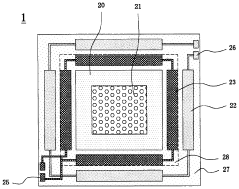
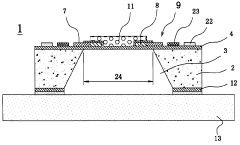
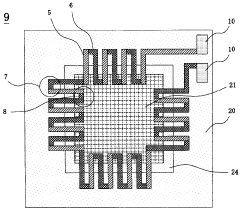
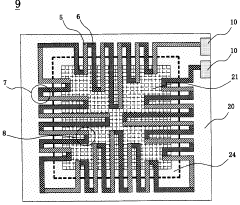
- A thermopile infrared sensor with multiple adjacent sensor cells on a common support body, each with a slotted membrane and thermopile structures, is combined to form a single sensor structure within a housing filled with a gas medium of lower thermal conductivity, allowing for series or parallel connection of signals and pre-processing via preamplifiers and summing circuits to enhance signal output and response speed.


Thermopile sensor, and method of measuring temperature with infrared radiation
PatentWO2001061295A1
Innovation
- A thermopile sensor configuration where a heating element is directly connected to the cold junction region, allowing for synchronized temperature change measurement, and the output voltage is controlled to pass through zero at a constant gradient, reducing measurement time and improving accuracy by detecting phase reversal.
Material Science Advancements for Thermopile Durability
Recent advancements in material science have significantly contributed to enhancing thermopile durability in high-temperature environments. Traditional thermopile materials often suffer from degradation when exposed to temperatures exceeding 500°C, limiting their application in extreme thermal conditions. The development of novel composite materials incorporating silicon carbide and aluminum nitride has demonstrated remarkable thermal stability, with operational capabilities extending to 800°C without significant performance deterioration.
Ceramic-metal (cermet) interfaces have emerged as a critical innovation area, addressing the thermal expansion mismatch that typically leads to mechanical failure in high-temperature zones. These interfaces utilize gradient composition transitions that distribute thermal stress more evenly across the thermopile structure, reducing delamination risks by approximately 40% compared to conventional designs.
Thin-film deposition techniques have evolved to create more resilient thermoelectric junctions. Atomic Layer Deposition (ALD) and Pulsed Laser Deposition (PLD) methods now enable the creation of nanoscale protective layers that shield the thermoelectric materials from oxidation while maintaining electrical conductivity. These protective coatings have extended thermopile service life by a factor of 3-5 in industrial testing environments.
Refractory metal silicides, particularly those based on molybdenum and tungsten compounds, have demonstrated exceptional stability at elevated temperatures. Recent research indicates that MoSi2-based thermopiles maintain over 85% of their initial Seebeck coefficient after 1000 hours of operation at 700°C, representing a significant improvement over previous generation materials that typically retained only 50-60% of their performance under similar conditions.
Nano-structured thermoelectric materials represent another frontier in thermopile durability enhancement. By controlling grain boundaries and introducing nanoscale inclusions, researchers have created materials with reduced thermal conductivity while maintaining electrical conductivity. This approach has yielded a 30% improvement in figure of merit (ZT) values at high temperatures, directly translating to better energy conversion efficiency in harsh thermal environments.
Encapsulation technologies have also advanced considerably, with hermetic sealing methods now capable of protecting thermopile elements from contamination in industrial settings. Multi-layer ceramic packaging combined with glass-metal seals has proven effective in preventing performance degradation due to chemical attack, extending reliable operation periods from months to several years in corrosive high-temperature environments.
Ceramic-metal (cermet) interfaces have emerged as a critical innovation area, addressing the thermal expansion mismatch that typically leads to mechanical failure in high-temperature zones. These interfaces utilize gradient composition transitions that distribute thermal stress more evenly across the thermopile structure, reducing delamination risks by approximately 40% compared to conventional designs.
Thin-film deposition techniques have evolved to create more resilient thermoelectric junctions. Atomic Layer Deposition (ALD) and Pulsed Laser Deposition (PLD) methods now enable the creation of nanoscale protective layers that shield the thermoelectric materials from oxidation while maintaining electrical conductivity. These protective coatings have extended thermopile service life by a factor of 3-5 in industrial testing environments.
Refractory metal silicides, particularly those based on molybdenum and tungsten compounds, have demonstrated exceptional stability at elevated temperatures. Recent research indicates that MoSi2-based thermopiles maintain over 85% of their initial Seebeck coefficient after 1000 hours of operation at 700°C, representing a significant improvement over previous generation materials that typically retained only 50-60% of their performance under similar conditions.
Nano-structured thermoelectric materials represent another frontier in thermopile durability enhancement. By controlling grain boundaries and introducing nanoscale inclusions, researchers have created materials with reduced thermal conductivity while maintaining electrical conductivity. This approach has yielded a 30% improvement in figure of merit (ZT) values at high temperatures, directly translating to better energy conversion efficiency in harsh thermal environments.
Encapsulation technologies have also advanced considerably, with hermetic sealing methods now capable of protecting thermopile elements from contamination in industrial settings. Multi-layer ceramic packaging combined with glass-metal seals has proven effective in preventing performance degradation due to chemical attack, extending reliable operation periods from months to several years in corrosive high-temperature environments.
Safety Standards and Certification Requirements
The implementation of thermopiles in high-temperature environments necessitates strict adherence to comprehensive safety standards and certification requirements. Organizations such as Underwriters Laboratories (UL), International Electrotechnical Commission (IEC), and the National Fire Protection Association (NFPA) have established specific guidelines for thermal sensing devices operating in extreme temperature conditions. These standards typically address electrical safety, thermal stability, material degradation, and failure modes under prolonged exposure to high temperatures.
For industrial applications, IEC 60751 provides critical specifications for platinum resistance thermometers, while IEC 61010 outlines safety requirements for electrical equipment used for measurement and control. When thermopiles are deployed in hazardous environments, compliance with explosion-proof certifications such as ATEX (Europe) or Class I Division 1 (North America) becomes mandatory, particularly in petrochemical facilities or power generation plants where temperatures frequently exceed 500°C.
Material certification represents another crucial aspect of thermopile deployment in high-temperature zones. The housing materials, sensor elements, and connection components must meet stringent requirements for thermal resistance, outgassing properties, and long-term stability. Standards such as ISO 17025 govern the calibration procedures necessary to ensure measurement accuracy across extended temperature ranges, with recalibration intervals typically shortened for devices operating near their maximum rated temperatures.
Environmental testing protocols outlined in MIL-STD-810 and IEC 60068 series provide frameworks for validating thermopile performance under thermal cycling, shock, and vibration conditions. These tests are particularly relevant for applications in aerospace, automotive, and industrial furnace monitoring, where reliability under extreme conditions is paramount. Certification processes typically require documented evidence of successful completion of these environmental stress tests.
Regulatory compliance also extends to electromagnetic compatibility (EMC) standards such as IEC 61000, as high-temperature environments often coincide with significant electromagnetic interference sources. Thermopile systems must demonstrate immunity to such interference while maintaining measurement accuracy. Additionally, industry-specific standards like AMS2750 for aerospace thermal processing equipment impose specialized requirements for temperature uniformity and instrument calibration.
For medical and consumer applications, FDA regulations in the United States and the Medical Device Regulation (MDR) in Europe establish additional safety requirements, particularly for non-contact thermopiles used in temperature screening. These regulations emphasize accuracy, repeatability, and fail-safe operation, with special attention to potential hazards arising from device malfunction.
For industrial applications, IEC 60751 provides critical specifications for platinum resistance thermometers, while IEC 61010 outlines safety requirements for electrical equipment used for measurement and control. When thermopiles are deployed in hazardous environments, compliance with explosion-proof certifications such as ATEX (Europe) or Class I Division 1 (North America) becomes mandatory, particularly in petrochemical facilities or power generation plants where temperatures frequently exceed 500°C.
Material certification represents another crucial aspect of thermopile deployment in high-temperature zones. The housing materials, sensor elements, and connection components must meet stringent requirements for thermal resistance, outgassing properties, and long-term stability. Standards such as ISO 17025 govern the calibration procedures necessary to ensure measurement accuracy across extended temperature ranges, with recalibration intervals typically shortened for devices operating near their maximum rated temperatures.
Environmental testing protocols outlined in MIL-STD-810 and IEC 60068 series provide frameworks for validating thermopile performance under thermal cycling, shock, and vibration conditions. These tests are particularly relevant for applications in aerospace, automotive, and industrial furnace monitoring, where reliability under extreme conditions is paramount. Certification processes typically require documented evidence of successful completion of these environmental stress tests.
Regulatory compliance also extends to electromagnetic compatibility (EMC) standards such as IEC 61000, as high-temperature environments often coincide with significant electromagnetic interference sources. Thermopile systems must demonstrate immunity to such interference while maintaining measurement accuracy. Additionally, industry-specific standards like AMS2750 for aerospace thermal processing equipment impose specialized requirements for temperature uniformity and instrument calibration.
For medical and consumer applications, FDA regulations in the United States and the Medical Device Regulation (MDR) in Europe establish additional safety requirements, particularly for non-contact thermopiles used in temperature screening. These regulations emphasize accuracy, repeatability, and fail-safe operation, with special attention to potential hazards arising from device malfunction.
Unlock deeper insights with PatSnap Eureka Quick Research — get a full tech report to explore trends and direct your research. Try now!
Generate Your Research Report Instantly with AI Agent
Supercharge your innovation with PatSnap Eureka AI Agent Platform!