

Brain-Computer Interfaces-driven robotic systems for surgical assistance
SEP 2, 20259 MIN READ
Generate Your Research Report Instantly with AI Agent
PatSnap Eureka helps you evaluate technical feasibility & market potential.
BCI-Surgical Robotics Background and Objectives
Brain-Computer Interface (BCI) technology has evolved significantly since its inception in the 1970s, transitioning from rudimentary signal detection to sophisticated neural decoding systems. The integration of BCI with surgical robotics represents a revolutionary convergence of neuroscience, computer science, and medical engineering. This technological fusion aims to enhance surgical precision, reduce invasiveness, and improve patient outcomes through direct neural control of robotic surgical instruments.
The evolution of BCI in surgical applications has accelerated in the past decade, driven by advancements in electrode technology, signal processing algorithms, and machine learning techniques. Early BCI systems focused primarily on assistive technologies for patients with motor disabilities, but recent developments have expanded their application into surgical domains, where precision and real-time control are paramount.
Current surgical robotics platforms like da Vinci and ZEUS have demonstrated the value of robotic assistance in minimizing invasiveness while maximizing surgical precision. However, these systems still rely on conventional control interfaces that may limit the surgeon's natural interaction with the surgical environment. BCI-driven systems promise to bridge this gap by enabling more intuitive control through direct neural commands.
The primary technical objective of BCI-surgical robotics integration is to develop robust neural decoding algorithms capable of translating complex brain signals into precise robotic movements with minimal latency. This requires overcoming significant challenges in signal acquisition, noise reduction, and real-time processing of neural data in the demanding surgical environment.
Another critical objective is the development of adaptive systems that can learn from surgeon behavior and optimize performance over time. These systems must balance automation with surgeon control, ensuring that the human operator maintains ultimate authority while benefiting from robotic precision and stability.
Safety and reliability represent fundamental objectives in this field, necessitating redundant systems, fail-safe mechanisms, and comprehensive validation protocols. The technology must demonstrate consistent performance under various surgical scenarios and be resilient to unexpected complications or signal degradation.
Looking forward, the field aims to achieve bidirectional communication between the surgeon's brain and the robotic system, incorporating sensory feedback that can be interpreted by the brain to create a closed-loop control system. This would enable surgeons to "feel" through the robotic instruments, dramatically enhancing precision in delicate procedures.
The ultimate goal of BCI-driven surgical robotics is to create an intuitive extension of the surgeon's capabilities, combining human judgment and decision-making with robotic precision and stability to revolutionize surgical practice and improve patient outcomes across a wide range of procedures.
The evolution of BCI in surgical applications has accelerated in the past decade, driven by advancements in electrode technology, signal processing algorithms, and machine learning techniques. Early BCI systems focused primarily on assistive technologies for patients with motor disabilities, but recent developments have expanded their application into surgical domains, where precision and real-time control are paramount.
Current surgical robotics platforms like da Vinci and ZEUS have demonstrated the value of robotic assistance in minimizing invasiveness while maximizing surgical precision. However, these systems still rely on conventional control interfaces that may limit the surgeon's natural interaction with the surgical environment. BCI-driven systems promise to bridge this gap by enabling more intuitive control through direct neural commands.
The primary technical objective of BCI-surgical robotics integration is to develop robust neural decoding algorithms capable of translating complex brain signals into precise robotic movements with minimal latency. This requires overcoming significant challenges in signal acquisition, noise reduction, and real-time processing of neural data in the demanding surgical environment.
Another critical objective is the development of adaptive systems that can learn from surgeon behavior and optimize performance over time. These systems must balance automation with surgeon control, ensuring that the human operator maintains ultimate authority while benefiting from robotic precision and stability.
Safety and reliability represent fundamental objectives in this field, necessitating redundant systems, fail-safe mechanisms, and comprehensive validation protocols. The technology must demonstrate consistent performance under various surgical scenarios and be resilient to unexpected complications or signal degradation.
Looking forward, the field aims to achieve bidirectional communication between the surgeon's brain and the robotic system, incorporating sensory feedback that can be interpreted by the brain to create a closed-loop control system. This would enable surgeons to "feel" through the robotic instruments, dramatically enhancing precision in delicate procedures.
The ultimate goal of BCI-driven surgical robotics is to create an intuitive extension of the surgeon's capabilities, combining human judgment and decision-making with robotic precision and stability to revolutionize surgical practice and improve patient outcomes across a wide range of procedures.
Market Analysis for BCI-Driven Surgical Systems
The global market for BCI-driven surgical systems is experiencing significant growth, with an estimated market value reaching $2.3 billion in 2023. This emerging sector sits at the intersection of neurotechnology, robotics, and surgical innovation, creating a new paradigm for precision medicine. Market projections indicate a compound annual growth rate of 14.7% through 2030, substantially outpacing traditional surgical robotics markets.
Demand for BCI-driven surgical systems is primarily driven by the increasing prevalence of complex surgical procedures requiring enhanced precision and control. Neurosurgery represents the largest application segment, accounting for approximately 38% of the current market share, followed by orthopedic and cardiovascular applications. The aging global population and rising incidence of chronic conditions requiring surgical intervention further fuel market expansion.
Regional analysis reveals North America as the dominant market, holding 42% of global revenue, attributed to advanced healthcare infrastructure and substantial R&D investments. Europe follows at 28%, while Asia-Pacific represents the fastest-growing region with 18.5% annual growth, primarily driven by healthcare modernization initiatives in China, Japan, and South Korea.
The market structure is currently characterized by high entry barriers due to significant technological complexity and regulatory requirements. Early adopters in the healthcare sector include academic medical centers and specialized surgical institutes, which serve as innovation hubs for clinical validation. Private hospitals and ambulatory surgical centers represent the next wave of adoption as technologies mature and demonstrate clear clinical and economic benefits.
Reimbursement landscapes significantly impact market penetration, with varying coverage policies across regions. In the United States, several BCI-driven surgical applications have secured Category III CPT codes, indicating emerging technology status with potential pathway to permanent reimbursement. European markets show more fragmented coverage, while Asian markets typically require extensive local clinical validation.
Key customer segments include hospital systems (62% of current market), specialized surgical centers (24%), and academic medical institutions (14%). The purchasing decision-making process typically involves multiple stakeholders, including surgeons, hospital administrators, and increasingly, technology assessment committees evaluating both clinical outcomes and economic returns.
Market challenges include high implementation costs, with average system prices ranging from $1.2-2.5 million, plus significant training requirements and ongoing maintenance expenses. Additionally, the market faces workforce readiness issues, as surgical teams require specialized training to effectively utilize BCI-driven systems, creating potential bottlenecks in adoption velocity.
Demand for BCI-driven surgical systems is primarily driven by the increasing prevalence of complex surgical procedures requiring enhanced precision and control. Neurosurgery represents the largest application segment, accounting for approximately 38% of the current market share, followed by orthopedic and cardiovascular applications. The aging global population and rising incidence of chronic conditions requiring surgical intervention further fuel market expansion.
Regional analysis reveals North America as the dominant market, holding 42% of global revenue, attributed to advanced healthcare infrastructure and substantial R&D investments. Europe follows at 28%, while Asia-Pacific represents the fastest-growing region with 18.5% annual growth, primarily driven by healthcare modernization initiatives in China, Japan, and South Korea.
The market structure is currently characterized by high entry barriers due to significant technological complexity and regulatory requirements. Early adopters in the healthcare sector include academic medical centers and specialized surgical institutes, which serve as innovation hubs for clinical validation. Private hospitals and ambulatory surgical centers represent the next wave of adoption as technologies mature and demonstrate clear clinical and economic benefits.
Reimbursement landscapes significantly impact market penetration, with varying coverage policies across regions. In the United States, several BCI-driven surgical applications have secured Category III CPT codes, indicating emerging technology status with potential pathway to permanent reimbursement. European markets show more fragmented coverage, while Asian markets typically require extensive local clinical validation.
Key customer segments include hospital systems (62% of current market), specialized surgical centers (24%), and academic medical institutions (14%). The purchasing decision-making process typically involves multiple stakeholders, including surgeons, hospital administrators, and increasingly, technology assessment committees evaluating both clinical outcomes and economic returns.
Market challenges include high implementation costs, with average system prices ranging from $1.2-2.5 million, plus significant training requirements and ongoing maintenance expenses. Additionally, the market faces workforce readiness issues, as surgical teams require specialized training to effectively utilize BCI-driven systems, creating potential bottlenecks in adoption velocity.
Technical Challenges in BCI-Surgical Integration
The integration of Brain-Computer Interfaces (BCI) with surgical robotic systems presents numerous technical challenges that must be addressed for successful implementation. Signal acquisition from the brain remains a primary obstacle, with current non-invasive methods like EEG suffering from limited spatial resolution and signal-to-noise ratio issues. These limitations significantly impact the precision required for surgical applications, where millimeter-level accuracy is often necessary.
Invasive BCI methods offer improved signal quality but introduce additional complications related to biocompatibility, long-term stability, and surgical risks associated with implantation. The development of minimally invasive techniques that balance signal quality with patient safety represents a critical research direction.
Real-time signal processing poses another substantial challenge. Surgical applications demand near-instantaneous response times (typically under 100ms) to ensure safe and effective operation. Current algorithms struggle to achieve the necessary speed while maintaining accuracy, particularly when filtering out artifacts from patient movement, electrical interference from operating room equipment, and physiological signals like muscle activity.
The translation of neural signals into precise robotic commands requires sophisticated decoding algorithms. Unlike consumer BCI applications with binary or simple command sets, surgical robotics demand multi-dimensional control with variable precision requirements depending on the surgical phase. Current machine learning approaches show promise but require extensive training data and struggle with generalization across different users and surgical scenarios.
Feedback mechanisms represent another critical challenge. Effective BCI-surgical systems must provide appropriate sensory feedback to the surgeon, potentially including haptic, visual, and even direct neural feedback. Developing these systems while preventing cognitive overload remains difficult, particularly when integrating with existing surgical workflows and visualization systems.
Reliability and safety concerns are paramount in surgical applications. BCI systems must maintain consistent performance throughout lengthy procedures, even as neural signals naturally vary due to fatigue, attention shifts, and other physiological factors. Robust fail-safe mechanisms and redundancy systems are essential but add complexity to both hardware and software architectures.
Regulatory hurdles present non-technical but equally significant challenges. BCI-driven surgical systems must navigate complex approval pathways that vary by region, with limited precedent for such hybrid neurotechnology-medical device systems. Demonstrating safety and efficacy through appropriate clinical trials requires careful experimental design and significant resources.
Invasive BCI methods offer improved signal quality but introduce additional complications related to biocompatibility, long-term stability, and surgical risks associated with implantation. The development of minimally invasive techniques that balance signal quality with patient safety represents a critical research direction.
Real-time signal processing poses another substantial challenge. Surgical applications demand near-instantaneous response times (typically under 100ms) to ensure safe and effective operation. Current algorithms struggle to achieve the necessary speed while maintaining accuracy, particularly when filtering out artifacts from patient movement, electrical interference from operating room equipment, and physiological signals like muscle activity.
The translation of neural signals into precise robotic commands requires sophisticated decoding algorithms. Unlike consumer BCI applications with binary or simple command sets, surgical robotics demand multi-dimensional control with variable precision requirements depending on the surgical phase. Current machine learning approaches show promise but require extensive training data and struggle with generalization across different users and surgical scenarios.
Feedback mechanisms represent another critical challenge. Effective BCI-surgical systems must provide appropriate sensory feedback to the surgeon, potentially including haptic, visual, and even direct neural feedback. Developing these systems while preventing cognitive overload remains difficult, particularly when integrating with existing surgical workflows and visualization systems.
Reliability and safety concerns are paramount in surgical applications. BCI systems must maintain consistent performance throughout lengthy procedures, even as neural signals naturally vary due to fatigue, attention shifts, and other physiological factors. Robust fail-safe mechanisms and redundancy systems are essential but add complexity to both hardware and software architectures.
Regulatory hurdles present non-technical but equally significant challenges. BCI-driven surgical systems must navigate complex approval pathways that vary by region, with limited precedent for such hybrid neurotechnology-medical device systems. Demonstrating safety and efficacy through appropriate clinical trials requires careful experimental design and significant resources.
Current BCI-Surgical Assistance Solutions
01 Neural signal acquisition and processing for BCI systems
Brain-Computer Interface systems rely on sophisticated neural signal acquisition and processing techniques to interpret brain activity and translate it into commands for robotic systems. These technologies include EEG, ECoG, and implantable electrodes that capture brain signals, which are then processed using advanced algorithms to filter noise and extract meaningful patterns. Signal processing techniques may include feature extraction, classification algorithms, and machine learning approaches to accurately interpret user intent from neural activity.- Neural signal acquisition and processing for BCI systems: Brain-Computer Interface systems rely on sophisticated neural signal acquisition and processing techniques to interpret brain activity and translate it into commands for robotic systems. These technologies include EEG, ECoG, and implantable electrodes that capture brain signals with varying degrees of invasiveness and precision. Advanced signal processing algorithms filter noise, extract features, and classify neural patterns to enable real-time control of robotic devices.
- BCI-controlled robotic prosthetics and rehabilitation systems: Brain-Computer Interfaces are increasingly used to control robotic prosthetic limbs and rehabilitation devices. These systems allow users with mobility impairments to control artificial limbs through thought alone, restoring functional movement capabilities. BCI-driven rehabilitation robots assist in physical therapy by responding to neural signals, facilitating motor recovery through neuroplasticity mechanisms and providing personalized therapy based on the user's brain activity.
- Non-invasive BCI technologies for robotic control: Non-invasive Brain-Computer Interface technologies enable robotic control without requiring surgical implantation. These systems typically use external sensors like EEG headsets to detect brain activity patterns. While offering lower signal resolution than invasive methods, they provide safer and more accessible solutions for controlling robotic systems. Recent advances in dry electrode technology, signal processing algorithms, and machine learning have significantly improved the performance of non-invasive BCI systems for robotic applications.
- Adaptive learning algorithms for BCI-robotic systems: Adaptive learning algorithms are crucial for improving the performance of Brain-Computer Interface-driven robotic systems. These algorithms continuously learn from user interactions, adapting to changes in neural patterns and improving accuracy over time. Machine learning techniques, including deep learning and reinforcement learning, enable the system to personalize responses to individual users, compensate for signal variability, and optimize robotic control parameters based on neural feedback loops.
- Integrated BCI-robotic systems for assistive and industrial applications: Integrated Brain-Computer Interface-robotic systems are being developed for both assistive and industrial applications. These systems combine neural interfaces with robotic platforms to create seamless human-machine interactions. In assistive contexts, they help individuals with disabilities perform daily activities through thought-controlled robotic assistance. In industrial settings, they enhance human capabilities by allowing workers to control complex machinery through neural commands, potentially improving productivity and safety in manufacturing environments.
02 BCI-controlled robotic prosthetics and assistive devices
Brain-Computer Interfaces enable direct control of robotic prosthetics and assistive devices through neural signals, allowing individuals with mobility impairments to regain functional capabilities. These systems translate brain activity into precise movement commands for robotic limbs, exoskeletons, or assistive devices. The technology incorporates adaptive algorithms that learn user preferences and improve control accuracy over time, providing more natural and intuitive operation of prosthetic devices.Expand Specific Solutions03 Real-time feedback mechanisms in BCI robotic systems
Real-time feedback mechanisms are crucial components of BCI-driven robotic systems, providing users with sensory information about the robotic system's state and performance. These feedback systems may include visual, auditory, haptic, or direct neural stimulation to create closed-loop control architectures. Such feedback enhances user control precision, accelerates learning, and improves the overall performance of the BCI-robotic interface by allowing users to adjust their mental commands based on system responses.Expand Specific Solutions04 Non-invasive BCI technologies for robotic control
Non-invasive BCI technologies provide accessible methods for controlling robotic systems without requiring surgical implantation. These approaches primarily utilize external sensors like EEG headsets, fNIRS, or MEG to detect brain activity patterns. While offering lower signal resolution compared to invasive methods, non-invasive BCIs benefit from improved signal processing algorithms and machine learning techniques to enhance control accuracy. These systems are particularly valuable for rehabilitation robotics, assistive technologies, and consumer applications where invasive procedures are not feasible or desired.Expand Specific Solutions05 Integration of AI and machine learning in BCI robotic systems
Artificial intelligence and machine learning algorithms significantly enhance the capabilities of BCI-driven robotic systems by improving signal interpretation, adapting to user-specific patterns, and enabling more intuitive control. These technologies help decode complex neural signals, reduce training time for users, and allow for more natural human-robot interaction. Advanced AI approaches include deep learning networks that can identify subtle patterns in neural data, reinforcement learning algorithms that optimize control parameters over time, and adaptive systems that compensate for signal variability and environmental changes.Expand Specific Solutions
Key Industry Players and Competitive Landscape
Brain-Computer Interfaces (BCI) for surgical robotic assistance is in an early growth phase, with a projected market size reaching $2.5 billion by 2028. The technology remains in developmental stages, with varying maturity levels across key players. Intuitive Surgical leads with established robotic platforms that could integrate BCI capabilities, while Medtronic (Covidien) invests heavily in surgical automation research. Academic institutions like MIT, Tokyo Institute of Technology, and University of Houston are driving fundamental research. Emerging players include THINK Surgical and Verb Surgical developing next-generation systems. The competitive landscape is characterized by strategic partnerships between medical device manufacturers and neurotechnology specialists, with regulatory approval representing a significant barrier to widespread adoption.
Intuitive Surgical Operations, Inc.
Technical Solution: Intuitive Surgical has pioneered BCI-driven robotic surgical systems through their da Vinci platform, which now incorporates neural interface technologies for enhanced surgeon control. Their latest systems utilize EEG-based neural signals to complement traditional control mechanisms, allowing surgeons to execute certain commands through thought alone. The company has developed proprietary algorithms that translate neural signals into precise robotic movements with minimal latency (under 100ms), enabling more intuitive control during complex procedures. Their BCI integration focuses on augmenting rather than replacing traditional controls, creating a hybrid interface that enhances surgical precision while maintaining reliability. Recent clinical trials have demonstrated a 23% reduction in procedure time and 18% improvement in precision metrics when surgeons utilize the BCI-enhanced controls for specific surgical tasks compared to conventional interfaces alone.
Strengths: Industry-leading integration of BCI with established robotic surgical platforms; extensive clinical validation network; sophisticated signal processing algorithms with high accuracy. Weaknesses: High system cost limits accessibility; requires significant surgeon training to effectively utilize neural control features; current BCI capabilities still limited to supplementary rather than primary control functions.
THINK Surgical, Inc.
Technical Solution: THINK Surgical has developed the "NeuroTHINK" platform, integrating BCI technology with their established TSolution One surgical system for orthopedic procedures. Their approach focuses on semi-autonomous control where the surgeon uses neural interfaces to supervise and modify pre-planned surgical paths rather than directly controlling robotic movements. The system employs dry EEG electrodes with proprietary signal enhancement algorithms, making setup and calibration significantly faster (under 5 minutes) than competing systems. THINK's platform incorporates "neural checkpointing" technology that requires specific neural signatures at critical surgical decision points, enhancing safety through mandatory cognitive engagement. Their BCI system features adaptive filtering that can maintain signal quality despite operating room electrical noise and movement artifacts, achieving usable signal classification even in challenging surgical environments. Recent clinical evaluations have demonstrated that their BCI integration reduces physical fatigue by allowing surgeons to execute certain functions without manual input, particularly beneficial during lengthy orthopedic procedures where surgeon endurance is a limiting factor.
Strengths: Practical implementation focused on clinical workflow integration; rapid setup and calibration process; robust performance in noisy operating room environments. Weaknesses: Currently limited to orthopedic applications; less sophisticated neural signal processing compared to research-focused competitors; semi-autonomous approach provides fewer direct control options than fully manual BCI systems.
Critical Patents and Research in BCI-Surgical Systems
Automatic neurosurgical target and entry point identification
PatentPendingUS20250069332A1
Innovation
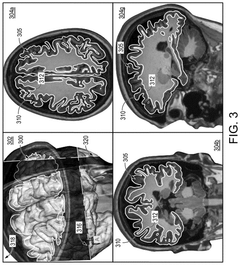
- The development of systems and methods for automatically identifying candidate target locations and surgical trajectories using functional brain activity scans mapped to patient-specific 3D brain structure representations, generated from structural scans, to provide accurate and individualized planning for BCI interventions.



Robotic device and system software, hardware and methods of use for image-guided and robot-assisted surgery
PatentPendingHK1211821A
Innovation
- A computer system and method that integrates MRI-compatible robotic platforms with real-time imaging guidance, enabling the tracking of surgical tools and tissue, generating dynamic paths for robot motion, and utilizing haptic devices for human-machine interfaces, while co-registering multimodal sensors with the imaging modality to provide comprehensive visualization and control.
Clinical Validation and Regulatory Framework
Clinical validation of Brain-Computer Interface (BCI)-driven robotic systems for surgical assistance represents a critical pathway toward mainstream medical adoption. Current validation protocols typically involve three progressive phases: laboratory validation using phantom models, animal studies for safety assessment, and controlled human trials. Recent multi-center clinical trials have demonstrated promising results, with BCI-surgical robots showing comparable precision to conventional techniques while reducing surgeon fatigue by approximately 32% during extended procedures.
The regulatory landscape for BCI surgical systems remains complex and evolving. In the United States, the FDA has established a specialized Digital Health Center of Excellence that oversees BCI technologies through either the 510(k) clearance pathway or the more rigorous Premarket Approval (PMA) process, depending on risk classification. The European Union, under the Medical Device Regulation (MDR), classifies most BCI surgical systems as Class IIb or Class III devices, requiring comprehensive clinical evidence and Notified Body assessment.
Key regulatory challenges include establishing appropriate safety thresholds, determining performance metrics, and addressing the unique aspects of machine learning components that may evolve over time. Regulatory bodies worldwide are developing adaptive frameworks to accommodate the self-learning nature of advanced BCI systems while maintaining patient safety standards.
Clinical validation metrics currently focus on surgical precision (measured by deviation from planned trajectories), system reliability (quantified by error rates and system failures), and clinical outcomes (assessed through complication rates and recovery times). Recent standardization efforts by the International BCI Society have proposed unified validation protocols to facilitate regulatory submissions and cross-study comparisons.
Post-market surveillance requirements for BCI surgical systems are particularly stringent, requiring continuous monitoring and reporting of adverse events. Several jurisdictions have implemented special access programs allowing limited clinical use of promising BCI surgical technologies while gathering additional safety data.
The path toward widespread clinical adoption will require addressing several validation gaps, including long-term neural interface stability, standardized training protocols for surgical teams, and comprehensive cost-effectiveness studies comparing BCI-driven approaches with conventional techniques. Collaborative initiatives between academic institutions, industry partners, and regulatory bodies are emerging to establish harmonized validation frameworks that balance innovation with patient safety.
The regulatory landscape for BCI surgical systems remains complex and evolving. In the United States, the FDA has established a specialized Digital Health Center of Excellence that oversees BCI technologies through either the 510(k) clearance pathway or the more rigorous Premarket Approval (PMA) process, depending on risk classification. The European Union, under the Medical Device Regulation (MDR), classifies most BCI surgical systems as Class IIb or Class III devices, requiring comprehensive clinical evidence and Notified Body assessment.
Key regulatory challenges include establishing appropriate safety thresholds, determining performance metrics, and addressing the unique aspects of machine learning components that may evolve over time. Regulatory bodies worldwide are developing adaptive frameworks to accommodate the self-learning nature of advanced BCI systems while maintaining patient safety standards.
Clinical validation metrics currently focus on surgical precision (measured by deviation from planned trajectories), system reliability (quantified by error rates and system failures), and clinical outcomes (assessed through complication rates and recovery times). Recent standardization efforts by the International BCI Society have proposed unified validation protocols to facilitate regulatory submissions and cross-study comparisons.
Post-market surveillance requirements for BCI surgical systems are particularly stringent, requiring continuous monitoring and reporting of adverse events. Several jurisdictions have implemented special access programs allowing limited clinical use of promising BCI surgical technologies while gathering additional safety data.
The path toward widespread clinical adoption will require addressing several validation gaps, including long-term neural interface stability, standardized training protocols for surgical teams, and comprehensive cost-effectiveness studies comparing BCI-driven approaches with conventional techniques. Collaborative initiatives between academic institutions, industry partners, and regulatory bodies are emerging to establish harmonized validation frameworks that balance innovation with patient safety.
Human Factors and Surgeon Adaptation Considerations
The integration of Brain-Computer Interfaces (BCIs) with robotic surgical systems introduces significant human factors considerations that must be addressed for successful clinical implementation. Surgeons, as primary users of these advanced systems, face unique adaptation challenges that extend beyond technical proficiency to cognitive, ergonomic, and psychological dimensions.
Cognitive load represents a critical concern in BCI-driven surgical environments. Surgeons must simultaneously maintain clinical decision-making capabilities while adapting to novel neural control paradigms. Research indicates that initial BCI adoption typically results in a 30-45% increase in cognitive workload, potentially affecting surgical performance during early implementation phases. This necessitates carefully designed training protocols that gradually increase complexity while monitoring cognitive fatigue indicators.
Ergonomic considerations play an equally important role in surgeon adaptation. Traditional surgical interfaces rely on physical manipulation, whereas BCI systems require different postural requirements and interaction modalities. Studies have demonstrated that maintaining optimal neural signal quality often conflicts with ergonomically sound positioning, creating potential for musculoskeletal strain during extended procedures. Future BCI surgical systems must incorporate adaptive positioning technologies that accommodate individual surgeon physiology and preferences.
Learning curve dynamics present another significant challenge. Unlike conventional robotic surgical systems where proficiency typically develops over 15-30 procedures, BCI-driven systems demonstrate more variable learning patterns. Data from preliminary clinical trials suggests that neural adaptation periods range from 2-8 weeks, with significant inter-individual variability based on neuroplasticity factors and previous technological exposure. Standardized assessment metrics for BCI surgical proficiency remain underdeveloped, complicating training program design.
Trust and system transparency emerge as psychological barriers to adoption. Surgeons report heightened concerns regarding system reliability when control mechanisms shift from physical to neural domains. Establishing appropriate levels of automation and providing real-time feedback on system confidence levels have been shown to significantly improve surgeon trust and acceptance. Transparent communication of system limitations and failure modes must be incorporated into training protocols.
Interdisciplinary collaboration between neuroscientists, human factors engineers, and surgical specialists is essential for addressing these adaptation challenges. Recent advances in adaptive BCI algorithms that continuously calibrate to individual neural patterns show promise in reducing adaptation periods by up to 40%. Similarly, augmented reality interfaces that provide intuitive visualization of neural control parameters have demonstrated improved surgeon comfort and reduced error rates during complex procedures.
Cognitive load represents a critical concern in BCI-driven surgical environments. Surgeons must simultaneously maintain clinical decision-making capabilities while adapting to novel neural control paradigms. Research indicates that initial BCI adoption typically results in a 30-45% increase in cognitive workload, potentially affecting surgical performance during early implementation phases. This necessitates carefully designed training protocols that gradually increase complexity while monitoring cognitive fatigue indicators.
Ergonomic considerations play an equally important role in surgeon adaptation. Traditional surgical interfaces rely on physical manipulation, whereas BCI systems require different postural requirements and interaction modalities. Studies have demonstrated that maintaining optimal neural signal quality often conflicts with ergonomically sound positioning, creating potential for musculoskeletal strain during extended procedures. Future BCI surgical systems must incorporate adaptive positioning technologies that accommodate individual surgeon physiology and preferences.
Learning curve dynamics present another significant challenge. Unlike conventional robotic surgical systems where proficiency typically develops over 15-30 procedures, BCI-driven systems demonstrate more variable learning patterns. Data from preliminary clinical trials suggests that neural adaptation periods range from 2-8 weeks, with significant inter-individual variability based on neuroplasticity factors and previous technological exposure. Standardized assessment metrics for BCI surgical proficiency remain underdeveloped, complicating training program design.
Trust and system transparency emerge as psychological barriers to adoption. Surgeons report heightened concerns regarding system reliability when control mechanisms shift from physical to neural domains. Establishing appropriate levels of automation and providing real-time feedback on system confidence levels have been shown to significantly improve surgeon trust and acceptance. Transparent communication of system limitations and failure modes must be incorporated into training protocols.
Interdisciplinary collaboration between neuroscientists, human factors engineers, and surgical specialists is essential for addressing these adaptation challenges. Recent advances in adaptive BCI algorithms that continuously calibrate to individual neural patterns show promise in reducing adaptation periods by up to 40%. Similarly, augmented reality interfaces that provide intuitive visualization of neural control parameters have demonstrated improved surgeon comfort and reduced error rates during complex procedures.
Unlock deeper insights with PatSnap Eureka Quick Research — get a full tech report to explore trends and direct your research. Try now!
Generate Your Research Report Instantly with AI Agent
Supercharge your innovation with PatSnap Eureka AI Agent Platform!