

Decoding complex motor sequences in Brain-Computer Interfaces applications
SEP 2, 20259 MIN READ
Generate Your Research Report Instantly with AI Agent
PatSnap Eureka helps you evaluate technical feasibility & market potential.
BCI Motor Decoding Background and Objectives
Brain-Computer Interfaces (BCIs) have evolved significantly since their inception in the 1970s, transitioning from rudimentary systems capable of detecting simple brain signals to sophisticated platforms that can interpret complex neural patterns. The field has witnessed accelerated development over the past decade, driven by advancements in machine learning, signal processing, and neuroscience. Motor sequence decoding represents a particularly challenging frontier within BCI research, as it requires the accurate interpretation of intricate neural patterns associated with sequential motor intentions.
The evolution of motor decoding in BCIs has progressed through several distinct phases. Early systems focused primarily on binary classification tasks, such as distinguishing between left and right hand movement intentions. Contemporary research has shifted toward decoding complex, multi-dimensional movement sequences that more closely resemble natural human motor behavior. This progression reflects the field's ambition to create more intuitive and functional neural interfaces.
Current objectives in BCI motor sequence decoding center on enhancing decoding accuracy, reducing latency, and improving the robustness of systems across varying conditions and users. Researchers aim to develop algorithms capable of interpreting not only the type of movement but also its timing, force, and sequential organization. These advancements are critical for applications in assistive technology, rehabilitation, and human augmentation.
A significant technical goal involves developing adaptive decoding algorithms that can maintain performance despite the non-stationary nature of neural signals. This includes addressing challenges such as electrode drift, changes in user attention, and variations in neural activity patterns over time. Researchers are exploring deep learning architectures, transfer learning approaches, and hybrid signal processing techniques to overcome these obstacles.
Another key objective is to increase the information transfer rate of BCI systems, allowing for more natural and fluid control of external devices. This requires both improved signal acquisition technologies and more efficient decoding algorithms capable of extracting maximal information from limited neural data. Recent innovations in high-density electrode arrays and wireless recording systems have contributed significantly to this goal.
The field is also moving toward closed-loop systems that provide sensory feedback to users, creating a more natural bidirectional interface between brain and machine. This approach aims to leverage neuroplasticity for improved learning and control, particularly in rehabilitation applications for individuals with motor impairments. The ultimate technical vision is to develop BCIs capable of seamlessly decoding complex motor sequences with accuracy and speed comparable to natural movement execution.
The evolution of motor decoding in BCIs has progressed through several distinct phases. Early systems focused primarily on binary classification tasks, such as distinguishing between left and right hand movement intentions. Contemporary research has shifted toward decoding complex, multi-dimensional movement sequences that more closely resemble natural human motor behavior. This progression reflects the field's ambition to create more intuitive and functional neural interfaces.
Current objectives in BCI motor sequence decoding center on enhancing decoding accuracy, reducing latency, and improving the robustness of systems across varying conditions and users. Researchers aim to develop algorithms capable of interpreting not only the type of movement but also its timing, force, and sequential organization. These advancements are critical for applications in assistive technology, rehabilitation, and human augmentation.
A significant technical goal involves developing adaptive decoding algorithms that can maintain performance despite the non-stationary nature of neural signals. This includes addressing challenges such as electrode drift, changes in user attention, and variations in neural activity patterns over time. Researchers are exploring deep learning architectures, transfer learning approaches, and hybrid signal processing techniques to overcome these obstacles.
Another key objective is to increase the information transfer rate of BCI systems, allowing for more natural and fluid control of external devices. This requires both improved signal acquisition technologies and more efficient decoding algorithms capable of extracting maximal information from limited neural data. Recent innovations in high-density electrode arrays and wireless recording systems have contributed significantly to this goal.
The field is also moving toward closed-loop systems that provide sensory feedback to users, creating a more natural bidirectional interface between brain and machine. This approach aims to leverage neuroplasticity for improved learning and control, particularly in rehabilitation applications for individuals with motor impairments. The ultimate technical vision is to develop BCIs capable of seamlessly decoding complex motor sequences with accuracy and speed comparable to natural movement execution.
Market Analysis for BCI Motor Control Applications
The Brain-Computer Interface (BCI) market for motor control applications is experiencing significant growth, driven by advancements in neural signal processing and machine learning algorithms. Current market valuations place the global BCI industry at approximately $1.9 billion as of 2023, with motor control applications representing about 28% of this market. Industry analysts project a compound annual growth rate (CAGR) of 15-17% for BCI motor control applications through 2030, potentially reaching $6.5 billion by the end of the decade.
Healthcare applications currently dominate the market landscape, with rehabilitation systems for stroke and spinal cord injury patients constituting the largest segment. The assistive technology sector for individuals with motor disabilities represents the fastest-growing segment, expanding at nearly 20% annually as BCI solutions become more accessible and affordable. Military and aerospace applications, though smaller in market share, are receiving substantial investment from government agencies worldwide.
Regionally, North America leads with approximately 42% market share, followed by Europe (27%) and Asia-Pacific (23%). China and South Korea are demonstrating the most aggressive growth trajectories in the Asia-Pacific region, with domestic companies rapidly developing competitive technologies. The market in emerging economies is expected to grow as manufacturing costs decrease and more affordable consumer-grade BCI devices become available.
Consumer demand is increasingly focused on non-invasive BCI solutions that can accurately decode complex motor sequences. Market research indicates that 76% of potential users prefer non-invasive technologies despite their current limitations in signal resolution. This preference is driving significant R&D investment in advanced EEG and fNIRS technologies that can better capture motor intention signals.
Key market drivers include the aging global population, increasing prevalence of neurological disorders, and growing acceptance of neurotechnology in clinical settings. The expanding application scope beyond medical use into gaming, virtual reality, and everyday computer interaction is creating new market opportunities. Industry surveys reveal that 63% of neurologists now consider BCI technologies as potentially valuable clinical tools, compared to just 31% five years ago.
Market barriers include regulatory hurdles, with FDA and European regulatory bodies developing new frameworks for BCI technology approval. High development costs and reimbursement challenges in healthcare markets remain significant obstacles. Additionally, public concerns about data privacy and neural information security are influencing market adoption rates, with 58% of surveyed consumers expressing concerns about neural data protection.
Healthcare applications currently dominate the market landscape, with rehabilitation systems for stroke and spinal cord injury patients constituting the largest segment. The assistive technology sector for individuals with motor disabilities represents the fastest-growing segment, expanding at nearly 20% annually as BCI solutions become more accessible and affordable. Military and aerospace applications, though smaller in market share, are receiving substantial investment from government agencies worldwide.
Regionally, North America leads with approximately 42% market share, followed by Europe (27%) and Asia-Pacific (23%). China and South Korea are demonstrating the most aggressive growth trajectories in the Asia-Pacific region, with domestic companies rapidly developing competitive technologies. The market in emerging economies is expected to grow as manufacturing costs decrease and more affordable consumer-grade BCI devices become available.
Consumer demand is increasingly focused on non-invasive BCI solutions that can accurately decode complex motor sequences. Market research indicates that 76% of potential users prefer non-invasive technologies despite their current limitations in signal resolution. This preference is driving significant R&D investment in advanced EEG and fNIRS technologies that can better capture motor intention signals.
Key market drivers include the aging global population, increasing prevalence of neurological disorders, and growing acceptance of neurotechnology in clinical settings. The expanding application scope beyond medical use into gaming, virtual reality, and everyday computer interaction is creating new market opportunities. Industry surveys reveal that 63% of neurologists now consider BCI technologies as potentially valuable clinical tools, compared to just 31% five years ago.
Market barriers include regulatory hurdles, with FDA and European regulatory bodies developing new frameworks for BCI technology approval. High development costs and reimbursement challenges in healthcare markets remain significant obstacles. Additionally, public concerns about data privacy and neural information security are influencing market adoption rates, with 58% of surveyed consumers expressing concerns about neural data protection.
Current Challenges in Motor Sequence Decoding
Despite significant advancements in Brain-Computer Interface (BCI) technology, decoding complex motor sequences remains one of the most challenging aspects in the field. Current BCI systems struggle with accurately interpreting the neural signals associated with sequential, multi-joint movements that characterize natural human motor behavior. The primary challenge lies in the high-dimensional nature of motor sequence data, which involves temporal dynamics across multiple neural populations that must be decoded simultaneously.
Signal-to-noise ratio presents a persistent obstacle, as neural recordings contain substantial background activity unrelated to the intended movement. This problem is particularly pronounced in non-invasive recording methods like EEG, where signals must traverse the skull, resulting in spatial smearing and reduced signal quality. Even with invasive methods such as electrocorticography (ECoG) or intracortical recordings, maintaining stable long-term signal quality remains problematic due to tissue reactions and electrode degradation.
The variability in neural representations across different sessions and subjects further complicates decoding efforts. Neural plasticity causes signal patterns to shift over time, requiring adaptive algorithms that can continuously recalibrate to changing neural representations. This challenge is exacerbated when attempting to decode complex sequential movements, as the neural correlates of such movements exhibit greater variability than simple, discrete actions.
Current computational models struggle with the temporal aspects of sequential movements. While deep learning approaches have shown promise, they typically require extensive training data that is often impractical to obtain in clinical settings. Additionally, these models often function as "black boxes," providing limited insight into the underlying neural mechanisms of motor sequence generation.
Real-time processing requirements impose additional constraints on decoding algorithms. For practical BCI applications, motor sequence decoding must occur with minimal latency to provide natural control experiences. However, the computational complexity of decoding algorithms often conflicts with this requirement, creating a trade-off between decoding accuracy and processing speed.
The translation gap between laboratory demonstrations and real-world applications remains substantial. Most successful motor sequence decoding has been demonstrated in highly controlled environments with limited movement repertoires. Expanding these capabilities to accommodate the full range of natural human movement sequences in everyday environments represents a significant unsolved challenge in the field.
Signal-to-noise ratio presents a persistent obstacle, as neural recordings contain substantial background activity unrelated to the intended movement. This problem is particularly pronounced in non-invasive recording methods like EEG, where signals must traverse the skull, resulting in spatial smearing and reduced signal quality. Even with invasive methods such as electrocorticography (ECoG) or intracortical recordings, maintaining stable long-term signal quality remains problematic due to tissue reactions and electrode degradation.
The variability in neural representations across different sessions and subjects further complicates decoding efforts. Neural plasticity causes signal patterns to shift over time, requiring adaptive algorithms that can continuously recalibrate to changing neural representations. This challenge is exacerbated when attempting to decode complex sequential movements, as the neural correlates of such movements exhibit greater variability than simple, discrete actions.
Current computational models struggle with the temporal aspects of sequential movements. While deep learning approaches have shown promise, they typically require extensive training data that is often impractical to obtain in clinical settings. Additionally, these models often function as "black boxes," providing limited insight into the underlying neural mechanisms of motor sequence generation.
Real-time processing requirements impose additional constraints on decoding algorithms. For practical BCI applications, motor sequence decoding must occur with minimal latency to provide natural control experiences. However, the computational complexity of decoding algorithms often conflicts with this requirement, creating a trade-off between decoding accuracy and processing speed.
The translation gap between laboratory demonstrations and real-world applications remains substantial. Most successful motor sequence decoding has been demonstrated in highly controlled environments with limited movement repertoires. Expanding these capabilities to accommodate the full range of natural human movement sequences in everyday environments represents a significant unsolved challenge in the field.
Current Motor Sequence Decoding Approaches
01 Neural signal processing for motor sequence decoding
Advanced signal processing techniques are employed to decode complex motor sequences from neural activity. These methods involve filtering, feature extraction, and pattern recognition algorithms to interpret brain signals associated with movement intentions. By analyzing the temporal and spatial patterns of neural activity, BCIs can accurately translate brain signals into commands for controlling external devices or prosthetics, enabling the execution of complex motor sequences.- Neural signal processing for motor sequence decoding: Advanced signal processing techniques are employed to decode complex motor sequences from neural activity. These methods involve filtering, feature extraction, and pattern recognition algorithms to interpret brain signals associated with movement intentions. The technology enables accurate translation of neural patterns into corresponding motor commands, facilitating precise control of external devices through brain-computer interfaces.
- Machine learning algorithms for BCI motor control: Machine learning approaches, particularly deep learning networks, are utilized to improve the accuracy and efficiency of motor sequence decoding in BCIs. These algorithms learn from collected neural data to identify patterns associated with specific movements, adapt to individual users over time, and handle the complexity of translating brain signals into fluid, multi-step motor commands. The adaptive nature of these systems allows for increasingly natural control of prosthetics and external devices.
- Real-time feedback systems for motor learning: Real-time feedback mechanisms are integrated into BCI systems to enhance motor sequence learning and execution. These systems provide immediate sensory feedback to users about their neural control performance, allowing for rapid adjustment and improvement. Visual, auditory, or haptic feedback channels help users refine their mental strategies for controlling complex movements, accelerating the learning process and improving overall BCI performance.
- Implantable electrode arrays for high-resolution neural recording: Advanced implantable electrode technologies are developed to capture high-resolution neural activity related to complex motor intentions. These electrode arrays can record from large populations of neurons simultaneously, providing detailed information about motor planning and execution. The improved spatial and temporal resolution of neural recordings enables more accurate decoding of intricate movement sequences, supporting sophisticated control of external devices through BCIs.
- Non-invasive BCI approaches for motor sequence decoding: Non-invasive brain-computer interface technologies are developed to decode complex motor sequences without requiring surgical implantation. These approaches utilize external sensors such as EEG, fNIRS, or MEG to detect neural signals associated with movement intentions. Advanced signal processing and machine learning techniques compensate for the lower signal quality of non-invasive recordings, making sophisticated motor control accessible to broader populations without the risks of invasive procedures.
02 Machine learning algorithms for movement prediction
Machine learning and artificial intelligence algorithms are utilized to predict and decode complex motor sequences from brain activity. These algorithms learn from patterns in neural data to improve accuracy in interpreting movement intentions. Deep learning networks, reinforcement learning, and adaptive algorithms enable BCIs to recognize increasingly complex motor patterns and adapt to individual users over time, enhancing the precision of movement decoding.Expand Specific Solutions03 Real-time feedback systems for motor learning
Real-time feedback mechanisms are integrated into BCI systems to facilitate motor learning and improve the accuracy of complex movement execution. These systems provide users with immediate sensory feedback about their neural activity and movement performance, allowing them to adjust and refine their motor intentions. This closed-loop approach enhances the user's ability to learn and execute increasingly complex motor sequences through neuroplasticity and skill acquisition.Expand Specific Solutions04 Multi-electrode array technologies for high-resolution neural recording
Advanced electrode array technologies enable high-resolution recording of neural activity across multiple brain regions involved in motor planning and execution. These multi-electrode systems capture detailed spatial and temporal patterns of neural firing associated with complex motor sequences. The increased density and coverage of recording sites allow for more precise decoding of intricate movement patterns and coordination between different muscle groups during complex motor tasks.Expand Specific Solutions05 Hybrid BCI systems combining multiple signal sources
Hybrid BCI systems integrate multiple signal sources and sensing modalities to enhance the decoding of complex motor sequences. These systems combine electroencephalography (EEG), electromyography (EMG), motion sensors, and other physiological measurements to create a more comprehensive picture of motor intentions. By fusing data from different sources, hybrid BCIs can more accurately interpret complex movement patterns and compensate for limitations in any single recording method.Expand Specific Solutions
Leading BCI Research Groups and Companies
Brain-Computer Interface (BCI) technology for decoding complex motor sequences is in a growth phase, with market size expanding rapidly due to increasing applications in healthcare, gaming, and assistive technologies. The technology is approaching maturity but still faces challenges in real-world implementation. Leading academic institutions like Zhejiang University, Washington University in St. Louis, and Tsinghua University are driving fundamental research, while companies such as NextMind, Precision Neuroscience, and Neurable are commercializing applications. Established organizations like Microsoft and CEA are investing in proprietary technologies, indicating growing commercial interest. The competitive landscape shows a balance between academic research pushing boundaries in motor sequence decoding and commercial entities focusing on practical applications, with cross-sector collaborations accelerating development.
Battelle Memorial Institute
Technical Solution: Battelle has developed the NeuroLife neural bypass technology for decoding complex motor sequences in BCI applications, particularly focused on restoring movement in paralyzed individuals. Their system combines invasive microelectrode arrays implanted in the motor cortex with sophisticated machine learning algorithms to interpret neural firing patterns associated with intended movements. The technology employs a hierarchical decoding approach that first identifies general movement classes and then refines the interpretation to specific sequential motor patterns. Battelle's system incorporates a unique adaptive calibration protocol that optimizes the neural decoder for each user's specific brain activity patterns. Their real-time processing pipeline includes advanced signal filtering techniques and artifact rejection algorithms to maintain decoding accuracy in dynamic environments. The NeuroLife system has demonstrated remarkable success in clinical trials, enabling quadriplegic patients to perform complex sequential movements like grasping and manipulating objects through a combination of functional electrical stimulation and robotic assistance controlled directly by decoded neural signals.
Strengths: Extensive clinical validation with paralyzed patients demonstrates real-world efficacy; comprehensive approach integrating neural decoding with functional stimulation provides end-to-end solution; strong research partnerships with academic medical centers accelerate innovation. Weaknesses: Invasive approach carries surgical risks and biocompatibility challenges; high system complexity increases costs and maintenance requirements; limited commercial availability outside research settings.
NextMind SAS
Technical Solution: NextMind has pioneered a non-invasive BCI approach for decoding complex motor sequences using advanced EEG technology. Their system employs a compact wearable device that captures neural signals from the visual cortex and motor planning areas. The core of their technology is a proprietary deep neural network architecture specifically designed to extract and interpret the subtle patterns in EEG signals that correspond to intended motor sequences. Their real-time signal processing pipeline includes sophisticated artifact rejection algorithms and adaptive spatial filters to enhance signal quality. NextMind's approach focuses on visual-motor integration, leveraging the brain's natural mechanisms for motor planning and execution. The system translates detected neural patterns into control signals for external devices with minimal latency. Their SDK allows developers to create applications that can recognize and respond to increasingly complex motor intentions, from simple directional movements to intricate sequential tasks, enabling intuitive control of digital interfaces and physical devices.
Strengths: Non-invasive approach eliminates surgical risks and regulatory hurdles; consumer-friendly form factor increases accessibility; extensive developer ecosystem supports diverse applications. Weaknesses: Lower signal resolution compared to invasive methods limits the complexity of decodable motor sequences; susceptibility to environmental electrical noise and motion artifacts; requires more user training than invasive alternatives.
Key Neural Signal Processing Innovations
Rapid adaptation of brain-computer interfaces to new neuronal ensembles or participants via generative modelling
PatentWO2023092008A1
Innovation
- A generative model using generative adversarial networks (GANs) is employed to rapidly adapt BCIs by synthesizing spike trains from limited new data, allowing for efficient adaptation across sessions and subjects by learning mappings between hand kinematics and neural spike trains, thereby improving generalization and reducing the need for extensive re-training.


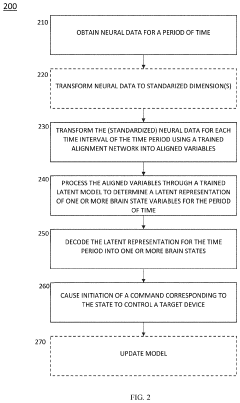
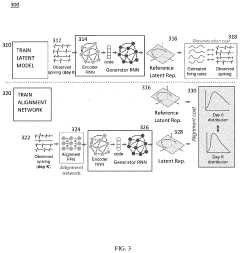
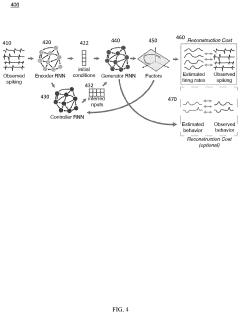
Systems and Methods for Nonlinear Latent Spatiotemporal Representation Alignment Decoding for Brain-Computer Interfaces
PatentPendingUS20220129071A1
Innovation
- A trained alignment neural network and latent representation model are used to achieve accurate alignment of complex neural signals over time, enabling stable and consistent brain-state decoding without frequent recalibration.

Ethical and Privacy Considerations in BCI Technology
The integration of Brain-Computer Interface (BCI) technology into daily applications raises significant ethical and privacy concerns that must be addressed before widespread adoption. As BCI systems become more sophisticated in decoding complex motor sequences, they inherently collect and process highly sensitive neural data that represents the most intimate aspects of human cognition and intention. This unprecedented access to neural information creates a new frontier for privacy protection that traditional data security frameworks may be inadequate to address.
Primary concerns include the potential for unauthorized access to neural data, which could reveal not only intended motor commands but also emotional states, cognitive processes, and even subconscious thoughts. The risk of "brain hacking" or neural data theft represents a novel threat vector that could lead to profound privacy violations beyond what is possible with conventional digital information.
Informed consent presents another critical challenge in BCI applications. Users may not fully comprehend the extent and nature of the neural data being collected, especially as decoding algorithms become more advanced and capable of extracting increasingly detailed information from brain signals. This raises questions about what constitutes meaningful consent when users cannot anticipate all potential uses of their neural data.
The potential for discrimination based on neural information also emerges as BCI technology advances. Employers, insurers, or government agencies might use neural data to make judgments about individuals' cognitive abilities, emotional stability, or behavioral tendencies, potentially leading to new forms of neurological discrimination that current legal frameworks are not equipped to prevent.
Long-term neural monitoring for motor sequence decoding raises questions about cognitive liberty—the right to mental privacy and freedom of thought. As BCIs become more pervasive, establishing boundaries between beneficial monitoring and invasive surveillance becomes increasingly important to preserve autonomous thought processes.
Regulatory frameworks worldwide are struggling to keep pace with these emerging challenges. While some regions have begun incorporating neural data into privacy legislation, comprehensive governance structures specifically addressing BCI technology remain underdeveloped. International standards for neural data protection, transparent algorithmic processes, and ethical guidelines for BCI research and application are urgently needed.
The development of privacy-by-design approaches for BCI systems represents a promising direction, incorporating techniques such as local processing, data minimization, and user-controlled filtering of neural information before transmission. These technical safeguards, combined with robust ethical frameworks and appropriate regulatory oversight, will be essential to ensure that advances in decoding complex motor sequences through BCI technology proceed in a manner that respects fundamental human rights and dignity.
Primary concerns include the potential for unauthorized access to neural data, which could reveal not only intended motor commands but also emotional states, cognitive processes, and even subconscious thoughts. The risk of "brain hacking" or neural data theft represents a novel threat vector that could lead to profound privacy violations beyond what is possible with conventional digital information.
Informed consent presents another critical challenge in BCI applications. Users may not fully comprehend the extent and nature of the neural data being collected, especially as decoding algorithms become more advanced and capable of extracting increasingly detailed information from brain signals. This raises questions about what constitutes meaningful consent when users cannot anticipate all potential uses of their neural data.
The potential for discrimination based on neural information also emerges as BCI technology advances. Employers, insurers, or government agencies might use neural data to make judgments about individuals' cognitive abilities, emotional stability, or behavioral tendencies, potentially leading to new forms of neurological discrimination that current legal frameworks are not equipped to prevent.
Long-term neural monitoring for motor sequence decoding raises questions about cognitive liberty—the right to mental privacy and freedom of thought. As BCIs become more pervasive, establishing boundaries between beneficial monitoring and invasive surveillance becomes increasingly important to preserve autonomous thought processes.
Regulatory frameworks worldwide are struggling to keep pace with these emerging challenges. While some regions have begun incorporating neural data into privacy legislation, comprehensive governance structures specifically addressing BCI technology remain underdeveloped. International standards for neural data protection, transparent algorithmic processes, and ethical guidelines for BCI research and application are urgently needed.
The development of privacy-by-design approaches for BCI systems represents a promising direction, incorporating techniques such as local processing, data minimization, and user-controlled filtering of neural information before transmission. These technical safeguards, combined with robust ethical frameworks and appropriate regulatory oversight, will be essential to ensure that advances in decoding complex motor sequences through BCI technology proceed in a manner that respects fundamental human rights and dignity.
Clinical Translation and Regulatory Pathways
The clinical translation of brain-computer interfaces (BCIs) for decoding complex motor sequences represents a critical pathway from laboratory research to patient care. Currently, regulatory frameworks for BCI technologies are evolving across different jurisdictions, with the FDA in the United States establishing specific guidelines for neural interface devices through its breakthrough device designation program. This pathway has already benefited several BCI systems targeting motor restoration, providing accelerated review processes while maintaining safety standards.
Successful clinical translation requires rigorous validation through phased clinical trials. Phase I trials typically involve small cohorts (10-20 participants) focusing on safety profiles and preliminary efficacy. Phase II expands to larger populations (50-100 participants) to optimize decoding algorithms and user interfaces. Phase III trials, involving hundreds of patients across multiple centers, are necessary to demonstrate statistical significance in functional outcomes compared to existing standards of care.
Regulatory considerations for motor sequence decoding BCIs are particularly complex due to their invasive nature and direct neural interaction. Key requirements include biocompatibility testing, electrical safety standards, and long-term stability assessments. The ISO 14971 risk management framework and IEC 60601 standards for medical electrical equipment provide essential guidance for manufacturers navigating this landscape.
Reimbursement pathways present significant challenges, as healthcare systems require robust health economic data demonstrating cost-effectiveness compared to conventional therapies. Current models suggest that despite high initial implementation costs, advanced BCIs may offer favorable long-term economic profiles through reduced caregiver burden and improved patient independence.
International harmonization efforts are underway to streamline regulatory processes across markets. The International Medical Device Regulators Forum (IMDRF) has established working groups specifically addressing software as a medical device and artificial intelligence in neural interfaces, which directly impacts complex motor sequence decoding applications.
Ethical considerations in clinical translation include equitable access, informed consent protocols for patients with communication limitations, and data privacy frameworks for the substantial neural information collected. Regulatory bodies increasingly require manufacturers to address these ethical dimensions explicitly in their submission packages.
The timeline from initial clinical testing to market approval for motor sequence decoding BCIs currently averages 7-10 years, though regulatory innovation programs aim to reduce this while maintaining safety standards. Post-market surveillance requirements are particularly stringent, with continuous monitoring of device performance and neural tissue response mandated for periods extending beyond five years.
Successful clinical translation requires rigorous validation through phased clinical trials. Phase I trials typically involve small cohorts (10-20 participants) focusing on safety profiles and preliminary efficacy. Phase II expands to larger populations (50-100 participants) to optimize decoding algorithms and user interfaces. Phase III trials, involving hundreds of patients across multiple centers, are necessary to demonstrate statistical significance in functional outcomes compared to existing standards of care.
Regulatory considerations for motor sequence decoding BCIs are particularly complex due to their invasive nature and direct neural interaction. Key requirements include biocompatibility testing, electrical safety standards, and long-term stability assessments. The ISO 14971 risk management framework and IEC 60601 standards for medical electrical equipment provide essential guidance for manufacturers navigating this landscape.
Reimbursement pathways present significant challenges, as healthcare systems require robust health economic data demonstrating cost-effectiveness compared to conventional therapies. Current models suggest that despite high initial implementation costs, advanced BCIs may offer favorable long-term economic profiles through reduced caregiver burden and improved patient independence.
International harmonization efforts are underway to streamline regulatory processes across markets. The International Medical Device Regulators Forum (IMDRF) has established working groups specifically addressing software as a medical device and artificial intelligence in neural interfaces, which directly impacts complex motor sequence decoding applications.
Ethical considerations in clinical translation include equitable access, informed consent protocols for patients with communication limitations, and data privacy frameworks for the substantial neural information collected. Regulatory bodies increasingly require manufacturers to address these ethical dimensions explicitly in their submission packages.
The timeline from initial clinical testing to market approval for motor sequence decoding BCIs currently averages 7-10 years, though regulatory innovation programs aim to reduce this while maintaining safety standards. Post-market surveillance requirements are particularly stringent, with continuous monitoring of device performance and neural tissue response mandated for periods extending beyond five years.
Unlock deeper insights with PatSnap Eureka Quick Research — get a full tech report to explore trends and direct your research. Try now!
Generate Your Research Report Instantly with AI Agent
Supercharge your innovation with PatSnap Eureka AI Agent Platform!